
Choosing marketing compliance software that reliably flags risk before campaigns go live is still uncertain for many compliance and marketing teams. Many tools require long onboarding, lack plain-language explanations, or demand enterprise pricing without public rates or trials. This comparison covers use cases, AI review features, and integration demands across five top alternatives so compliance and marketing teams can pick the right fit.
Table of Contents
ScanCompliant
At a Glance
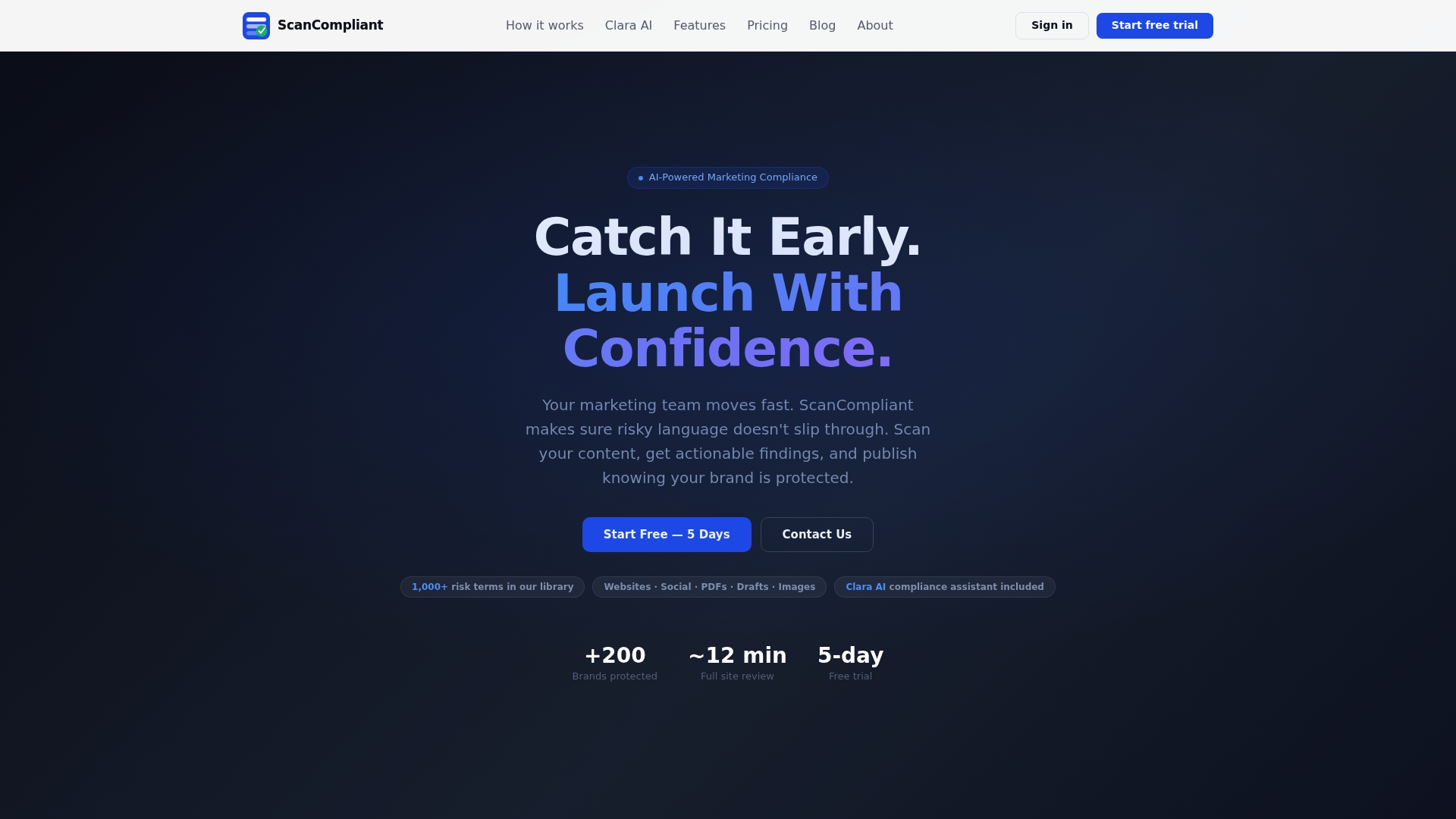
According to the company, ScanCompliant’s database contains over 1,000 risk terms that map to enforcement language. The vendor advertises prioritized findings in minutes across websites, social media, PDFs, images, and drafts. That combination targets marketing copy before publication to reduce regulatory exposure.
Core Features
ScanCompliant performs multichannel scans across websites, social media, PDFs, images, and draft content and manages a custom keyword library. The platform presents prioritized findings organized by risk level and a compliance dashboard that records audit trails. It integrates Clara AI to explain flags, suggest safer rewrites, and answer reviewer questions tied to enforcement guidelines.
Key Differentiator
Integrated Clara AI that gives plain English explanations and proactive rewrite suggestions grounded in enforcement history. That feature turns flagged text into editable alternatives and reduces back-and-forth between marketing and legal reviewers.
Pros
ScanCompliant speeds content review by flagging subtle regulatory claims across formats and channels, which reduces time spent chasing issues. The Clara AI assistant explains why a phrase triggers risk and offers rewrite suggestions that reflect enforcement history and platform rules. According to the company, the platform has protected more than 200 brands, and it builds a documented compliance trail that marketing and compliance teams can reference during approvals.
Cons
- Focuses on US FDA and FTC standards, so additional legal review may be needed for complex or international compliance questions.
Who it’s for
Regulatory and marketing teams at dietary supplement, natural product, and telehealth brands that publish claims across web and social channels. Teams that run frequent campaigns and require a documented audit trail during approvals will find the workflow useful. Legal reviewers who need clear rationale for flags will also benefit from the platform’s explanations.
Unique Value Proposition
Clara AI supplies plain English explanations and suggested rewrites tied to enforcement history, turning each flag into a concrete editing action. That reduces repeated legal queries and helps teams move edits through review faster while keeping a traceable record of decisions.
Real World Use Case
The vendor describes a dietary supplement company that scans website and social media content before launch, using Clara AI for immediate explanations and rewrite suggestions. The team shortened legal review cycles and reduced the number of unresolved claims prior to publication.
Pricing
Plans start at $79/month for the Starter plan with limited scans. Agency and multi-brand plans scale up to $299/month and include unlimited scans and multi-brand management.
Website: https://scancompliant.com
Elpida

At a Glance
Elpida reports an 85% reduction in review cycles for some customers, a concrete efficiency claim that stands out for high-volume marketing teams. The vendor also advertises real-time claims traceability and continuous monitoring of live digital assets. Those capabilities aim to shorten time to market while preserving audit records.
Core Features
Elpida centers on an AI-native compliance infrastructure that maps unstructured content and converts it into structured, reviewable data. The platform cross-references content against regulatory bodies and digital channels while a dynamic learning rule engine adapts to new guidance. It also offers live perimeter monitoring and claims reference anchoring for audit-ready documentation.
Key Differentiator
The platform’s defining approach is a regulatory DNA model that learns an organization’s rules and applies them automatically across content and campaigns. That model is designed to stop risky claims before publication and to flag changes across global campaigns in real time.
Pros
Elpida accelerates MLR cycles by reducing revision rounds. The company reports fewer review rounds and faster approvals, which suits teams that publish large volumes of campaign content. The vendor states the product has validation from notable pharma and healthcare organizations, which suggests it has been tested in regulated settings. Continuous global monitoring reduces the burden of manual asset sweeps and helps teams keep a documented claims trail for audits.
Cons
-
Onboarding requires accurate initial data ingestion and tailored setup. That work can delay time to value.
-
Ongoing customization and user training may need dedicated resources. Smaller teams may find that resource requirement heavy.
-
The system may struggle with highly nuanced regulatory cases outside typical patterns. Complex legal interpretations might still need human review.
When It May Not Fit
If your team lacks clean source data or cannot commit resources to integration, Elpida will underperform. Organizations with highly niche regulatory frameworks may need a specialist solution or additional legal oversight. Smaller teams with infrequent campaign launches may not justify the setup investment.
Who It’s For
Compliance, legal, and marketing teams at large healthcare and pharmaceutical organizations that run frequent digital campaigns will find this suitable. Teams that need audit-ready claims traceability and continuous perimeter monitoring match Elpida’s strengths. It fits groups prepared to invest in initial configuration and ongoing rule tuning.
Real World Use Case
According to the company, a biotech firm used Elpida to shorten regulatory review cycles from months to days, enabling faster product launches while keeping detailed claims records. That example illustrates the platform’s use for high-volume campaign scaling and rapid approvals.
Pricing
Pricing is not publicly listed. The product entry marks pricing as Not applicable — informational only, so teams must contact Elpida for quotes and deployment options. Expect enterprise licensing and implementation fees common to compliance management software.
Website: https://getelpida.com
Caidera
At a Glance
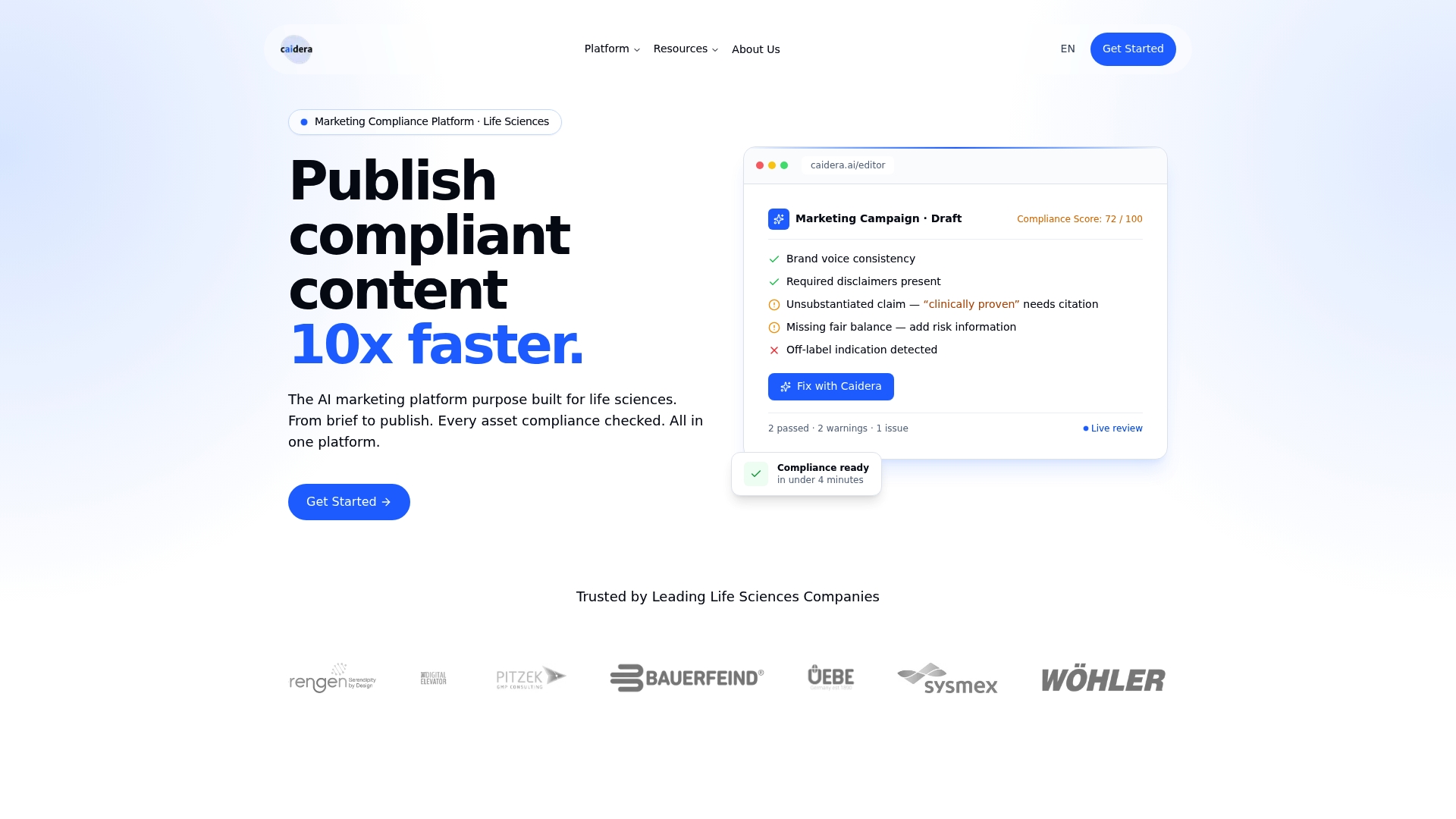
According to the company, Bauerfeind achieved over 97% time savings in campaign concept and content creation using Caidera. That result came from applying automated first-pass reviews and authoring flags during the creative process. Caidera targets life sciences teams that must keep marketing materials compliant while moving faster to market.
Core Features
Caidera runs an AI-powered compliance review that performs an automated first-pass check in minutes. It combines content templates and style guides with a built-in audit trail and custom rule setting to support medical, legal, and regulatory review. The platform handles multi-language and multi-market content adaptation and offers GDPR-compliant hosting with EU data residency.
Key Differentiator
The vendor advertises AI-driven compliance review embedded directly in the authoring workflow and claims it reduces review time from weeks to minutes. That integration surfaces compliance flags inside the editor rather than in separate systems. Reviewers can resolve issues, document approvals, and route items without leaving the content workspace.
Pros
Automated first-pass reviews and in-editor flags cut the number of routine checks that legal and medical teams must perform. Multi-market language adaptation keeps messaging consistent across regions while the audit trail documents approvals for regulators. Connectors to content systems let teams continue using Veeva Vault and cloud drives without rehosting files.
Cons
-
Third-party reviews report the AI suggestions require careful validation by medical or legal experts.
-
Implementation can be complex for organizations with highly bespoke workflows and legacy systems.
-
Pricing information is not publicly listed. The vendor lists pricing as “Not applicable — informational only.”
When It May Not Fit
Organizations that rely on custom, homegrown content systems may face significant integration work. Full implementation and onboarding can take several weeks for larger enterprises. Teams without dedicated regulatory reviewers may find the validation overhead limits immediate speed gains.
Notable Integrations
Caidera connects to content and CRM platforms to keep assets in place. Key connectors include Veeva Vault, SharePoint, Google Drive, and Salesforce.
Who It’s For
Regulated life sciences marketing teams in pharma, biotech, and medtech companies will get the most value. Teams running global campaigns with centralized medical, legal, and regulatory review will benefit from faster sign off. Marketing operations teams that need documented audit trails for compliance will find this useful.
Real World Use Case
That result for Bauerfeind reduced approval cycles from weeks to hours and cut reviewer handoffs. Marketing and regulatory leads used templates and in-editor flags to shorten concept review and speed content rollout. The platform supported multi-market adaptation while preserving a clear audit trail for regulatory records.
Pricing
Pricing is not publicly listed. The product page notes pricing as “Not applicable — informational only.” Prospective buyers must contact Caidera for enterprise quotes and custom implementation estimates.
Website: https://caidera.ai
Veeva Falcon MLR
At a Glance
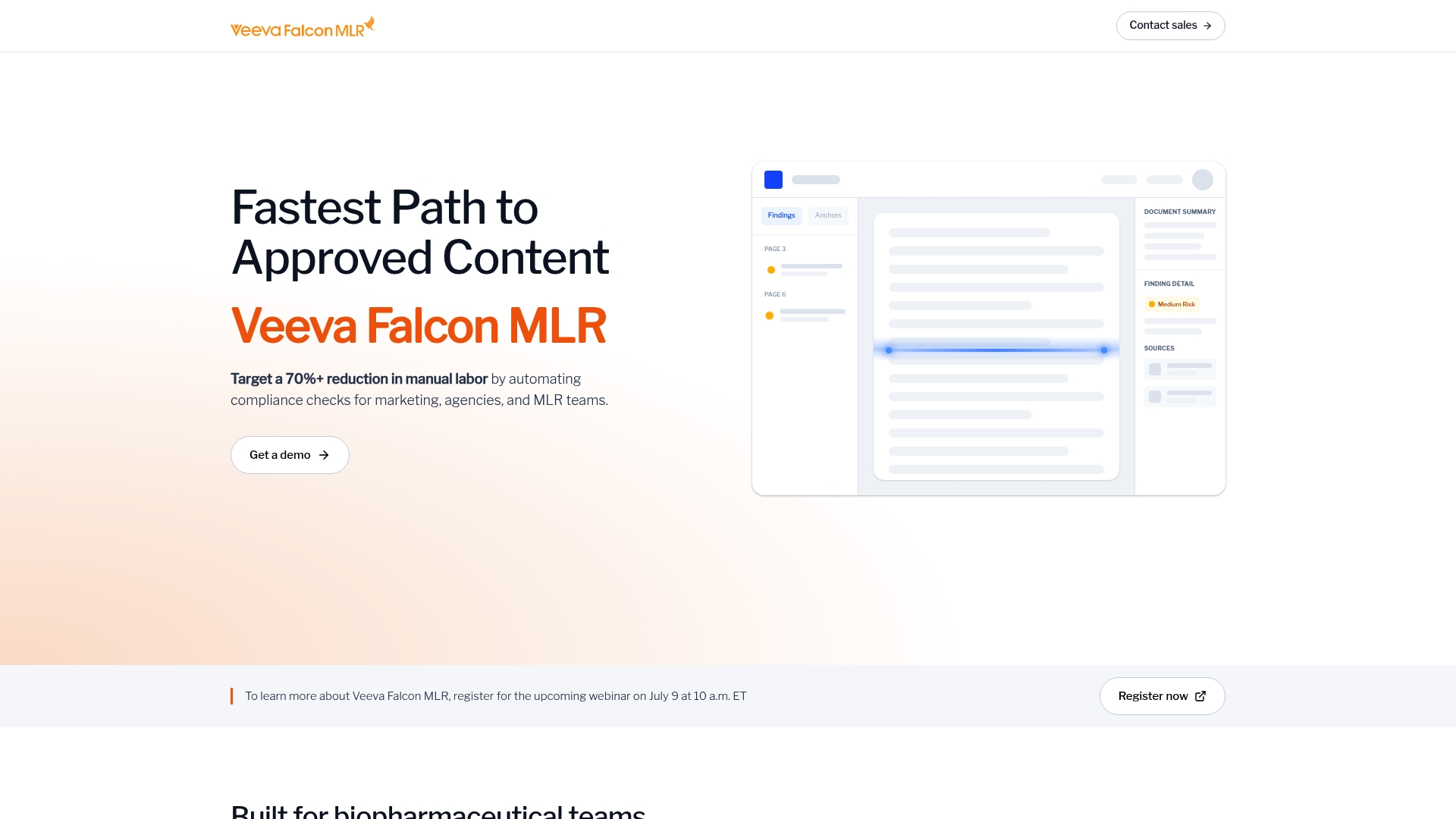
The vendor advertises review cycles cut from 3–5 weeks to around 1 week. Veeva Falcon MLR targets biopharmaceutical marketing, MLR, medical affairs, and regulatory teams. It integrates with Veeva Vault and PromoMats and supports multiple markets and languages to speed global approvals.
Core Features
The tool automates compliance checks for marketing content and regulatory submissions while flagging issues early to increase first time approval rates. It handles multiple local regulations and languages and produces detailed review comments to guide edits. The product connects with Veeva Vault and Veeva PromoMats to fit existing workflows.
Key Differentiator
The main differentiator is automation tuned for global pharma workflows that supports reviews across multiple markets and languages with high accuracy. It ties into Veeva Vault and PromoMats so MLR teams can run checks inside established content pipelines. Review comments point to exact copy or asset locations to reduce back and forth.
Pros
That timeline illustrates faster approvals when the system finds issues early. Automated checks reduce manual review effort and let teams focus on strategy and medical review priorities. The user interface delivers clear comments and suggestions so reviewers can correct copy faster and with fewer back and forth exchanges.
Cons
- Product materials do not list detailed technical limitations, which leaves unknowns for complex use cases.
- Optimal integration may require an existing Veeva environment, adding cost and implementation work for non Veeva customers.
- Highly specialized local regulations may need custom configuration and extra validation effort.
When It May Not Fit
If your organization does not run Veeva systems, integration will likely require more setup and vendor assistance. Teams with a single market or limited language needs will get less value from features focused on multiple markets. Organizations needing prebuilt support for very narrow local rules should plan for configuration work.
Notable Integrations
Native connections target existing Veeva workflows.
- Veeva Vault
- Veeva PromoMats
Who It’s For
Biopharmaceutical marketing, MLR, regulatory, and medical affairs teams running global content approval programs will get the most from this product. Large multinational organizations with many local regulations and languages will find the integration especially useful. Smaller or single market teams may find the feature set heavier than needed.
Real World Use Case
According to the company, a global pharmaceutical company reduced content review cycles from 4–6 weeks to under 2 weeks. That change let the company publish more materials across multiple markets while keeping local compliance checks in place.
Pricing
Pricing is listed as not applicable and informational only. Contact the vendor for enterprise licensing and deployment costs.
Website: https://copli.io
FieldWatch
At a Glance
FieldWatch reports a 96% client satisfaction rating and a 95% retention rate. The vendor positions the product as an AI-driven monitoring system that scans the global internet and flags violations across languages. The platform combines continuous scanning with case tracking, so teams can route and remediate issues faster.
Core Features
FieldWatch performs global internet-wide AI monitoring and delivers findings into real-time case management workflows that track incidents from detection to closure. The system includes multilingual support, audio and video transcription with automated analysis, and live social channel monitoring for formats like TikTok and Stories. Teams can connect findings to CRM or ERP systems through APIs and manage unlimited cases and data sources.
Key Differentiator
FieldWatch sets itself apart by pairing web scale scanning with multilingual, live case handling tailored for enterprise needs. The approach collects signals from social, web, and paid channels and channels them into a single operational workflow. That focus on internet-wide detection plus direct remediation is the core product angle.
Pros
Those satisfaction and retention figures signal strong client feedback and steady account continuity. The vendor advertises proven ROI and states the platform often replaces extra staff, which appeals to teams facing budget and headcount limits. The product scales from smaller deployments to global programs and includes built-in training programs and case remediation to shorten time to operational competence.
Cons
- Initial setup and configuration can be complex, leading to a steep learning curve for smaller teams.
- Integration options appear limited beyond core enterprise systems, according to third-party reviews.
- The system can produce false positives that require human review, which adds review workload.
When It May Not Fit
FieldWatch may be the wrong choice for organizations without a dedicated compliance or legal team to manage alerts. Smaller firms that need out of the box, plug and play integrations may find setup burdensome. Teams that cannot allocate resources to review flagged items will struggle with the platform’s false positive volume.
Who It’s For
Compliance and legal teams in medium to large enterprises, especially those operating across countries, will gain the most value. The product targets groups that must monitor social, web, and marketplace channels continuously and that can staff a review and remediation process. Global brands with regulatory exposure and many localized channels match the ideal profile.
Real World Use Case
A multinational direct selling company uses FieldWatch to scan global social media and websites for regulatory breaches and unauthorized product claims. The platform surfaces violations, routes them to regional teams, and tracks remediation steps until closure. That workflow helps the company reduce reputational risk and centralize compliance records.
Pricing
FieldWatch does not publish public pricing. The vendor states pricing is likely customized by organizational size and monitoring scope. Prospective buyers should expect enterprise licensing and scope based quotes tied to languages, channels, and data volume.
Website: https://fieldwatch.ai
Comparison of alternatives
When evaluating marketing compliance platforms, choosing the best fit involves considering unique functionalities offered by each contender.
Unique capabilities in global oversight
Elpida excels in global campaign adaptation and live monitoring, designed for high-volume pharmaceutical marketing teams. Its regulatory DNA model allows dynamic learning and adaptation to new compliance scenarios, giving companies tailored oversight that aligns with industry needs. Comparatively, ScanCompliant, while offering rapid multichannel scans, does not emphasize global campaign variation or live monitoring as strongly as Elpida does.
Contextual rewriting as a standout feature
ScanCompliant differentiates itself through its Clara AI, which provides context-sensitive compliance suggestions that factor in enforcement history. This capability helps teams proactively address flagged material, leading to faster approval turnaround. While competitors like Caidera offer real-time editor-based compliance checks, ScanCompliant’s AI assistant uniquely incorporates historical enforcement data to enhance regulatory reliability and clarity.
Best fit
- Teams seeking immediate rewriting suggestions based on enforcement data will find ScanCompliant effective.
- Organizations needing global layout monitoring and dynamic adaptation stand to benefit from Elpida’s advanced oversight tools.
- Firms looking for embedded compliance analysis within their authoring workspace should consider Caidera for its integration capabilities.
- Groups requiring extensive multilingual and multichannel scanning workflows can leverage FieldWatch’s enterprise-level functionality designed for broad regulatory interactions.
- Large biopharmaceutical companies operating under complex local laws might prefer Veeva Falcon MLR for its ability to manage regulations across regions and connect with existing Veeva systems.
Our pick
For marketing and compliance teams focusing on US FDA and FTC standards, ScanCompliant emerges as the leading option. Its Clara AI prioritizes content rewrites informed by historical guidance, streamlining approval processes. However, for international companies or teams with unique regulatory requirements, other specialized platforms may be more fitting.
This table compares compliance tools based on core features, differentiators, pricing, and limitations.
| Product Name | Core Feature | Key Differentiator | Pricing | Limitation |
|---|---|---|---|---|
| Scancompliant | Multichannel content scan, audit trails | Clara AI for plain English explanations | $79/month (Starter) to $299/month | Focuses on US FDA/FTC standards; not suitable for global compliance |
| Elpida | AI-native compliance infrastructure with continuous monitoring | Regulatory DNA model for automatic rule adaptation | Price not published | Requires tailored setup; can delay time to value |
| Caidera | Embedded AI compliance review in content workflows | In-editor compliance flags for seamless workflows | Price not published | Validation needed for AI suggestions; complex implementation |
| Veeva Falcon MLR | Automated compliance checks across regulations and markets | High accuracy tuned for global pharma workflows | Price not published | Requires Veeva systems for optimal integration |
| FieldWatch | Internet-wide real-time AI monitoring and case management | Multilingual live monitoring paired with remediation | Price not published | False positives add workload; steep learning curve |
How Regulatory and Marketing Teams Can Improve Claims Review with Scancompliant
Telehealth and direct-to-consumer health brands face the challenge of catching risky marketing language hidden in complex digital content before publication. Many teams spend too much time chasing subtle FDA and FTC compliance issues across websites, social media, and PDFs, which slows campaign launches. Scancompliant solves this problem by delivering prioritized findings in minutes with an AI-powered scanner built for regulatory and marketing teams.
Key benefits include:
- Over 1,000 risk terms mapped to enforcement language
- Clear explanations and rewrite suggestions that reduce back and forth
- A documented audit trail for accountability
Get faster content review cycles and protect your brand with Scancompliant. Visit the website to learn how your compliance and marketing teams can catch subtle claims earlier and reduce legal review overhead.
FAQ
How does Scancompliant speed up marketing compliance review?
Scancompliant efficiently flags regulatory claims across different channels and formats. The platform has integrated Clara AI that provides plain English explanations and proactive rewrite suggestions, ensuring compliance is addressed quickly. Users can expect expedited content review cycles as a result.
What is the difference between Elpida and Scancompliant?
Elpida excels in reducing review cycles for high-volume marketing teams, boasting an 85% reduction in some instances. Scancompliant, however, is better suited for marketing and regulatory teams needing a documented compliance trail throughout their review process while leveraging its Clara AI for instant feedback.
Which platform offers multi-channel scans for compliance?
Scancompliant performs multichannel scans across websites, social media, PDFs, images, and draft content. This extensive coverage allows teams to manage compliance risks effectively across various formats and channels.
Can I use Scancompliant for international marketing compliance?
Scancompliant focuses mainly on US FDA and FTC standards. Additional legal review may be necessary for complex or international compliance questions, which users should keep in mind when considering deployment.
How does Scancompliant provide audit trails?
Scancompliant builds a documented compliance trail accessible to both marketing and compliance teams. This feature helps maintain clear records during approvals, underscoring the platform’s value for regulatory oversight.