Managing regulatory checks across marketing campaigns without slowing launches or missing compliance risks increases workload for many teams. Some platforms restrict free trials, gate advanced features behind sales calls, or lack transparent pricing, making it hard to test before full commitment. This comparison shows pricing, content review features, and workflow support so you can match a platform to your regulatory and marketing requirements.
Table of Contents
ScanCompliant
At a Glance
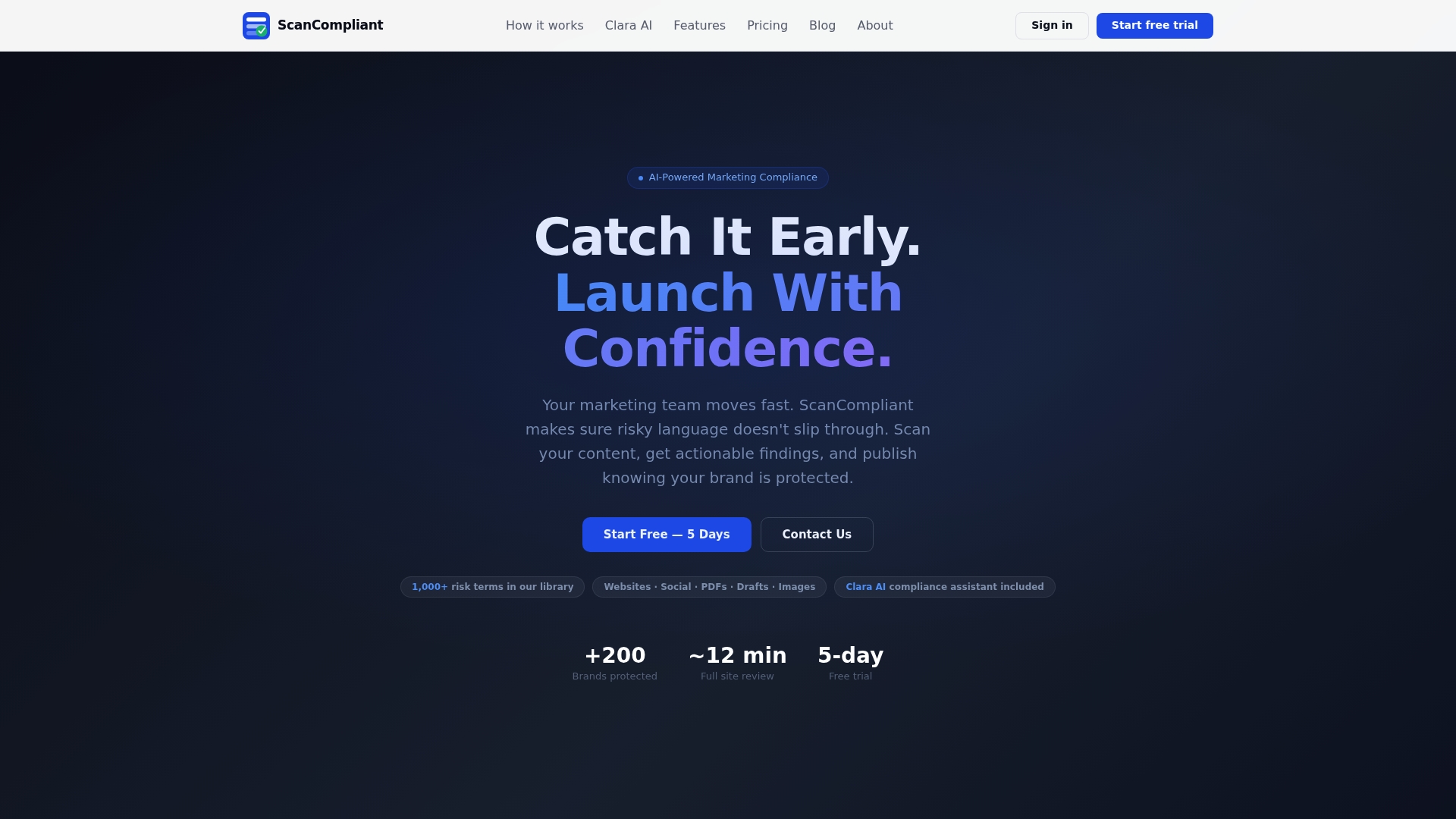
According to the company, ScanCompliant reports it has already protected more than 200 brands. The platform uses AI to scan marketing content and flags risky regulatory language before publication. It claims a library of over 1,000 risk terms drawn from enforcement history and returns prioritized findings in minutes.
Core Features
ScanCompliant scans websites, social posts, PDFs, documents, and images across channels. It provides risk ranked findings with exact locations and plain English explanations for each hit. Teams can add a custom keyword library and use a brand risk dashboard to track trends. Clara AI answers follow up questions and suggests safer rewrites. Role based access and multi user collaboration are included, plus export of findings to Excel with links in a single click.
Key Differentiator
ScanCompliant combines a large enforcement derived term library with an embedded assistant. The platform’s database of over 1,000 risk terms targets language regulators have acted on. Clara AI then converts flagged items into plain English explanations and safer rewrite options so reviewers spend less time decoding alerts.
Pros
-
Automates detection of regulatory risk using terms sourced from enforcement history. This reduces time spent hunting for phrases that trigger regulator scrutiny.
-
Clara AI provides plain English explanations and rewrite suggestions. Legal and marketing teams can iterate copy faster with an audit trail.
-
Supports a wide set of content types including images and PDFs. That makes the tool useful for multi channel campaigns and product listings.
-
Brand level dashboard and reporting let teams measure compliance trends and document review activity. Reports export to Excel with links for offline audits.
-
Offers a free trial and tiered subscription plans for small teams, growing brands, and agencies. That pricing mix helps teams test before committing to a plan.
Cons
- The AI can produce false positives or miss nuanced context, so legal review remains necessary.
Who It’s For
Marketing, regulatory, and legal teams at dietary supplement, natural products, telehealth, and DTC wellness brands. Ideal users are those who review website copy, product listings, and social campaigns and want consistent, repeatable checks tied to enforcement history.
Unique Value Proposition
ScanCompliant starts with a large enforcement based term library and pairs it with Clara AI for human readable guidance. That combination reduces the back and forth between marketing and legal by surfacing prioritized risks and offering safer rewrite suggestions. For teams that need documented audit trails and faster review cycles, the workflow replaces manual line by line legal checks with targeted, explainable findings.
Real World Use Case
A dietary supplement brand runs a new product launch. The content team uploads landing pages, social drafts, and PDF spec sheets. ScanCompliant scans each asset, highlights regulator risk language, and provides rewrite suggestions. The marketing team fixes flagged lines and exports the findings report for the legal file before the launch.
Pricing
Pricing starts at $79/month for small teams. Pro costs $149/month and adds unlimited scans and more features. Agency pricing starts at $299/month for enterprise needs.
Website: https://scancompliant.com
Copli
At a Glance
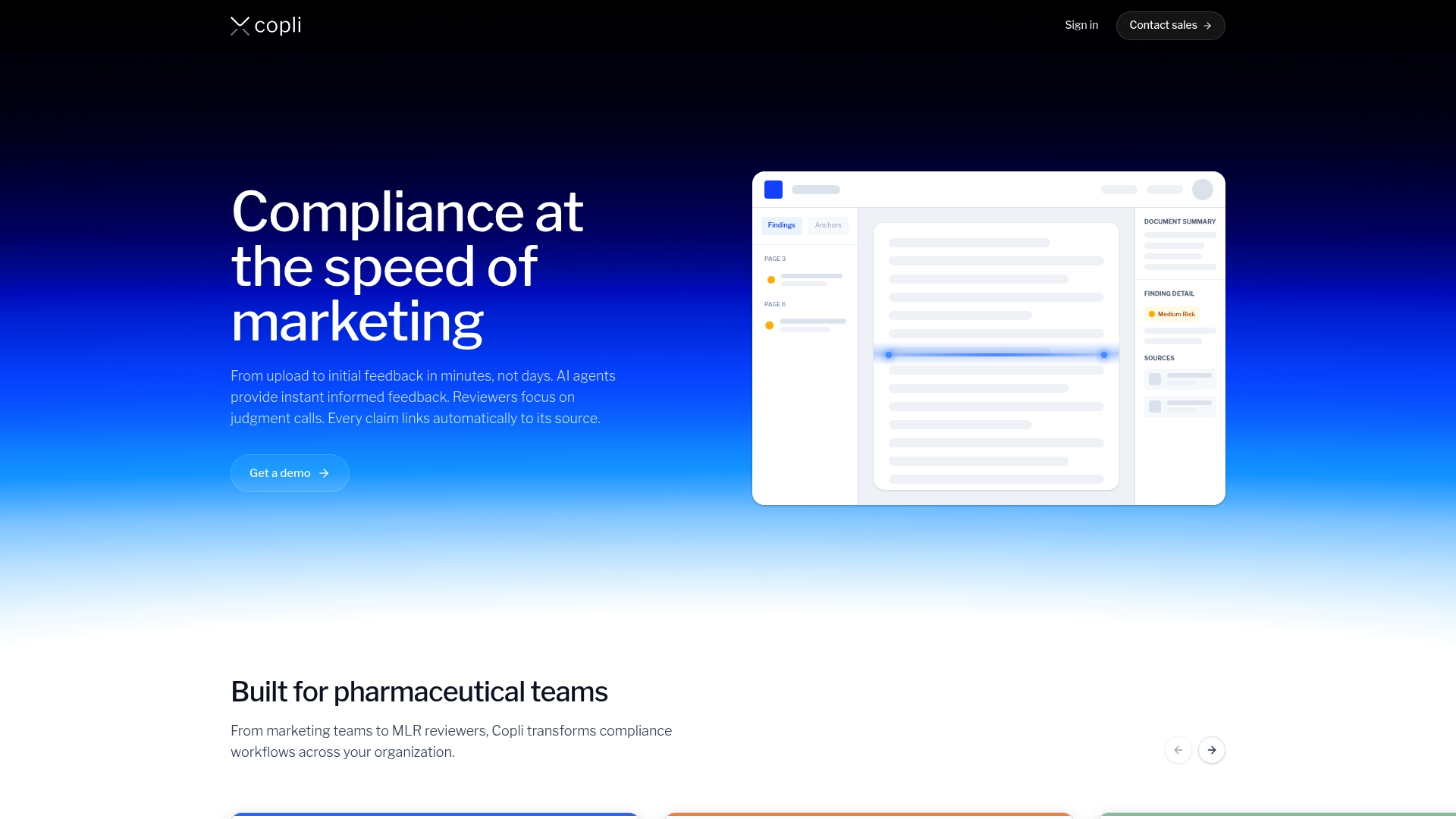
Copli’s marketing materials claim up to 80% faster time to market. That figure frames the product as a speed tool for regulatory review in pharma and healthcare. It inserts checks into existing review systems and emphasizes faster approvals without replacing core workflows.
Core Features
- Instant feedback on marketing and compliance claims to flag risky language before final review. This cuts repetitive review passes.
- Automated verification against regulatory standards in multiple markets so reviewers can see where claims may conflict with local rules.
- Veeva Vault PromoMats integration to connect reviews directly to existing content repositories and approval paths.
- Multi-market review capability that supports regional differences in labeling and claims.
- Auto-capture of reviewer decisions to build institutional knowledge and reduce repeated questions.
Key Differentiator
Copli pairs AI-driven instant feedback with deep Veeva Vault connectivity. That combination lets teams run automated checks inside the system they already use. For organizations that have invested in Veeva, the product aims to reduce handoffs and speed approvals while keeping an audit trail.
Pros
- Reduces manual review time. The vendor says review cycles shift from weeks to days, which frees reviewer capacity for judgment calls.
- Improves detection of compliance issues. Users report fewer missed claim errors and clearer guidance for edits.
- Saves reviewer time by highlighting likely problems rather than requiring full manual scans of every item.
- Integrates with Veeva Vault PromoMats, so teams do not need to export files for separate checks.
- Provides continuous monitoring for typos, broken references, and claim drift, which helps maintain content quality between major reviews.
Cons
- Public documentation gives limited detail on how deeply workflows can be customized for unique processes.
- The vendor does not list public pricing or trial options, making procurement planning harder.
- The system may depend on the accuracy of source references; poor source data can reduce detection quality.
- Support for non-Veeva content flows is not well documented in public materials.
When It May Not Fit
If your team does not use Veeva Vault PromoMats, Copli may add integration work or miss key repository hooks. If you require fully transparent, published pricing before vendor talks, this product might cause delays. Organizations with heavily bespoke workflows should confirm customization capabilities before committing.
Notable Integrations
- Veeva Vault PromoMats
Who It’s For
Regulatory, compliance, and marketing teams at pharmaceutical, biotech, and healthcare companies that use Veeva for content management. Teams that need faster review cycles and a captured audit trail for reviewer decisions will get the most value. Smaller teams without Veeva may find the fit weaker.
Real World Use Case
According to Copli, a global pharmaceutical company reduced approval time from 5 weeks to 1 week using the platform. The vendor reports that the implementation also caught compliance issues that manual reviewers missed, allowing faster, broader market deployment.
Pricing
The vendor lists pricing as not applicable in public materials. No starting price or free trial is published, so procurement requires direct contact for quotes and deployment options.
Website: https://copli.io
Aithena
At a Glance
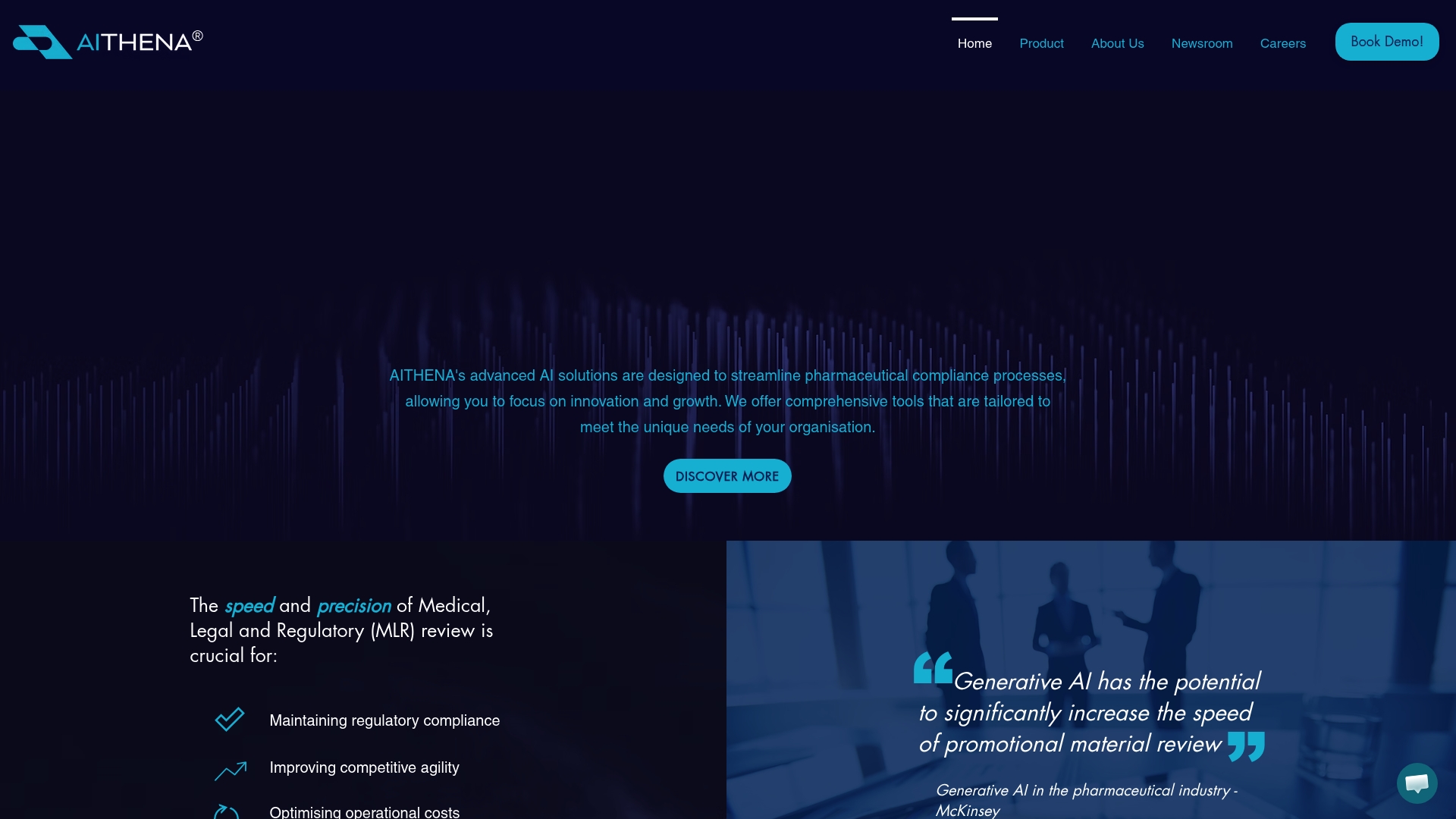
Automates real time pharmaceutical material review aligned to the latest UK and EU standards. According to the company, this capability can cut review cycles from days to minutes for marketing and safety content. That claim targets Medical Affairs and Regulatory teams that need faster, repeatable approvals.
Core Features
- Fully automated medical, legal, and regulatory review engine that flags compliance issues in documents and promotional copy.
- Real time checking of pharmaceutical materials against current UK and EU guidance to speed sign off.
- Consistent and objective review outputs to reduce reviewer variability across teams.
- Integration of AI with expert regulatory knowledge to improve accuracy of findings.
- Support for medical signatory workflows, including the quoted feature “Signatory Ready” for formal approvals.
Key Differentiator
Aithena centers its offering on aligning automated review to the latest UK and EU rules while combining AI with regulatory expertise. That focus makes the tool specifically useful for companies operating under those jurisdictions. The product emphasizes repeatable, objective decisions rather than manual interpretation by different reviewers.
Pros
-
Automates complex reviews, which can reduce manual checking and lower human error across many documents. This frees regulatory reviewers to focus on exceptions.
-
Offers real time review to accelerate approval cycles for promotional and non promotional communications. Faster checks help marketing and regulatory teams meet tight launch schedules.
-
Keeps outputs consistent so reviewers see the same findings across similar materials. Consistency helps audit trails and internal dispute resolution.
-
Provides a secure, private deployment tailored to the UK and Ireland market, which matches regional compliance needs for local affiliates.
-
Supports medical, legal, and regulatory sign offs through the “Signatory Ready” workflow, which prepares materials for formal approval.
Cons
-
Third party reviews highlight potential complexity during integration and onboarding, which can extend implementation timelines.
-
Organizations that prefer deep custom analysis or manual oversight may find the AI driven workflow restrictive for highly bespoke cases.
-
Publicly available review data is limited, so buyers must rely on vendor descriptions for performance expectations.
When It May Not Fit
If your company uses heavily customized or legacy content tools, integration effort could be significant. Teams that need bespoke review logic for niche products may struggle to map those rules into the system. Smaller regulatory teams with simple manual reviews may not gain enough value to justify change.
Who It’s For
Pharmaceutical companies, Medical Affairs, and Regulatory teams that operate in the UK and EU and want to automate compliance checks. Best for organizations with repeatable promotional workflows and a desire to reduce reviewer variability.
Real World Use Case
According to the company, a global pharmaceutical firm used Aithena to automate reviews of marketing materials and reduced multi day review cycles to minutes. That claim suggests the tool can support faster product launches while maintaining regional compliance.
Pricing
Not applicable — informational only. The vendor lists pricing as informational only, so procurement normally requires a direct quote based on deployment scope and integration needs.
Website: https://aithena.co.uk
Comparison of alternatives
When exploring marketing compliance automation tools, identifying the best option involves evaluating specialized strengths and tailored features among the alternatives.
Content compatibility across platforms
ScanCompliant excels in offering extensive support for varied content types, such as websites, social media, PDFs, and visual assets. This compatibility suits teams engaging in diverse marketing strategies. In comparison, Aithena narrows its functionality to UK and EU guidelines, making it highly suitable for industries within those jurisdictions, although its platform may lack the broader adaptability seen in ScanCompliant.
Integration within existing workflows
Copli distinguishes itself with its integration into established frameworks like Veeva Vault PromoMats, a significant feature for pharmaceutical companies reliant on these systems. This capability ensures maximized efficiency within preexisting workflows. Conversely, ScanCompliant emphasizes documentable compliance audits across different content formats, representing a more generalized approach for industries requiring versatile applicability.
Best fit
- For dietary supplement and DTC wellness brands requiring compliance checks across various content types, ScanCompliant offers an appropriately versatile solution.
- Pharmaceutical teams utilizing Veeva Vault PromoMats will benefit from the integration provided by Copli for automating compliance checks.
- Organizations primarily operating under UK and EU regulatory frameworks should consider Aithena for its localization to these regions.
Our pick
ScanCompliant remains an effective choice for its compatibility with varying content types, while alternatives may address niche needs more directly.
Evaluating marketing compliance platforms reveals their unique attributes and ideal scenarios for application.
| Product | Core Feature | Key Differentiator | Ideal Users | Pricing | Limitation |
|---|---|---|---|---|---|
| ScanCompliant | AI-driven regulatory risk detection | Enforcement-based term library and Clara AI | Marketing and legal teams in DTC wellness and similar fields | Starts at $79/month | May flag false positives requiring manual review |
| Copli | Automated feedback for marketing claims | Veeva Vault PromoMats integration | Pharma and healthcare teams using Veeva systems | Not disclosed | Limited to specific integration environments |
| Aithena | Real-time compliance checks | Focus on UK/EU pharmaceutical regulations | Regulatory teams in UK/EU markets needing procedural standardization | Not applicable | Integration complexity for bespoke workflows |
Elevate Your Marketing Compliance with Scancompliant
When searching for top comeply.com alternatives, the key challenge is catching risky marketing language quickly and accurately to avoid regulator scrutiny. Scancompliant addresses this pain point by scanning across websites, social posts, PDFs, and images to flag over 1,000 enforcement-derived risk terms. This lets marketing and regulatory teams prioritize findings and reduce review cycles from days to minutes.
Benefits include:
- Rapid AI-powered scans tailored to telehealth and DTC health brands
- Plain English explanations and safer rewrite suggestions
- Documented audit trails for compliance accountability
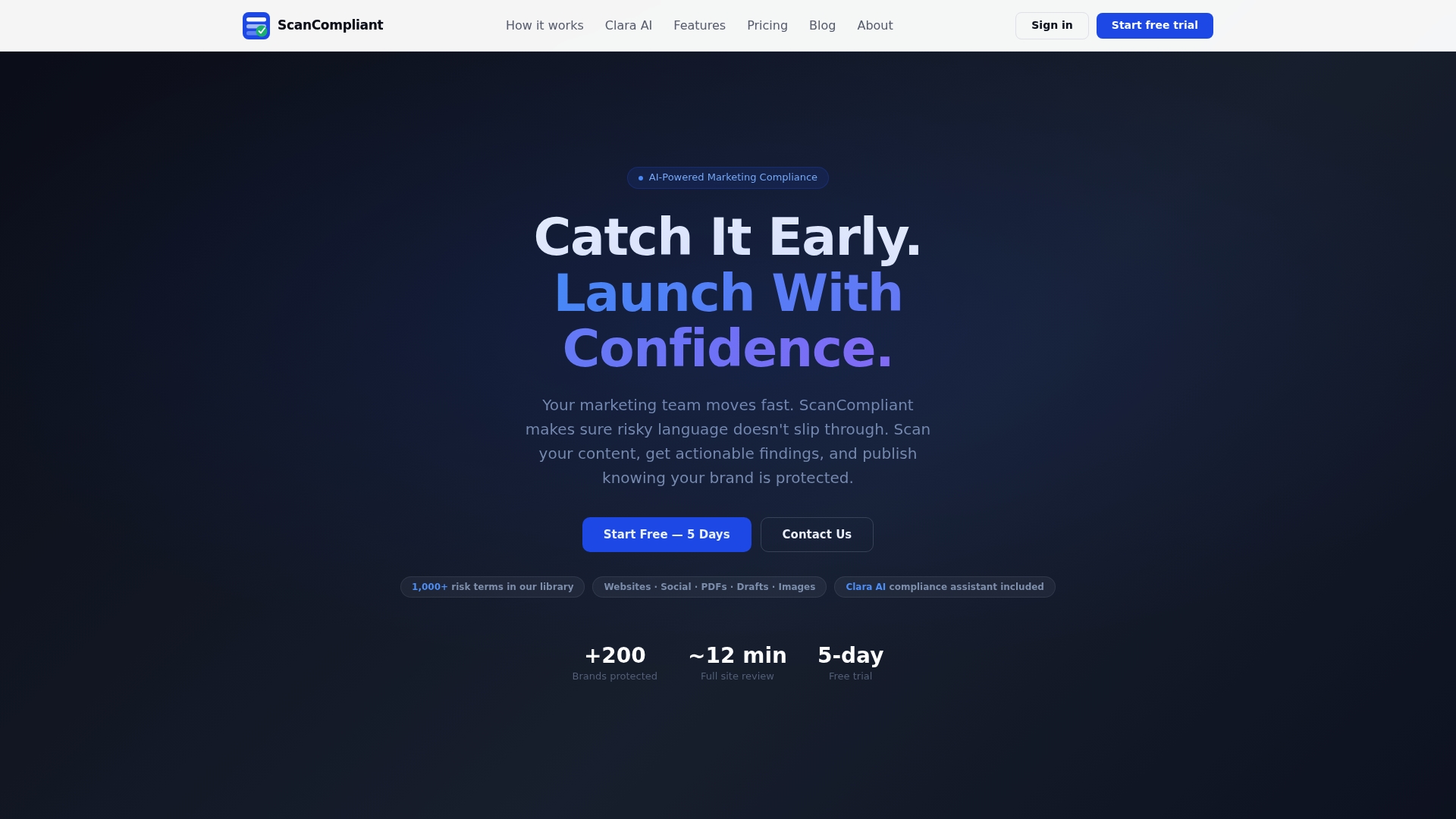
Don’t let compliance slow your product launches or leave your team guessing. Visit Scancompliant to see how this platform can help you catch subtle regulatory risks faster. Upload your marketing materials and generate a compliance report in minutes for smoother reviews and confident launches.
FAQ
How does Scancompliant help detect regulatory risks in marketing content?
Scancompliant uses AI to scan marketing content and identifies risky regulatory language before publication. It has a library of over 1,000 risk terms derived from enforcement history, providing prioritized findings in minutes. This means teams can quickly identify and address potential compliance issues before publishing.
What is the difference between Scancompliant and Copli regarding content review?
Copli is designed for instant feedback on marketing claims, especially for pharmaceutical and healthcare sectors, reducing review cycles significantly. In contrast, Scancompliant excels in providing detailed explanations and rewrite suggestions for flagged items, making it better suited for brands that require in-depth compliance guidance.
Which features make Scancompliant ideal for marketing, regulatory, and legal teams?
Scancompliant features like Clara AI, which provides plain English explanations and safer rewrite suggestions, are specifically beneficial for marketing, regulatory, and legal teams. This allows teams to iterate copy faster and ensures they have an audit trail, facilitating smoother compliance processes.
Can Scancompliant effectively handle multi-channel marketing campaigns?
Yes, Scancompliant supports the scanning of websites, social posts, PDFs, documents, and images across channels, making it highly useful for multi-channel campaigns. This versatility ensures that different types of content undergo compliance checks, helping brands maintain consistent messaging without regulatory pitfalls.
What pricing options are available for Scancompliant?
Scancompliant offers pricing starting at $79 per month for small teams, with Pro plans at $149 per month and agency pricing starting at $299 per month for enterprise needs. This tiered pricing allows teams to choose a plan that fits their budget and requirements.
1 Comment