
Compliance review turnaround time benchmarks define the expected duration to complete regulatory assessments based on case complexity and organizational process maturity. In healthcare, where FDA and FTC scrutiny is constant, missing these benchmarks creates audit exposure, regulatory penalties, and operational drag. 81% of compliance cases close within 30 days, but that figure masks wide variation by case type. This guide gives you the specific ranges, the tools that move the needle, and the process changes that actually work.
1. What are the typical compliance review turnaround time benchmarks by case type?
Compliance review timelines, formally called investigation closure benchmarks, vary by case complexity more than any other factor. A single-dimension policy violation and a multi-party fraud investigation are not the same animal, and treating them with the same deadline creates either unnecessary pressure or dangerous complacency.
Here are the standard benchmark ranges used by compliance teams in 2026:
| Case Type | Typical Turnaround Time |
|---|---|
| Simple policy violations | 1–2 weeks |
| Harassment or discrimination complaints | 3–6 weeks |
| Conflict of interest reviews | 2–4 weeks |
| Financial irregularities | 4–8 weeks |
| Complex fraud investigations | 3–6 months or longer |
The 30-day overall closure rate is a useful directional metric, not a hard deadline. Thoroughness must take priority over speed for complex cases, and cases flagged as stale after 60–90 days of inactivity should trigger a formal review of progress. Use these benchmarks to set realistic expectations with leadership, not to rush investigators toward defensible outcomes.
Pro Tip: Set a 48-hour acknowledgment target for every new case, regardless of complexity. Acknowledgment speed is the one metric that signals process maturity to regulators without requiring any investigation to be rushed.
2. How does automation impact compliance review turnaround times?
Automation is the single largest lever available for reducing compliance review turnaround time. The data is not ambiguous. Workflow automation reduces compliance processing time by 73%–80%, with audit response times improving by up to 92%. That is not a marginal gain. It is a structural shift in what a compliance team can handle per quarter.

Specific examples make the scale concrete. Periodic client reviews that previously required 90 minutes now complete in 15 minutes with automation. Alert reviews dropped from 45 minutes to 4 minutes in documented case studies. These are not edge cases. They reflect what happens when repetitive, rules-based tasks move out of human hands and into automated workflows.
The areas where automation delivers the most value in healthcare compliance include:
- Evidence collection: Automated intake pulls documents, timestamps, and metadata without manual assembly.
- Alert triage: AI-driven prioritization routes high-risk flags to senior reviewers immediately.
- Audit trail generation: Every action is logged automatically, with version, context, and ownership captured in real time.
- Status tracking: Automated dashboards replace manual spreadsheet updates, eliminating a major source of dead time.
- Scalability: Volume spikes during regulatory cycles do not require proportional headcount increases.
For SOC 2 Type II certification specifically, automation reduces average certification time from 6.8 months to 3.1 months. That 40% reduction translates directly into faster audit readiness for healthcare organizations managing multiple regulatory frameworks simultaneously.
Pro Tip: Before selecting an automation platform, map your current workflow in writing. Tools like Vanta or Drata integrate well with existing systems, but only if you know which handoffs are manual and which are already digital. Automating a broken process just makes the errors faster.
3. What are the common bottlenecks in compliance reviews, and how to reduce them?
Dead time is the primary enemy of efficient compliance review timelines. Document assembly, version comparison, and manual status tracking consume the majority of review hours, not actual risk assessment. This is the uncomfortable truth most compliance leaders avoid: adding headcount to a manual-heavy process does not fix the structural problem. It scales the inefficiency.
The most common bottlenecks in healthcare compliance reviews fall into three categories. First, intake delays occur when cases arrive through inconsistent channels with incomplete information, forcing investigators to chase basic documentation before analysis can begin. Second, handoff gaps between legal, compliance, and clinical teams create waiting periods where cases sit unassigned or unacknowledged. Third, audit trail gaps force reviewers to reconstruct context from scratch, because the original review captured conclusions but not the reasoning or source material behind them.
A complete audit trail must preserve source material, versions, ownership, and timestamps. Without that context, every subsequent review of the same case starts from zero. That redundancy is a direct driver of extended average compliance review duration across organizations.
Effective tactics for reducing these bottlenecks include:
- Standardize intake forms to require all necessary documentation at submission.
- Assign a case owner within 24 hours of intake, with escalation rules for unassigned cases.
- Use automated version control so reviewers always work from the current document without manual reconciliation.
- Implement governance checkpoints at 30 and 60 days for open cases to prevent silent aging.
- Conduct quarterly workflow audits to identify where cases consistently stall.
Pro Tip: Treat your compliance workflow like a healthcare IT risk assessment: map every handoff, assign ownership to each step, and set a time threshold for escalation. Unowned steps are where cases go to age.
4. How to set realistic turnaround time standards and tiered milestones
Turnaround time standards work best when they are tiered by case type and tracked through defined milestones rather than a single closure deadline. A flat 30-day target applied to every case type creates the wrong incentives. Investigators rush complex cases or pad simple ones to hit the same number.
A practical milestone framework for healthcare compliance cases looks like this:
- Acknowledgment: Confirm receipt within 48 hours of intake.
- Triage and classification: Assign case type and complexity tier within 5 business days.
- Investigation plan: Document scope, assigned reviewers, and evidence requirements within 10 business days.
- Interim status update: Provide a written update to stakeholders at the 30-day mark for any open case.
- Closure target: Set based on case type using the benchmark table above.
- Stale case review: Flag any case with no documented activity in 60–90 days for supervisory review.
The metrics that matter most for benchmarking compliance processes are median time to close by case type, intake-to-assignment time, and the percentage of open cases beyond their tier threshold. Median is more useful than average here because a single 180-day fraud investigation skews averages significantly. Track the distribution, not just the mean.
Tiered targets and continuous metric monitoring allow compliance teams to identify bottlenecks before they become audit findings. Review your thresholds quarterly and adjust based on actual closure data, not assumptions from prior years.
5. Best practices for reducing compliance review turnaround times in healthcare
Effective compliance review practices in healthcare combine process governance, targeted automation, and a phased approach to technology adoption. No single tool solves a structural workflow problem. The organizations that consistently meet their turnaround time standards share three characteristics: they design the workflow before selecting the tool, they pilot before scaling, and they monitor continuously.
Successful AI adoption requires a phased crawl-walk-run approach, starting with low-risk, repetitive tasks. Scaling AI too quickly across complex case types introduces compliance gaps and rework that erases the time savings. Start with document intake and alert triage. Expand to investigation planning and audit trail generation once the baseline is stable.
The FDA has demonstrated what is possible at the institutional level. AI and cloud pilots at FDA reduced regulatory administrative tasks from 10 days to 20 minutes without compromising safety standards. Real-time clinical trial monitoring cut timelines by 20%–40%. Healthcare compliance teams can apply the same logic at the organizational level by implementing real-time dashboards and continuous audit functions rather than periodic manual reviews.
“Focusing on workflow design first, not just tools, is critical for realizing meaningful turnaround time improvements with automation in compliance.” — Clarkston Consulting
Key practices that consistently reduce manual review regulatory bottlenecks:
- Redesign intake and triage workflows before deploying any automation tool.
- Use real-time monitoring dashboards to track case aging daily, not weekly.
- Train staff on the new workflow, not just the new software.
- Leverage regulatory services expertise to validate that your process changes align with current FDA and FTC expectations.
- Run continuous audits rather than annual reviews to catch drift before it compounds.
Key takeaways
Healthcare compliance teams that benchmark by case type and automate strategically achieve the fastest, most defensible review cycles.
| Point | Details |
|---|---|
| Benchmark by case type | Simple violations close in 1–2 weeks; complex fraud investigations take 3–6 months or longer. |
| Automation cuts time by 73%–80% | Automating intake, triage, and audit trails delivers the largest time reductions. |
| Dead time is the real problem | Document assembly and manual tracking consume more review hours than actual risk assessment. |
| Use tiered milestones | Set acknowledgment, triage, investigation, and closure targets separately by case complexity. |
| Design workflow before selecting tools | Phased AI adoption starting with low-risk tasks prevents compliance gaps and rework. |
The uncomfortable truth about chasing faster review cycles
I have seen compliance teams celebrate hitting a 30-day average closure rate while their most consequential cases, the ones that actually carry regulatory and reputational risk, were rushed to meet that number. Speed metrics are seductive because they are easy to report. Thoroughness is harder to quantify, and that asymmetry creates real danger.
The teams that get this right treat their benchmark data as a diagnostic tool, not a performance scorecard. When your median time to close for harassment complaints is 6 weeks and the benchmark says 3–6 weeks, that is useful information. When you start cutting corners on evidence review to hit the lower end of that range, you have crossed from benchmarking into risk creation.
My honest recommendation: publish your turnaround time standards internally, track them publicly within your compliance function, and review them quarterly. Transparency about where you are relative to benchmarks builds more organizational trust than hitting an arbitrary number. And when a complex case genuinely requires 90 days, document why. A well-documented 90-day closure is more defensible than a rushed 25-day one with gaps in the audit trail.
Technology is a genuine accelerator here, but only after the workflow is sound. I have watched organizations deploy Vanta or Drata on top of a broken intake process and wonder why their timelines did not improve. The tool did exactly what it was supposed to do. The process was the problem. Fix the process first, then automate it.
— Compliant Team
How Scancompliant helps healthcare teams meet review benchmarks
Healthcare compliance teams face a specific challenge that general compliance platforms do not address: marketing content that carries regulatory risk before it ever reaches a formal review queue. Scancompliant’s AI-powered compliance platform scans content against a database of over 1,000 risk terms, identifies problematic language, and delivers prioritized findings in minutes rather than days.
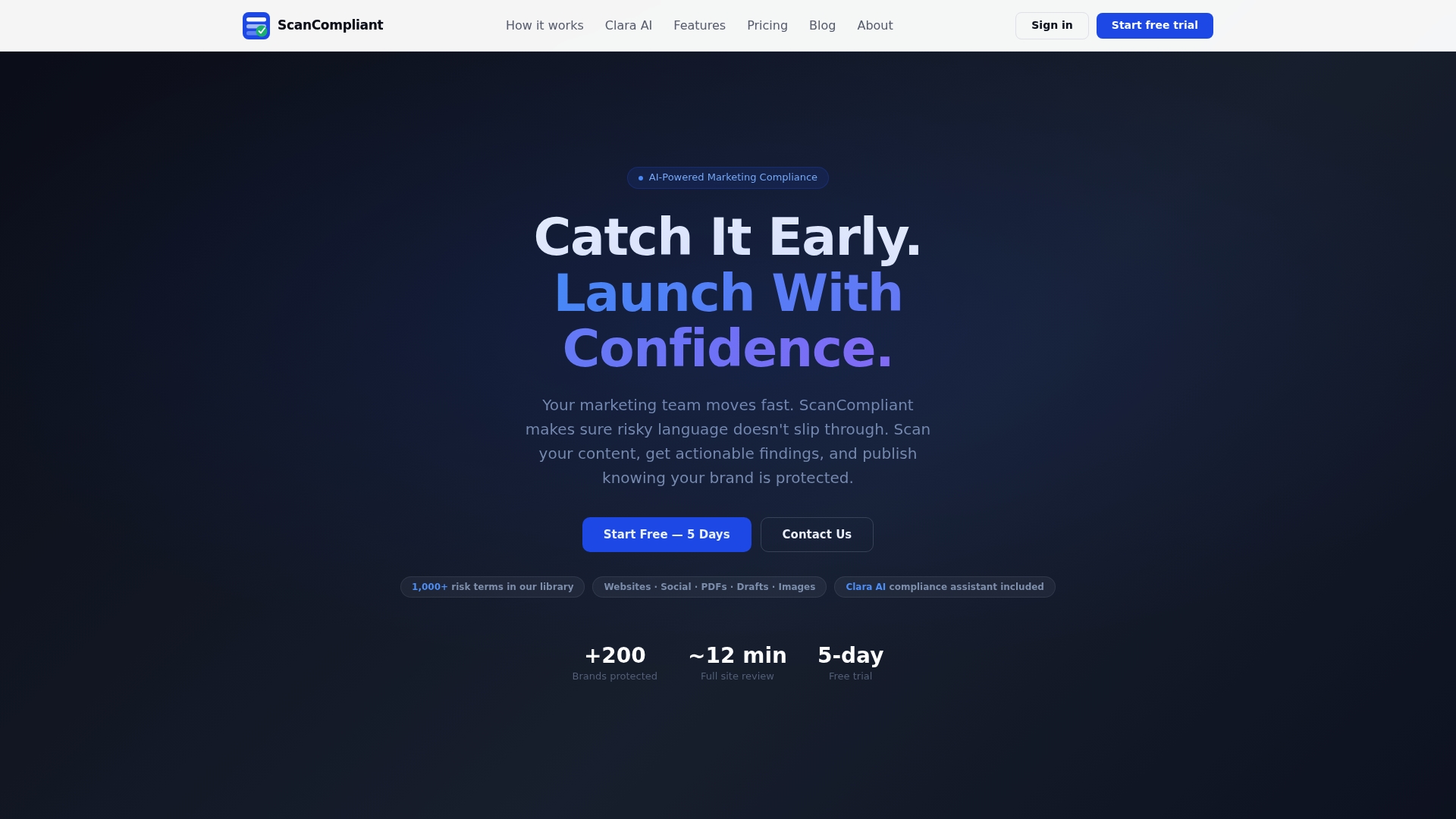
For telehealth and direct-to-consumer health brands, that speed matters. Content that would take a human reviewer hours to assess moves through Scancompliant’s workflow in minutes, with a documented audit trail that satisfies FDA and FTC accountability requirements. More than 200 brands already rely on Scancompliant to catch the subtle claims that manual reviewers miss. If your team is working to reduce review cycle times without sacrificing compliance quality, explore Scancompliant’s pricing to find the right fit for your workflow.
FAQ
What is the average compliance review turnaround time?
81% of compliance cases close within 30 days, but averages vary significantly by case type, ranging from 1–2 weeks for simple policy violations to 3–6 months for complex fraud investigations.
How much can automation reduce compliance review time?
Workflow automation reduces compliance processing time by 73%–80% and improves audit response times by up to 92%, based on documented case studies in financial and healthcare compliance environments.
What metrics should I track to benchmark compliance processes?
Track median time to close by case type, intake-to-assignment time, and the percentage of open cases that exceed your tier-specific threshold. Median is more reliable than average because outlier investigations skew the mean.
When should a compliance case be flagged as stale?
Cases with no documented activity for 60–90 days should be flagged for supervisory review. This threshold is a standard practice for managing case aging and preventing silent delays in complex investigations.
What is the fastest way to improve compliance turnaround time without adding headcount?
Redesign your intake and triage workflow to eliminate dead time from document assembly and manual status tracking, then apply automation to those redesigned steps. Workflow design before tool selection is the critical sequence that most teams reverse.
3 Comments