
A compliance backlog is the accumulation of unresolved regulatory review tasks that outpaces a team’s capacity to close them. Healthcare compliance teams face this challenge constantly, and how compliance teams manage backlogs determines whether organizations stay ahead of FDA and FTC obligations or fall into reactive firefighting. The most effective approach treats the backlog as a dedicated, scoped project with triage protocols, enforced workflows, and clear ownership. Teams that apply this structure report measurable results: one documented program achieved over 96% on-time closure and reduced its backlog by 31% within six months.
How do compliance teams implement triage and prioritization to handle backlogs?
Triage is the first and most critical step in any backlog management strategy. Without it, teams spend equal energy on a low-risk social media caption and a high-stakes FDA-regulated product claim. That misallocation is where backlogs grow fastest.
The standard approach scores each issue on two axes: risk severity and resolution complexity. Severity measures the regulatory consequence of leaving an issue open. Complexity measures how many people, systems, or approvals are needed to close it. Scoring both dimensions within 48 hours of intake prevents the pile-up that comes from delayed decisions.
Aging taxonomy adds a second layer of control. Items get bucketed by how long they have been open: under 30 days, 30–90 days, and over 90 days. Each bucket carries a different escalation trigger. A 90-day-old item that has not moved should automatically surface to a senior reviewer, not wait for someone to notice it.
- Severity score: Assign a 1–5 rating based on regulatory exposure and potential enforcement action.
- Complexity score: Rate by number of stakeholders, evidence requirements, and approval steps.
- Age bucket: Categorize by time open and attach automatic escalation rules to each tier.
- Resolution path: Define whether the item needs a single reviewer, a cross-functional team, or external counsel.
Initial triage should be handled by lower-level staff to protect senior bandwidth. Senior reviewers then focus on escalated items, not routine intake. This division of labor is one of the most underused efficiency gains in healthcare compliance programs.
Pro Tip: Build a triage decision tree with no more than five questions. If a reviewer needs more than five answers to score an item, the scoring criteria are too complex to apply consistently.
What role do structured workflows and enforcement play in reducing backlog bottlenecks?
Poor workflow enforcement is the most common reason compliance cases stall. Teams rely on email follow-ups, verbal reminders, and personal relationships to move cases forward. That approach fails at scale. Automated task dependencies and escalation triggers replace manual chasing with process-driven accountability.
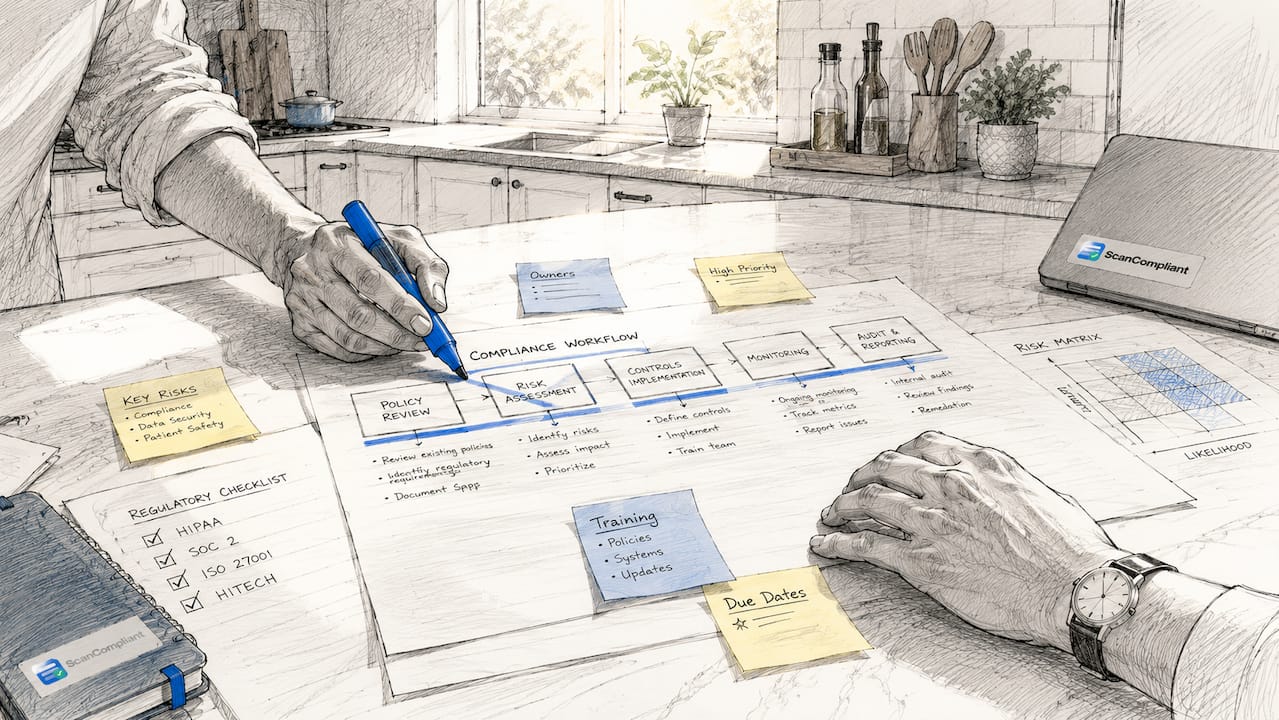
A structured workflow defines what must happen before the next step can begin. Evidence attachment is a clear example. A case should not advance to legal review until the supporting documentation is uploaded. The system enforces that prerequisite automatically, not a project manager sending a reminder email.
Escalation must be time-based, not relationship-based. When a task sits idle for a defined period, the system flags it and notifies the responsible party’s supervisor. This removes the awkwardness of a junior team member chasing a senior reviewer and replaces it with a neutral, system-generated prompt.
Shared visibility is the other critical element. When every stakeholder can see case status in real time, accountability becomes structural rather than personal. Teams stop asking “where does this stand?” because the answer is always visible.
- Define task prerequisites. No case advances without required evidence, approvals, or sign-offs attached.
- Set time-based escalation rules. Idle tasks trigger notifications automatically after a defined period.
- Assign single owners. Every task has one named responsible party, not a shared team inbox.
- Build shared dashboards. All stakeholders see live case status without requesting updates.
- Audit workflow completion rates. Track how often cases stall at each step to identify recurring bottlenecks.
Pro Tip: Run a 30-day workflow audit before deploying any new system. Map where cases stall most often. Those are the exact points where automated enforcement will deliver the fastest results.
How do healthcare compliance teams organize backlogs into prioritized workstreams?
Fragmentation, not volume, causes backlog chaos. Healthcare compliance teams often manage dozens of disconnected obligations simultaneously. Each item sits in isolation with no clear relationship to the others. Grouping related tasks into named workstreams with assigned owners and explicit sequencing creates the clarity that isolated task lists cannot.
A workstream is a cluster of related compliance obligations that share a common regulatory goal, a single owner, and a defined sequence of steps. For example, all tasks related to updating telehealth marketing content for FTC compliance belong in one workstream, not scattered across three spreadsheets and two email threads.
The table below shows how fragmented tasks compare to organized workstreams across key management dimensions.
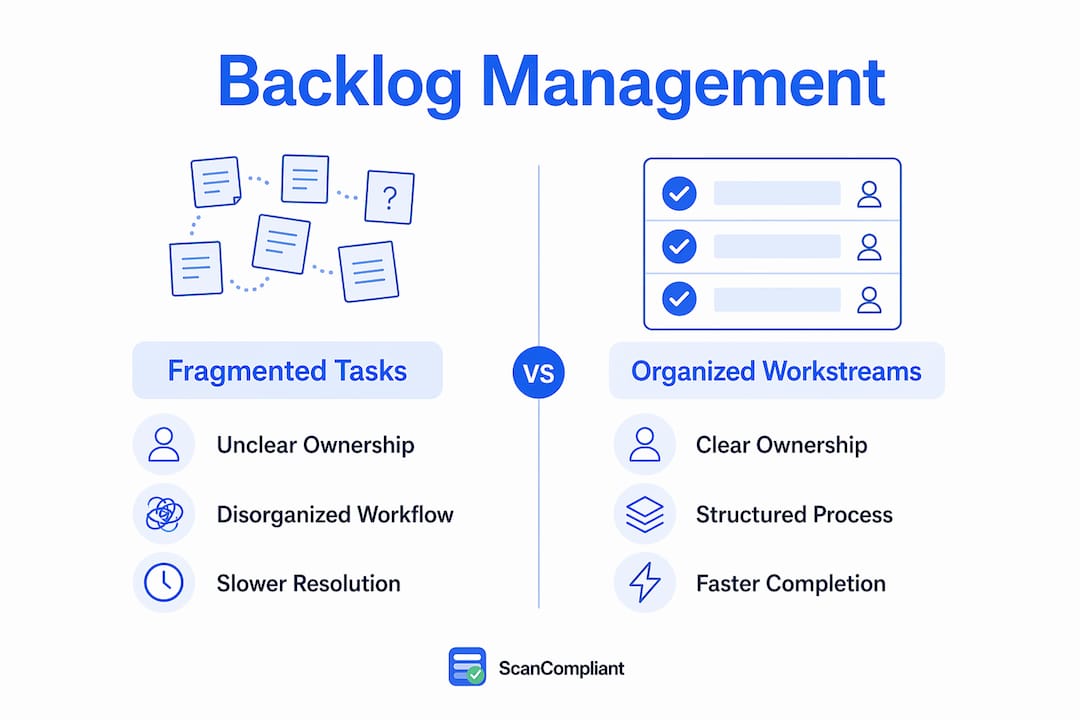
| Management dimension | Fragmented task list | Organized workstream |
|---|---|---|
| Ownership | Unclear or shared | Single named owner |
| Sequencing | Ad hoc | Defined with dependencies |
| Progress visibility | Manual status checks | Real-time dashboard |
| Escalation path | Relationship-based | System-triggered |
| Completion criteria | Vague | Explicit definition of done |
Limiting active workstreams prevents overload. Teams that run too many parallel workstreams split attention and slow every track. A practical ceiling is three to five active workstreams at any time. New items enter a queue and get sequenced into an existing workstream or wait for capacity.
Defining “done” for each workstream is non-negotiable. Without a clear completion standard, items linger in a gray zone between open and closed. That gray zone is where backlogs quietly grow. For compliance review turnaround benchmarks, explicit done criteria are the single biggest factor separating high-performing teams from those that perpetually fall behind.
What technologies and tools optimize backlog management in healthcare compliance?
Technology does not solve a broken process, but it dramatically accelerates a working one. The most impactful tools in healthcare compliance backlog management fall into three categories: AI-enhanced workflow platforms, remediation planning tools, and real-time reporting dashboards.
AI-powered regulatory change management improves compliance testing efficiency by up to 75%. That figure reflects the reduction in manual review time when AI flags high-risk content before it reaches a human reviewer. The human reviewer then focuses on confirmed risks, not screening tasks.
- AI content scanning: Platforms that scan marketing content against a database of risk terms catch problematic language before it enters the review queue. Scancompliant, for example, carries over 1,000 risk terms and has protected more than 200 brands by delivering prioritized findings in minutes rather than days.
- Remediation planning tools: Specialized platforms deliver owner-assigned remediation plans with prioritized gaps in as few as 5 business days. That speed compresses the planning phase that often delays backlog reduction efforts.
- Workflow enforcement platforms: Systems that enforce task prerequisites, evidence requirements, and time-based escalations reduce the manual coordination burden on compliance leads.
- Real-time dashboards: Compliance dashboards that surface backlog age, owner status, and closure rates give leadership the visibility needed to intervene before issues become enforcement risks.
The role of technology in compliance teams has shifted from record-keeping to active process enforcement. Teams that treat their tech stack as a passive archive miss the efficiency gains that active workflow tools deliver.
What best practices and pitfalls should healthcare compliance teams know?
The most common mistake in managing a compliance backlog is treating it as a permanent, ever-growing list rather than a scoped project with a defined end state. Backlog management requires the same project discipline as any other regulatory initiative: a scope, a timeline, and a closure standard.
- Archive stale items. Items untouched for over 6 months should be archived, not carried forward. Carrying them creates false urgency and clutters active reviews.
- Use a tiered taxonomy. A three-tier structure linking delivery items to initiatives and initiatives to strategic goals prevents scope creep and clarifies what belongs in the active backlog.
- Enforce a definition of ready. No item enters the active backlog without a clear description, an assigned owner, and defined evidence requirements. Vague items stall workflows.
- Do not treat all issues as equally urgent. Uniform urgency is the fastest path to paralysis. Triage scoring exists precisely to differentiate.
- Schedule regular grooming sessions. A weekly or biweekly backlog review keeps items current, removes resolved tasks, and re-sequences priorities as regulatory conditions change.
Pro Tip: Set a hard limit on active backlog items per owner. When an owner’s active count exceeds that limit, new items queue automatically. This prevents the invisible overload that causes experienced team members to quietly deprioritize critical tasks.
Key Takeaways
Effective compliance backlog management requires triage, structured workflows, and clear ownership. Teams that apply these three elements consistently close more cases faster and maintain regulatory standing with far less reactive effort.
| Point | Details |
|---|---|
| Triage within 48 hours | Score every item by risk severity and complexity before it enters the active backlog. |
| Automate escalation | Use time-based, system-triggered escalation instead of manual follow-ups to prevent stalling. |
| Organize into workstreams | Group related tasks under a single owner with explicit sequencing and a clear definition of done. |
| Limit active workstreams | Cap parallel workstreams at three to five to prevent attention fragmentation and slowdowns. |
| Archive stale items | Remove items untouched for over 6 months to keep the backlog accurate and actionable. |
What I’ve learned about backlogs that most guides won’t tell you
The cultural shift is harder than the process change. Every healthcare compliance team I’ve observed has the intellectual understanding that triage and prioritization matter. The real obstacle is getting senior reviewers to accept that a system-generated escalation carries the same weight as a personal request from leadership. That acceptance does not come from a policy memo. It comes from leadership visibly respecting the system’s output and acting on it.
Technology changes team dynamics in ways that catch people off guard. When workflow enforcement removes the need to chase colleagues, some team members feel less needed. The best compliance leads reframe that shift: the team’s value moves from coordination to judgment. The system handles the reminders. The people handle the decisions that require expertise.
The other thing most guides skip: backlog management is never finished. The goal is not to reach zero items. The goal is to maintain a backlog that is current, scored, and owned. A well-managed backlog of 50 items is healthier than an empty one that refills chaotically every quarter. Build the process to sustain that health, not to declare victory once.
— Compliant Team
Scancompliant and the backlog problem healthcare teams face
Healthcare compliance teams dealing with marketing content backlogs face a specific challenge: human reviewers miss subtle language risks that accumulate into regulatory exposure. Scancompliant addresses that gap directly.

Scancompliant’s AI-powered platform scans marketing content against more than 1,000 risk terms, flags problematic language before publication, and delivers prioritized findings in minutes. That speed compresses the review queue that feeds most content backlogs. The platform also maintains a documented compliance trail, giving teams the accountability record that regulators expect. More than 200 brands already rely on Scancompliant to catch what human review misses. Explore the full platform to see how it fits your team’s review process.
FAQ
What is a compliance backlog in healthcare?
A compliance backlog is the accumulation of unresolved regulatory review tasks that exceeds a team’s current capacity to close them. In healthcare, these tasks typically include content reviews, audit findings, and regulatory change assessments.
How do you prioritize compliance tasks in a backlog?
Score each item by risk severity and resolution complexity within 48 hours of intake. Items with high severity and low complexity should move first, as they deliver the greatest risk reduction for the least effort.
How often should a compliance backlog be reviewed?
A weekly or biweekly grooming session keeps the backlog current. Regular grooming removes resolved items, re-scores changed priorities, and prevents stale tasks from cluttering the active queue.
What causes compliance backlogs to grow out of control?
Treating all issues as equally urgent and relying on manual follow-ups are the two primary causes. Uniform urgency prevents triage from functioning, and manual chasing fails at scale when case volume increases.
Can AI reduce compliance review backlogs?
AI-enhanced workflows improve compliance testing efficiency by up to 75% by automating the screening phase and surfacing only confirmed risks for human review. That reduction in screening time directly shrinks the content review backlog.
Recommended
- Compliance Review Turnaround Time Benchmarks: 2026 Guide – scancompliant.com
- The Role of Technology in Compliance Teams: 2026 Guide – scancompliant.com
- Compliance Risk Reporting for Healthcare Teams: 2026 Guide – scancompliant.com
- Healthcare Marketing Compliance Training Teams: 2026 Guide – scancompliant.com
1 Comment