
How compliance teams prioritize findings: the core framework
Compliance teams prioritize findings by applying a risk-based ranking system that evaluates severity, regulatory exposure, and operational impact, then assigns ownership with fixed remediation windows. The highest-risk items get addressed first. Everything else gets sequenced by dependency and complexity.
Three elements anchor every effective prioritization system:
-
Severity classification: Critical, major, minor, and observation tiers each carry distinct remediation timelines and escalation rules.
-
Leadership alignment: NIST guidance establishes that priority reflects an order of precedence set by those with appropriate authority, typically a Chief Compliance Officer or equivalent, not just numeric exposure scores.
-
Documented audit trails: Every triage decision, including the risk tier assigned, the rationale, the reviewer, and the timestamp, must be recorded from the moment a finding is logged.
-
Cross-functional collaboration: Marketing, regulatory, and legal teams must align on what “critical” means before a finding ever hits the queue.
-
Continuous reassessment: Priorities shift as products, markets, and regulations change. A static list becomes a liability.
For telehealth and DTC health brands, where FDA and FTC scrutiny of marketing claims is constant, this framework is not optional. It is the difference between a defensible compliance program and one that collapses under regulatory review.
Table of Contents
- What frameworks do compliance teams use to rank risks?
- How to execute remediation with clear timelines and ownership
- How Scancompliant improves prioritization speed and accuracy
- Why compliance prioritization must evolve continuously
- Why prioritizing compliance findings protects your brand
- What US telehealth and DTC brands face in practice
- How FDA and FTC regulations shape prioritization criteria
- What KPIs tell you if your prioritization system is working
- Scancompliant gives your team a faster path to defensible compliance
- Key Takeaways
What frameworks do compliance teams use to rank risks?
The most effective ranking systems combine impact scoring with dependency mapping. Severity alone is not enough. A ranking-based approach creates a transparent audit trail that lets teams defend resource allocation during regulatory reviews, which is exactly what the DOJ and federal agencies expect to see.
Statistic callout: Regular, thorough risk assessments can reduce compliance incidents by 30%, according to industry surveys.
Practical frameworks for telehealth and DTC brands include:
- Impact and dependency mapping: Before sequencing remediation, teams tag each finding with upstream and downstream dependencies. A control gap that blocks five other remediation tasks moves to the front, regardless of its standalone severity score.
- Regulatory linkage scoring: Findings tied to FDA promotional content rules or FTC substantiation requirements receive a compliance weight multiplier. Even a minor defect escalates if it touches a mandatory regulatory clause.
- Chronological order is a trap. Prioritizing by document ownership or timestamp is one of the most common mistakes teams make. High-volume medium-risk findings pile up and bury the small cluster of critical blockers underneath.
- Enterprise alignment: Per NIST guidance, factors like corporate reputation, regulatory standing, and mission impact all influence where a finding lands in the queue, not just its technical exposure value.
How to execute remediation with clear timelines and ownership
Triage is not investigation. It is a 15–30 minute assessment to assign a risk tier and route the finding to the right owner. The goal is speed and consistency, not conclusions.
Execution timelines by severity tier:
- Critical: Immediate ownership assignment, 0–3 month execution window. These findings get isolated and sequenced first.
- Major: 3–6 month window, sequenced by dependency after critical items are planned.
- Minor: 6–12 months, batched by document family or content category.
- Observation: Continuous quality hardening, no fixed deadline.
Every finding record must include a finding ID, requirement reference, severity score, named owner, due window, dependency links, closure evidence criteria, and current status. Documenting the risk tier, rationale, reviewer, and timestamp at the point of triage is what creates an audit-ready trail. Closure evidence must be defined at task creation, not at follow-up.
Pro Tip: Set escalation triggers in writing before a finding enters the queue. Common triggers include discovery of additional affected parties, evidence of repeat behavior, or connection to an active regulatory inquiry. When investigators know exactly when to escalate, the escalation itself becomes part of the documented trail.
How Scancompliant improves prioritization speed and accuracy
Manual content review in telehealth and DTC marketing is slow and inconsistent. Human reviewers miss subtle claims. Scancompliant addresses this directly by scanning marketing content with AI, flagging risk terms before publication, and delivering prioritized findings in minutes rather than days.

| Metric | Scancompliant impact |
|---|---|
| Brands protected | 200+ |
| Risk terms in database | 1,000+ |
| Review cycle speed | Minutes vs. manual hours |
| Compliance trail | Documented, audit-ready output |
Key workflow benefits:
- Pre-publication scanning: Catches FDA and FTC risk language before content goes live, not after a complaint is filed.
- Prioritized output: Findings are ranked by risk level, so teams address the highest-exposure claims first without manual sorting.
- Audit documentation: Every scan produces a compliance trail that supports regulatory accountability.
- Scalable review: Teams reviewing high-volume content pipelines, such as email campaigns, landing pages, and social ads, can run consistent checks without adding headcount.
For healthcare compliance teams managing content across multiple channels, the ability to catch subtle claims that human reviewers miss is the practical advantage.
Pro Tip: Configure Scancompliant’s risk term database to reflect your current regulatory environment. As FDA guidance on telehealth claims or FTC substantiation standards evolve, updating the platform’s parameters keeps your prioritization criteria current without rebuilding your review process from scratch.
Why compliance prioritization must evolve continuously
A compliance program that worked two years ago may be inadequate today. Effective compliance management systems must be dynamic, reassessing risk profiles as brands shift products, enter new markets, or adopt new technologies.
Triggers for reassessment in telehealth and DTC brands:
- New product lines or therapeutic claims that expand regulatory exposure
- Entry into new states with distinct telehealth prescribing or advertising rules
- Changes in FDA enforcement priorities or FTC guidance on health claims
- Significant growth in content volume that outpaces existing review capacity
- Post-audit findings that reveal gaps in the current prioritization criteria
Annual review processes should evaluate whether the risk assessment is current, whether ownership assignments still reflect the actual team structure, and whether closure evidence standards match what regulators currently expect. Governance checkpoints on critical and major queues should run at least quarterly. For healthcare compliance reporting, tracking metrics like time-to-triage, tier distribution, and closure rates reveals whether the prioritization system is actually working.
Why prioritizing compliance findings protects your brand
Prioritizing compliance findings is the mechanism by which a compliance program converts audit output into measurable risk reduction. Without it, teams close low-impact items first because they are easy, while critical blockers sit unresolved.
For telehealth and DTC health brands, the stakes are concrete. An unaddressed FDA violation in a paid ad can trigger a warning letter. An FTC substantiation gap in a landing page can result in a consent order. The compliance trail built through structured prioritization, including triage records, ownership logs, and closure evidence, is what demonstrates to regulators that the program is credible and proactive, not reactive. Secure communication practices across the care team, including secure email protocols for clinical staff, are part of the same defensible posture.
What US telehealth and DTC brands face in practice
The compliance environment for US telehealth brands is unusually complex. Marketing teams are producing content at high volume across channels where FDA and FTC rules apply simultaneously. A single landing page may contain drug efficacy claims subject to FDA promotional standards, testimonials subject to FTC endorsement guidelines, and pricing language subject to state consumer protection rules.
In practice, teams that lack a structured prioritization process default to reviewing content by submission order or by whoever is asking loudest. That approach consistently produces the same outcome: minor policy questions get answered quickly while high-exposure claims sit in the queue. Scancompliant’s pre-publication scanning breaks that pattern by surfacing the highest-risk language first, giving regulatory teams a ranked list rather than a flat inbox.
How FDA and FTC regulations shape prioritization criteria
Federal regulations function as hard constraints in any telehealth or DTC compliance prioritization system. FDA rules on drug promotion, including requirements around fair balance, substantiation, and off-label claims, automatically elevate any finding that touches those areas. FTC rules on health claim substantiation and endorsements do the same.
Modern prioritization links each finding to the specific regulatory clause it implicates. A missing fair balance disclosure in a paid social ad is not a “minor” finding just because the ad is short. Its regulatory linkage makes it critical. Multi-dimensional tagging that connects findings to FDA and FTC clauses ensures even small defects escalate when they touch mandatory requirements. The compliance trail documentation that supports this process is what regulators examine when they assess program credibility.
What KPIs tell you if your prioritization system is working
Tracking the right metrics reveals whether prioritization is producing actual risk reduction or just activity.
| KPI | What it measures |
|---|---|
| Time-to-triage | Speed of initial risk tier assignment after a finding is logged |
| Tier distribution | Ratio of critical to minor findings; shifts signal changing risk exposure |
| Closure rate by tier | Whether critical items close within their 0–3 month windows |
| Escalation frequency | How often findings move to a higher tier during remediation |
| Repeat finding rate | Whether the same gaps recur across audit cycles |
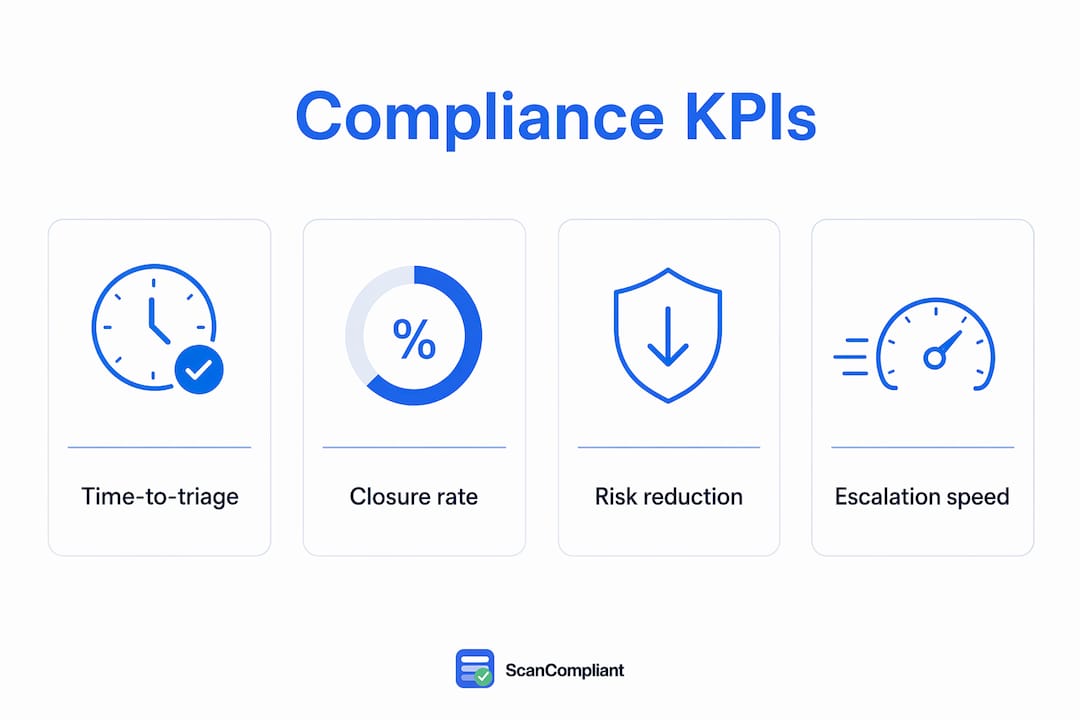
Closure rate on critical findings is the single most telling metric. If critical items are not closing within their defined windows, the prioritization system has an ownership or resource problem, not a ranking problem.
Scancompliant gives your team a faster path to defensible compliance
Marketing and regulatory teams at telehealth and DTC brands spend too much time sorting through content manually, only to miss the claims that carry the most regulatory risk.
Scancompliant scans marketing content before it publishes, flags over 1,000 risk terms mapped to FDA and FTC standards, and delivers a ranked, documented output in minutes. More than 200 brands already use it to run faster review cycles without adding compliance headcount. The platform produces an audit-ready compliance trail automatically, so when a regulator asks how you handled a specific claim, the answer is already documented.
Start protecting your content with Scancompliant, or review platform pricing to find the plan that fits your team’s volume.
Key Takeaways
Compliance teams that prioritize findings by severity, regulatory linkage, and dependency, rather than by submission order, consistently close critical risks faster and build more defensible audit trails.
| Point | Details |
|---|---|
| Risk-based ranking is the standard | Severity, regulatory exposure, and dependency mapping determine sequence, not chronology or document ownership. |
| Critical findings need 0–3 month windows | Immediate ownership and a fixed execution window prevent critical blockers from stalling behind lower-risk items. |
| Regular, thorough risk assessments can reduce compliance incidents by 30%, according to industry surveys. | |
| Continuous reassessment is required | Compliance risk profiles must be updated as products, markets, and regulations change, not just at annual audit cycles. |
| Scancompliant automates the hardest part | Scancompliant scans marketing content pre-publication, ranks findings by risk level, and produces a documented compliance trail for over 200 brands. |
Recommended
- The Role of Technology in Compliance Teams: 2026 Guide – scancompliant.com
- Compliance Risk Reporting for Healthcare Teams: 2026 Guide – scancompliant.com
- Risk-Prioritized Compliance for Healthcare Marketers: 2026 Guide – scancompliant.com
- Compliance Review Stages: A Guide for Health and Marketing Teams – scancompliant.com