
For telehealth and DTC health brands, integrating compliance checks into the content pipeline means embedding FDA and FTC requirements directly into how content gets created, reviewed, and approved — not bolted on at the end. Done right, this approach catches risky claims before they reach a reviewer’s desk, cuts revision cycles, and produces a documented trail that holds up under regulatory scrutiny.
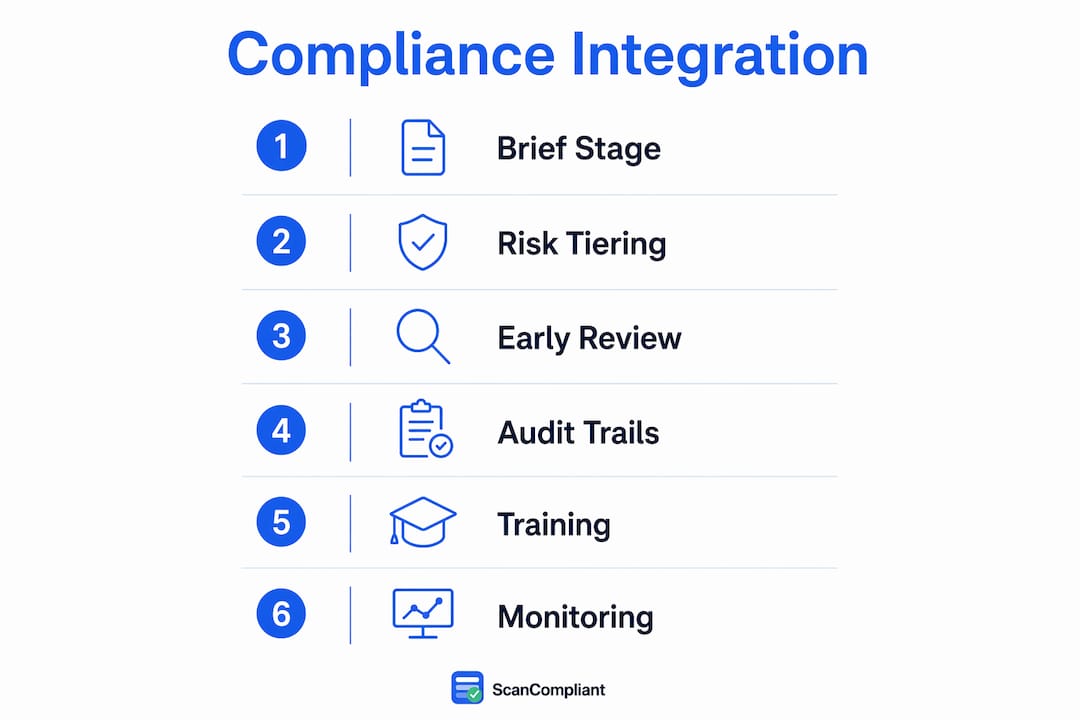
Here is what a functional compliance integration looks like in practice:
- Legal guardrails in briefs: Approved claim libraries, mandatory disclaimers, and “do’s and don’ts” checklists built into every content brief before a word is written
- Tiered review workflows: Risk-based routing that sends low-risk educational content through a lighter review path while reserving full Medical-Legal-Regulatory (MLR) scrutiny for high-stakes campaigns
- Early feedback loops: Compliance and legal teams engaged during drafting, not after the final copy is submitted
- Audit trails: Version-controlled records capturing who reviewed what, when, and why — ready for an FDA or FTC inspection
- Telehealth-specific guardrails: Protocols addressing HIPAA, implied FDA-approval claims, and the “common enterprise” risk the FDA has flagged for telehealth platforms
- Automation tools: AI-powered platforms like Scancompliant that scan content against a database of risk terms before human reviewers ever see it
Table of Contents
- How to integrate compliance checks into your content pipeline from the brief stage
- Tiered review workflows that match scrutiny to actual risk
- Why early compliance involvement prevents last-minute delays
- Building audit trails that hold up under FDA and FTC scrutiny
- Telehealth-specific regulatory risks your content pipeline must address
- How Scancompliant supports proactive compliance integration
- Training your content team to handle compliance responsibilities
- Metrics that tell you whether compliance integration is actually working
- Managing collaboration between marketing, legal, and regulatory teams
- Keeping your pipeline current as FDA and FTC regulations change
- Scancompliant catches what your team cannot afford to miss
- Key Takeaways
How to integrate compliance checks into your content pipeline from the brief stage
The most effective place to catch a compliance problem is before the writer has committed to a claim. Embedding legal guardrails — approved claim libraries, required disclaimers, and explicit “do not say” lists — directly into content briefs shifts the compliance burden upstream, where fixing a problem costs minutes instead of days.
In practice, this means every brief includes:
- A pre-approved claims library the writer can draw from without triggering a review flag
- Mandatory disclaimer language for the content type (prescription drug, supplement, telehealth service)
- A short list of prohibited phrases specific to the campaign’s risk category
- Reference citations required to substantiate any efficacy claim under FTC substantiation standards
Drafting tools can reinforce these guardrails in real time. Submission intake forms that lack mandatory fields for claims, references, and risk tiering force reviewers to hunt for context rather than make decisions — a documented bottleneck in MLR workflows. Standardizing those fields at intake removes that friction entirely.
Pro Tip: Build a template module for each content type — social post, landing page, email — with the relevant disclaimer pre-populated and the prohibited-phrases list embedded as a comment. Writers see the guardrails without needing to look them up.
Tiered review workflows that match scrutiny to actual risk
Not every piece of content carries the same regulatory exposure. A blog post on hydration habits is not the same compliance risk as a paid ad claiming a compounded GLP-1 produces the same results as an FDA-approved drug. Treating them identically wastes expert reviewer time and creates the bottlenecks that push marketing teams to route around compliance entirely.
A practical three-tier structure:
- Low risk: General wellness content, educational articles, lifestyle posts. Light review by a trained content editor; no full MLR required.
- Medium risk: Content referencing specific services, treatments, or conditions. Medical review required; legal review optional based on claim specificity.
- High risk: Prescription drug advertising, efficacy claims, testimonials, anything touching an FDA-regulated product. Full MLR review with documented rationale for every approval.
Tiered promotional review allows low-risk derivative content to bypass full MLR scrutiny, freeing your most qualified reviewers for the campaigns that genuinely need them. Running medical and legal reviews in parallel — rather than sequentially — further compresses cycle time without reducing rigor.
Why early compliance involvement prevents last-minute delays
Waiting until a piece is fully written before involving compliance is the single most common reason content gets stuck. Delaying compliance involvement until final sign-off leads to unpredictable reviews; early collaboration creates feedback loops that make compliance more predictable and less punitive.
Best practices for building those loops:
- Schedule a brief alignment call between marketing, medical, and legal before any high-risk campaign brief is written
- Assign a compliance point of contact to each campaign who can answer questions during drafting
- Use shared drafting tools where compliance can leave inline comments rather than sending redlined documents by email
- Set explicit deadlines for each review stage so no piece sits waiting for a response
The goal is a content review workflow where compliance feedback arrives while the writer can still act on it cheaply, not after the design team has already built out the campaign assets.
Building audit trails that hold up under FDA and FTC scrutiny
A robust audit trail showing who reviewed what, when, and why is what separates a defensible compliance program from a liability. The rationale behind a change matters as much as the change itself — a reviewer who approved a claim without documenting why leaves the brand exposed if that claim is later challenged.
An effective audit trail captures:
- Every version of the content with timestamps and author attribution
- Reviewer comments and the specific claims or language they addressed
- The rationale for approvals, rejections, and modifications
- Final sign-off with the reviewer’s name, role, and date
Verification software that compares downstream marketing assets against approved masters catches formatting and transcription errors that human reviewers routinely miss. Integrating this into your document management platform means the audit trail builds itself rather than depending on someone remembering to save a version. For a deeper look at what this documentation should include, the compliance trail guide from Scancompliant covers the structure in detail.
Telehealth-specific regulatory risks your content pipeline must address
Telehealth marketing operates under a layer of regulatory complexity that general healthcare marketing does not. The FDA’s recent enforcement sweep sent cease-and-desist letters to telehealth platforms including well-known brands for claims that implied compounded products were equivalent to FDA-approved drugs. The agency’s theory: platforms connecting consumers to independent providers and pharmacies may constitute a “common enterprise” subject to FDA misbranding provisions.
Regulatory considerations specific to telehealth and DTC health brands:
- Implied FDA approval: Phrases like “same active ingredient as Ozempic” or “clinically proven” on compounded products have already triggered warning letters
- HIPAA and analytics: HIPAA compliance extends to the entire marketing technology stack — analytics configurations must exclude protected health information from tracking pixels and ad platforms
- Testimonials and patient data: Any use of patient stories requires explicit consent documentation; the FTC’s BetterHelp action illustrates the cost of mishandling health data shared with ad networks
- AI disclosure requirements: California AB 489 and Texas’s 2026 disclosure rule both prohibit implying that AI-delivered care comes from a licensed human provider
- State-level variation: Telehealth advertising rules differ by state; a claim permissible in one jurisdiction may trigger enforcement in another
For teams managing telehealth email marketing compliance, the same “common enterprise” risk applies to email campaigns that reference compounded products alongside FDA-approved brand names.
How Scancompliant supports proactive compliance integration
Scancompliant is an AI-powered content scanning platform built specifically for telehealth and DTC health brands. It scans marketing content against a database of more than 1,000 risk terms, flags problematic language in minutes, and generates a documented compliance trail — all before the piece reaches a human reviewer.
| Feature | What it does for your team |
|---|---|
| 1,000+ risk term database | Catches subtle non-compliant claims human reviewers often miss |
| Rapid AI scanning | Returns prioritized findings in minutes, not days |
| Automated audit trail | Documents every scan, flag, and resolution for regulatory defense |
| 200+ brands protected | Proven at scale across telehealth and DTC health marketing |
| Pipeline integration | Fits into existing content workflows without rebuilding your process |
The platform’s value is most visible in high-volume content environments where a single missed claim can trigger an FDA warning letter. By automating the first-pass review, Scancompliant lets your compliance team focus on judgment calls rather than pattern-matching against a risk term list.
Training your content team to handle compliance responsibilities
Compliance integration fails when writers and editors treat it as someone else’s job. The most effective programs assign clear roles: a content owner responsible for brief compliance, a subject-matter reviewer for medical accuracy, and a legal or regulatory reviewer for claim substantiation. Each role needs defined scope and a deadline.

Regular training keeps the team current. FDA guidance evolves, FTC enforcement priorities shift, and what passed review last year may not pass today. Short quarterly sessions covering recent enforcement actions — the kind of pattern-matching the FDA’s AI surveillance tools now flag — give writers the context to self-correct before submission. Pairing training with a regulatory review checklist gives teams a concrete reference rather than abstract rules.
Metrics that tell you whether compliance integration is actually working
Three numbers tell most of the story: average time from submission to approval, average revision rounds per piece, and the percentage of content that clears first-pass review without a compliance flag. If approval time is long and revision rounds are high, the problem is almost always upstream — either the brief lacks guardrails or compliance wasn’t involved early enough.
Track where content stalls. Delays that consistently occur at the same reviewer or stage point to a capacity or process gap, not a content quality problem. Compliance risk reporting that surfaces these patterns gives leadership the data to address root causes rather than symptoms.
Managing collaboration between marketing, legal, and regulatory teams
The friction between marketing speed and compliance rigor is real, but it is mostly a communication problem. Marketing teams often do not know which specific phrases trigger legal concern; legal teams often do not know which campaign constraints are negotiable. A shared glossary of approved and prohibited terms, built collaboratively, closes most of that gap without requiring a meeting for every piece of content.
Pre-campaign alignment sessions — where marketing, medical, and legal agree on the claim boundaries before writing begins — eliminate the back-and-forth that happens when legal sees finished copy for the first time. Centralized workflow tools that route content automatically based on risk tier remove the email chains that lose versions and obscure accountability. The molecular lab claim denial playbook from Labrynix offers a useful parallel on optimizing MLR team workflows for faster, more consistent decisions.
Keeping your pipeline current as FDA and FTC regulations change
Regulatory change is not an event — it is a constant. The FDA’s 2026 enforcement push used AI surveillance tools to flag technical violations that previously went unaddressed. The FTC’s Health Products Compliance Guidance sets the substantiation bar before an ad runs, not after. Both agencies have signaled they will continue expanding scrutiny of digital health advertising.
Build a regulatory monitoring function into your pipeline. Assign someone to track FDA warning letters, FTC orders, and state-level telehealth advertising rules on a monthly basis. When a new enforcement pattern emerges — implied approval claims, unsubstantiated outcome guarantees, privacy policy mismatches — update your approved claims library and prohibited-phrases list before the next campaign brief goes out. Compliance workflow automation tools that allow rapid updates to risk term databases make this adaptation faster and less dependent on manual intervention.
Scancompliant catches what your team cannot afford to miss
Catching a non-compliant claim after an FDA warning letter costs far more than catching it in the brief. Scancompliant gives regulatory and marketing teams a first-pass AI scan that flags risky language in minutes, backed by a database of 1,000+ risk terms built specifically for healthcare and telehealth marketing.

The platform has protected more than 200 brands, generates a documented compliance trail with every scan, and fits into existing content workflows without requiring a process rebuild. For teams managing high content volume under FDA and FTC scrutiny, it is the difference between catching a problem on Tuesday morning and reading about it in a warning letter six weeks later. See how Scancompliant works and check pricing options that scale with your team’s output.
Key Takeaways
Integrating compliance checks into your content pipeline requires legal guardrails at the brief stage, risk-tiered review workflows, early cross-functional feedback, and a documented audit trail that satisfies FDA and FTC inspection standards.
| Point | Details |
|---|---|
| Start at the brief | Embed approved claim libraries and prohibited-phrase lists before writing begins to prevent downstream revisions. |
| Tier your reviews | Route low-risk content through lighter review paths; reserve full MLR scrutiny for high-stakes campaigns. |
| Involve compliance early | Early legal and compliance engagement makes reviews predictable and cuts revision rounds. |
| Document the rationale | Audit trails must capture why changes were made, not just who made them, to be defensible under FDA scrutiny. |
| Scancompliant | AI-powered scanning against 1,000+ risk terms delivers prioritized compliance findings in minutes, protecting 200+ brands. |
1 Comment