
A repeatable DTC brand compliance audit process delivers a time-stamped, documented compliance trail fit for FDA, FTC, and HHS-OIG review. Your immediate next action: run a scoped content and vendor inventory, then secure legal sign-off on your acceptance criteria before a single asset gets reviewed. Scancompliant’s AI-powered scanning platform supports this cycle by flagging risky language before it ever reaches a regulator or an acquirer.
Table of Contents
- What does a DTC brand compliance audit actually cover?
- How does the end-to-end audit process work?
- What goes on the operational audit checklist?
- How should you sample assets and build an auditable evidence trail?
- Who owns what, and how fast must reviews turn around?
- How do you embed compliance into the content lifecycle?
- What tooling do you need, and how does it preserve evidence?
- How do you triage findings and remediate without blocking campaigns?
- What do M&A buyers and regulators actually want to see?
- Where do you start? A 30/90/180-day plan
- Key Takeaways
- The compliance audit gap most DTC health brands ignore
- Scancompliant makes the audit process operational, not theoretical
- Useful sources and primary references
What does a DTC brand compliance audit actually cover?
Scope determines whether your audit holds up under scrutiny or collapses the moment a regulator asks a follow-up question. For U.S. telehealth and healthcare DTC brands, the scope must span seven domains: product classification, VAT/GST, responsible person designations, AI content disclosures, data localization, packaging & labeling requirements, and consumer dispute resolution, according to 2026 regulatory best practices recommended for cross-border DTC compliance audits.
Compliance audits are increasingly considered a deal-breaker in acquisition due diligence. Buyers expect continuous evidence and an auditable trail, not point-in-time attestations.
Your regulatory anchors determine what “pass” and “fail” mean. FDA guidance governs health claims and labeling, including the distinction between structure/function claims and drug claims. FTC rules cover deceptive advertising and, since October 2024, the Consumer Reviews Rule (16 CFR Part 465) carries civil penalties up to $51,744 per violation. HHS-OIG’s January 2026 Special Advisory Bulletin addresses Anti-Kickback Statute risk in manufacturer DTC prescription programs, stressing that prescriber independence and recordkeeping are central to any AKS analysis. HIPAA/HITECH applies to any telehealth data flow touching protected health information.
Define your audit objective before you start. Regulatory readiness requires evidence that every live claim is substantiated and every disclosure is current. Marketing assurance requires pre-publish gates on every campaign. M&A diligence requires a packaged evidence bundle with legal sign-offs that an acquirer’s counsel can review in days, not weeks.
How does the end-to-end audit process work?
The audit is a continuous cycle, not an annual project. Tie it to your release and campaign calendars so checks happen before exposure, not after.
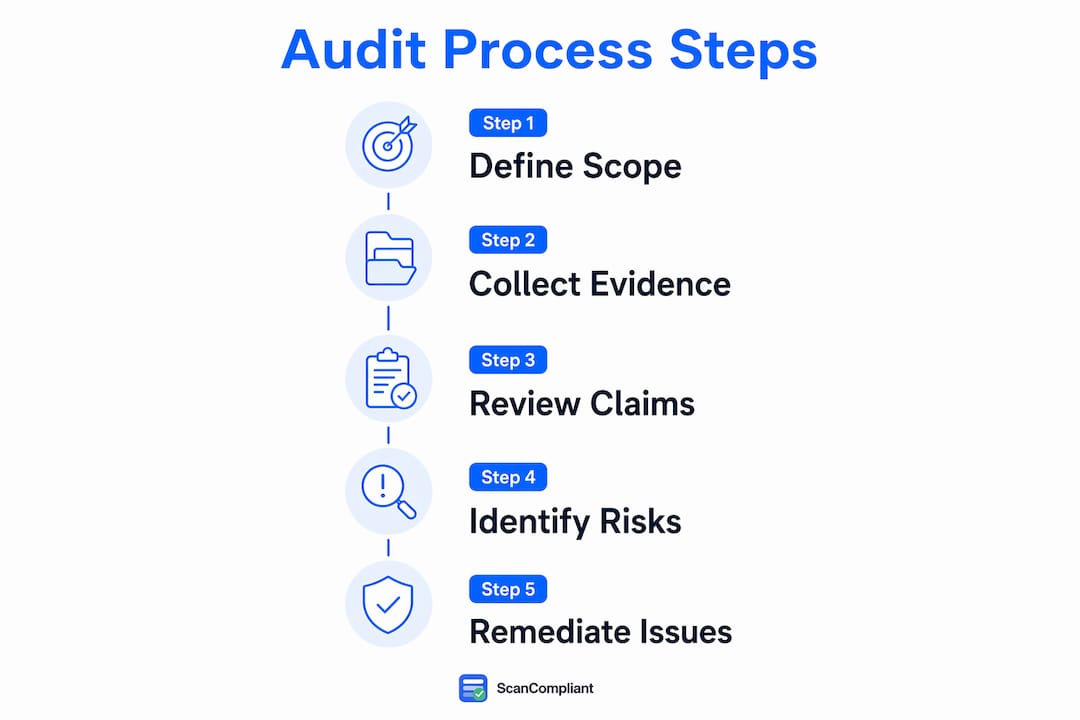
- Prepare and scope. Define the asset universe, assign roles, confirm regulatory anchors, and get legal sign-off on acceptance criteria.
- Inventory and classify. Catalog every content type and vendor deliverable. Tag each asset by channel, risk tier, and last-reviewed date.
- Risk review. Apply your risk taxonomy to each asset class. Flag claims, disclosures, and data flows that require substantiation or remediation.
- Sample and gather evidence. Pull a stratified sample, capture time-stamped screenshots and metadata, and document the reviewer chain.
- Remediate and record. Prioritize findings by severity, apply fixes, and log every change with before/after evidence and re-scan confirmation.
- Monitor and repeat. Schedule quarterly spot checks, align re-audits with platform updates, and maintain a living regulatory change log.
Legal review belongs at step 1 (sign-off on scope and acceptance criteria) and again at step 5 for any high-severity finding that requires a claim rewrite or a structural program change. Counsel sign-offs should attest to the specific claim, the substantiation reviewed, and the date of review.
What goes on the operational audit checklist?

The table below maps content types to their most common failure points and the evidence reviewers must capture.
| Content type | Common failure points | Evidence to capture |
|---|---|---|
| Site pages and landing pages | Unsubstantiated efficacy claims, missing ISI, off-label promotion | Timestamped screenshot, substantiation file, legal sign-off |
| Paid ads (search, display, social) | Cure/guarantee language, missing fair balance, FTC disclosure failures | Ad creative export, placement metadata, disclosure audit log |
| Email and SMS | Misleading subject lines, TCPA consent gaps, unsubscribe failures | Campaign metadata, consent records, delivery logs |
| Social posts and influencer content | Missing #ad/#sponsored disclosure, conditional review incentives | Post archive, influencer agreement, disclosure audit |
| Telehealth intake forms and scripts | Informed consent gaps, HIPAA notice deficiencies, CPOM risk | Form version history, consent acknowledgment records |
| Testimonials and reviews | Conditionally incentivized reviews, unrepresentative results | Review generation workflow audit, incentive policy documentation |
| Vendor and agency deliverables | AI-generated copy without disclosure, unvetted claims | Vendor contract, content sign-off records, DPA |
| Clinical governance | Prescriber independence documentation, QA protocol records | Clinician contracts, AKS compliance records |
Risky claim examples and compliant replacements:
- “Cures anxiety” → “May support a calm mood” (with substantiation on file)
- “Guaranteed results in 30 days” → “Results vary; see our clinical study summary”
- “FDA-approved” (for an unapproved supplement) → Remove entirely; describe regulatory status accurately
- “Our doctors prescribe only what works” → “Our licensed clinicians follow evidence-based protocols”
For telehealth email marketing, subject lines are a frequent FTC trigger. “Lose 20 lbs guaranteed” in a subject line is an enforcement target; “Personalized weight management plans” is not.
How should you sample assets and build an auditable evidence trail?
Defensible sampling follows a stratified approach: prioritize by traffic volume, recency of publication, and channel risk level. High-traffic landing pages and active paid campaigns always enter the sample. For email and SMS, pull the three most recent campaigns per program. For social, sample the top 20 posts by engagement plus any influencer content published in the last 90 days.
Evidence standards for each sampled asset:
- Full-page screenshot with visible URL and timestamp (browser-based capture tools that embed metadata are preferable to manual screenshots)
- Campaign or asset metadata: creation date, author, approval chain, version number
- Content sign-off record linking the asset to the reviewer and legal counsel where applicable
- Substantiation file for any clinical or efficacy claim
- Vendor deliverable documentation and the associated data processing agreement
- Analytics or consent tag snapshot confirming correct implementation at time of review
- Legal opinion or counsel sign-off for high-severity or novel claims
Retention policy matters. Audit artifacts should be retained for a minimum period consistent with your legal counsel’s recommendation and any applicable state or federal record-keeping requirements. A compliance documentation system that stores immutable, time-stamped records is the difference between a defensible trail and a folder of screenshots no one can authenticate.
Who owns what, and how fast must reviews turn around?
Core roles:
- Compliance owner: Sets policy, owns the risk taxonomy, and signs off on audit scope.
- Legal reviewer: Reviews high-severity findings and novel claims; provides contemporaneous sign-offs.
- Clinical governance lead: Owns prescriber independence documentation and QA protocols for telehealth programs.
- Marketing reviewer: Applies the checklist to campaign assets before launch.
- Engineering owner: Manages analytics tags, consent platforms, and privacy controls.
- Vendor compliance point-of-contact: Ensures third-party agencies and contractors meet the same standards as internal teams.
Pro Tip: Map every vendor relationship to a named internal point-of-contact. When an agency produces a non-compliant asset, you need a documented escalation path, not a group email thread.
HHS-OIG advisory bulletins are useful structural guides but do not create safe harbors. Brands should document a compliance narrative and obtain legal sign-offs to create record evidence.
Suggested SLAs by risk tier: high-severity findings (live claims with regulatory exposure) require a response within 24 hours and a fix or takedown within 48 hours. Medium-severity findings (disclosure gaps, formatting issues) should be remediated within five business days. Low-severity findings (style inconsistencies, minor formatting) can enter the next sprint cycle.
How do you embed compliance into the content lifecycle?
Compliance checks belong in the pipeline, not after it. The most effective teams treat pre-publish scanning the same way engineering treats security gates: a required step before any asset goes live.
Pro Tip: Add a compliance gate to your CMS publish workflow. A one-click pre-publish scan that flags risk terms before a writer hits “publish” catches more issues than a weekly batch review.
Practical integration points:
- Pre-publish scans in your CMS triggered on every draft submission
- Compliance criteria added to sprint acceptance checklists for product and feature releases
- Tagging reviews in creative platforms before any paid campaign activates
- Audit re-runs aligned with platform updates (new app installs, analytics wiring changes often create privacy exposure)
For compliant content releases, training is the other half of the equation. Run a quarterly training cycle covering updated regulatory guidance, new risk terms added to your taxonomy, and documented decision rules for edge cases. A living regulatory change log that records effective dates, markets affected, and remediation owners keeps the team current without relying on memory.
What tooling do you need, and how does it preserve evidence?
| Tool class | Function | Evidence output |
|---|---|---|
| Content scanner (e.g., Scancompliant) | Detects risk terms, flags claims pre-publish | Time-stamped scan report, risk taxonomy export |
| Consent management platform | Manages cookie and HIPAA consent | Consent logs with timestamps and version history |
| Version control and ticketing | Tracks asset changes and remediation status | Audit trail of edits, approvals, and closures |
| Privacy/DSR tooling | Handles data subject requests and HIPAA access | Request logs, response records |
| Server-side analytics capture | Preserves tag state at time of review | Snapshot exports with date and configuration metadata |
Scancompliant’s platform scans content against a database of over 1,000 risk terms, delivers prioritized findings in minutes, and exports a time-stamped audit bundle that counsel or an acquirer’s team can review directly. The compliance trail it produces links each asset to its reviewer, the scan result, and any legal sign-off, satisfying the evidence chain regulators and M&A teams expect.
Immutable logs matter. Any evidence that can be edited after the fact is not evidence. Your tooling stack should write records that cannot be retroactively altered, with access logs showing who viewed or exported each record.
How do you triage findings and remediate without blocking campaigns?
Triage by two axes: regulatory/legal severity and business impact. A live paid ad with a cure claim is high severity and high impact. A blog post with a missing disclosure is medium severity and low impact. That matrix sets your sprint priorities.
Remediation playbook by severity:
- High: Immediate takedown or replacement with compliant containment language. Document the takedown with a timestamp. Notify legal. Rewrite and substantiate before republishing. Re-scan before the asset goes live again.
- Medium: Apply a temporary fix (remove the specific claim, add the missing disclosure). Log the interim state. Complete a full rewrite within the SLA. Verify with a re-scan.
- Low: Queue for the next sprint. Log the finding with a target resolution date. Close with evidence of fix.
Every remediation ticket should include: the original asset, the finding description, the severity rating, the assigned owner, the fix applied, and a re-scan confirmation. That ticket is part of your compliance trail.
What do M&A buyers and regulators actually want to see?
Legal uncertainty around DTC prescription programs means documentation and structural alignment with OIG low-risk characteristics are not optional — they are the primary defense during any inquiry.
A diligence bundle for M&A or regulatory review should include: a complete asset inventory spreadsheet, a stratified evidence sample with timestamps, a remediation log showing findings closed and verified, legal sign-offs on high-severity claims and program structure, vendor data processing agreements, and a current regulatory change log.
The narrative components counsel will want: a written description of your compliance program, training records showing staff were trained and when, governance cadence documentation (who reviews what, how often), and evidence that your clinical governance meets AKS independence criteria.
Common red flags buyers flag: gaps in the remediation log, missing legal sign-offs on claims that were later challenged, no evidence of prescriber independence documentation, and a compliance program that exists on paper but has no training records. Pre-empt all of them by treating every audit cycle as if an acquirer’s counsel will review it next quarter. For guidance on responding to regulatory scrutiny, coordinate with counsel before, not after, an inquiry arrives.
Where do you start? A 30/90/180-day plan
- Days 1–30: Complete a scoped content and vendor inventory. Select your initial sample. Get legal sign-off on acceptance criteria and your risk taxonomy. Run a baseline scan and document findings.
- Days 31–90: Complete prioritized remediations for all high- and medium-severity findings. Embed a pre-publish compliance gate into at least one active campaign workflow. Set a quarterly review calendar with named owners.
- Days 91–180: Automate selected scans within your CMS and campaign tools. Train all reviewers on updated regulatory guidance and document the training. Prepare an M&A-ready evidence bundle: inventory, sample evidence set, remediation log, legal sign-offs, and vendor DPAs.
Key Takeaways
A compliant DTC brand audit program is continuous, evidence-first, and tied to every release and campaign cycle, not a once-a-year exercise.
| Point | Details |
|---|---|
| Treat compliance as continuous | Align audits with release and campaign cycles; quarterly spot checks catch regressions before regulators do. |
| Inventory and sampling are non-negotiable | Stratified sampling across channels and risk tiers produces defensible evidence; undocumented reviews do not. |
| Time-stamped approvals are the audit trail | Every asset needs a chain linking it to its reviewer, scan result, and legal sign-off to satisfy M&A and regulatory review. |
| Embed pre-publish gates in the content lifecycle | A CMS-level compliance check before publish catches more issues than any batch review process. |
| Scancompliant centralizes the evidence trail | Its AI scanning, risk taxonomy, and time-stamped audit exports give regulatory and marketing teams a single, defensible record. |
The compliance audit gap most DTC health brands ignore
The most common failure mode is not a bad claim. It is a good compliance program that runs annually and then sits untouched for eleven months while the marketing team ships thirty campaigns. By the time the next audit runs, the remediation log is a fiction and the evidence trail has holes a regulator could drive through.
The fix is not more auditors. It is treating compliance the same way a well-run engineering team treats security: a gate in the pipeline, not a review at the end. A living regulatory change log, quarterly spot checks tied to platform updates, and documented sign-offs on every high-severity claim are not bureaucratic overhead. They are the difference between a brand that survives an FTC inquiry and one that settles it.
For telehealth and DTC prescription programs specifically, the HHS-OIG’s January 2026 guidance makes prescriber independence documentation a structural requirement, not a nice-to-have. Brands that have not documented their clinical governance will find that gap is the first thing an acquirer’s counsel flags. The evidence bundle you build today is the compliance narrative you defend tomorrow.
Scancompliant makes the audit process operational, not theoretical
Regulatory and marketing teams that have read this far know what a compliant audit program looks like. The harder problem is running it consistently without adding headcount or blocking campaigns.
Scancompliant is built for exactly that gap. Its AI-powered scanner checks content against more than 1,000 healthcare and DTC risk terms, returns prioritized findings in minutes, and exports a time-stamped audit bundle your legal team or an acquirer’s counsel can review without translation. More than 200 brands have used it to build a documented compliance trail that holds up under scrutiny. A scoped pilot, covering an asset inventory, a 100-asset sample scan, and a prioritized remediation backlog, gives your team a working evidence bundle and a repeatable process within weeks. For teams building out healthcare content marketing alongside compliance programs, that combination of speed and documentation is what makes the difference between a program that exists and one that protects you. Start your pilot at scancompliant.com.
Useful sources and primary references
- HHS-OIG Guidance on Manufacturer DTC Platforms, Arnold & Porter (2026) — Primary analysis of the January 2026 Special Advisory Bulletin and AKS framework for DTC prescription programs.
- HHS OIG Special Advisory Bulletin on DTC Prescription Drug Sales, ArentFox Schiff — Guidance on documentation, prescriber independence, and recordkeeping for AKS compliance.
- FTC Consumer Reviews Rule (16 CFR Part 465) and Endorsement Guides, Promise Legal — Practical breakdown of the October 2024 rule, civil penalty exposure, and DTC brand obligations.
- Legal Uncertainty in DTC Drug Programs, Wiley Law — Analysis of Senate scrutiny and the case for comprehensive AKS documentation.
- Direct-to-Consumer Pharmacy Models: Legal and Compliance Risks, Frier Levitt — Covers AKS, CPOM, telemedicine prescribing rules, and contracting requirements.
- HHS OIG Guidance on AKS Risk in DTC Drug Sales, Morgan Lewis — Detailed review of the SAB’s four key program characteristics and remaining open questions.
- Regulatory Change Log Best Practices, Online Store News — Practitioner guidance on maintaining a living change log mapped to remediation owners and effective dates.
- Continuous Compliance Audit Engine for DTC, Online Store News — Framework for aligning technical audits with platform update cycles.
This article provides general information about U.S. regulatory compliance frameworks and is not legal advice. Confirm current rules and their application to your specific program with qualified legal counsel.
Recommended
- Compliance Sign-Off Process: A Guide for Healthcare Teams – scancompliant.com
- How Compliance Databases Are Built for Healthcare Teams – scancompliant.com
- How Content Compliance Audits Work for Healthcare Teams – scancompliant.com
- Healthcare Brand Compliance Program Best Practices – scancompliant.com
1 Comment