
Compliance documentation systems are defined as structured frameworks that govern how healthcare organizations create, store, manage, and trace regulatory compliance records. The role of compliance documentation systems goes far beyond filing paperwork. These systems are the operational backbone of any effective compliance program, connecting regulatory obligations from bodies like the U.S. Department of Health and Human Services, the FDA, and OSHA to real, auditable evidence. Without them, healthcare organizations face enforcement exposure, audit failures, and the kind of fragmented recordkeeping that regulators treat as a red flag. With them, compliance becomes a measurable, defensible business function.
What are the core components and types of compliance documentation systems?
Enterprise compliance management systems, commonly called CMS platforms, have five core functions: a centralized regulatory database, requirements management, evidence management, workflow automation, and active regulatory change monitoring. Each function builds on the next. A centralized database captures every applicable regulation. Requirements management maps those regulations to specific obligations. Evidence management stores the proof that those obligations are met. Workflow automation keeps renewals, approvals, and reviews on schedule. Regulatory change monitoring alerts teams when rules shift.

The types of compliance documentation systems range from basic to fully integrated. At the entry level, teams use shared drives or document management software to store policies and procedures. These tools organize files but do not link evidence to obligations automatically. At the enterprise level, purpose-built compliance platforms replace manual filing with structured audit trails, obligation mapping, and automated evidence capture. The gap between these two categories is significant in practice.
The most critical architectural feature of any effective system is the traceability layer. This layer connects each regulatory obligation to the specific controls and evidence that satisfy it. Without traceability, a compliance team can have thousands of documents and still fail an audit because no one can prove which document covers which requirement.
- Centralized regulatory database: Stores all applicable laws, standards, and guidance in one place
- Obligation mapping: Links each regulation to the specific internal controls that address it
- Evidence management: Captures and organizes proof of compliance, from training records to approval logs
- Workflow automation: Triggers reviews, renewals, and escalations on schedule
- Audit trail: Maintains a timestamped record of every action taken on a compliance document
Pro Tip: When evaluating documentation systems, test whether the platform can show you, in three clicks or fewer, which evidence satisfies a specific HIPAA or FDA requirement. If it cannot, the traceability layer is missing.
How do compliance documentation systems benefit healthcare organizations?
The most direct benefit of a well-built compliance documentation system is reduced enforcement exposure. Effective compliance management systems influence the severity of penalties in regulatory investigations, affecting the form of resolution and whether an independent monitor is imposed. That means the quality of your documentation directly shapes what happens when regulators come knocking.
Operational efficiency is the second major benefit. Top compliance teams organize documentation by regulation, product, and expiry date to avoid firefighting and maintain readiness. When documentation is structured this way, compliance officers spend less time hunting for evidence and more time managing actual risk.
“Compliance documentation is often mistakenly viewed as paperwork, but it is a key business imperative that reduces legal risks and protects consumers.” — Effective Compliance Management Systems
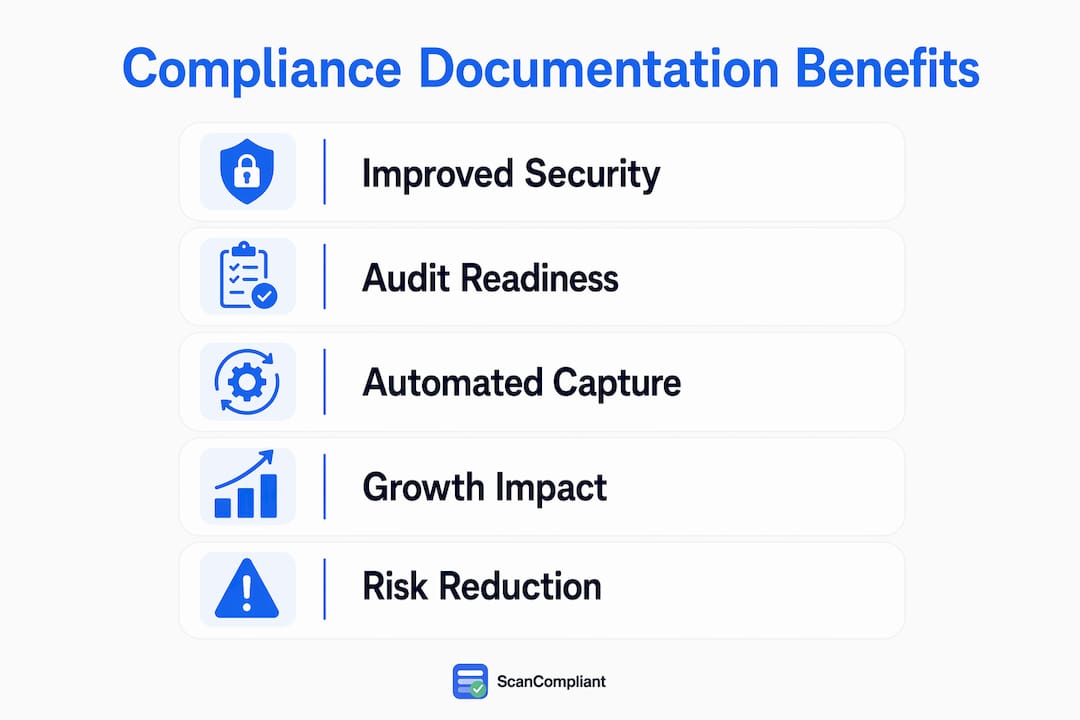
Data security and audit readiness improve substantially with integrated systems. Automated evidence capture from operational systems reduces manual errors and produces timely, audit-ready documentation. Healthcare organizations that achieve this level of integration also benefit from stronger board confidence, because leadership can see a clear, real-time picture of the organization’s compliance posture.
Organizations that build strong data privacy and compliance practices are more likely to achieve over 10% annual growth in top and bottom line results. That figure reflects a broader truth: compliance infrastructure is not a cost center. It is a growth enabler.
What challenges do healthcare compliance teams face without effective documentation systems?
Fragmented documentation is the most common and costly failure mode in healthcare compliance. When teams rely on generic tools like shared drives, they create a structural problem. General-purpose tools like SharePoint fail to link evidence automatically to regulatory obligations, which means every audit becomes a manual evidence hunt. That hunt consumes hours, introduces version control errors, and often surfaces gaps at the worst possible time.
The following challenges appear consistently in healthcare organizations without purpose-built compliance systems:
- Manual evidence collection: Staff spend significant time locating, formatting, and submitting documents during audits instead of managing ongoing compliance.
- Version control failures: Multiple versions of the same policy circulate without a clear record of which is current, creating confusion and audit risk.
- Obligation gaps: Without obligation mapping, teams cannot confirm that every regulatory requirement has a corresponding control and evidence record.
- Enforcement escalation: Regulators assess the quality of compliance systems when determining penalties. Weak documentation signals weak oversight.
- Board-level blind spots: Leadership cannot make informed decisions about compliance risk when documentation is scattered across unconnected tools.
Treating compliance documentation as a paper exercise leads to consumer harm and legal consequences. Active oversight and integration are not optional features. They are the difference between a compliance program that protects the organization and one that creates liability.
Pro Tip: Conduct a quarterly “evidence drill” by selecting three random regulatory obligations and timing how long it takes your team to produce the supporting evidence. If the answer is more than 15 minutes per obligation, your documentation system needs structural work.
How to implement compliance documentation systems in healthcare settings?
Implementation starts with a clear inventory of regulatory obligations. Before selecting a platform or redesigning a process, compliance officers need a complete map of every applicable standard, from HIPAA privacy rules to FDA marketing regulations to state-level licensing requirements. This obligation inventory becomes the foundation that every other component builds on.
The best compliance teams use integrated regulatory intelligence, obligation mapping, evidence management, and workflow tools rather than isolated file storage. That integration is the goal of implementation, not just the adoption of new software.
Key steps for a successful implementation include:
- Centralize evidence capture: Connect the documentation system to operational systems such as training platforms, approval workflows, and risk registers so evidence flows in automatically.
- Assign document ownership: Every policy, procedure, and evidence record needs a named owner responsible for accuracy and timely renewal.
- Establish version control: Use a system that timestamps every edit and maintains a full revision history, so auditors can see the document’s lifecycle.
- Automate review cycles: Set automated reminders for document expiry and regulatory update reviews. Manual calendar reminders fail under workload pressure.
- Link obligations to evidence: Build the traceability layer from day one. Every obligation in the regulatory database should point directly to the controls and evidence that satisfy it.
The table below outlines the four phases of a practical implementation timeline for healthcare compliance teams.
| Phase | Focus | Key output |
|---|---|---|
| 1. Inventory | Map all regulatory obligations | Obligation register |
| 2. Structure | Assign ownership and version control | Document governance policy |
| 3. Integration | Connect to operational systems | Automated evidence feeds |
| 4. Monitoring | Activate regulatory change alerts | Real-time compliance dashboard |
Compliance workflow automation is the single biggest efficiency gain available to healthcare teams in 2026. Automation removes the manual steps that create errors and delays, and it produces a timestamped audit trail as a natural byproduct of normal operations.
What emerging trends are shaping compliance documentation in healthcare?
The most significant shift in compliance documentation is the move from reactive recordkeeping to proactive risk management. Purpose-built platforms now use AI to monitor regulatory changes in real time, flagging updates that affect existing obligations before they create gaps. That capability transforms documentation from a historical record into a live compliance signal.
Operational integration and automation create a compliance infrastructure that responds dynamically to regulatory change and audit demands. Healthcare organizations that build this infrastructure gain a measurable advantage in both audit outcomes and enforcement negotiations.
Several trends are accelerating this shift:
- AI-powered regulatory monitoring: Platforms scan regulatory feeds and automatically flag changes that affect mapped obligations, reducing the lag between rule changes and internal updates.
- Centralized GRC platforms: Governance, risk, and compliance tools are replacing siloed document management systems, giving compliance officers a single view of risk across the organization.
- Real-time evidence capture: Integration with electronic health record systems, training platforms, and approval tools means evidence is captured at the point of activity, not assembled after the fact.
- Proactive risk prediction: Advanced platforms analyze documentation patterns to identify obligations at risk of lapsing before they actually do.
Enforcement agencies also assess tone at the top and compliance culture alongside documentation during investigations. Technology can build the infrastructure, but leadership behavior determines whether that infrastructure is taken seriously. The role of technology in compliance teams is to support that culture, not replace it.
Key Takeaways
Compliance documentation systems are the structural foundation of every effective healthcare compliance program, connecting regulatory obligations to auditable evidence through traceability, automation, and integrated oversight.
| Point | Details |
|---|---|
| Traceability is non-negotiable | Every obligation must link directly to the controls and evidence that satisfy it. |
| Generic tools create audit risk | Shared drives and file storage cannot replace purpose-built platforms with obligation mapping. |
| Automation reduces manual error | Connecting documentation systems to operational tools produces accurate, timely evidence automatically. |
| Culture amplifies documentation | Enforcement agencies assess management oversight alongside records, so tone at the top matters. |
| Implementation follows four phases | Inventory, structure, integration, and monitoring build a defensible compliance infrastructure. |
Why compliance documentation deserves more than a filing cabinet
Most compliance officers I work with inherited a documentation system that was never designed to be one. It is a collection of folders, email threads, and spreadsheet trackers that grew organically over years of regulatory pressure. The result is a system that looks like compliance but cannot survive a serious audit.
The insight that changed how I think about this is simple: documentation is not evidence of compliance unless it is connected to the obligation it satisfies. A policy manual sitting in a shared drive proves nothing. A policy manual linked to a specific HIPAA requirement, with a timestamped record of staff training and a named owner who reviewed it last quarter, proves everything.
The organizations that get this right treat their documentation system as a business asset, not an administrative burden. They invest in SOP compliance frameworks that create structure from day one. They automate the evidence capture that used to consume days of staff time. And when regulators arrive, they can produce a complete, traceable compliance record in hours, not weeks.
The uncomfortable truth is that most healthcare organizations are one serious audit away from discovering how fragile their documentation actually is. The time to fix that is before the investigation, not during it.
— Compliant Team
Scancompliant for healthcare compliance documentation
Healthcare compliance teams face a specific documentation challenge that general platforms were not built to solve: marketing content that makes implicit health claims without triggering an internal review.
Scancompliant addresses this directly. The platform scans marketing content with AI, identifying risky language against a database of over 1,000 risk terms before content is published. It has already protected more than 200 brands, producing a documented compliance trail that supports both FDA and FTC audit readiness. For telehealth and direct-to-consumer health brands, that trail is the difference between a defensible content review process and a liability. Explore Scancompliant’s platform to see how it fits into your compliance documentation workflow.
FAQ
What is the role of compliance documentation systems in healthcare?
Compliance documentation systems create a traceable, auditable record that connects regulatory obligations to the evidence that satisfies them. They reduce enforcement exposure, support audit readiness, and give leadership a clear view of organizational compliance posture.
What are the main types of compliance documentation systems?
The main types range from basic document management tools, such as shared drives and file storage, to purpose-built compliance platforms with obligation mapping, automated evidence capture, and real-time regulatory monitoring.
How do compliance documentation systems reduce regulatory risk?
Effective systems influence enforcement outcomes by demonstrating active oversight and a structured compliance program. Regulators assess documentation quality when determining penalty severity and whether independent monitors are required.
What is a traceability layer in compliance documentation?
A traceability layer links each regulatory obligation to the specific internal controls and evidence records that satisfy it. It is the core feature that transforms a document library into an audit-ready compliance system.
How do healthcare teams implement compliance documentation systems?
Implementation follows four phases: inventorying all regulatory obligations, establishing document ownership and version control, integrating with operational systems for automated evidence capture, and activating monitoring for regulatory changes.
Recommended
- Compliance Workflow Automation Use Cases for Healthcare Teams – scancompliant.com
- The Role of Technology in Compliance Teams: 2026 Guide – scancompliant.com
- SOP Compliance for Healthcare Teams: 2026 Guide – scancompliant.com
- Compliance Risk Reporting for Healthcare Teams: 2026 Guide – scancompliant.com