
A content review workflow is defined as the structured sequence of stages, roles, and approval steps that govern how marketing content moves from draft to publication. For healthcare marketing and regulatory teams, content review workflow best practices are not optional process improvements. They are the operational backbone that keeps brands compliant with FDA and FTC regulations while maintaining publishing velocity. A poorly designed workflow produces missed claims, regulatory exposure, and costly rework. A well-designed one catches problems early, documents every decision, and gives teams a defensible audit trail.
1. What are the core stages of an effective content review workflow?
Every high-performing content review workflow follows the same five stages: editorial review, SEO review, legal and compliance review, brand review, and final sign-off. Each stage has a distinct purpose and a distinct owner. Collapsing stages or assigning them to the same person creates confusion and slows the entire process.
The most important structural decision is which reviews run in parallel and which run sequentially. Parallel independent reviews are the standard for effectiveness: editorial and SEO reviews run simultaneously, and legal and brand reviews run simultaneously if legal approval does not depend on brand sign-off first. Final sign-off remains sequential because it requires consolidated feedback from all prior stages. Running reviews in parallel cuts total cycle time without sacrificing thoroughness.

Role definition is equally critical. The workflow must separate reviewers from approvers. Reviewers provide feedback. Approvers make final decisions and carry accountability for risk. Limiting approvers to those with genuine strategic or regulatory authority speeds the workflow and reduces the chance of conflicting directives. A smaller, focused approval group consistently outperforms a large, loosely defined one.
Key roles in a healthcare content workflow include:
- Editorial reviewer: Checks accuracy, readability, and style compliance
- SEO reviewer: Verifies keyword density, metadata, and link integrity
- Legal/compliance reviewer: Flags FDA and FTC risk terms and regulatory claims
- Brand reviewer: Confirms tone, messaging, and visual standards
- Final approver: Signs off only after all prior stages are complete
2. How standardized checklists improve compliance and reduce rework
A pre-publish checklist is the single most reliable tool for maintaining content quality at scale. Segmenting checklists by content type yields both efficiency and compliance. A healthcare blog post requires different checks than a regulatory submission or a paid social ad. Using one generic checklist for all content types creates gaps and redundant review cycles.
A strong pre-publish checklist for healthcare marketing content covers:
- Fact verification: Every clinical or statistical claim is sourced and current
- Link validation: All outbound links resolve and point to credible sources
- Keyword density: Maintained at 1–2% to meet SEO standards without over-optimization
- Readability standard: Written at an 8th-grade reading level per editorial guidelines
- Regulatory language audit: No unapproved disease claims, no misleading efficacy language
- Brand voice alignment: Tone and terminology match approved brand standards
- Audit trail entry: Review completion is logged with reviewer name, date, and decision
Checklists also need to evolve. A monthly retrospective reviewing missed errors and workflow slips, then updating checklists accordingly, is an advanced practice that prevents the same mistakes from recurring. Teams that skip retrospectives find their checklists becoming outdated within a quarter. The checklist is a living document, not a one-time setup.
Pro Tip: Build a separate checklist column for healthcare-specific regulatory items. Mixing FDA and FTC compliance checks into a general editorial checklist causes reviewers to skim past them. Isolation forces attention.
Version control and documented approvals belong in every checklist workflow. Verbal agreements and email threads do not constitute an audit trail under FDA or FTC scrutiny. Every approval must be logged in a designated system with a timestamp and the approver’s identity.
3. SLA benchmarks that prevent bottlenecks in content approval
Service level agreements, or SLAs, are the time boundaries that keep a content approval process moving. Without them, reviews drift indefinitely and publishing schedules collapse. High-performing review stages follow these turnaround benchmarks:
- Editorial review: 24–48 hours from submission
- SEO review: 24 hours from submission
- Legal and compliance review: 48–72 hours from submission
- Brand review: 24–48 hours from submission
- Final sign-off: 24 hours after all prior reviews are complete
These benchmarks serve as diagnostics, not just targets. When a stage consistently misses its SLA, that is the signal of a structural problem: too many approvers, unclear scope, or a reviewer without enough authority to act.
Non-response is the most common stall in final approval. Treating non-response as a rejection and triggering escalation to a backup approver after SLA expiration is the correct protocol. Waiting indefinitely for a silent approver is not a workflow. It is a gap.
Pro Tip: Assign a named backup approver for every final sign-off role before the workflow launches. Do not wait for a missed deadline to identify one. The backup should have the same authority as the primary approver.
Tracking review turnaround times alongside engagement metrics connects workflow performance to marketing outcomes. A team that publishes faster and tracks what performs better can continuously refine both the content and the process that produces it.
4. Why role clarity is the foundation of a fast content approval process
Confusing “reviewer” with “approver” is one of the most common and costly mistakes in content workflow design. A reviewer’s job is to provide feedback within their area of expertise. An approver’s job is to make a binding decision and accept accountability for it. When these roles blur, everyone feels empowered to block content and no one feels responsible for moving it forward.
Rigorous role definition and limiting approvers to those with strategic authority is the fix. In healthcare marketing, that typically means the compliance officer holds final authority over regulatory language, and the marketing director holds final authority over brand and messaging. No one else needs final approval power.
A clear creative brief prevents the most upstream source of review confusion. When writers receive vague or incomplete briefs, reviewers spend their time correcting strategic misalignment rather than checking compliance. The brief is the contract between the content creator and the review team. Getting it right before drafting starts saves multiple review cycles.
5. How to integrate compliance experts early in the review process
Late-stage compliance gating is the most expensive mistake in healthcare content workflows. When a compliance officer reviews a finished draft for the first time and finds fundamental regulatory problems, the entire piece may need to be rewritten. That rework costs time, budget, and team morale.
Early involvement of subject matter experts and compliance officers during the drafting phase prevents embedded mistakes before they compound. The compliance officer does not need to write the content. They need to flag risk terms, unapproved claims, and structural issues while the draft is still fluid and easy to change.
Practical ways to integrate compliance early include:
- Brief-stage review: Compliance officer approves the content angle and key claims before writing begins
- Draft-stage check: A light-touch regulatory scan at the 50% draft mark catches directional problems early
- Pre-submission review: A full compliance check before the piece enters the formal review queue
- Scancompliant scan: An AI-powered scan against more than 1,000 risk terms before human reviewers see the draft
This front-loaded approach aligns with FDA and FTC standards by making proactive compliance checks part of the creation process, not a gate at the end. Teams that adopt this model report fewer revision cycles and stronger regulatory defensibility when their content is scrutinized.
The compliance sign-off process also becomes cleaner when compliance has been involved from the start. Formal sign-off becomes a confirmation, not a discovery session.
Key takeaways
Effective healthcare content review workflows require defined stages, parallel reviews, SLA benchmarks, and early compliance integration to maintain quality and regulatory defensibility.
| Point | Details |
|---|---|
| Separate reviewers from approvers | Limit final approvers to those with strategic or regulatory authority to prevent stalls. |
| Run parallel reviews | Editorial and SEO reviews run simultaneously; final sign-off stays sequential. |
| Use segmented checklists | Build separate checklists per content type to catch regulatory and editorial gaps. |
| Set and enforce SLAs | Legal and compliance reviews should complete within 48–72 hours; treat non-response as rejection. |
| Involve compliance early | Integrate compliance officers at the brief and draft stages to eliminate costly late-stage rework. |
What I’ve learned about healthcare content review workflows
The most persistent myth I encounter is that longer review cycles produce better content. They do not. They produce exhausted reviewers, missed deadlines, and content that has been edited so many times it no longer sounds like anything. The teams with the fastest, cleanest workflows are the ones with the tightest role definitions, not the most reviewers.
The second thing I have seen consistently is that the creative brief is treated as a formality. Teams spend hours debating a finished draft when the real problem is a vague brief that gave the writer no clear direction on regulatory boundaries. A well-written brief with approved claims, prohibited language, and audience context cuts review time more than any tool or process change.
Retrospectives are underused in healthcare marketing teams. A monthly review of what slipped through, what caused delays, and what checklist items need updating is the practice that separates teams that improve from teams that repeat the same mistakes every quarter. It takes 45 minutes. It saves days.
The audit trail question comes up every time a brand faces regulatory scrutiny. Email threads and Slack messages are not audit trails. They are noise. Every approval needs a timestamp, a named approver, and a system of record. That discipline protects the brand and protects the individuals who signed off.
— Compliant Team
Scancompliant: built for healthcare content compliance
Healthcare marketing teams face a specific problem. Human reviewers catch most issues, but not all of them. Subtle risk terms, implied efficacy claims, and FTC-triggering language slip through even experienced eyes.
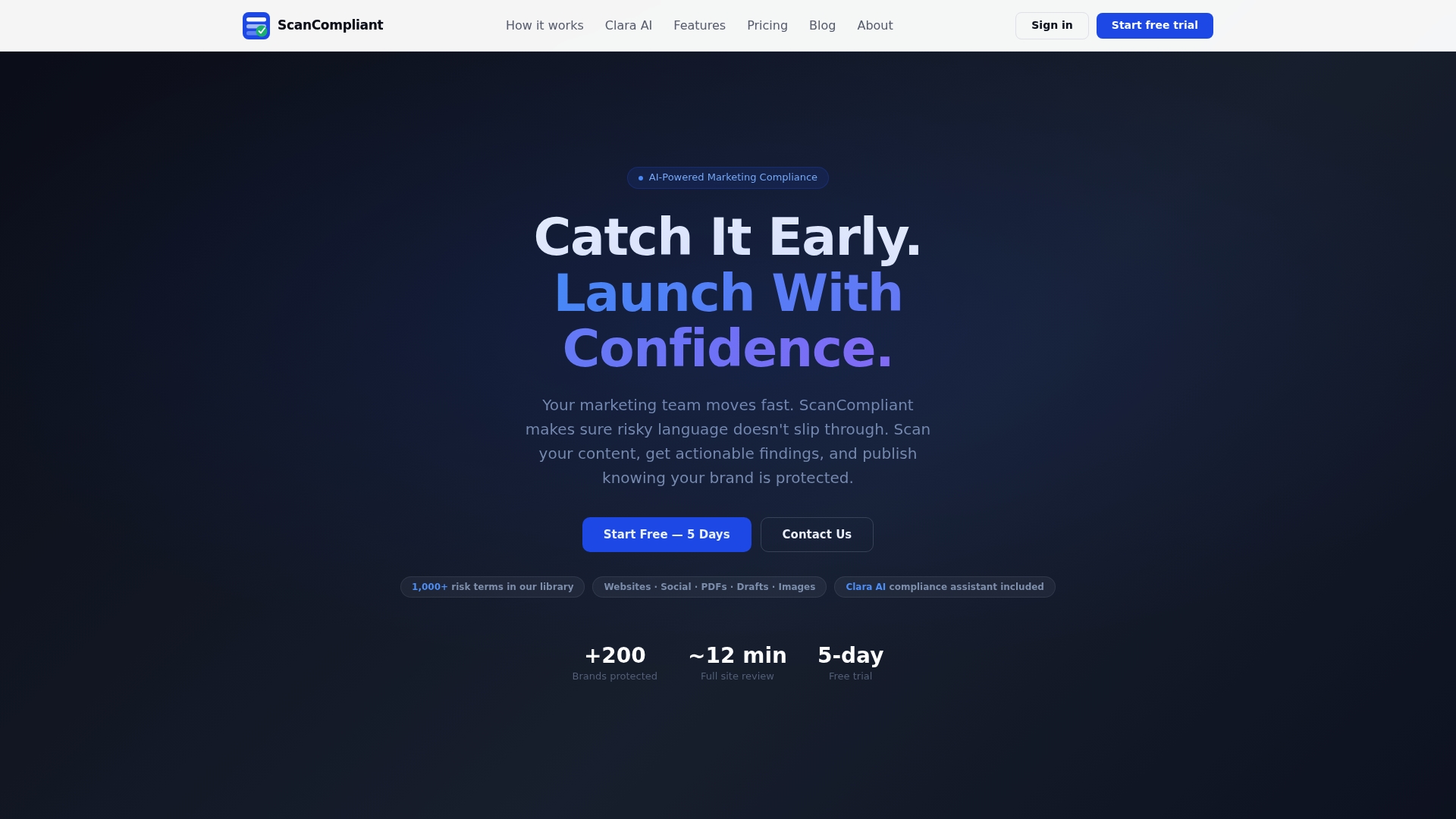
Scancompliant scans content against a database of more than 1,000 risk terms and delivers prioritized findings in minutes. It has already protected more than 200 brands by catching what human review misses. The platform creates a documented compliance trail for every scan, giving regulatory teams the audit-ready records they need. For healthcare marketing teams that need marketing compliance made simple, Scancompliant fits directly into the review workflow before content reaches human approvers. Explore compliance workflow automation to see how it works for healthcare teams.
FAQ
What is a content review workflow in healthcare marketing?
A content review workflow is the defined sequence of stages, roles, and approvals that moves marketing content from draft to publication while meeting FDA and FTC standards. It includes editorial, SEO, legal, brand, and final sign-off stages.
How long should each content review stage take?
Editorial review should complete within 24–48 hours, SEO review within 24 hours, legal and compliance review within 48–72 hours, and final sign-off within 24 hours after all prior reviews are done.
What is the difference between a reviewer and an approver?
A reviewer provides feedback within their area of expertise. An approver makes a binding decision and carries accountability for risk. Limiting approvers to those with strategic or regulatory authority prevents bottlenecks.
Why should compliance be involved early in the content process?
Early compliance involvement during drafting prevents embedded regulatory mistakes that require full rewrites later. It reduces rework costs and strengthens a brand’s defensibility under FDA and FTC scrutiny.
How do you prevent stalled approvals in a content workflow?
Treat non-response from a final approver as a rejection and escalate to a named backup approver after the SLA window expires. Assign backup approvers before the workflow launches, not after a deadline is missed.
Recommended
- How Content Compliance Audits Work for Healthcare Teams – scancompliant.com
- Compliance Review Turnaround Time Benchmarks: 2026 Guide – scancompliant.com
- Regulatory Review Checklist for Healthcare Marketing – scancompliant.com
- Compliance Workflow Automation Use Cases for Healthcare Teams – scancompliant.com