
A regulatory review checklist for marketing content is a structured framework that verifies every healthcare marketing asset meets FDA, FTC, HIPAA, and brand compliance standards before publication. In healthcare, this process is formally called the Medical-Legal-Regulatory (MLR) review. The stakes are high: a single unsubstantiated claim can trigger an FDA warning letter, a consent decree, or a public trust crisis. This article breaks down the essential components of an effective marketing compliance checklist, the governance structures that prevent delays, and the digital tools that make audit-ready reviews achievable at scale.
1. what goes into a regulatory review checklist for marketing content
A complete MLR checklist covers four core compliance areas: data privacy, advertising claims, disclaimers, and brand governance. Each area requires specific verification steps before any content goes live.
Core checklist areas every healthcare marketer needs:
- Data privacy: Confirm opt-out requests are processed within 10 business days to comply with TCPA and related communication laws.
- Advertising claims: Verify every efficacy or safety claim is supported by primary source evidence, not just a linked article.
- Disclaimers: Confirm required FDA or FTC disclosures appear in the correct format, placement, and font size for each channel.
- Brand governance: Check that all content aligns with approved messaging, tone, and visual identity standards.
Beyond these four pillars, a well-built checklist includes supplementary modules that activate based on content type. A social media post triggers platform-specific policy checks. A video asset triggers audio disclosure verification. A clinical claim triggers evidence mapping against peer-reviewed sources.
The most objective checklists use weighted scoring criteria: 30% brand voice, 25% readability, 25% accuracy, and 20% SEO. That weighting forces reviewers to prioritize clinical accuracy and brand consistency over search optimization, which is the right call for regulated health content.

Submission completeness is the final layer. Every piece of content submitted for review should arrive with a claims brief that lists the primary claim, evidence sources, intended audience, distribution channels, and required disclaimers. Missing any one of these elements is the fastest way to trigger a rejection and restart the clock.
Pro Tip: Build your checklist in a tiered format. Tier 1 covers universal requirements like HIPAA and FTC disclosures. Tier 2 activates sector-specific rules for pharma, telehealth, or supplements. Tier 3 covers platform policies for digital channels like Meta, Google, or connected TV.
2. how pre-approved content libraries cut review volume
Pre-approved content libraries are collections of vetted claims, boilerplate disclaimers, and approved messaging blocks that marketing teams can reuse without triggering a full MLR review. They are the single most effective way to reduce compliance bottlenecks in high-volume content environments.
Pre-approved libraries reduce redundant MLR review volume by 50–70%. That reduction means your compliance team spends less time re-reviewing identical claims and more time on genuinely new content that carries real risk.
Best practices for managing a content library:
- Tag every approved asset with an expiration date tied to the underlying evidence or regulatory guidance.
- Assign a library owner, typically a regulatory affairs lead, who approves additions and removes outdated content.
- Integrate the library directly into your content management system so writers can pull approved language without leaving their workflow.
- Conduct a full library audit every six months or whenever FDA or FTC guidance changes.
The governance framework behind the library matters as much as the library itself. A library without a clear update protocol becomes a liability. Writers start pulling outdated claims because they assume “approved” means “always approved.” That assumption is wrong and dangerous in healthcare marketing.
Pro Tip: Create a “fast lane” review path for content that uses only pre-approved library elements. If a piece contains nothing new, it should require only a single sign-off rather than a full MLR panel review.
3. governance and workflow strategies that prevent review delays
Clear governance is the difference between a review process that runs in days and one that stalls for weeks. Process negotiation, not reviewer speed, is the primary cause of MLR delays. When stakeholders disagree about who has final approval authority, content sits in limbo while teams negotiate.
A RACI matrix (Responsible, Accountable, Consulted, Informed) solves this directly. A RACI matrix defines who owns each review step, who has veto authority, and who receives notification only. Without it, a marketing director and a regulatory affairs manager can both believe they hold final approval, and neither will move until the other does.
Documentation and audit trails
A compliance trail documenting who approved what and when is not optional in healthcare marketing. It is your primary defense in a regulatory audit. Every approval, revision request, and sign-off should be timestamped and stored in a system that cannot be edited retroactively.
Audit logs also serve an internal function. When a claim is challenged six months after publication, you need to trace exactly which evidence supported it and who verified that evidence at the time of approval.
Submission completeness requirements
Incomplete submissions missing evidence or disclaimers are the leading cause of review delays and automatic rejections. A single missing source reference can send a piece back through the entire review cycle, adding weeks to your timeline.
Require a standardized claims brief for every submission. The brief should include the primary claim, supporting evidence with primary source citations, required disclaimers, target audience, and distribution channels. This single document eliminates most back-and-forth between marketing and regulatory teams.
“Fact-checking for healthcare marketing must include primary source verification, not just link validation, to maintain compliance and credibility.” — AI Content Review Checklist
4. how to integrate AI tools into your compliance review process
AI-assisted compliance platforms have changed what is possible in marketing content review. AI platforms detect missing disclosures, verify claims, and produce audit logs that accelerate review cycles without sacrificing accuracy. That combination addresses the two biggest complaints from compliance teams: reviews take too long, and human reviewers miss subtle risks.
What AI compliance tools do in practice:
- Scan content for risk terms before submission, flagging language that could trigger FDA or FTC scrutiny.
- Identify missing disclosures automatically, including channel-specific requirements for digital and broadcast.
- Check brand consistency across all assets in a single pass, catching tone and messaging deviations that human reviewers often overlook.
- Generate timestamped approval records that feed directly into your audit trail.
Training your team on these platforms is not optional. A tool is only as effective as the people using it. Compliance teams that understand how to interpret AI-generated risk flags, and how to override them with documented justification, get the most value from the technology.
The common FDA warning letter triggers in supplement and DTC health marketing are exactly the kind of subtle, pattern-based risks that AI tools catch most reliably. Human reviewers miss them because they read for meaning. AI tools scan for pattern matches across thousands of risk terms simultaneously.
Pro Tip: Run AI compliance scans at the draft stage, not just before final submission. Catching a risky claim early costs minutes to fix. Catching it after legal review costs days.
5. building a digital marketing audit into your review cycle
A digital marketing audit is a structured review of all active marketing assets to confirm ongoing compliance, not just pre-publication compliance. Healthcare brands that treat compliance as a one-time gate before launch consistently find themselves exposed when regulations change or evidence standards shift.
The audit should cover paid search ads, organic content, email campaigns, social media, and any influencer or partner content published under your brand. Each channel carries different regulatory requirements. A Google search ad for a prescription drug faces different disclosure rules than an Instagram post for a supplement.
Schedule audits quarterly at minimum. If your brand operates in a high-scrutiny category like telehealth, weight loss, or mental health, monthly audits are the right cadence. The compliance blog at Scancompliant covers channel-specific audit requirements in detail, including how to structure reviews for DTC health brands navigating multiple regulatory frameworks simultaneously.
Document every audit finding and the corrective action taken. That documentation becomes part of your compliance trail and demonstrates to regulators that your brand operates a proactive, not reactive, compliance program.
6. training marketing teams on content review guidelines
Content review guidelines only work if the people creating content understand them. Most compliance failures in healthcare marketing originate not from bad intent but from marketing teams that do not know which claims require evidence, which disclosures are mandatory, or which channels have platform-specific restrictions.
Training should be role-specific. A copywriter needs to know which claim categories trigger mandatory disclaimers. A social media manager needs to know platform policies for health-related advertising. A campaign manager needs to know how to complete a claims brief correctly. Generic compliance training that covers all roles at once produces surface-level awareness without the depth that prevents real errors.
Build training into your onboarding process and require annual recertification. Regulations change. FDA guidance on digital health marketing has evolved significantly, and teams trained two years ago may be operating on outdated assumptions. Pair training with access to your pre-approved content library so writers have a practical resource to use immediately.
Key takeaways
An effective regulatory review checklist for healthcare marketing content requires a tiered structure, clear governance, pre-approved content libraries, and AI-assisted scanning to achieve both compliance accuracy and review speed.
| Point | Details |
|---|---|
| Use a tiered checklist structure | Separate universal requirements from sector-specific and channel-specific modules to reduce reviewer confusion. |
| Pre-approved libraries cut review volume | Pre-vetted content libraries reduce redundant MLR reviews by 50–70%, freeing compliance teams for high-risk content. |
| Governance prevents delays | A RACI matrix eliminates approval authority conflicts, which are the primary cause of MLR process delays. |
| Submissions must be complete | Every content submission needs a claims brief with evidence, disclaimers, audience, and channels to avoid rejection cycles. |
| AI tools extend human review capacity | AI compliance platforms catch risk terms and missing disclosures that human reviewers miss, while generating audit-ready logs. |
The case for treating compliance as a workflow, not a checkpoint
By Compliant Team
The most common mistake I see healthcare marketing teams make is treating regulatory review as a final gate. Content gets created, refined, approved internally, and then handed to compliance at the last possible moment. That sequence guarantees delays, rework, and frustration on both sides.
Viewing compliance review as a continuous workflow produces faster, less error-prone releases. When compliance criteria are embedded at the brief stage, writers know which claims need evidence before they write a single word. That front-loading eliminates the most expensive rework cycles.
I have also seen teams underestimate how much governance structure matters. A well-designed checklist sitting inside a poorly governed process will still produce delays. The checklist tells you what to check. The RACI matrix tells you who checks it and who decides. You need both.
Pre-approved content libraries are the most underused tool in healthcare marketing compliance. Teams that build and maintain them properly can move approved content to publication in hours rather than days. The upfront investment in building the library pays back quickly in reduced review cycles and lower compliance risk.
The final point I will make is about audit readiness. Regulators do not just evaluate whether your current content is compliant. They evaluate whether your organization has a documented history of operating a compliant program. Timestamped approval records, claims briefs, and evidence libraries are not administrative overhead. They are your defense.
— Compliant Team
See how Scancompliant simplifies your compliance review
Healthcare marketing teams that rely on manual MLR reviews face a real tradeoff between speed and accuracy. Scancompliant resolves that tradeoff directly.
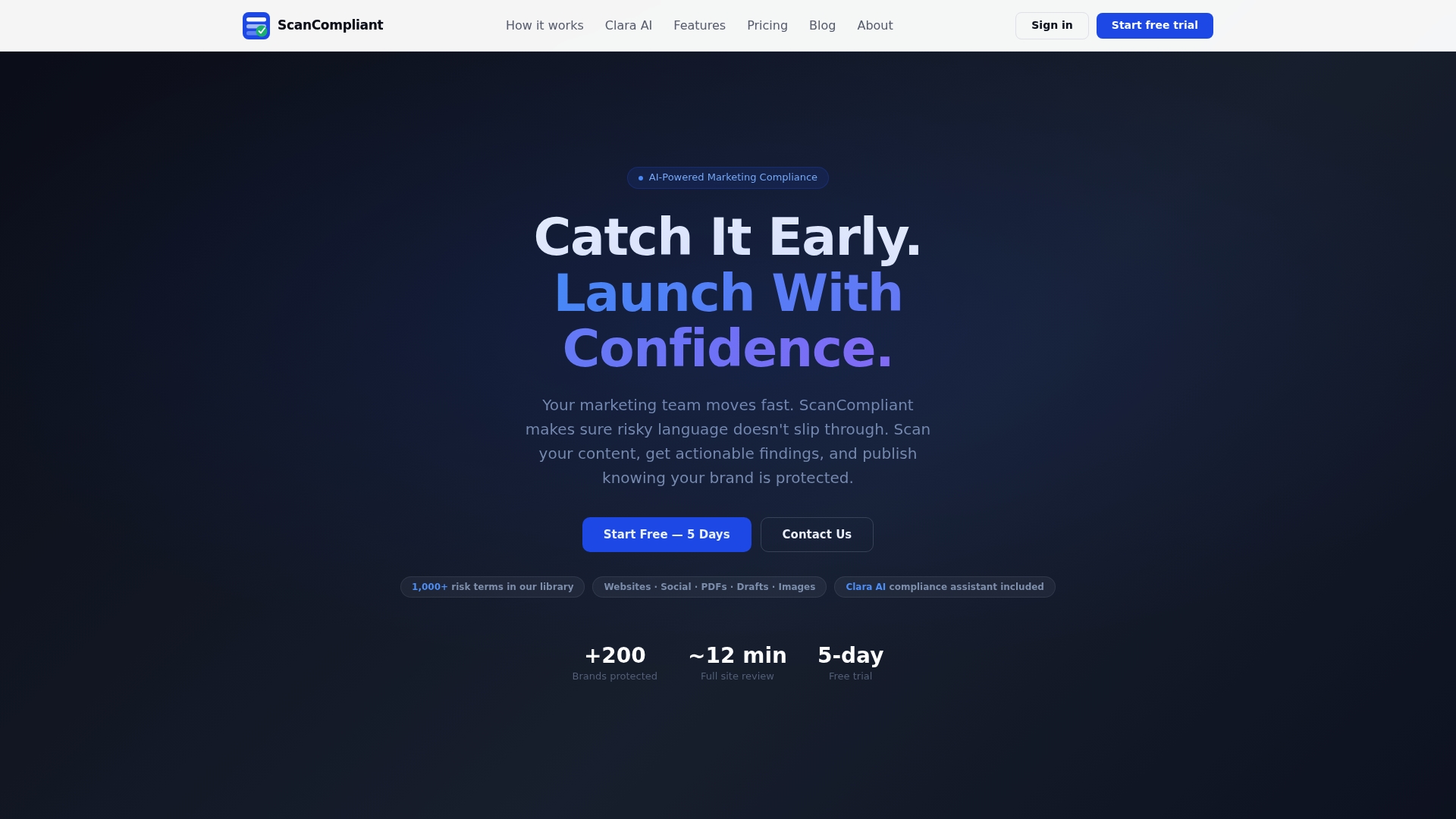
Scancompliant’s AI-powered platform scans marketing content against a database of over 1,000 risk terms, flags risky language before publication, and generates a documented compliance trail for every review. It has already protected more than 200 brands, delivering prioritized findings in minutes rather than days. For telehealth and DTC health brands navigating FDA and FTC requirements, that speed and accuracy combination is the difference between confident publishing and costly corrections. Explore Scancompliant to see how it fits your existing review workflow and approval process.
FAQ
What is a regulatory review checklist for marketing content?
A regulatory review checklist for marketing content is a structured framework that verifies healthcare marketing assets meet FDA, FTC, HIPAA, and brand standards before publication. In pharma and health marketing, this process is formally called an MLR (Medical-Legal-Regulatory) review.
What are the most common causes of MLR review delays?
Process negotiation and incomplete submissions are the two leading causes of MLR delays. Missing evidence, absent disclaimers, or unclear approval authority can add weeks to a review cycle.
How do pre-approved content libraries help compliance teams?
Pre-approved content libraries reduce redundant MLR review volume by 50–70% by allowing teams to reuse vetted claims and boilerplate language without triggering a full review panel.
What should a claims brief include for regulatory review?
A claims brief should include the primary claim, supporting evidence with primary source citations, required disclaimers, target audience, and distribution channels. This document prevents back-and-forth between marketing and regulatory teams.
How does AI improve the content approval process in healthcare marketing?
AI compliance platforms detect missing disclosures, flag risk terms, and generate timestamped audit logs automatically. They catch pattern-based risks that human reviewers miss, particularly in high-volume DTC health content environments.
4 Comments