
Compliance workflow automation is the practice of using technology to execute regulatory tasks in a repeatable, documented sequence, replacing manual handoffs with system-driven processes that produce audit-ready evidence at every step. For healthcare compliance officers operating under HIPAA, HHS OCR oversight, and GRC frameworks like NIST and ISO, automation is not optional. It is the difference between a defensible compliance program and a reactive one. The core compliance workflow structure moves from regulation identification through control implementation, monitoring, and reporting. Each stage is a candidate for automation, and the compliance workflow automation use cases below map directly to that sequence.
1. What are the core compliance workflow automation use cases?
Automation in healthcare compliance falls into five primary categories. Each one addresses a distinct stage of the compliance lifecycle.
- Automated evidence collection: Continuous syncing of logs, access records, and control proofs from connected systems
- Continuous control monitoring: Real-time testing of compliance controls with alerts on failures or deviations
- Content compliance screening: Pre-publication review and approval workflows for regulated marketing materials
- Vendor and procurement management: Trigger-based task routing for onboarding, Business Associate Agreement tracking, and risk evaluation
- Audit workflow automation: Centralized evidence organization, timestamping, and reporting for OCR and internal audits
These categories align with the compliance management steps of identification, control implementation, monitoring, reporting, and remediation. Automating compliance procedures across all five stages produces a connected program rather than a collection of isolated fixes. The result is audit-proof documentation and a measurable reduction in manual workload for your team.
2. How automated evidence collection transforms audit readiness

Automated evidence collection is the highest-impact use case for most healthcare compliance teams. It replaces the annual scramble of chasing logs and screenshots with a continuous, system-driven process.
The core mechanism works as follows:
- System integration: Connect your cloud infrastructure, HRIS, EHR, and ERP systems via APIs to a central compliance platform.
- Continuous syncing: The platform pulls logs, access control records, backup confirmations, and risk assessment outputs on a scheduled or real-time basis.
- Timestamping: Every piece of evidence receives an immutable timestamp and is tagged to the relevant control or regulatory requirement.
- Centralized storage: Evidence is organized by control family, audit period, and regulatory framework, ready for immediate retrieval.
- Corrective action documentation: When a control fails, the remediation steps and their outcomes are captured automatically alongside the original evidence.
Automated evidence collection includes logs, risk assessments, corrective actions, and control proofs gathered from integrated systems. This means proof is timestamped, organized, and available for audits instead of compiled at the last minute. Healthcare teams that treat evidence as continuous data synced in real time maintain audit readiness without the seasonal scramble that consumes weeks of staff time.
Pro Tip: Schedule automated evidence pulls at the same frequency as your highest-risk control tests. If your access control reviews run weekly, your evidence sync should run weekly too. Mismatched cadences create gaps that auditors notice.
3. What role does continuous control monitoring play in compliance automation?
Continuous control monitoring keeps your compliance program active between formal audits. Without it, you only discover control failures when an auditor does.
HIPAA compliance automation centers on continuous control monitoring with alerts on failed tests to stay audit-ready. This approach reduces the risk of non-compliance between OCR audits through proactive issue detection. The practical benefits for your team include:
- Real-time failure alerts: When a control test fails, the system routes an alert to the responsible owner immediately, not at the next quarterly review.
- Automated risk scoring: Failed controls feed into a live risk register, giving compliance officers a current view of organizational exposure.
- Remediation task routing: Alerts connect directly to task assignment workflows, so the right person receives a remediation ticket without manual intervention.
- Trend reporting: Automated dashboards show control performance over time, which is exactly what OCR auditors want to see as evidence of a mature program.
- Regulatory mapping: Controls are mapped to specific HIPAA safeguards or NIST requirements, so a failure immediately surfaces which regulation is at risk.
The distinction between monitoring and auditing matters here. Auditing is periodic. Monitoring is permanent. Healthcare organizations that automate monitoring shift from a reactive posture to a proactive one, which is the standard regulators increasingly expect.
Pro Tip: Connect your monitoring alerts directly to your remediation workflow tool. A failed control that generates an alert but requires a manual email to assign a fix is still a manual process. The alert and the task assignment must be one automated action.
4. How can healthcare content compliance be automated within regulatory workflows?
Healthcare marketing content sits at the intersection of HIPAA, FDA regulations, and FTC guidelines. Manual review at scale is slow and inconsistent. Automation addresses both problems.
Content compliance automation includes pre-publication screening, approval workflows, role-based permissions, and tamper-proof audit trails. These tools prevent compliance violations in regulated healthcare marketing while supporting speed and scale. A well-designed content compliance workflow operates as follows:
- Pre-publication screening: Content is scanned against a database of prohibited claims, risk terms, and regulatory language before it reaches a reviewer.
- Automated routing: Content that passes initial screening routes to the appropriate reviewer based on content type, channel, and risk level.
- Role-based permissions: Only designated reviewers can approve content for specific channels, and the system enforces this without manual gatekeeping.
- Approval checkpoints: Legal or compliance team members receive flagged content for manual review, while low-risk content moves through automatically.
- Audit trail creation: Every review action, approval, rejection, and edit is logged with a timestamp and user attribution, creating an immutable record.
Governance built into content workflows, combining scanning, permissions, and approvals, sustains compliance at scale. This matters because healthcare organizations publishing across websites, email, and social media cannot rely on individual reviewers to catch every violation. Automation catches what humans miss, and the audit trail proves it.
A common pitfall is relying solely on pre-publication approvals. Embedding real-time monitoring and immutable audit trails is necessary for ongoing compliance, not just pre-launch checks. Content that was compliant at publication can become non-compliant when regulations change, and only continuous monitoring catches that shift.
You can review a regulatory review checklist for healthcare marketing to see how pre-publication screening maps to specific regulatory requirements.
5. What are the key use cases for vendor and procurement compliance automation?
Vendor management is a high-risk area for healthcare organizations because every Business Associate Agreement represents a direct HIPAA obligation. Manual tracking of vendor onboarding, contract status, and risk reviews creates gaps that regulators find.
Vendor compliance automation uses trigger-based workflows for onboarding, compliance review assignment, evidence capture, and audit logging. This supports regulatory requirements like HIPAA Business Associate Agreements and enterprise procurement controls. The specific use cases include:
- Onboarding triggers: When a new vendor is added to your ERP system, the workflow automatically initiates a compliance review task, assigns it to the responsible team member, and sets a deadline.
- BAA tracking: The system monitors Business Associate Agreement expiration dates and triggers renewal workflows before agreements lapse.
- Risk evaluation routing: Vendors are scored by data access level and service type, and higher-risk vendors automatically receive more intensive review workflows.
- Evidence capture: Every review action, contract version, and approval is logged automatically, creating a vendor-specific audit trail.
- Ongoing monitoring: Post-onboarding, the system schedules periodic vendor risk reviews and routes them without manual calendar management.
Orchestrated compliance automation that connects systems via APIs and logs all workflow steps produces more audit-defensible programs. Central orchestration acts as the connective layer, enabling continuous monitoring, task routing, and immutable audit trails across your vendor portfolio.
For teams managing telehealth vendor relationships, the telehealth compliance considerations around data handling add another layer of automation priority to vendor oversight workflows.
Key takeaways
Compliance workflow automation succeeds when it connects evidence collection, control monitoring, content screening, and vendor management into one documented, audit-ready system rather than isolated task fixes.
| Point | Details |
|---|---|
| Evidence collection is continuous | Automate evidence syncing from all connected systems on the same cadence as your control tests. |
| Monitoring beats periodic auditing | Real-time control monitoring with automated alerts catches failures before OCR auditors do. |
| Content workflows need governance layers | Combine pre-publication scanning, role-based approvals, and audit trails to sustain compliance at scale. |
| Vendor automation starts with triggers | Connect ERP onboarding events to compliance review tasks automatically to eliminate BAA tracking gaps. |
| End-to-end architecture matters | Isolated task automations fail. Connect all workflow stages through a central orchestration layer. |
Why most compliance automation projects fall short
Healthcare compliance teams often invest in automation tools and still find themselves scrambling before audits. The reason is almost always architectural, not technological.
The tools exist. The problem is that most implementations automate individual tasks without connecting them. A team might automate evidence collection but still route remediation tasks by email. Or they automate content approvals but store audit logs in a separate system that requires manual export. These disconnects are where compliance programs break down.
The insight that changed how I think about this: compliance workflows succeed when designed as end-to-end documented sequences rather than disconnected task automations. That means mapping every handoff point before selecting a tool, not after.
The second failure mode is underestimating integration complexity. Many automation projects fail when integration across compliance evidence systems and workflow task routing is underestimated. Healthcare environments typically involve EHR systems, cloud infrastructure, HRIS platforms, and marketing tools, all with different APIs and data formats. A compliance officer who treats this as an IT problem will wait months for results. One who maps the data flows first and selects tools based on integration capability will move faster.
My practical advice: start with your audit evidence requirements and work backward. Identify every piece of evidence your last audit required. Then ask which systems hold that evidence and whether they have APIs. That exercise reveals your integration priorities and prevents you from buying a tool that cannot connect to your actual environment.
— Compliant Team
Scancompliant for healthcare content compliance automation
Healthcare compliance teams managing marketing content across websites, email, and social channels face a specific challenge: catching risky language before it reaches regulators or patients.
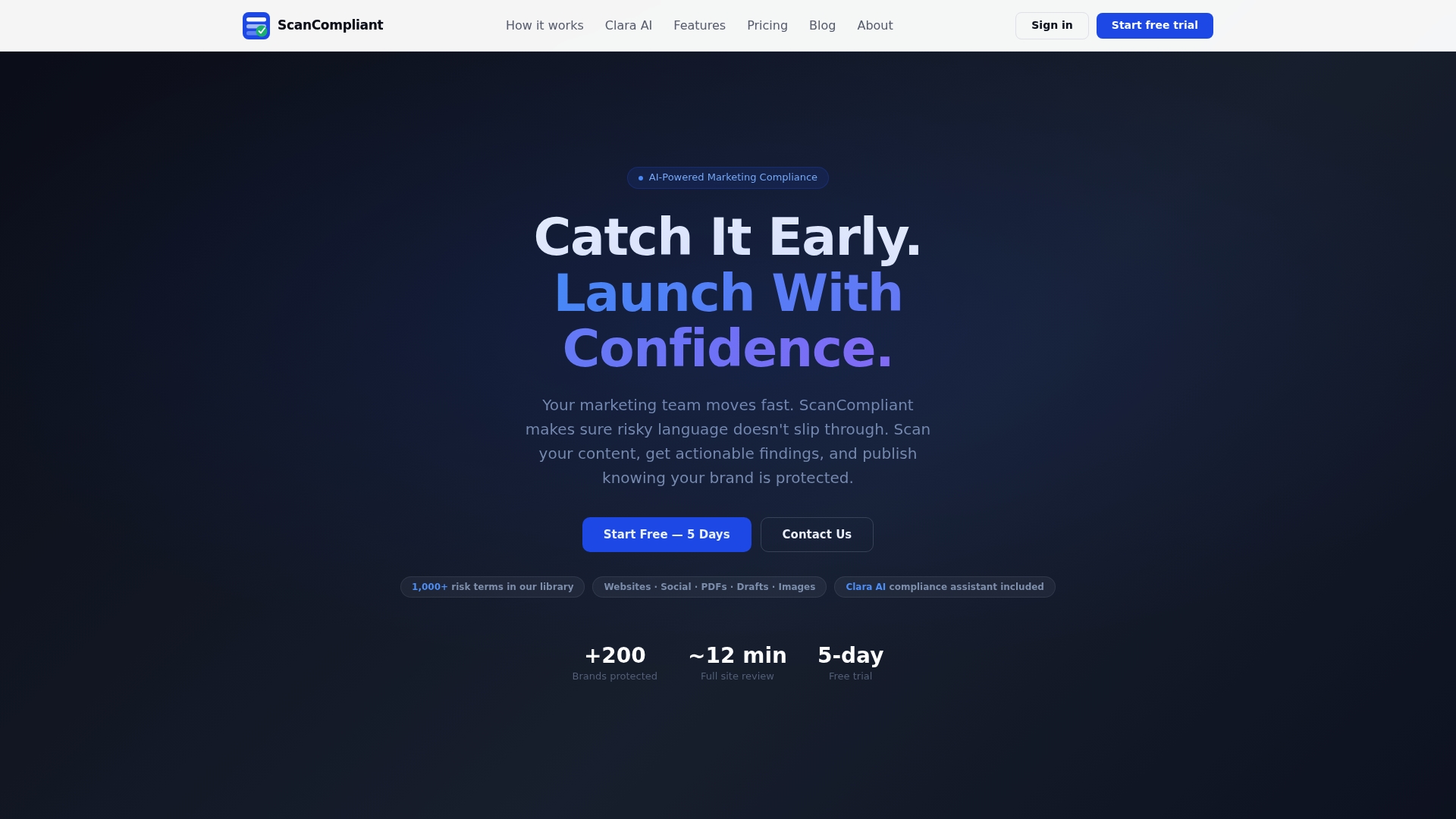
Scancompliant is built for exactly this workflow. The platform scans content against a database of over 1,000 risk terms, identifies violations in minutes, and delivers prioritized findings that your team can act on before publication. It has protected more than 200 brands by catching the subtle FDA and FTC violations that manual reviewers miss. The platform also creates a documented compliance audit trail for every review cycle, giving your team the audit-ready documentation that regulators expect. See how Scancompliant works for healthcare regulatory and marketing teams.
FAQ
What is compliance workflow automation in healthcare?
Compliance workflow automation is the use of technology to execute regulatory tasks in a repeatable, documented sequence. In healthcare, this covers evidence collection, control monitoring, content review, and vendor management under frameworks like HIPAA and NIST.
How does automated evidence collection support HIPAA audits?
Automated evidence collection continuously syncs logs, access records, and control proofs from connected systems with immutable timestamps. This eliminates last-minute manual compilation and gives OCR auditors organized, audit-ready documentation on demand.
What is the difference between continuous monitoring and periodic auditing?
Continuous monitoring tests compliance controls in real time and alerts teams to failures immediately. Periodic auditing reviews controls at set intervals. Monitoring catches issues between audits, which is the standard healthcare regulators increasingly expect.
How does content compliance automation work for healthcare marketing?
Content compliance automation scans marketing materials against regulatory risk terms before publication, routes content through role-based approval workflows, and logs every review action in a tamper-proof audit trail. This applies to websites, email campaigns, and social media under FDA and FTC guidelines.
What triggers vendor compliance workflows in healthcare organizations?
Vendor compliance workflows are typically triggered when a new vendor is added to an ERP or procurement system. The trigger initiates a compliance review task, assigns it to the responsible team member, and begins tracking Business Associate Agreement status and renewal deadlines automatically.