
Technology in compliance teams is defined as the systematic use of AI, machine learning, and integrated data platforms to automate regulatory monitoring, reduce human error, and maintain continuous adherence to healthcare regulations. The role of technology in compliance teams has shifted from a support function to the operational core of modern compliance programs. 50% of compliance firms have adopted advanced tools like machine learning and behavioral analytics. That adoption rate signals a profession in the middle of a fundamental change. At the same time, 33% of compliance teams identify data management and quality as their most acute challenge, which means technology adoption alone is not enough. The right architecture matters just as much as the tools themselves.
What are the primary technology capabilities transforming compliance teams?
The most impactful compliance technology solutions do three things well: detect risk earlier, reduce alert noise, and connect regulatory knowledge to real-time data. Each of these capabilities addresses a specific failure point in traditional, manual compliance workflows.
AI-driven risk detection is the clearest example. Machine learning models analyze transaction patterns, communication logs, and behavioral signals to flag anomalies that rule-based systems miss entirely. Behavioral analytics can identify unusual patterns across thousands of data points simultaneously, something no human reviewer can replicate at scale.

False positive alerts are one of the biggest drains on compliance team capacity. AI-augmented platforms reduce false positive alerts in investigation queues by up to 75% without fully replacing legacy rules engines. That reduction means analysts spend time on genuine risks instead of chasing noise.
Large Language Models now add another layer of capability. LLMs achieve 80–100% accuracy on legal reasoning benchmarks, which makes them genuinely useful for document review, policy interpretation, and regulatory mapping. Healthcare compliance teams can use these models to process FDA guidance documents, flag non-compliant marketing claims, and cross-reference regulatory updates automatically.
Key technology capabilities that healthcare compliance teams should prioritize:
- Automated data collection from multiple sources including EHR systems, marketing platforms, and transaction logs
- Behavioral analytics for detecting unusual patterns in prescribing, billing, or marketing activity
- Natural language processing for scanning marketing content against FDA and FTC regulatory language
- Integrated regulatory knowledge bases that update automatically when regulations change
- Audit trail generation that documents every compliance decision for regulatory defensibility
Pro Tip: Boards should prioritize AI initiatives that improve effectiveness by focusing on risk identification rather than automating low-value administrative tasks. Efficiency gains are secondary to program quality.
How do integrated compliance technology solutions improve data management?
Fragmented technology is the most common reason compliance programs fail under regulatory scrutiny. A unified framework integrating people, governance, and technology outperforms any collection of disconnected tools. Healthcare organizations that rely on legacy systems often face data silos, inconsistent record formats, and manual reconciliation processes that introduce errors at every step.
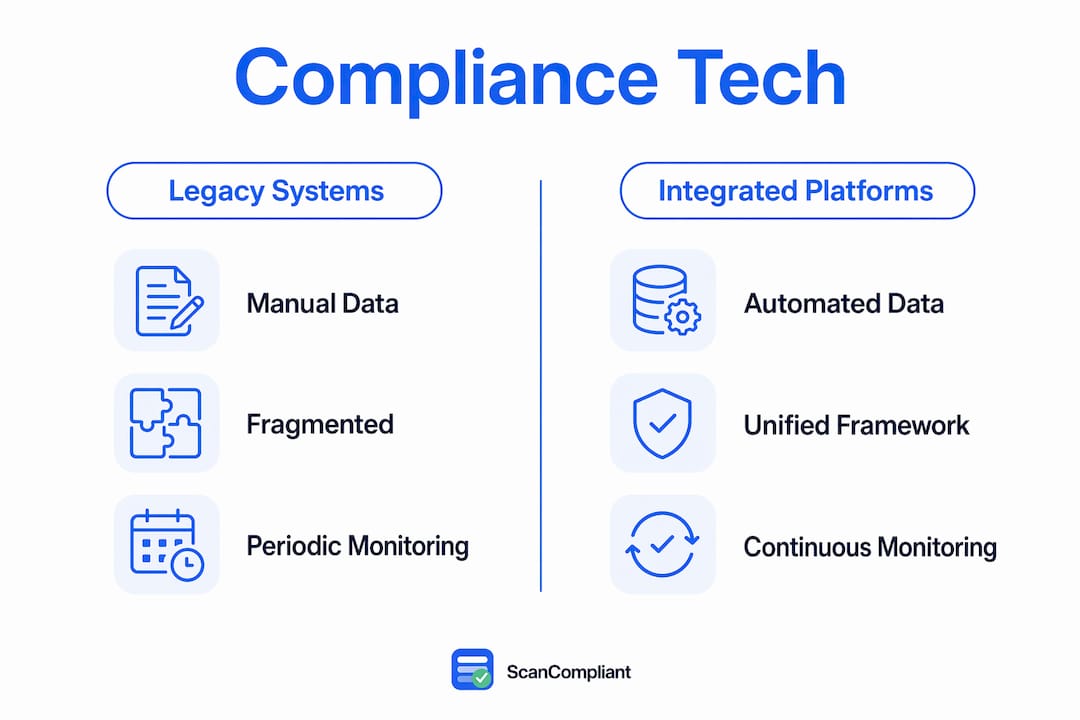
The impact of technology on compliance becomes clearest when you compare legacy approaches to integrated platforms side by side.
| Capability | Legacy systems | Integrated platforms |
|---|---|---|
| Data collection | Manual, periodic | Automated, continuous |
| Regulatory updates | Requires manual review | Auto-updated rule sets |
| Audit trail | Fragmented across systems | Centralized and searchable |
| False positive rate | High, analyst-dependent | Reduced with AI filtering |
| Risk detection speed | Days to weeks | Real-time or near real-time |
| Data governance | Inconsistent | Built-in lineage and controls |
Continuous monitoring is the feature that changes compliance from reactive to proactive. Instead of reviewing activity after a complaint or audit trigger, integrated platforms flag issues as they occur. A telehealth brand, for example, can monitor every piece of marketing content against an updated database of FDA risk terms before that content goes live.
Data lineage and governance are equally critical for healthcare compliance. Regulators expect organizations to demonstrate not just what decision was made, but why, when, and based on what data. Integrated platforms capture this automatically. The security and data governance standards built into purpose-built compliance tools provide the auditability that generic software cannot.
What is the evolving role of compliance professionals in the age of AI?
The compliance technologist is the emerging professional standard. Compliance technologists blend regulatory knowledge with technology management and represent the future of the profession. This is not a role for IT generalists. It requires deep familiarity with healthcare regulations like HIPAA, FDA marketing rules, and FTC guidelines, combined with the ability to design and govern AI workflows.
Human judgment remains irreplaceable in this model. AI identifies patterns and surfaces risk signals. A compliance professional decides what those signals mean, how to escalate them, and what regulatory response is appropriate. Compliance professionals skilled in AI interrogation consistently outperform those who use AI as a passive tool, producing higher-quality risk escalations and better regulatory decisions.
The skill sets that define effective compliance technologists today include:
- Regulatory fluency across FDA, FTC, and HIPAA frameworks relevant to healthcare marketing
- AI workflow design including prompt engineering, model evaluation, and output validation
- Data governance covering data provenance, access controls, and audit readiness
- Critical interrogation of AI outputs to catch errors before they become compliance failures
- Cross-functional communication to translate regulatory requirements into technical specifications
Generic AI models often lack the jurisdictional and auditability features that healthcare compliance requires. Domain-specific architectures built for regulated industries outperform general-purpose language models on compliance tasks. This means compliance professionals must evaluate tools critically, not just adopt whatever AI platform is most visible.
Pro Tip: When evaluating AI tools, ask vendors specifically about healthcare compliance training data and jurisdictional coverage. A model trained on general legal text performs differently than one trained on FDA enforcement actions and FTC warning letters.
Which practical steps can healthcare compliance teams take to implement technology?
Implementation fails most often at the preparation stage, not the technology stage. Healthcare compliance teams that skip organizational readiness assessments end up deploying tools that do not fit their data environment or workflow structure.
-
Assess organizational readiness. Map your current data sources, identify gaps in data quality, and document existing compliance workflows before selecting any platform. Technology cannot fix a process that is not understood.
-
Prepare your data environment. Work with data custodians across clinical, marketing, and finance teams to standardize formats and establish data governance policies. Fine-tuning AI models on proprietary compliance data creates a competitive advantage by improving institutional intelligence over time. Clean, well-governed data is the foundation for that advantage.
-
Choose incremental integration over full platform replacement. Deploy one capability at a time, such as automated content scanning for marketing materials, before expanding to transaction monitoring or behavioral analytics. This approach limits disruption and allows teams to build confidence in AI outputs before expanding reliance on them.
-
Train compliance technologists internally. Identify team members with both regulatory knowledge and comfort with technology tools. Invest in structured training on AI workflow management, output validation, and governance documentation. External training programs and certifications in compliance technology are increasingly available.
-
Build continuous monitoring and feedback loops. Successful AI deployment requires continuous model monitoring, challenger testing, and analyst feedback to maintain accuracy and regulatory defensibility. Schedule regular reviews of AI performance metrics and update models as regulations change.
A practical starting point for many healthcare teams is the regulatory review checklist approach, which maps specific regulatory requirements to specific technology controls. This creates a clear audit trail showing that every regulatory requirement has a corresponding technology check.
Key Takeaways
Technology in compliance teams works best when AI capabilities, integrated data governance, and trained compliance technologists operate together within a unified framework.
| Point | Details |
|---|---|
| AI reduces alert noise | AI-augmented platforms cut false positive alerts by up to 75%, freeing analysts for genuine risks. |
| Integration beats fragmentation | Unified platforms combining people, governance, and technology outperform disconnected legacy tools. |
| Compliance technologists are the future | Professionals who blend regulatory expertise with AI workflow skills produce better compliance outcomes. |
| Domain-specific tools matter | Generic AI models lack the jurisdictional and auditability features healthcare compliance requires. |
| Continuous monitoring is non-negotiable | Proactive, real-time risk detection replaces reactive issue management in effective compliance programs. |
The mindset shift compliance leaders cannot afford to skip
The teams I see struggle most with technology adoption are not the ones with bad tools. They are the ones that treat AI as a replacement for judgment rather than a partner to judgment. That distinction sounds simple, but it changes everything about how a compliance program is designed.
Healthcare compliance carries real consequences. An FDA warning letter, an FTC enforcement action, or a HIPAA breach does not just create legal exposure. It damages patient trust in ways that are very difficult to rebuild. When compliance teams use AI passively, accepting outputs without interrogating them, they transfer accountability to a system that cannot be held accountable. That is a governance failure, not a technology success.
The compliance professionals I have seen thrive in this environment are the ones who treat AI as a thinking partner. They ask the model to surface risk signals, then they apply regulatory judgment to decide what those signals mean. They validate outputs against their own knowledge of FDA enforcement patterns and FTC guidance. They document their reasoning, not just the AI’s output. That combination of machine speed and human judgment is where real compliance excellence lives.
The practical implication for compliance leaders is this: invest in your team’s ability to interrogate AI, not just operate it. The compliance sign-off process should reflect human accountability at every decision point, even when AI does the initial analysis. Technology raises the floor of what a compliance program can achieve. Human expertise determines the ceiling.
— Compliant Team
How Scancompliant helps healthcare teams stay ahead of regulatory risk
Healthcare marketing teams face a specific compliance challenge that general AI tools are not built to solve. Every piece of content, from a telehealth landing page to a supplement email campaign, carries FDA and FTC risk that human reviewers routinely miss under time pressure.
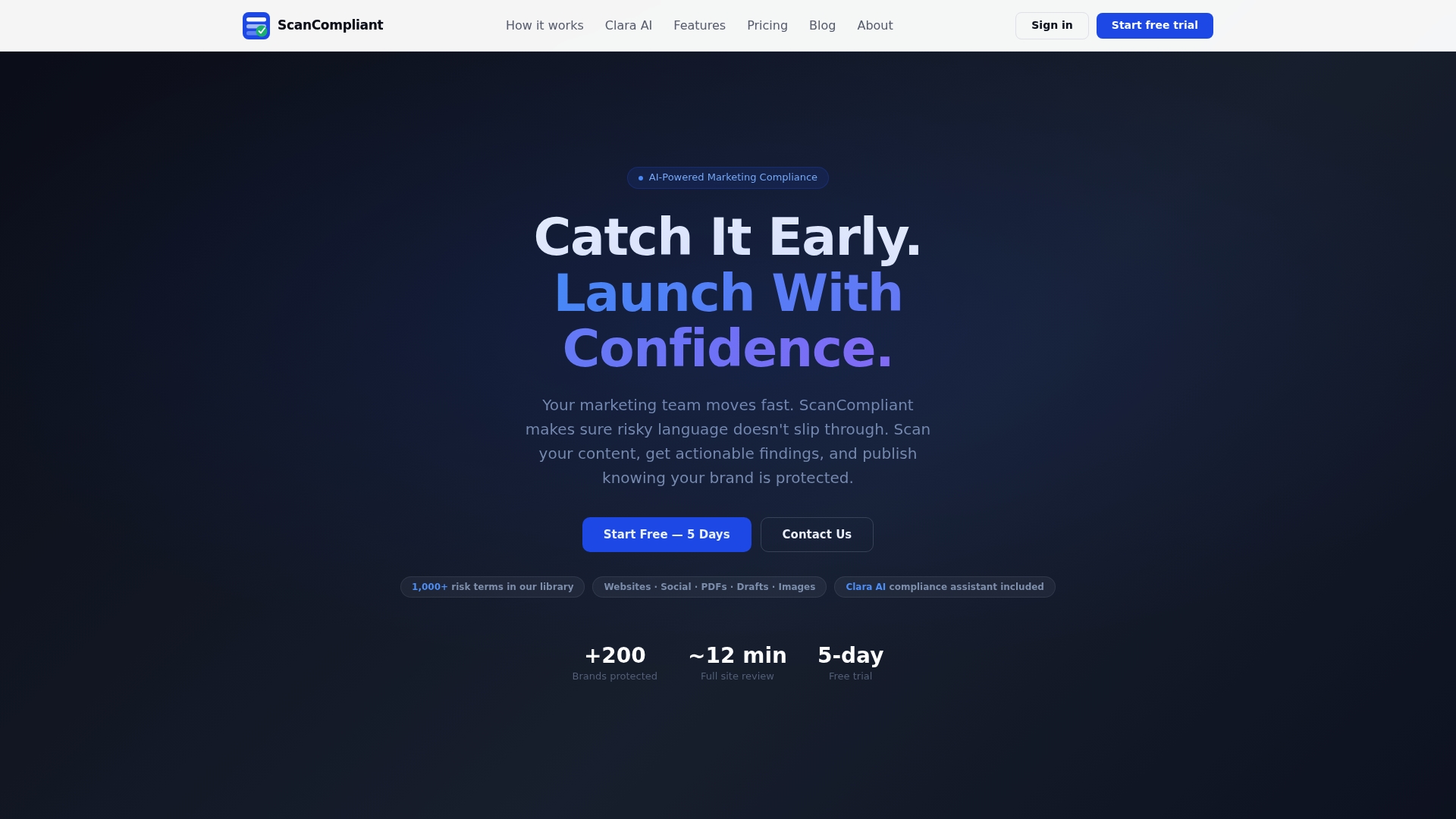
Scancompliant is built specifically for this problem. The platform scans marketing content against a database of over 1,000 risk terms, identifies non-compliant language before publication, and delivers prioritized findings in minutes. It has already protected more than 200 brands and creates a documented compliance trail for every review cycle. For regulatory and marketing teams that need to move fast without creating legal exposure, Scancompliant’s automated compliance platform provides the speed and accuracy that manual review cannot match. The platform’s data security and governance standards are built for regulated healthcare environments.
FAQ
What is the role of technology in compliance teams?
Technology in compliance teams automates regulatory monitoring, reduces false positive alerts, and enables continuous risk detection. It shifts compliance programs from reactive issue management to proactive, real-time oversight.
How does AI reduce false positives in compliance investigations?
AI-augmented platforms reduce false positive alerts by up to 75% by applying machine learning to distinguish genuine risk signals from routine activity. This frees compliance analysts to focus on cases that actually require human judgment.
What skills do compliance technologists need?
Compliance technologists need regulatory fluency across frameworks like FDA, FTC, and HIPAA, combined with the ability to design AI workflows, validate model outputs, and maintain governance documentation.
Why do healthcare compliance teams need domain-specific AI tools?
Generic AI models lack the jurisdictional specificity and auditability features that healthcare regulations require. Domain-specific tools trained on FDA enforcement actions and healthcare compliance data produce more accurate and defensible results.
How should compliance teams start implementing AI tools?
Start by assessing data quality and workflow readiness before selecting any platform. Deploy one capability at a time, train internal compliance technologists, and build feedback loops to continuously improve model accuracy.
Recommended
- Healthcare Marketing Compliance Training Teams: 2026 Guide – scancompliant.com
- Top 3 Comply.com Alternatives in Marketing Compliance 2026 – scancompliant.com
- Telehealth Email Marketing Compliance Tips for 2026 – scancompliant.com
- Compliance Sign-Off Process: A Guide for Healthcare Teams – scancompliant.com
2 Comments