
Healthcare marketing compliance training teams are the structured groups responsible for ensuring every campaign, claim, and channel your organization uses meets HIPAA, FTC, and FDA requirements. Without them, a single unreviewed social post or misconfigured pixel can trigger an Office for Civil Rights (OCR) audit, a Federal Trade Commission (FTC) warning, or worse. This guide covers the training frequencies, team structures, platform tools, and content strategies that make compliance training programs work in telehealth and direct-to-consumer (DTC) health marketing.
What do healthcare marketing compliance training teams actually require?
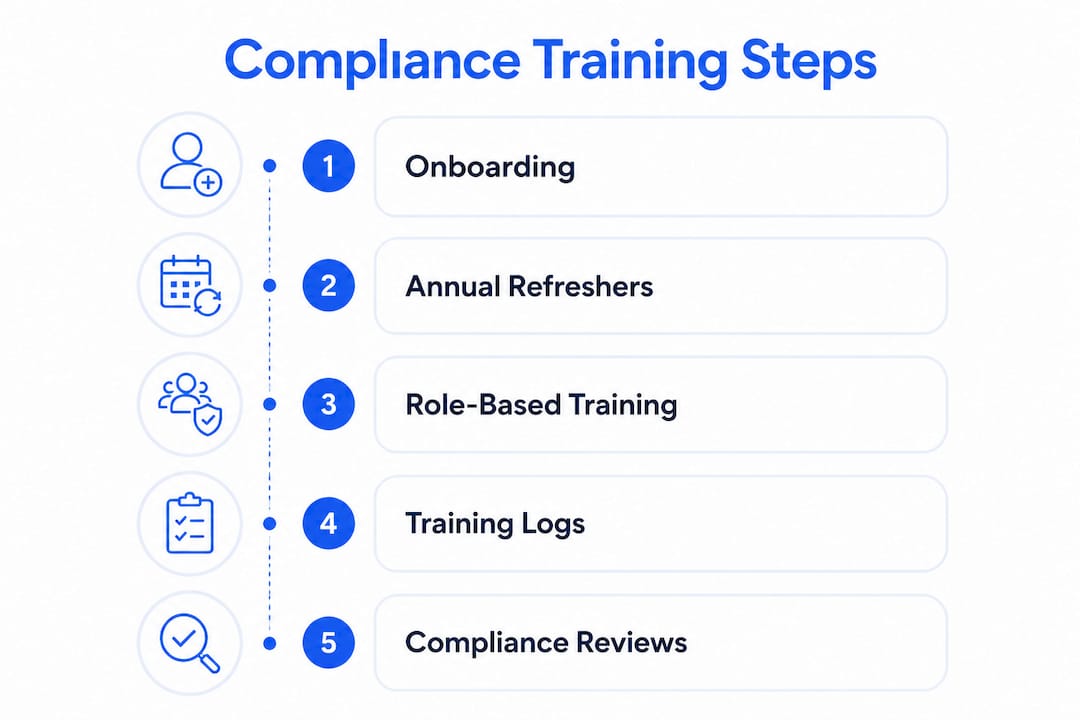
The training requirements for healthcare marketing teams go well beyond a one-time onboarding module. The standard framework combines initial training, annual refreshers, and event-triggered updates.
Initial onboarding must cover HIPAA authorization requirements, FTC truth-in-advertising rules, and FDA claim restrictions. New hires in marketing roles should complete this before publishing any content. Generic programs that treat a copywriter and a media buyer identically miss the point entirely.

Annual refreshers are the de facto compliance standard. Annual training and retraining after material policy changes form the baseline auditors expect when reviewing your training records. That expectation is not written into a single statute. It is built from OCR enforcement patterns and FTC guidance.
Quarterly training is the right cadence for telehealth marketing teams specifically. Quarterly refreshers for telehealth teams are recommended because FDA and FTC enforcement priorities in this space shift faster than in traditional healthcare marketing. A team running paid social for a telehealth platform in January may face entirely different risk exposure by April.
Comprehensive programs are more substantial than most teams expect. HIPAA and cybersecurity training programs typically consist of 34 modules totaling 6.5 hours, or shorter intensive sessions of 60 minutes. That range reflects the difference between a full organizational rollout and a targeted refresher for a specific role.
- Onboarding: HIPAA basics, FTC advertising rules, FDA claim restrictions, PHI handling
- Annual: Policy updates, breach case studies, platform-specific risks, attestation sign-off
- Quarterly (telehealth): Enforcement updates, new channel risks, AI tool use policies
- Event-triggered: Regulatory changes, new product launches, platform policy shifts
Pro Tip: Keep a training log that records the date, content covered, trainer name, and employee attestation for every session. Auditors look for exactly this documentation, and gaps are treated as evidence of non-compliance.
How should compliance teams be structured for marketing reviews?
Team structure is the variable most organizations get wrong. The right structure depends on your ad production volume and monthly ad spend, not on headcount alone.
Compliance review processes must scale with ad spend. Small teams running under $100,000 in monthly ad spend can operate effectively with a trained creative lead who holds compliance responsibilities alongside their primary role. That person needs deeper training than the rest of the team, but a dedicated hire is not yet justified.
The calculus changes at scale. Marketing teams producing more than $100,000 in monthly ad spend should have a dedicated compliance reviewer managing ad review, appeals, and team training. At that volume, the risk exposure from a single non-compliant campaign exceeds the cost of the role.
The most effective structure places the compliance reviewer inside the creative approval workflow, not at the end of it. Integrating compliance leaders into onboarding and creative approval workflows shifts the function from a final checkpoint to a strategic collaborator. Campaigns get reviewed earlier, revisions are smaller, and the team learns faster.
| Team Size | Ad Spend | Recommended Structure | Primary Compliance Role |
|---|---|---|---|
| 1–5 people | Under $50K/month | Trained creative lead | Reviews copy, flags claims, maintains logs |
| 5–15 people | $50K–$100K/month | Shared compliance lead | Owns review workflow, trains team quarterly |
| 15+ people | Over $100K/month | Dedicated compliance reviewer | Full-time review, appeals, training program |
Pro Tip: Assign a backup compliance reviewer for every primary role. Campaigns do not pause for vacations, and a single point of failure in your review process is a liability.
What tools improve healthcare marketing compliance training efficiency?
The right platform transforms compliance training from a manual burden into a trackable, auditable system. Centralized learning management systems (LMS) are the foundation.
MedTrainer is the most cited platform in healthcare compliance circles for good reason. Role-based automated compliance workflows save healthcare marketing teams up to 40 hours per week in administrative tasks by replacing manual tracking with centralized dashboards. That is not a marginal efficiency gain. It is the difference between a compliance program that runs and one that stalls.
The features that matter most for marketing teams are different from those that matter for clinical staff. Look for these when evaluating any platform:
- Modular course libraries covering HIPAA, FTC, FDA, and cybersecurity
- Role-based assignment so copywriters, media buyers, and directors receive different content
- Scenario-based learning that uses real marketing situations, not clinical case studies
- Completion tracking and certificates that generate audit-ready documentation automatically
- Refresher alerts triggered by time elapsed or regulatory updates
- Policy acknowledgment tracking with timestamped employee sign-offs
Integration matters as much as features. Platforms that connect with credentialing software and policy management tools give compliance teams a single source of truth. When an OCR auditor asks for training records, you pull one report instead of assembling spreadsheets from three systems.
Pro Tip: Before selecting a platform, ask the vendor for a sample audit report. If it does not show training dates, content titles, employee names, and completion status in one exportable view, keep looking.
How do you build role-based compliance training content that works?
The most common failure in healthcare marketing compliance training is teaching rules without teaching reasoning. Standard HIPAA training is insufficient alone. True compliance is built through logic-based training that focuses on the rationale behind regulations, enabling marketers to adapt when they encounter new platforms, AI tools, or campaign formats that no training module has covered yet.
A copywriter who understands why a health claim requires substantiation will catch a problem in a new ad format. A copywriter who only memorized a list of banned phrases will not.
Role-based training should use real-world marketing scenarios, including social media moderation, event photography, and platform integrations, to build practical knowledge. Abstract regulatory language does not stick. A scenario where a team member must decide whether a before-and-after photo requires a disclaimer does.
Technology compliance is the area most teams underestimate. Server-side conversion tracking that removes PHI before transmission to third-party platforms is the industry standard. Basic tools like HTTPS or privacy policies are not sufficient to prevent a breach. Your training content must address the tech stack directly, not just the copy.
Content development works best when legal and compliance experts co-author the modules with marketing leaders. Legal brings regulatory accuracy. Marketing brings the real scenarios. Neither group alone produces training that is both correct and usable.
Pro Tip: Include short assessments after each module and require a passing score before sign-off. This creates a documented record of comprehension, not just attendance, which is a stronger audit defense.
What are the biggest challenges in sustaining compliance training programs?
Sustaining a compliance training program is harder than launching one. The three most common failure points are outdated content, low completion rates, and insufficient documentation.
- Outdated training content is the most dangerous failure. FDA and FTC enforcement priorities in telehealth and DTC marketing shift regularly. A training module built in 2023 that has not been updated does not reflect current risk. Assign a content owner who reviews every module against current guidance at least annually.
- Low completion rates signal a structural problem, not a motivation problem. If your team is not completing training, the modules are too long, too generic, or scheduled at the wrong time. Break content into 10–15 minute segments and integrate completion into existing workflow checkpoints, such as campaign launch approvals.
- Insufficient documentation is the failure auditors find most often. OCR and FTC auditors expect to see training dates, content descriptions, trainer credentials, and employee attestations. A spreadsheet with names and checkboxes does not meet that standard.
Vendor management is a compliance training topic that most programs skip entirely. Vendors and technology tools used in marketing must have a Business Associate Agreement (BAA) to prevent OCR audit risks. Your team needs to know how to vet vendors, what a BAA covers, and what happens when a vendor cannot or will not sign one.
“Marketing compliance risk often stems from the marketing technology stack rather than the copy itself. Training teams to audit their tools is as important as training them to audit their words.”
Pro Tip: Use your LMS analytics to identify which modules have the lowest completion rates and the highest failure rates on assessments. Those two data points tell you exactly where your training program needs the most work.
Key takeaways
Effective healthcare marketing compliance training teams combine role-specific content, documented cadence, and integrated workflows to protect organizations from HIPAA, FTC, and FDA enforcement.
| Point | Details |
|---|---|
| Training frequency matters | Telehealth teams need quarterly training; annual refreshers are the minimum standard for all healthcare marketers. |
| Structure scales with spend | Teams spending over $100K monthly need a dedicated compliance reviewer, not just a trained creative lead. |
| Logic beats checklists | Training that explains regulatory reasoning produces marketers who adapt to new platforms and tools. |
| Documentation is the defense | Audit-ready records require dates, content descriptions, and employee attestations, not just completion checkboxes. |
| Tech stack is a compliance risk | Vendor vetting and BAA management must be part of every team’s training curriculum, not an afterthought. |
Why compliance training is a marketing advantage, not just a legal requirement
I have watched marketing teams treat compliance training as something that happens to them rather than something they own. That posture is expensive. The teams that perform best in regulated healthcare categories are the ones where compliance knowledge is distributed across the team, not siloed in one reviewer who becomes a bottleneck.
The shift happens when training moves from annual checkbox to ongoing conversation. When a media buyer understands why a testimonial requires a disclaimer, they write the brief differently. When a creative director knows that a before-and-after image triggers FDA scrutiny, they flag it before it reaches legal review. That is not compliance slowing marketing down. That is compliance making marketing faster.
Role-based training is the mechanism that creates this outcome. Generic programs produce generic awareness. Role-specific programs produce marketers who can make real decisions in real time. The FDA warning letter triggers that most commonly hit DTC health brands are not obscure regulatory edge cases. They are the predictable result of teams that were never trained on the specific risks of their specific roles.
The other shift I advocate for is treating the compliance training program as a living document. Regulatory guidance from the FTC on endorsements, FDA on disease claims, and OCR on pixel tracking has all changed materially in the past two years. A training program that does not reflect those changes is not a compliance program. It is a liability dressed up as one.
Invest in scalable tools, assign clear ownership, and build a culture where asking a compliance question before publishing is the norm, not the exception.
— Compliant Team
How Scancompliant supports your compliance training program
Scancompliant gives healthcare marketing and compliance teams the tools to catch risky content before it goes live, not after an audit finds it.
The platform scans marketing copy against a database of over 1,000 risk terms, flags FDA and FTC violations in minutes, and generates a documented compliance trail that supports audit readiness. For telehealth and DTC health brands managing high-volume content production, Scancompliant integrates directly into creative review workflows so compliance happens at the right moment in the process. More than 200 brands already use it to protect their marketing programs. See how it fits your team at Scancompliant, or review platform pricing to find the right plan for your organization’s scale.
FAQ
What is the required training frequency for healthcare marketing teams?
Annual training is the de facto standard for general HIPAA compliance, with supplemental training required after material policy changes. Telehealth marketing teams should complete quarterly refreshers to keep pace with FDA and FTC enforcement updates.
How does role-based training differ from standard compliance training?
Role-based training assigns content specific to each team member’s function, such as copy review for writers or vendor vetting for operations staff. Generic programs cover broad rules; role-based programs build the practical judgment each role actually needs.
What documentation do auditors expect from compliance training programs?
OCR and FTC auditors look for training dates, content descriptions, trainer credentials, and signed employee attestations. A centralized LMS like MedTrainer can generate this documentation automatically in an exportable audit report.
Do marketing technology tools require a business associate agreement?
Yes. Any vendor or technology tool that handles protected health information (PHI) in a marketing context requires a BAA. Teams must vet their full tech stack, including analytics platforms and ad tools, not just their clinical software.
What makes compliance training content effective for marketing teams?
Effective training explains the reasoning behind regulations, not just the rules. Scenario-based content drawn from real marketing situations, such as social media moderation or pixel configuration, produces better compliance judgment than abstract rule memorization.
3 Comments