
Enforcement risk drops when your organization runs a living, risk-prioritized compliance program that embeds controls into creative workflows, maintains documented audit trails, and engages regulators before problems escalate. That is the short answer. Everything below is the operational detail.
TL;DR — key trust signals regulators look for:
- DOJ, FERC, and CFTC factor effective programs in enforcement discretion and may decline action entirely
- OCR and FTC actively surveil public-facing websites; client-side tracking pixels on condition pages are a recurring high-risk pattern
- Documented audit trails and timely self-reporting are the two most cited mitigation signals in agency guidance
48–72 hour quick-action list:
- Disable or server-side-gate client-side pixels on any condition, drug, or symptom page
- Preserve current logs, campaign versions, and approval records
- Pull your claims grid and flag any claim not tied to current approved labeling
- Convene a cross-functional review with marketing, legal, and compliance present
Table of Contents
- How healthcare brands prevent enforcement actions: the core program
- What does a Trust Architecture actually look like in practice?
- Operational controls that stop risky content before it publishes
- How technology reduces enforcement risk for healthcare teams
- Why proactive regulatory engagement is a prevention strategy
- If you find a potential violation, here is how to contain it
- Metrics and testing that prove your program is working
- Recordkeeping practices that reduce enforcement exposure
- Key Takeaways
- The Compliant Team’s view on where most programs actually fail
- Scancompliant gives your team a documented defense before you need one
- Primary sources and further reading
How healthcare brands prevent enforcement actions: the core program
Federal enforcement agencies explicitly credit compliance programs that are effective, reasonably designed, and actually implemented — not just documented. Each element below has to demonstrably function, not just exist on paper.
Governance. The Chief Compliance Officer needs a direct reporting line to the board, genuine decision rights, and independence from the business units being overseen. CCO independence and periodic program updates are explicitly recommended features of regulator-friendly programs. If your CCO reports to the General Counsel who reports to the CEO who approves the marketing budget, that structure will not impress an investigator.
Policies and procedures. Version-controlled, tested, and enforced — not a PDF graveyard. Policies covering marketing claims, privacy, data flows, and claims substantiation need to be digestible enough that a marketer can actually use them. Quantity does not equal effectiveness; a single clear policy beats five overlapping ones nobody reads.
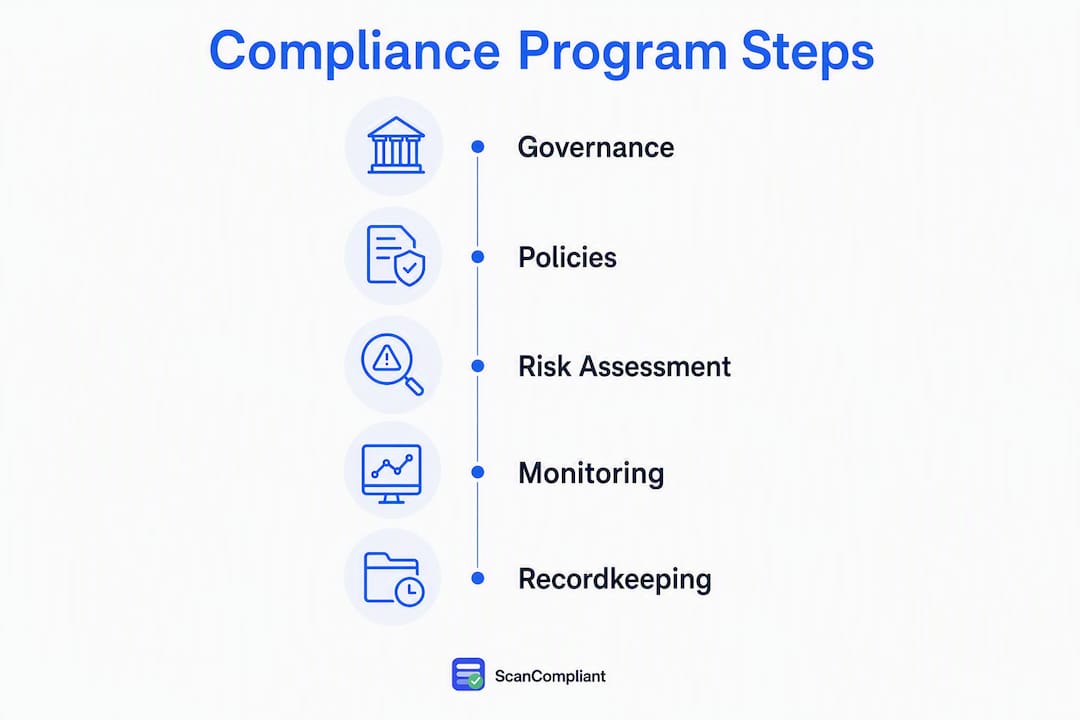
Risk assessment. Score channels, campaigns, and content types periodically and document the scoring. High-risk categories for healthcare brands include DTC drug claims, symptom-focused landing pages, and any conversion flow that involves tracking pixels near health-condition data.
Training. Role-based curricula matter. A marketer needs different training than a legal reviewer or an agency partner. Completion records are evidence; verbal assurances are not. Build role-based training programs that produce certificates you can show a regulator.
Monitoring and reporting. Continuous content scanning, vendor oversight, and a functioning incident-reporting channel. Remediation workflows need owners and deadlines, not just acknowledgment.
“If it isn’t written down, it didn’t happen.” Regulators reviewing governance failures consistently find that organizations knew about problems but left them undocumented — and that gap is what turns a manageable issue into an enforcement action.
Pro Tip: Run a quarterly “policy stress test”: pick three recent campaigns and trace each claim back through your approval workflow. If you cannot reconstruct the approval chain in under 10 minutes, your audit trail has a gap.
What does a Trust Architecture actually look like in practice?
The reactive model — legal as a final gatekeeper reviewing finished creative — stifles speed and creates compliance gaps. Trust Architecture flips that: compliance inputs arrive during ideation, not after the copy is written.
The four layers work together:
- Foundation layer: legal and regulatory baseline — HIPAA, FTC Act, FDA promotional standards, and platform policies — mapped to your specific product category
- Structure layer: channel-specific controls (what is permitted in paid search vs. email vs. influencer content differs materially)
- Experience layer: claims phrasing, fair-balance requirements, and mandatory disclosures baked into approved copy archetypes
- Algorithmic layer: the signals platforms reward or penalize, which increasingly overlap with regulatory requirements
Practically, this means your creative brief template must require, before any work begins: target audience definition, applicable regulatory constraints, mandatory citations or substantiation sources, a privacy and data-flow map for any tracking involved, and a mitigation plan for the highest-risk claim in the brief.
Transition teams by giving compliance a seat in the weekly campaign planning call, not just the final review. Track compliance KPIs — percent of briefs with complete regulatory inputs, number of claims flagged pre-launch — alongside performance KPIs. That pairing changes the conversation from “compliance slows us down” to “compliance is part of how we measure success.”

Pro Tip: Build a library of pre-approved claim archetypes for your top five content categories. Writers pull from approved language; compliance reviews exceptions. Review cycle time drops significantly.
A living claims grid maps every tagline and promotional claim to current approved prescribing information and updates immediately when labels change. Static PDF checklists fail in dynamic environments — this is one of the most common patterns in FDA warning letters.
Operational controls that stop risky content before it publishes
Pre-publication approval gates need teeth: no content goes live without a compliance sign-off logged in your system of record. A regulatory review checklist for every asset type — paid ads, landing pages, email, social — keeps reviewers consistent and creates the paper trail you need.
On the technical side, client-side tracking pixels on condition or prescription pages that send identifiers to vendors without a signed BAA are a recurring enforcement trigger. Mitigate with server-side tracking, automated PHI filtering, and intermediaries that de-identify data before it reaches ad platforms.
| Control | What it does | Minimum evidence to retain |
|---|---|---|
| Pre-publication approval gate | Blocks unchecked content from going live | Timestamped approval record with reviewer ID |
| Living claims grid | Maps every claim to current labeling | Version history with label-change dates |
| Server-side tracking | Prevents PHI from reaching ad platforms | Configuration logs, BAA with data vendor |
| Vendor BAA registry | Confirms all data-path vendors are covered | Signed BAAs, annual renewal dates |
| Automated content scan | Catches risk terms before publication | Scan report with findings and dispositions |
Vendor oversight deserves its own cadence. Assess new vendors before onboarding, require security attestations and BAAs contractually, and test vendor compliance annually. An undiscovered gap in a vendor’s data handling becomes your problem when OCR comes calling.
How technology reduces enforcement risk for healthcare teams
AI-powered content scanning does something human reviewers cannot do at scale: it catches subtle implied claims and risk-term combinations across every asset, every time, without reviewer fatigue. The capabilities that materially reduce exposure include risk-term databases, claims-matching against the living claims grid, automated flagging of implied health claims, server-side tracking configuration checks, and a BAA registry that surfaces expiring agreements.
Integration matters as much as capability:
- Embed scanning into your CMS or publishing pipeline so a risk score is generated before the publish button is available
- Require evidence attachments on every approval — the scan report, the claims-grid match, the substantiation source
- Surface compliance risk scores in campaign dashboards alongside CTR and conversion data
Pro Tip: When an automated scan flags a claim, document the disposition — “accepted risk with legal sign-off” or “rewritten per suggestion” — not just the finding. That disposition log is what demonstrates good faith to a regulator reviewing your program.
A practical scenario: a DTC telehealth brand runs its landing pages through an AI scanner before a product launch. The scan surfaces three implied efficacy claims the human reviewer had cleared. The team rewrites two and obtains substantiation for the third. The audit trail from that scan, including the rewrite history, later helps the brand respond to an OCR inquiry by demonstrating proactive containment steps. That is the difference between a documented program and a folder of good intentions.
Why proactive regulatory engagement is a prevention strategy
Companies that regulators already know tend to fare better when issues arise. Building that relationship before you need it is one of the highest-return investments a compliance team can make.
- Assign an owner to monitor FDA, FTC, and OCR rulemaking calendars and flag upcoming comment periods at least 60 days in advance
- File substantive public comments — agencies notice organizations that engage with evidence rather than just objection
- Join relevant standards working groups; participation gives early signals and an opportunity to shape practical requirements
- Keep a regulator contact log: every interaction, every inquiry, every informal conversation documented with date, topic, and outcome
When you reach out to a regulator proactively — or respond to an inquiry — include the owner of the issue, a realistic timeline, the remedial actions already taken, and the evidence supporting containment. That structure signals a functioning program, not a scramble.
Proactive communication when self-identifying potential issues often leads to constructive regulator dialogue and mitigation. Delays or recalcitrance escalate enforcement risk.
An analysis of over 1,100 financial representation enforcement cases found that companies receiving cooperation credit from regulators saw penalties reduced by around 49% on average. The principle applies across regulatory contexts: the organization that calls first, with evidence in hand, is treated differently than the one that waits.
If you find a potential violation, here is how to contain it
Speed and documentation quality in the first 72 hours determine whether a self-identified issue stays internal or becomes an enforcement matter.
- Contain (0–24 hours): Disable the risky tracker, content, or campaign. Do not delete anything — preserve all versions, logs, and approval records as they exist right now
- Preserve and quantify (24–72 hours): Document affected transactions, impressions, and data flows. Assign a single regulatory liaison who owns all external communications
- Root-cause analysis (72 hours–7 days): Identify the control that failed, not just the symptom. Write a remediation plan with specific corrective actions, enhanced controls, and owner sign-offs
- Engage regulators (7–14 days, or sooner if required): Submit an initial response that includes granular quantitative analysis of affected transactions, proof of containment, US regulatory nexus, and a remediation timeline
The quality of that initial submission matters enormously. Regulators expect quantitative impact analysis and proof of containment — a vague “we are looking into it” response is worse than silence.
Metrics and testing that prove your program is working
A compliance program without measurement is a policy document. These KPIs give you evidence of effectiveness you can show to regulators or auditors.
| KPI | Target | Measurement cadence |
|---|---|---|
| Percent of content scanned before publish | all high-risk asset types | Monthly |
| Time-to-review for compliance sign-off | Defined SLA per asset type | Monthly |
| High-risk findings remediated | Track open vs. closed rate | Weekly |
| Vendor BAA coverage | all data-path vendors | Quarterly |
| Tabletop exercise completion | Annual minimum | Annual |
Test your program, not just your content. Run quarterly content-sample audits pulling 10–15 assets at random and tracing each through the approval workflow. Calibrate your automated scanner against new FDA guidance and FTC policy updates at least twice a year. Run red-team tests for tracking leaks — have a technical team member attempt to trigger a pixel on a condition page and document whether controls caught it.
Recordkeeping practices that reduce enforcement exposure
What you keep, and how you index it, determines whether your program looks credible to a regulator or looks assembled after the fact.
Retention checklist:
- Campaign approvals with reviewer ID and timestamp
- Claims substantiation dossiers: claim text, source citations, biostatistician sign-off where applicable, and date-stamped approvals
- Training completion certificates by role and date
- Vendor contracts, BAAs, and security attestations with renewal dates
- Periodic risk assessments with scoring methodology
- Incident logs with containment steps and remediation outcomes
For each substantiation dossier, the structure should be: claim text exactly as published, the source that supports it, who reviewed and approved it, and when. If the claim was rewritten from a riskier version, include the original and the reason for the change. That redaction log is evidence of a functioning review process.
Pro Tip: When responding to an initial regulatory inquiry, lead with the quantitative impact — number of affected users, transaction volume, date range — and attach the containment evidence before the regulator asks for it. Regulators expect that level of specificity, and providing it proactively signals a mature program.
Build your compliance risk reporting cadence around these records so they are current, not reconstructed.
Key Takeaways
A living, risk-prioritized compliance program that embeds Trust Architecture, continuous monitoring, and documented regulator engagement is the most reliable way to reduce enforcement exposure for healthcare brands.
| Point | Details |
|---|---|
| Embed compliance early | Build Trust Architecture into creative briefs and planning, not just final review, to catch risk before content is written. |
| Document everything | Timestamped approvals, claims substantiation dossiers, and incident logs are the evidence regulators evaluate when assessing program credibility. |
| Fix pixel risk now | Disable client-side tracking pixels on condition and drug pages without BAAs; server-side tracking with PHI filtering is the required mitigation. |
| Engage regulators proactively | Companies that self-report and cooperate early receive cooperation credit; penalties in comparable cases have been reduced by around 49% on average. |
| Use Scancompliant | Scancompliant scans content against 1,000+ risk terms before publication, generates audit-trail exports, and has protected more than 200 brands from risky claims reaching live channels. |
The Compliant Team’s view on where most programs actually fail
Most healthcare brands do not get into enforcement trouble because they ignored compliance. They get into trouble because compliance was treated as a checkpoint at the end of the process rather than a constraint built into the beginning. The Trust Architecture framing is not a rebranding exercise — it is a structural fix for the most common failure mode.
What gets missed in most discussions of preventing regulatory actions is the documentation gap. Teams run solid reviews, catch real risks, and rewrite claims — but they do not log the disposition. Six months later, when an OCR inquiry arrives, they cannot reconstruct what they reviewed, what they changed, or why. The program existed; the evidence did not.
The other underappreciated lever is the regulator relationship itself. Healthcare brands that participate in public comment periods, attend FDA advisory committee meetings, and maintain a contact log with agency staff are not just being good citizens. They are building the credibility that determines how an inquiry gets handled. An agency that already knows your organization as a cooperative, evidence-forward participant treats your initial response differently than it treats a submission from a brand it has never encountered.
Scaling this across agency partners and remote teams requires one thing above all: the same tools and workflows, not just the same policies. A policy document sent to an agency partner does not create compliance. A shared scanning workflow with documented outputs does.
Scancompliant gives your team a documented defense before you need one
Most compliance gaps are not discovered by the compliance team. They are discovered by a regulator. Scancompliant changes that by scanning your websites, social content, product listings, and marketing documents against a database of 1,000+ FDA and FTC risk terms before anything publishes.

The platform flags explicit and implied claims, prioritizes findings by risk level, explains each issue in plain English, and suggests compliant rewrites — all in minutes. Every scan produces an audit-trail export your legal team can attach to a regulatory response. More than 200 brands have used Scancompliant to catch the claims human reviewers miss and to build the documented program that regulators credit.
During a pilot, test scan coverage across your highest-risk asset types, check integration with your CMS or publishing workflow, and export a sample audit report to confirm it meets your documentation standard. Start your free trial at Scancompliant and see what your current content is carrying before a regulator does.
Primary sources and further reading
These are the primary regulatory and practitioner sources that support the recommendations in this article.
- Proactive Compliance, Strategic Defense — Mondaq: Explains how DOJ, FERC, and CFTC factor effective compliance programs into enforcement discretion. Read this first if you are building the governance section of your program.
- Proactive Compliance in Health Care — Crowell: Covers proactive regulator engagement and self-reporting as mitigation strategies. Directly applicable to the incident response playbook.
- Pharma DTC Advertising — Curve Compliance: Details the FDA letter campaign of September 9, 2025 and the pixel-tracking enforcement patterns OCR and FTC are pursuing. Required reading for DTC and telehealth marketing teams.
- FDA Drug Advertising Warning Letters — Auroratic: Practical analysis of what triggers FDA warning letters and how a living claims grid prevents the most common patterns.
- OFAC Enforcement: A Practical Overview — Mondaq: The evidence-quality guidance for initial regulatory responses applies directly to OCR and FTC inquiries. Use the submission framework described here.
- Engage Early or Lose Leverage — Lexology Pro: The 49% penalty-reduction finding and the Airbus cooperation case study. Useful for building the internal business case for proactive engagement.
- Avoiding Enforcement — Baker and Partners: Governance failure patterns and the “death by a thousand cuts” escalation model. Useful for board-level presentations on why the program structure matters.
This article is general information, not legal or regulatory advice. Confirm current requirements with the relevant agency or a qualified compliance professional for your specific situation.
Recommended
- Healthcare Brand Compliance Program Best Practices – scancompliant.com
- Responding to Regulatory Scrutiny: Your Health Brand Guide – scancompliant.com
- Risk-Prioritized Compliance for Healthcare Marketers: 2026 Guide – scancompliant.com
- How Content Compliance Audits Work for Healthcare Teams – scancompliant.com
1 Comment