
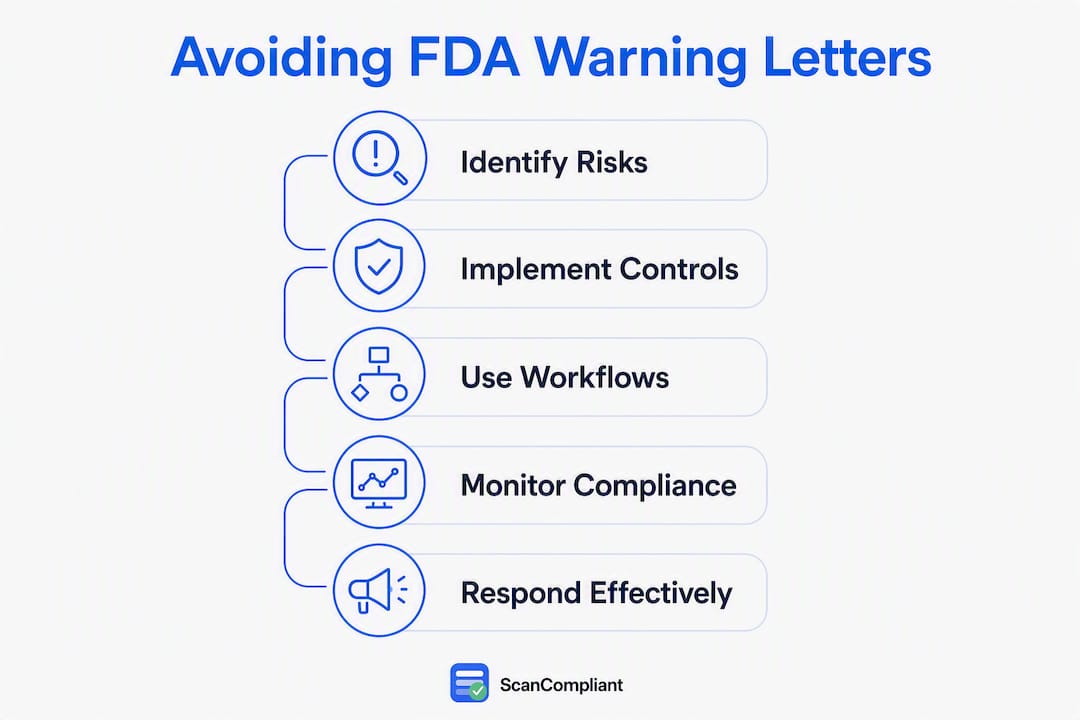
Regulatory and marketing teams at U.S. health brands can dramatically cut their escalation risk by doing three things consistently: scanning every published claim across the full digital surface and mapping each one to documented evidence, treating every Form FDA 483 observation as a system-level finding that requires root-cause analysis and verified CAPA, and running continuous automated reviews that link marketing assets to quality records before publication. That is the short version. The rest of this guide provides the templates, timelines, and operational controls to make it stick.
Immediate action checklist (copy into your incident playbook):
- Scan your full marketing surface, including legacy web pages, marketplace listings, and creator content, for disease claims and implied drug language; attach evidence to every claim.
- Treat each Form FDA 483 observation as a systemic signal, not an isolated finding; document root cause across the system and build a CAPA with milestones and verification metrics.
- Implement a continuous, automated review workflow using a platform like Scancompliant that links marketing assets to quality records and generates an audit-ready compliance trail.
- Assign a named owner and review date to every published asset; schedule quarterly sweeps of all digital touchpoints.
- Notify executive management of any inspection observation within 24 hours and document that notification in writing.
Table of Contents
- Why FDA Warning Letters matter more than most brands realize
- What triggers FDA Warning Letters most often?
- How to control marketing claims before they become enforcement triggers
- What your QMS and supply chain need to be inspection-ready
- What to expect during an FDA inspection and how Form FDA 483 works
- How to write a 483 or Warning Letter response that actually closes the matter
- What happens after a Warning Letter: the escalation path and its costs
- How AI-assisted scanning and contradiction maps change the prevention equation
- Key Takeaways
- What compliance teams that avoided escalation actually did differently
- Scancompliant gives health brands a faster path to inspection-ready marketing
- Authoritative sources and further reading
Why FDA Warning Letters matter more than most brands realize
An FDA Warning Letter is a formal written notice from the U.S. Food and Drug Administration stating that a company has violated federal law in a way the agency considers significant enough to warrant corrective action. It is public, permanent, and searchable. The moment one lands on your company, it is visible to retailers, investors, insurance carriers, and every competitor who runs a Google alert on your brand name.
The consequences do not stop at reputational harm. A Warning Letter can trigger refusal to approve pending applications, import alerts that block product at the border, product seizures, injunctions requiring a court-supervised shutdown of operations, and in the most serious cases, consent decrees that place a company under years of third-party oversight. Each step up that ladder is harder and more expensive to reverse than the one before it.
Statistic callout: FDA guidance and regulatory counsel analysis confirm that inadequate Form FDA 483 responses are a primary driver of Official Action Indicated (OAI) designations and subsequent Warning Letters. The FDA expects an initial written response within a short, recommended timeframe after receiving a 483, and responses that are vague, incomplete, or narrowly scoped routinely accelerate escalation rather than prevent it.
Beyond regulatory risk, the financial exposure is real. Remediation, outside counsel, operational downtime, and lost retail placement can collectively run into hundreds of thousands to millions of dollars per enforcement action. The brands that avoid this outcome are not the ones with the best lawyers on speed dial. They are the ones that built prevention into their daily operations before an inspector walked through the door.
What triggers FDA Warning Letters most often?
Understanding the common triggers is the fastest way to prioritize your compliance resources. The FDA’s health fraud Warning Letters database and public enforcement records point to a consistent set of failure modes across supplements, DTC health products, cosmetics, OTC drugs, and devices.
- Disease claims and implied drug language: Stating or implying that a product treats, cures, or prevents a named condition converts a supplement or cosmetic into an unapproved drug under federal law. This includes indirect language, testimonials framed as outcomes, and before/after imagery.
- Unsupported efficacy claims: Structure/function claims for dietary supplements must be backed by competent and reliable scientific evidence specific to the ingredient, formulation, and dose. Generic citations to ingredient studies rarely satisfy this standard.
- Missing DSHEA disclaimers: Even a fully permissible structure/function claim loses its regulatory defense if the required “This statement has not been evaluated by the Food and Drug Administration” disclaimer is absent or improperly placed.
- Label misbranding: Incorrect net quantity, missing required elements, misleading serving size representations, or unsubstantiated “free from” claims all qualify.
- CGMP failures: Missing or incomplete batch records, unvalidated methods, inadequate environmental monitoring, and poor change control are among the most cited manufacturing findings.
- Data integrity violations: Altered records, missing audit trails, or undocumented changes to raw data are treated as serious by FDA investigators and often indicate systemic quality failures.
- Inadequate complaint handling: Failure to investigate consumer complaints, document outcomes, or escalate serious adverse events to the appropriate FDA reporting pathway.
- Poor supplier controls: Unqualified ingredient suppliers, missing certificates of analysis, and no incoming material testing program.
- Weak or vague 483 responses: Responding with “we will evaluate” or “we will consider” language without specific timelines, root-cause documentation, and CAPA milestones is itself a trigger for escalation.
Five specific language patterns appear repeatedly in supplement enforcement: disease verbs (“treats,” “heals,” “cures”), named medical conditions, comparisons to prescription drugs, drug-class claims (“works like a statin”), and strong testimonials presented as clinical outcomes. Each one is a red flag that FDA reviewers and FTC staff are trained to catch.
One finding that surprises many teams: auditing only the physical label covers roughly 20% of actual compliance exposure. Most enforcement risk lives in legacy web pages, email campaigns, Amazon listings, and creator content that was published years ago and never reviewed against current standards. That digital footprint is where the majority of Warning Letters originate for supplement and DTC health brands. For a deeper look at the most frequent supplement-specific triggers, the 7 most common FDA Warning Letter triggers in supplement marketing is worth reviewing before your next audit cycle.

How to control marketing claims before they become enforcement triggers
Prevention at the marketing layer starts with a structured approval workflow, not a style guide. Every piece of content that makes a health claim, whether a product page, an email subject line, a paid ad, or a creator script, needs to pass through a documented review before it goes live.

The approval workflow your team needs
The workflow has four required artifacts: the draft asset, the claim inventory (every health-related statement extracted and listed), the evidence packet (the specific studies, internal data, or regulatory citations that support each claim), and the signed approval record with the reviewer’s name, date, and any conditions attached. Without all four, the asset does not publish. That rule sounds simple, but enforcing it across a marketing team that operates at speed requires a system, not a policy memo.
Structure/function claims under DSHEA must describe how a nutrient affects normal body structure or function, not what it does to a disease state. The line between “supports healthy blood sugar levels already in the normal range” and “lowers blood sugar” is the line between a permissible claim and an unapproved drug claim. When rewriting borderline language, the test is intent and specificity: does the claim describe a normal physiological process, or does it imply correction of an abnormal one? If a reviewer cannot answer that question confidently in 30 seconds, the claim needs revision.
Influencer and marketplace content
Creator and influencer scripts require the same pre-approval process as owned content, plus two additional controls. First, every script must be archived with a version timestamp and the creator’s signed acknowledgment that they will not deviate from approved language. Second, marketplace copy, including Amazon A+ content, third-party retailer pages, and affiliate landing pages, must be swept on a scheduled basis because sellers and affiliates routinely modify copy without notifying the brand.
For healthcare advertising ideas that align with compliant content structures, the healthcare advertising guidance from Digital Ash Agency covers practical approaches to structuring promotional content within regulatory boundaries.
The contradiction map
A contradiction map is a living document that links every external claim to its internal evidence record. Each row contains the claim text, the asset URL or file reference, the supporting evidence citation, the evidence quality rating, the review date, and the asset owner. When an FDA investigator cross-references your public-facing claims against your submissions or quality records, a contradiction map lets you respond in hours rather than days. Brands without one are at materially higher risk because the gap between what they publish and what they can prove is invisible until an inspector makes it visible.
Pro Tip: When reviewing short-form content, paid social, and creator videos, flag any claim that names a body system and pairs it with a result word (“supports,” “boosts,” “improves,” “reduces”). Those combinations are the most common implied-disease triggers in short-form enforcement actions. Build a one-page creator brief that lists pre-approved claim language and explicitly prohibits the five high-risk phrasing patterns.
What your QMS and supply chain need to be inspection-ready
Manufacturing and quality system failures account for a significant share of Warning Letters across drug, device, and supplement categories. The controls below are the ones FDA investigators most consistently request and most commonly find missing.
Must-have QMS controls:
- Complete, contemporaneous batch records with no blank fields and no retroactive entries
- Validated analytical methods with documented method validation reports and ongoing system suitability checks
- Traceable supplier documentation: current certificates of analysis, supplier qualification records, and incoming material testing results for every ingredient lot
- ALCOA+ data integrity practices applied to all electronic and paper records: Attributable, Legible, Contemporaneous, Original, Accurate, plus Complete, Consistent, Enduring, and Available
- Documented change control for every modification to a formula, process, equipment, or facility, with impact assessment and re-validation where required
- Training logs that show each employee completed role-specific training before performing the task, not after a finding
For operational risk management frameworks that map these controls to inspection expectations, the operational compliance risk guide covers QMS design in more depth.
CAPA template: required fields
Every corrective and preventive action plan must include: the observation or trigger event, the root cause (not the symptom), the scope of affected SKUs or batches, the specific corrective actions with assigned owners, the implementation timeline with milestone dates, the verification method and success metric, and the evidence attachments that will confirm closure. A CAPA that says “retrain staff” without specifying who, on what, by when, and how you will verify retention is not a CAPA. It is a placeholder, and FDA reviewers treat it as one.
When to escalate to legal counsel
Escalate immediately when an investigator issues a Form FDA 483 with more than two observations, when any observation touches data integrity, when a product is detained or seized, or when the company receives a Warning Letter. Document executive management notification in writing within 24 hours. FDA guidance expects that senior leadership is aware of and accountable for quality system failures, and the absence of documented executive involvement is itself a finding in consent decree proceedings.
What to expect during an FDA inspection and how Form FDA 483 works
FDA inspections follow a predictable structure, and knowing the phases lets you allocate resources before an investigator arrives rather than scrambling after.
Pre-inspection: Designate a single point of contact for the inspection team. Confirm that all batch records, SOPs, training logs, and validation reports are retrievable within 30 minutes. Brief executive management and legal counsel. Do not move, destroy, or alter any records.
Day of inspection: The point of contact escorts the investigator and answers questions directly and factually. Do not volunteer information beyond what is asked. Assign a separate person to retrieve documents so the point of contact stays present with the investigator at all times. Photograph or copy every document provided to the investigator. Note every question asked and every area examined.
48–72 hours after inspection: If the investigator issues a Form FDA 483 at the close of the inspection, the clock starts immediately.
Statistic callout: FDA guidance establishes that companies should provide an initial written response to Form FDA 483 observations within a recommended timeframe. Responses that miss this timeframe or arrive with vague language may lead to escalation.
Form FDA 483 is a list of inspectional observations, not a final enforcement action. It is the strategic crossroads: a well-constructed response can resolve the matter at the inspection level; a weak one hands the FDA the justification it needs to escalate. Every observation on the 483 should be treated as a signal of a systemic root cause, not an isolated incident requiring a one-time fix.
How to write a 483 or Warning Letter response that actually closes the matter
The structure of an effective response is not complicated, but every element must be present and substantive. A documented root-cause analysis and system-level CAPA are the two elements regulatory counsel most consistently identify as the difference between a response that closes an observation and one that triggers a Warning Letter.
Response template outline:
- Executive summary: One paragraph stating that the company takes the observations seriously, has conducted root-cause analysis, and is implementing system-level corrections. Name the executive accountable for oversight.
- Point-by-point response: Address each observation individually, in the order listed on the 483 or Warning Letter. Never group observations or address them collectively.
- Root-cause analysis for each observation: State the specific root cause, not the symptom. “The batch record was incomplete because the SOP did not require a second-person verification step” is a root cause. “Human error” is not.
- CAPA with milestones: For each observation, list the corrective action, the preventive action, the owner, the implementation date, and the verification metric.
- Verification and metrics: Describe how you will confirm the CAPA worked. Include the data you will collect, the threshold for success, and the timeline for verification.
- Attachments index: List every supporting document attached: revised SOPs, training records, updated batch record templates, validation reports, and any interim controls already implemented.
Example root-cause + CAPA entry:
Observation: Batch records for Lot 2024-0412 contained blank fields in the in-process testing section.
Root cause: The in-process testing SOP (SOP-QC-007, Rev. 3) did not specify which fields were mandatory, and no second-person verification step was required before batch record closure.
Corrective action: SOP-QC-007 revised to designate all in-process fields as mandatory; second-person verification step added to batch record closure procedure. Effective date: [date]. Owner: QA Director.
Preventive action: Electronic batch record system configured to prevent closure when mandatory fields are blank. All QC staff retrained on revised SOP by [date]. Training records attached as Exhibit C.
Verification: QA will audit 100% of batch records for the next 30 production runs and report results to executive management monthly. Success threshold: zero blank mandatory fields.
Tone matters as much as structure. Vague or defensive language such as “we will evaluate,” “we will consider,” or “we are looking into” is a primary escalation trigger. Every commitment in the response must be specific, time-bound, and verifiable.
Pro Tip: When full remediation genuinely requires more than 15 business days, submit the initial response on time and include: (1) a clear acknowledgment of each observation, (2) the root-cause analysis completed to date, (3) the interim controls already in place, and (4) a specific timeline for full CAPA completion with a commitment to provide a follow-up submission by a named date. This approach demonstrates good faith and reduces the likelihood of OAI designation while remediation continues.
For a broader framework on handling regulatory scrutiny across functions, the health brand regulatory scrutiny guide covers cross-functional response planning in detail.
What happens after a Warning Letter: the escalation path and its costs
A Warning Letter is not the end of the enforcement sequence. It is a formal notice that the FDA has identified a significant violation and expects correction. If the response is inadequate or the violation continues, the agency has several escalation options, each with longer timelines and higher costs.
Escalation pathway and typical timing:
- Warning Letter: Issued after OAI designation. Company has 15 business days to respond. FDA typically evaluates the response within 30 days and decides whether to close, monitor, or escalate.
- Import alert: Can be issued in parallel with or shortly after a Warning Letter for foreign-manufactured products or U.S. brands with offshore manufacturing. Products are detained at the border without physical examination.
- Seizure: FDA works with the Department of Justice to seize products in commerce. Can occur weeks to months after a Warning Letter if violations continue.
- Injunction: A federal court order requiring the company to stop manufacturing or distributing until compliance is achieved. Typically takes months to pursue but can shut down operations entirely.
- Consent decree: A negotiated court agreement placing the company under third-party oversight, often for years. Compliance costs under a consent decree routinely reach seven figures annually.
- Criminal referral: Reserved for the most serious cases involving fraud, intentional adulteration, or repeated willful violations.
Statistic callout: Regulatory counsel and FDA guidance confirm that inadequate 483 responses can lead to refusal to approve pending applications in addition to Warning Letters and downstream enforcement. For brands with NDAs, ANDAs, or 510(k)s in review, a Warning Letter can freeze approvals indefinitely.
The financial exposure at each level compounds quickly. Warning Letter remediation alone, including outside counsel, consultant fees, and operational downtime, typically runs into hundreds of thousands of dollars. Consent decree compliance, with mandatory third-party auditors and court reporting requirements, can exceed that annually for years. The brands that avoid this trajectory are the ones that treated the 483 as the moment to resolve the issue, not the moment to minimize it.
How AI-assisted scanning and contradiction maps change the prevention equation
The traditional compliance review model, where a regulatory affairs professional manually reads through marketing copy before publication, has a structural flaw: it does not scale to the volume and velocity of modern digital content, and it cannot systematically audit legacy assets that were published before the current team arrived.
The contradiction map in practice
A contradiction map links every external claim to the internal evidence file that supports it, with a verification timestamp. When an FDA investigator or agency AI cross-references your public-facing claims against your submissions, the map lets you demonstrate in real time that every claim is substantiated. Brands without this linkage are at higher risk because the gap between what they publish and what they can prove only becomes visible during an inspection, at the worst possible moment.
How AI scanning supports the map
An AI-powered platform built for this purpose performs several functions that manual review cannot replicate at scale:
- Risk-term taxonomy: A database of flagged terms, including disease verbs, named conditions, drug-class language, and implied efficacy phrases, applied at the sentence level across every scanned asset.
- Semantic classification: Sentence-level analysis that catches implied claims even when no explicit disease term is used, such as “helps your body fight off infection” in a supplement context.
- Evidence attachment: Each flagged claim can be linked directly to the supporting evidence file, creating the contradiction map automatically as content moves through the review workflow.
- Prioritized remediation queue: Findings are ranked by risk level so regulatory teams address the highest-exposure items first, not the most recent ones.
- Audit-ready output: The platform generates a timestamped compliance trail that documents what was reviewed, when, by whom, and what action was taken, which is exactly what an FDA investigator would request.
Statistic callout: Scancompliant’s database covers more than 1,000 risk terms and has protected more than 200 brands, with documented faster review cycles compared to manual processes. The platform’s AI assistant provides plain-English explanations of each finding and suggests compliant rewrite options, reducing the back-and-forth between regulatory and marketing teams.
For a detailed look at how compliance databases are structured to support claim-to-evidence mapping, the compliance database architecture guide covers the technical and governance design behind audit-ready systems.
| Digital asset type | Common risk finding | Prevention control |
|---|---|---|
| Legacy product pages | Unapproved disease claims in older copy | Scheduled full-surface scan with risk-term taxonomy |
| Marketplace listings (Amazon, Walmart) | Seller-modified efficacy language | Quarterly sweep + seller agreement with pre-approved copy |
| Creator/influencer content | Testimonials framed as clinical outcomes | Pre-approved scripts + archived signed acknowledgments |
| Paid social ads | Implied drug claims in short-form copy | Pre-publication AI scan + evidence attachment required |
| Email campaigns | Disease verbs in subject lines | Automated scan before send + versioned approval record |
For teams managing healthcare content marketing at scale, building the contradiction map into the content brief stage, before a writer drafts a single sentence, cuts remediation time significantly.
Key Takeaways
Avoiding FDA Warning Letters requires treating every published claim and every inspection observation as a system-level risk, not an isolated incident.
| Point | Details |
|---|---|
| Scan the full digital surface | Label review covers roughly 20% of exposure; legacy web pages, marketplace listings, and creator content carry the majority of enforcement risk. |
| Map every claim to evidence | A contradiction map linking each public claim to its supporting evidence file is the single most effective pre-inspection control. |
| Respond to 483s within 15 business days | Initial responses must include root-cause analysis and specific CAPA milestones; vague language accelerates escalation to Warning Letters. |
| Treat observations as systemic | Narrow fixes to individual findings routinely lead to repeat citations; system-level CAPA with verified outcomes is what closes observations permanently. |
| Scancompliant automates the prevention layer | With over 1,000 risk terms and protection for more than 200 brands, Scancompliant links marketing assets to evidence records and generates audit-ready compliance trails before publication. |
Executive 30/60/90-day plan: In the first 30 days, convene regulatory, legal, and marketing leadership to run a full-surface scan of all digital assets and build the initial contradiction map. In days 31–60, implement the approval workflow with required artifacts, deploy automated scanning for all new content, and complete a gap assessment of QMS controls against the CGMP checklist above. By day 90, conduct a mock 483 rehearsal with cross-functional teams, verify that all open CAPA items have documented milestones and owners, and schedule quarterly sweeps of marketplace and creator content.
What compliance teams that avoided escalation actually did differently
The pattern that separates brands that resolve 483 observations quietly from those that receive Warning Letters is not the size of the legal team or the sophistication of the QMS on paper. It is posture. Teams that avoided escalation stopped treating compliance as a checkpoint at the end of the content or manufacturing process and started treating it as a continuous ownership question: who is accountable for this claim, what evidence supports it, and when was it last verified?
Three habits that compliance teams consistently report as high-leverage:
- Weekly sweep and triage: A standing 30-minute review of newly published content, flagged items from the automated scan, and any marketplace or creator content that went live in the prior week. The goal is not perfection; it is speed of detection.
- Mandatory evidence attach in approvals: No asset moves to published status without an evidence link in the approval record. This single control closes the gap between what marketing believes is substantiated and what regulatory can actually defend.
- Cross-functional 483 rehearsals: Quarterly tabletop exercises where the regulatory, legal, and operations teams walk through a simulated inspection scenario, including a mock 483 with two or three realistic observations. Teams that have done this at least once respond to real inspections with measurably less confusion about who retrieves documents, who speaks, and who notifies executive management.
Pro Tip: Embed executive accountability into CAPA verification by requiring that the executive sponsor sign the CAPA closure memo, not just the initial CAPA plan. FDA consent decree proceedings consistently cite the absence of documented senior management involvement in quality system oversight. A signature on the closure memo creates a paper trail that demonstrates the accountability FDA expects.
Scancompliant gives health brands a faster path to inspection-ready marketing
Most health brands discover their marketing compliance gaps during an inspection, not before it. Scancompliant is built to close that gap before the FDA does.

The platform scans websites, social media, product listings, and documents for FDA and FTC risk in minutes, not days. Its database of over 1,000 risk terms catches explicit disease claims, implied drug language, and the five high-risk phrasing patterns that appear most often in enforcement actions. Every finding comes with a plain-English explanation and a suggested compliant rewrite, so regulatory and marketing teams spend less time debating whether a claim is risky and more time publishing content that is defensible. The audit-ready compliance trail the platform generates is exactly the documentation an FDA investigator would request during an inspection.
Regulatory affairs, legal, and content operations teams at telehealth companies, supplement brands, and DTC health companies use Scancompliant to run pre-publication scans, build contradiction maps, and maintain versioned approval records across the full marketing surface. The result is faster review cycles and a documented compliance history that holds up under scrutiny.
Start a trial or request a demo at scancompliant.com to see how the platform fits your team’s workflow. If you want to evaluate plans and pricing before committing, the pricing page has full details on subscription tiers for teams of all sizes.
Authoritative sources and further reading
The resources below are the primary references for the regulatory claims, timelines, and enforcement standards covered in this guide. Use them to support internal training materials, 483 response documentation, and marketing review SOPs.
- FDA Warning Letters database (health fraud): Searchable database of Warning Letters citing unapproved claims, tainted products, and health fraud violations.
- FDA Warning Letters: About Warning and Close-Out Letters: FDA’s own description of what a Warning Letter is, when it is issued, and what close-out means.
- FDA Inspection Observations (Form FDA 483): FDA’s public database of inspectional observations by product category and fiscal year.
- FDA Issues Expectations for Drug Manufacturing 483 Responses | Alston & Bird: Regulatory counsel analysis of FDA’s 2026 draft guidance on 483 response expectations, timelines, and OAI criteria.
- FDA Form 483 Response Strategy | Garg Law: Practical legal guidance on structuring root-cause analysis and CAPA in 483 and Warning Letter responses.
- FDA Consent Decrees: What They Are and How to Avoid Them | The FDA Expert: Analysis of how systemic inspection findings escalate to consent decrees and what operational posture prevents them.
- Supplement FDA Warning Letter Language to Avoid | Influencer Advisory: Breakdown of the five high-risk language patterns most frequently cited in supplement enforcement actions.
- DSHEA or Drug? How AI Audit Tools Catch Marketing Claims | Aurora TIC: Industry analysis of why digital assets, not labels, carry the majority of supplement compliance exposure.
- Scancompliant Compliance Blog: Ongoing regulatory updates, marketing compliance guides, and enforcement trend analysis for health brands.
Statistic callout: The FDA defines health fraud as the deceptive promotion, advertising, distribution, or sale of a product represented as effective to prevent, diagnose, treat, cure, or lessen an illness or condition that has not been scientifically proven safe and effective for such purposes. Every claim on your marketing surface is evaluated against that standard, whether it appears on the label or in a TikTok caption from a creator you paid six months ago.
Recommended
- Responding to Regulatory Scrutiny: Your Health Brand Guide – scancompliant.com
- Compliance Blog — ScanCompliant
- The 7 Most Common FDA Warning Letter Triggers in Supplement Marketing — ScanCompliant Blog
- GLP-1 Marketing Compliance in 2026: What the FDA Warning Letter Wave Means for Your Brand — ScanCompliant