
Operational compliance risk is defined as the probability that day-to-day business processes, systems, or people fail to consistently follow internal policies, contracts, or regulations, primarily due to unintentional errors rather than deliberate misconduct. In healthcare and telehealth, this risk category sits at the intersection of patient safety, regulatory obligation, and business continuity. Over 96% of privacy incidents stem from unintentional mistakes, not bad actors. That single statistic reframes the entire compliance conversation: the threat is not rogue employees but ordinary workflow gaps. Understanding operational compliance risk is the first step toward closing those gaps before a regulator does.
What is operational compliance risk in healthcare?
Operational compliance risk is the industry term for what happens when standard business activities drift away from required standards. The formal compliance risk definition covers any failure to meet legal, regulatory, or contractual obligations. Operational compliance risk narrows that definition to the execution layer: the daily decisions, handoffs, and system interactions where failure actually occurs.
Healthcare organizations face a uniquely dense regulatory environment. HIPAA governs patient data handling. FDA and FTC rules constrain how telehealth brands communicate with patients. State licensing requirements add another layer. Each regulation creates a specific set of required behaviors. When those behaviors are not consistently embedded in workflows, operational compliance risk grows.

The distinction between operational risk and compliance risk matters here. Compliance risk asks whether the organization meets its obligations. Operational risk asks whether the processes that produce compliance are functioning correctly. In practice, the two overlap completely in healthcare: a broken intake process is both an operational failure and a HIPAA compliance failure at the same time.
What are the common types and sources of operational compliance risk?
Four primary sources drive operational compliance failures: process breakdowns, people failures, system outages, and external events. Each one shows up differently in healthcare settings.
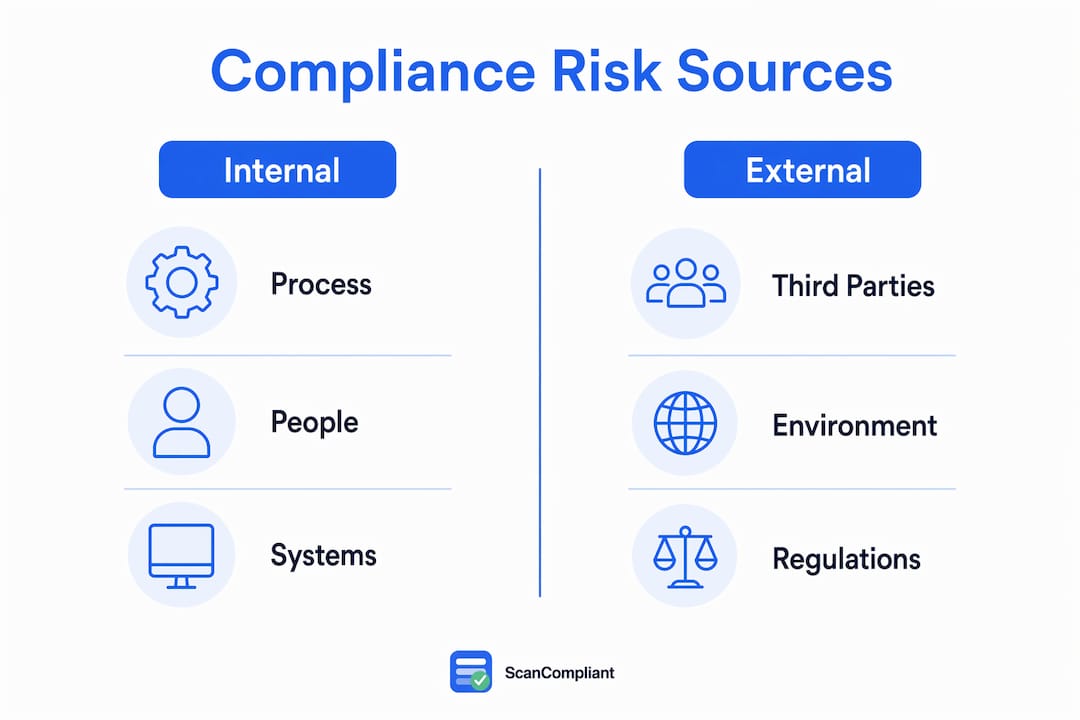
Process breakdowns occur when documented procedures are not followed in practice. A telehealth onboarding workflow that skips vendor security reviews before granting data access is a process breakdown. The policy exists. The execution does not.
People failures are the most common source. Untrained staff mishandle protected health information. Clinicians skip required documentation steps under time pressure. Marketing teams publish health claims without regulatory review. These are not malicious acts. They are the predictable result of insufficient training, unclear ownership, or competing priorities.
System failures include EHR outages that prevent proper documentation, automated billing errors that create false claims exposure, and content management systems that publish unapproved marketing copy. Technology does not eliminate operational compliance risk. It relocates it.
External events cover vendor failures, regulatory changes, and public health emergencies that force rapid operational changes. Telehealth expanded dramatically during recent years. That speed created compliance gaps that organizations are still closing.
The types of compliance risks that emerge from these sources include:
- Unauthorized disclosure of patient data due to misconfigured access controls
- Unapproved health claims in marketing content that violate FTC or FDA standards
- Missed contractual obligations with payers or technology vendors
- Delayed incident response that breaches HIPAA notification timelines
- Inadequate staff training records that fail audit requirements
Understanding operational compliance through this source-based lens helps compliance officers prioritize. Not every risk deserves equal attention. The ones tied to patient data and marketing claims carry the highest regulatory and reputational exposure in telehealth.
How does operational compliance risk impact healthcare organizations?
The financial cost of unmanaged compliance risk is direct and measurable. The average cost of a data breach reached $4.44 million in 2025. That figure includes regulatory fines, legal costs, breach notification expenses, and lost business. For a mid-sized telehealth company, a single breach of that magnitude can threaten the entire operation.
Regulatory fines compound the financial damage. HIPAA civil penalties range from hundreds to millions of dollars depending on the level of negligence. FTC enforcement actions against telehealth brands making unsupported health claims have increased in recent years. License revocation is the worst-case outcome: a healthcare organization that loses its operating license cannot recover.
Reputational damage is harder to quantify but equally serious. Patients share health data with telehealth providers based on trust. A compliance failure that exposes that data destroys the relationship permanently. Partners, payers, and referral networks also withdraw when a brand becomes associated with regulatory violations.
The less visible cost is operational disruption. A compliance investigation consumes leadership attention, legal resources, and staff time for months. That disruption slows product development, delays patient care improvements, and diverts budget from growth. Managing operational risk proactively costs a fraction of what reactive crisis management costs.
What does an effective operational compliance risk management framework look like?
An effective operational risk management lifecycle runs through six stages: monitoring, hazard identification, assessment, decision-making, control implementation, and ongoing supervision. Each stage has a specific function. Skipping any one of them creates a gap that auditors will find.
-
Monitoring establishes baseline visibility into current operations. You cannot manage what you cannot see. This stage involves mapping workflows, identifying where compliance-sensitive activities occur, and setting up data collection.
-
Hazard identification catalogs the specific risks within those workflows. In healthcare, this means identifying every point where patient data is accessed, every marketing claim that touches a health outcome, and every vendor relationship that involves protected information.
-
Assessment assigns likelihood and impact scores to each identified hazard. A compliance risk assessment that uses consistent scoring criteria gives leadership a ranked list of priorities rather than an undifferentiated list of concerns.
-
Decision-making determines the response to each assessed risk. Accept, mitigate, transfer, or avoid. High-impact risks in patient data handling require mitigation. Lower-impact administrative risks may be accepted with documented rationale.
-
Control implementation translates decisions into specific actions embedded in workflows. A control is not a policy statement. It is a specific step, system check, or approval gate that prevents or detects a compliance failure.
-
Ongoing supervision tracks whether controls are working. Key risk indicators (KRIs) relevant to healthcare include overdue compliance training completions, delayed breach notifications, and unapproved content published to patient-facing channels.
Pro Tip: Assign a named owner to every control. Controls without owners drift. When a control has a specific person responsible for its execution and evidence capture, it gets done.
Effective compliance is not a one-time event. It is a continuous cycle of assessment, control, and governance. Organizations that treat their framework as a living system outperform those that update it only before audits.
How can compliance leaders embed controls into daily workflows?
Most organizations struggle to move beyond paper policies to operational compliance where actual workflows capture evidence of control execution. The gap between a documented policy and a functioning control is where most compliance failures live.
The transition from paper to workflow-level compliance requires three shifts:
- Integration with existing systems. Controls embedded in EHR platforms, content management systems, and communication tools execute automatically. Controls that require staff to open a separate compliance portal do not execute reliably.
- Automated compliance scanning. Telehealth brands that publish patient-facing content need automated review before publication. Manual review at scale is slow and inconsistent. Scancompliant scans marketing content against over 1,000 risk terms and flags problematic language before it reaches patients, giving compliance teams prioritized findings in minutes rather than days.
- Near-miss tracking. Near misses predict future breaches and are easier to address than audit findings or actual losses. A near miss is any event that could have caused a compliance failure but did not. Tracking them reveals weak controls before they produce incidents.
Rapid telehealth growth creates compliance debt when quick operational changes bypass compliance design. Embedding compliance scanning directly into content and operational pipelines prevents that debt from accumulating. The alternative is a growing backlog of unreviewed decisions that become audit liabilities.
Cultural accountability matters as much as technical controls. Compliance responsibilities must align with operational roles. The person who approves a patient-facing email campaign should own the compliance check for that email. Distributing ownership across the organization makes compliance a shared operational function rather than a legal department afterthought.
Pro Tip: Build compliance checkpoints into existing approval workflows rather than creating parallel compliance processes. Parallel processes get skipped under deadline pressure. Embedded checkpoints do not.
Scope drift and framework overlap reduce audit effectiveness. A unified risk taxonomy that clearly distinguishes operational compliance risks from strategic or financial risks keeps reporting clean and audit committees informed.
What monitoring and audit approaches sustain ongoing compliance?
Continuous monitoring is the operational compliance strategy that separates organizations that pass audits from those that prepare for them. The difference is real-time visibility versus retrospective discovery.
Key risk indicators for healthcare compliance teams include:
- Percentage of staff with current compliance training certifications
- Number of overdue vendor security reviews
- Volume of patient-facing content published without documented compliance review
- Time elapsed between incident detection and required regulatory notification
- Frequency of near-miss events by workflow category
Internal and external audits serve different functions within this monitoring structure. Internal audits test whether controls are executing as designed. External audits verify that the overall program meets regulatory standards. Both require documented evidence of control execution, not just policy documentation.
Technology updates and staff turnover are the two most common causes of compliance drift. When a new EHR feature changes a data access workflow, the compliance controls attached to that workflow must update simultaneously. When a trained staff member leaves, their replacement needs the same training before taking on compliance-sensitive responsibilities. Monitoring systems that flag these events automatically keep the program current without requiring manual oversight of every change.
Key Takeaways
Operational compliance risk is the leading cause of regulatory exposure in healthcare and telehealth, and it originates almost entirely from process gaps and unintentional errors rather than deliberate misconduct.
| Point | Details |
|---|---|
| Define the risk precisely | Operational compliance risk covers execution failures in daily workflows, not just legal violations. |
| Know the four sources | Process, people, systems, and external events each require distinct controls and monitoring approaches. |
| Quantify the financial exposure | A single data breach averages $4.44 million in 2025, making proactive controls a clear financial priority. |
| Use the six-stage framework | Monitor, identify, assess, decide, implement controls, and supervise continuously to close compliance gaps. |
| Embed controls in workflows | Paper policies do not prevent failures. Controls integrated into EHR systems and content pipelines do. |
The compliance trap most healthcare leaders fall into
The most persistent misconception I see in healthcare compliance is treating operational compliance as a documentation exercise. Teams build policy libraries, complete annual training, and file audit reports. Then a breach happens, and the investigation reveals that the policies existed but the controls did not run.
The real discipline of operational compliance is translating policy language into verifiable daily actions. That means asking, for every requirement, “Where in our actual workflow does this happen, and how do we know it happened?” If the answer involves someone checking a box in a spreadsheet, the control is fragile. If the answer involves a system-enforced step with a logged output, the control is real.
Embedding operational risk management into business strategy gives leaders the ability to make risk-based decisions rather than compliance-based ones. That shift matters. A compliance-based decision asks “Are we allowed to do this?” A risk-based decision asks “What is the exposure if this control fails, and is that exposure acceptable?” The second question produces better outcomes.
Telehealth organizations face particular pressure here because growth speed creates compliance debt. Every new product feature, new patient population, or new marketing channel adds compliance surface area. The organizations that manage this well are the ones that build compliance review into their launch process, not their post-launch remediation process.
— Compliant Team
How Scancompliant supports operational compliance in telehealth
Healthcare and telehealth compliance teams need tools that work at the speed of their operations.
Scancompliant integrates directly into content review workflows, scanning patient-facing marketing material against over 1,000 risk terms before publication. The platform flags risky language with prioritized findings, giving compliance officers a documented review trail that satisfies FDA and FTC audit requirements. More than 200 brands have used Scancompliant to reduce review cycle times and eliminate the compliance debt that accumulates when content moves faster than manual review can follow. For teams building out their operational compliance program, Scancompliant provides the automated scanning layer that turns policy requirements into verifiable workflow controls.
FAQ
What is operational compliance risk in simple terms?
Operational compliance risk is the chance that daily business activities fail to follow required policies or regulations, usually because of human error or process gaps rather than intentional wrongdoing.
How is operational compliance risk different from general compliance risk?
General compliance risk covers whether an organization meets its legal obligations. Operational compliance risk focuses specifically on the execution layer: whether the daily workflows and systems that produce compliance are actually functioning correctly.
What are the most common examples of compliance risk in healthcare?
Common examples include unauthorized patient data disclosure, unapproved health claims in marketing content, missed HIPAA breach notification deadlines, and inadequate staff training documentation.
How do you start a compliance risk assessment for a telehealth organization?
Map every workflow that touches patient data or patient-facing communications, assign likelihood and impact scores to each identified risk, then prioritize controls for the highest-exposure areas first.
Why do near misses matter in operational compliance monitoring?
Near misses reveal weak controls before they produce actual failures. Tracking them gives compliance teams predictive risk data that is far easier to act on than post-incident audit findings.
Recommended
- Compliance Risk Reporting for Healthcare Teams: 2026 Guide – scancompliant.com
- SOP Compliance for Healthcare Teams: 2026 Guide – scancompliant.com
- The Role of Technology in Compliance Teams: 2026 Guide – scancompliant.com
- Compliant Content Release in Healthcare Marketing: 2026 Guide – scancompliant.com