
Compliance risk reporting in healthcare teams is the systematic process of identifying, documenting, and communicating risks related to regulatory adherence to protect patient safety and organizational integrity. Healthcare compliance officers face mounting pressure from the HIPAA Security Rule, OIG guidance, and Medicare Advantage program requirements to treat risk reporting as a continuous operational discipline, not a periodic checkbox. Compliance dashboards, risk registers, and anonymous reporting channels are the core tools that turn raw risk data into defensible audit evidence. This guide gives you a practical framework for building, executing, and maintaining compliance risk reporting workflows aligned with 2026 regulatory expectations.
What frameworks and regulations guide compliance risk reporting healthcare teams?
The HIPAA Security Rule sets the foundational requirement for risk analysis in healthcare. Risk analysis must be accurate and thorough, updated whenever environmental or operational changes occur rather than on a fixed calendar schedule. That means a system migration, a new vendor relationship, or a workforce reduction each triggers a documentation update obligation.
The OIG’s Medicare Advantage Industry Segment-Specific Compliance Program Guidance, known as the MA ICPG, gives compliance teams a centralized reference for identifying risk areas and recommended mitigating actions. It is the clearest published baseline for building a Medicare Advantage compliance program with measurable reporting components. Teams that anchor their risk reporting structure to the MA ICPG produce more specific, auditable findings than those relying on generic frameworks.
OCR’s 2026 enforcement posture has sharpened the stakes considerably. Recent settlements have directly linked enforcement actions to failures in demonstrating adequate, current risk analysis. OCR now treats the currency of risk analysis as a first-order compliance metric, not a background administrative task.
Key regulatory drivers for healthcare compliance reporting in 2026:
- HIPAA Security Rule: requires documented, updated risk analysis tied to security control gaps
- OIG MA ICPG: provides risk identification and mitigation benchmarks for Medicare Advantage plans
- OCR enforcement: links settlement liability to inadequate or outdated risk analysis documentation
- HIPAA Breach Notification Rule: mandates notification to affected individuals within 60 days of discovery
- Medicare Cost Report requirements: mandate timely, accurate filings with internal audit oversight
Breach notification timing deserves its own attention. The 60-day notification window starts at discovery, not at the conclusion of an investigation. Compliance teams that confuse these two dates create serious regulatory exposure.
What tools and processes do healthcare teams need for effective risk reporting?
The risk register is the operational backbone of any healthcare compliance reporting program. Effective risk registers link each identified risk to specific HIPAA privacy and security control families, assign remediation owners, and define update triggers. A risk register without named owners and documented evidence is a list, not a compliance tool.

Heatmaps translate risk register data into visual priority maps that compliance committees can act on quickly. They show which risks cluster at high likelihood and high impact, directing audit resources where exposure is greatest. When heatmaps feed directly into compliance dashboards, the connection between risk identification and remediation becomes traceable.
Compliance dashboards must carry measurable Key Risk Indicators with defined thresholds. Models recommend 45–60 KRIs for healthcare organizations, with 8–12 escalated quarterly to risk committees. That ratio keeps leadership focused without creating alert fatigue that causes real risks to get buried.
| Tool | Primary function | Audit value |
|---|---|---|
| Risk register | Documents risks, owners, and controls | Proves systematic identification |
| Compliance dashboard | Tracks KRIs with threshold alerts | Shows active monitoring |
| Heatmap | Visualizes risk by likelihood and impact | Supports resource prioritization |
| Anonymous hotline or web form | Captures employee-reported concerns | Demonstrates open reporting culture |
| Audit workplan | Schedules monitoring activities by risk level | Aligns oversight with risk profile |
Anonymous reporting channels are non-negotiable for a functioning compliance program. Hotlines, web forms, and documented investigations are core components of an effective healthcare compliance program. The channel itself is not enough. Every report must trigger a documented follow-up process, or the hotline becomes a formality rather than a risk-reduction mechanism.
Pro Tip: Assign each anonymous report a tracking number and a mandatory response deadline. Compliance teams that close the loop on every submission build the documentation trail that auditors look for when evaluating program effectiveness.
Internal auditing and monitoring must operate as distinct, continuous activities. Auditing tests whether controls work. Monitoring checks whether they are being used. Both feed the reporting cycle, and both require their own documentation to satisfy OCR or OIG scrutiny. Review how content compliance audits work to understand how continuous monitoring integrates with formal audit cycles.
How should healthcare teams execute compliance risk reporting workflows?
Execution starts with role clarity. Every risk entry in your register needs a named owner, a defined review frequency, and an escalation path. Without that structure, compliance reporting produces documents rather than accountability.
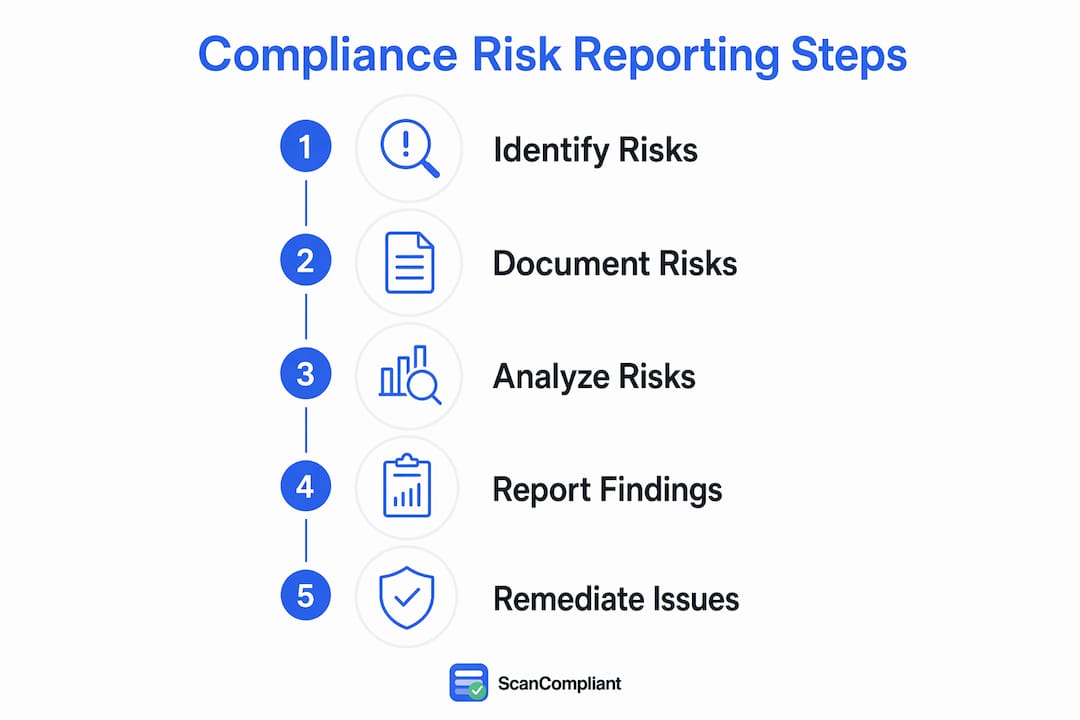
A practical operational workflow for healthcare teams looks like this:
- Assign risk owners at intake. Every newly identified risk gets a responsible party before it enters the register. Ownership without a named individual defaults to no one.
- Set KRI thresholds at amber and red levels. Amber triggers an internal review. Red triggers escalation to the compliance committee within a defined timeframe. Enforcing preset escalation timeframes prevents ambiguity during audits.
- Document breach discovery and PHI determination dates separately. Treating these as distinct event start points creates a defensible evidence package for OCR. The 60-day notification clock starts at discovery, not at determination.
- Audit high-risk components on a scheduled cycle. Medicare Cost Reports, including DSH calculations, are audit focal points that require dedicated compliance oversight. Schedule these reviews before filing deadlines, not after.
- Refresh risk analysis after every significant operational change. A new EHR system, a workforce reduction, or a third-party vendor change each qualifies as a trigger event. Document the trigger, the review date, and the outcome.
- Conduct formal risk analysis refresh cycles at least annually. Even without trigger events, an annual review confirms that the risk register reflects current operations and that controls remain effective.
Pro Tip: Build your escalation workflow into your compliance dashboard as an automated alert rather than a manual calendar reminder. Automated thresholds remove human delay from the escalation chain and create a timestamped record that satisfies auditor questions about response timeliness.
Documenting remediation outcomes is as important as documenting the risks themselves. A risk register that shows identified problems but no resolution history signals to auditors that your program identifies issues but does not close them. Every remediation plan needs a target date, a responsible owner, and a documented outcome. The compliance sign-off process is a practical model for building that accountability structure into your workflows.
What common challenges undermine compliance risk reporting in healthcare?
Stale risk analyses are the most common and most costly failure in healthcare compliance reporting. OCR’s 2026 enforcement posture treats risk analysis as a living document driving active remediation, not a yearly checkbox. A risk analysis that was thorough two years ago but has not been updated since a major system change is a liability, not an asset.
Underreporting is the second major failure point. Employees who fear retaliation do not use reporting channels. Compliance programs that lack a documented non-retaliation policy produce incomplete risk data. Incomplete risk data produces incomplete reporting. The fix is cultural and structural: publish the non-retaliation policy, train managers on it, and track report volume as a KRI in its own right.
Warning signs that your compliance risk reporting program needs attention:
- Risk register entries have no named owners or update dates
- KRIs have no defined thresholds or escalation procedures
- Anonymous reports are logged but show no documented follow-up
- Breach notification timelines are tracked by notification date only, not discovery date
- Audit workplans are not aligned to the current risk register
Decorative KRIs are a subtler problem. A KRI that says “monitor HIPAA compliance” without a measurable threshold and a defined response is not a KRI. It is a placeholder. Compliance reporting systems only work when employee reports translate into documented investigations and internal monitoring linked to actual risk reduction. The same principle applies to KRIs: measurability is not optional.
Audit workplans that are not aligned to the current risk register produce coverage gaps. If your highest-rated risks are not the focus of your next audit cycle, your program is not functioning as designed. Align audit scheduling to risk scores, and update the workplan whenever the risk register changes materially.
Key Takeaways
Effective compliance risk reporting in healthcare requires structured tools, named ownership, and continuous documentation that connects identified risks to verified remediation outcomes.
| Point | Details |
|---|---|
| Risk analysis must stay current | Update documentation after every significant operational change, not just on a fixed annual schedule. |
| KRIs need defined thresholds | Set amber and red escalation levels for each KRI so responses are automatic and timestamped. |
| Anonymous reports require follow-up | Every submission to a hotline or web form must trigger a documented investigation with a tracked outcome. |
| Breach timing starts at discovery | Log discovery date and PHI determination date separately to build a defensible OCR evidence package. |
| Audit workplans must match risk profiles | Schedule audit cycles around your highest-rated risks, and update the workplan when the register changes. |
What I have learned about compliance risk reporting after years in the field
The compliance officers who build the most defensible programs share one habit: they treat their risk register as a live operational document, not a filing cabinet. Every time I have reviewed a program that failed an OCR audit or an OIG review, the root cause was the same. The documentation existed, but it was disconnected from what the organization was actually doing. Risk entries had no owners. KRIs had no thresholds. Reports came in but nothing happened afterward.
The shift that changes everything is linking every risk entry to a named person, a specific control, and a documented remediation outcome. That linkage is what turns a compliance program from a paper exercise into a functional risk-reduction system. It is also exactly what auditors look for first.
The 2026 OCR enforcement trend reinforces this. Regulators are not just asking whether you have a risk analysis. They are asking whether it is current, whether it drove control changes, and whether you can prove it. That is a fundamentally different standard, and it requires a fundamentally different approach to how you build and maintain your reporting infrastructure.
One practical shift that pays dividends: stop treating your compliance dashboard as a reporting tool and start treating it as a decision-support tool. If your dashboard does not tell you what to do next, it is not doing its job. Build escalation logic into the thresholds, assign response owners to each alert, and review the dashboard in every compliance committee meeting. That discipline, applied consistently, is what separates programs that survive enforcement scrutiny from those that do not.
— Compliant Team
How Scancompliant supports healthcare compliance teams
Healthcare compliance teams managing marketing content face a specific risk that traditional audit processes miss: risky language published before anyone flags it. Scancompliant’s AI-powered compliance platform scans marketing content against a database of over 1,000 risk terms, identifying problematic claims before they reach patients or regulators.
Scancompliant has protected more than 200 brands by delivering prioritized findings in minutes rather than days. For telehealth and direct-to-consumer health brands, that speed means marketing teams can move fast without creating FDA or FTC exposure. The platform also generates a documented compliance trail, giving compliance officers the audit-ready evidence they need when regulators ask for proof of review. See Scancompliant’s pricing plans to find the right fit for your team’s review volume and regulatory obligations.
FAQ
What is compliance risk reporting in healthcare?
Compliance risk reporting in healthcare is the systematic process of identifying, documenting, and communicating regulatory risks to protect patient safety and organizational integrity. It includes risk registers, compliance dashboards, KRI tracking, and anonymous reporting channels.
How often should healthcare teams update their risk analysis?
The HIPAA Security Rule requires risk analysis to be updated in response to environmental or operational changes, not on a fixed calendar schedule. Any significant system change, vendor addition, or workforce event triggers an update obligation.
What are Key Risk Indicators in healthcare compliance?
Key Risk Indicators are measurable metrics with defined thresholds that signal when a compliance risk requires escalation. Healthcare frameworks recommend 45–60 KRIs per organization, with 8–12 escalated to risk committees each quarter.
When must a HIPAA breach be reported to affected individuals?
HIPAA Breach Notification requires notification to affected individuals within 60 days of discovery. The clock starts at discovery, not at the conclusion of the investigation or the PHI determination date.
How does the OIG MA ICPG support compliance risk reporting?
The OIG’s Medicare Advantage Industry Segment-Specific Compliance Program Guidance provides a centralized reference for identifying risk areas and recommended mitigating actions. Teams that use it as a baseline produce more specific and auditable compliance findings than those relying on generic frameworks.
Recommended
- Healthcare Marketing Compliance Training Teams: 2026 Guide – scancompliant.com
- Compliance Review Turnaround Time Benchmarks: 2026 Guide – scancompliant.com
- How Content Compliance Audits Work for Healthcare Teams – scancompliant.com
- Compliance Sign-Off Process: A Guide for Healthcare Teams – scancompliant.com
4 Comments