
A compliance sign-off process is a formal control workflow that validates proposed activities against regulatory and internal requirements before execution, creating an audit-ready record with signer identity, document version, and timestamp. For compliance officers and healthcare professionals in telehealth and direct-to-consumer health branding, this process is not optional governance paperwork. It is the documented proof that your team reviewed, approved, and authorized content or actions under the right authority at the right time. FDA and FTC enforcement actions regularly cite missing or incomplete approval records as evidence of systemic compliance failure.
What is a compliance sign-off process, step by step?
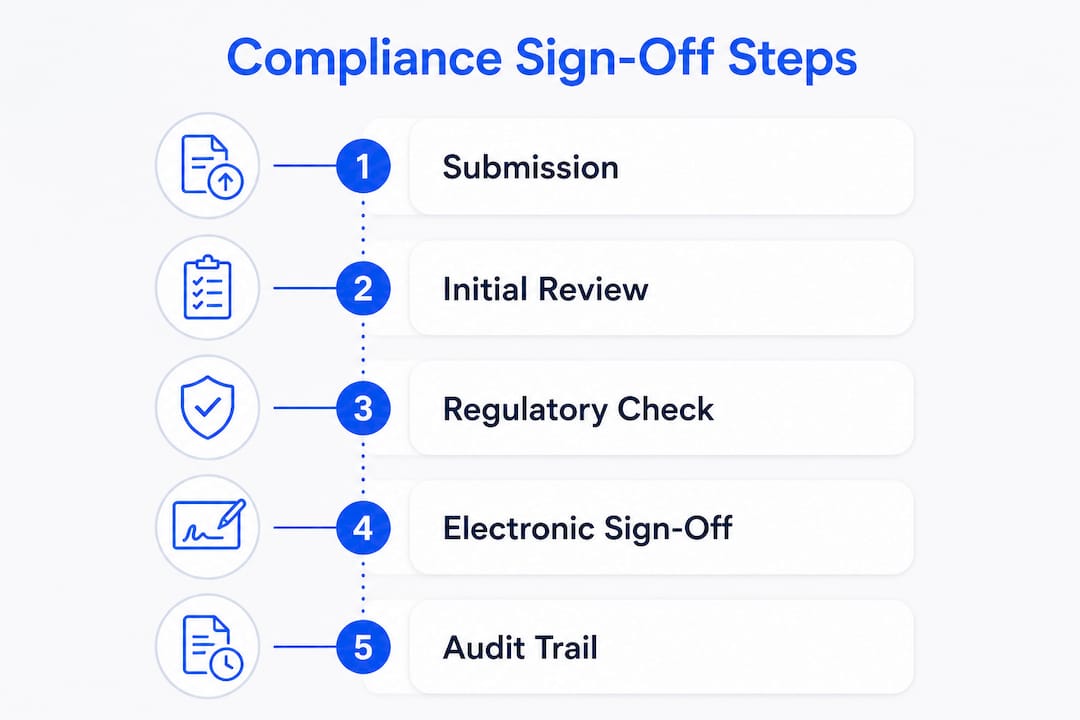
The compliance sign-off process, also called a compliance approval workflow, moves a document or action through defined checkpoints before it receives formal authorization. Each stage produces evidence that survives regulatory scrutiny.
Here are the core stages:
- Submission. The initiating team submits the asset, whether a marketing claim, clinical protocol, or policy update, along with required documentation and mandatory fields completed. Incomplete submissions are rejected at intake, not discovered later.
- Requirement validation. The system or reviewer checks the submission against applicable rules. For telehealth brands, this means FDA regulations on health claims and FTC rules on advertising substantiation. For DTC health brands, common FDA triggers like unsubstantiated efficacy claims are flagged here.
- Risk-based review. Compliance and legal teams assess the asset based on its risk profile. A social media post carries different risk than a clinical consent form. High-risk assets receive deeper scrutiny and more reviewers.
- Final authorization. Low-risk assets may need one sign-off. High-risk assets require multi-tiered approvals from compliance leadership and executive stakeholders. Each approver’s identity, role, and timestamp are captured.
- Record locking. The approved version is locked. No edits are permitted without triggering a new review cycle.
Pro Tip: Build rejection criteria into step one. If a submission arrives without the required regulatory context or document version number, return it immediately. Reviewing incomplete submissions wastes reviewer time and creates ambiguous audit records.
How do electronic signatures strengthen the approval process?

Electronic signatures are legally valid under the ESIGN Act and UETA when they capture signer intent, identity, and timestamp. This matters because a printed signature on a PDF stored in a shared drive does not meet audit-grade standards. Regulators want to know who signed, what version they reviewed, and whether they held valid authority at that moment.
Technology transforms the compliance approval process in four specific ways:
- Automated routing sends submissions to the correct reviewer based on asset type and risk level, eliminating manual handoffs that create delays and lost records.
- Version control locks document versions at each stage so reviewers cannot inadvertently approve an edited draft. Audit trails require immutable logs, version locking, and content hashing, not just saved email threads.
- AI-assisted validation flags risky language before human reviewers ever see the document. AI-assisted review can reduce review times by 30–50% compared to manual handoffs.
- Re-signing triggers automatically prompt signatories when a policy updates. Auditors expect annual re-acknowledgment or immediate re-signing upon material policy changes, not a blanket assumption that last year’s approval still applies.
Platforms like Diligent and workflow tools that integrate compliance checks directly into CRM or project management systems reduce the friction that causes teams to bypass formal sign-off entirely.
Pro Tip: Treat your audit trail as a separate technical artifact from your approval record. Saving the approval email is not an audit trail. Your system needs to capture the exact document version reviewed, the signer’s authority at signing time, and a tamper-evident log.
What are the biggest pitfalls in sign-off procedures?
Most compliance bottlenecks are not caused by regulatory complexity. Fragmented data and uncentralized sources are the primary drivers of rework, delays, and missed approvals. Understanding where sign-off procedures break down helps you fix the right problems.
| Common Pitfall | Root Cause | Recommended Fix |
|---|---|---|
| Rework from conflicting document versions | No centralized version control | Use a single platform with locked version history |
| Approvals with no audit trail | Email-based sign-off without logging | Require platform-generated, timestamped records |
| Wrong person approving | Static authority lists not updated | Verify signatory authority dynamically at each signing event |
| Disputes stalling approvals | No escalation path defined | Pre-define risk-based escalation routes before disputes arise |
| Compliance bypassed under deadline pressure | Sign-off not embedded in workflow | Integrate compliance checks into existing project tools |
Sign-off authority is dynamic. Personnel change, roles shift, and delegations expire. An audit-ready system must confirm that the signer held valid authority at the exact moment of signing, not just that a signature exists on the document. This is a detail that many organizations overlook until a regulator asks for it.
The approval versus audit trail confusion is equally damaging. Approval confirms a decision was made. An audit trail proves the decision was made correctly, by the right person, on the right version, under the right authority. Conflating the two leaves organizations exposed during regulatory reviews.
How does this process apply to telehealth and DTC health brands?
Telehealth and DTC health brands operate under a regulatory stack that includes FDA, FTC, and HIPAA. Each layer adds sign-off requirements that general compliance frameworks do not fully address. A marketing claim for a telehealth service, for example, must clear FTC substantiation standards and avoid FDA-regulated disease claims, often in the same sentence.
The compliance sign-off requirements for these brands typically follow this sequence:
- Marketing content submission with the specific claim category identified, such as structure/function, efficacy, or comparative.
- Automated pre-screening for risk terms. Scancompliant’s database of over 1,000 risk terms catches language that human reviewers routinely miss, including subtle implied claims that trigger FDA warning letters.
- Compliance officer review of flagged content with documented rationale for approval or rejection. This rationale becomes part of the audit record.
- Legal review for high-risk claims, particularly those referencing clinical outcomes or patient testimonials.
- Executive sign-off for campaigns above a defined risk threshold. Executive signatures on risk reports signal high-level endorsement and responsibility, which regulators treat as evidence of organizational intent.
- Annual re-acknowledgment of internal policies governing marketing claims, plus immediate re-signing when FDA or FTC guidance updates affect existing approved content.
Pro Tip: Map your sign-off requirements to specific regulatory triggers, not just asset types. A blog post about telehealth weight loss services carries different FDA exposure than a general wellness article. Your routing rules should reflect that distinction.
Telehealth brands also face event-driven re-acknowledgment cycles. When the FTC updates its health advertising guidance or FDA issues a new warning letter category, every previously approved asset in that category needs re-review. Building that trigger into your policy acknowledgment process prevents the assumption that old approvals cover new regulatory realities.
Key takeaways
A compliance sign-off process is only as strong as the audit trail it produces, the authority it verifies, and the technology that enforces it consistently.
| Point | Details |
|---|---|
| Define the process formally | A compliance sign-off process must capture signer identity, document version, and timestamp to be audit-ready. |
| Separate approval from audit trail | Saving an approval email is not an audit trail; use immutable logs and version locking instead. |
| Verify authority dynamically | Confirm each signer held valid authority at signing time, not just that a signature exists. |
| Embed sign-off in existing workflows | Integrating compliance checks into project tools reduces bypass risk under deadline pressure. |
| Apply sector-specific routing | Telehealth and DTC brands need claim-category routing that reflects FDA and FTC exposure levels. |
Why sign-off is a governance tool, not a formality
By Compliant Team
After working with regulatory and marketing teams across telehealth and DTC health brands, the pattern I see most often is this: organizations treat sign-off as the last step before publishing, not as a governance control that runs through the entire content lifecycle. That framing creates real risk.
When sign-off is positioned as a final gate, teams optimize for getting through it quickly. Reviewers feel pressure to approve rather than scrutinize. Audit trails get assembled after the fact rather than generated in real time. And when a regulator asks for documentation, the records look like they were built to satisfy a checklist rather than to demonstrate genuine oversight.
The organizations that handle FDA and FTC scrutiny well treat sign-off as a strategic accountability mechanism. Every approval is a documented assertion that a qualified person, with valid authority, reviewed a specific version of content against specific regulatory standards. That framing changes how teams prepare submissions, how reviewers document their rationale, and how leadership thinks about their signature on a risk report.
The technology piece matters, but only after the governance model is right. AI-assisted pre-screening and automated routing are powerful tools. They catch what humans miss and they generate consistent records. But if your sign-off authority lists are outdated or your escalation paths are undefined, technology will just move bad process faster.
The most underrated best practice in compliance sign-off is dynamic authority verification. Most teams maintain a static list of approved signatories and never update it when people change roles. Auditors notice this. Build the verification step into your platform so it happens automatically at every signing event.
— Compliant Team
How Scancompliant supports your sign-off workflow
Compliance officers and marketing teams at telehealth and DTC health brands need a system that catches risk before it reaches human reviewers, not after.

Scancompliant’s AI-powered platform scans marketing content against a database of over 1,000 risk terms, delivering prioritized findings in minutes. The platform has protected more than 200 brands by identifying subtle FDA and FTC violations that manual review misses. Every scan produces a documented compliance trail, giving your team the audit-ready evidence that regulators expect. Whether you are managing multi-stage approval workflows or preparing for an annual re-acknowledgment cycle, Scancompliant’s marketing compliance tools give your team the speed and documentation depth to stay ahead of regulatory exposure. Review transparent pricing options to find the plan that fits your review volume.
FAQ
What is a compliance sign-off process?
A compliance sign-off process is a formal workflow that validates proposed activities against regulatory and internal requirements before execution. It produces an audit-ready record capturing signer identity, document version, and timestamp.
How does a compliance sign-off differ from an audit trail?
Approval confirms a decision was made; an audit trail proves it was made correctly. Audit trails require immutable logs, version locking, and content hashing, not just saved email approvals.
What sign-off requirements apply to telehealth marketing?
Telehealth marketing must clear FDA rules on health claims, FTC substantiation standards, and HIPAA requirements where patient data is referenced. High-risk claims require multi-tiered sign-offs from compliance officers and executive leadership.
How often should compliance sign-offs be renewed?
Auditors expect annual re-acknowledgment of policies and immediate re-signing when material policy changes occur. Event-driven triggers, such as new FDA guidance or FTC warning letter categories, should also prompt re-review of previously approved content.
Can electronic signatures satisfy compliance sign-off requirements?
Yes. Electronic signatures are legally valid under the ESIGN Act and UETA when they capture signer intent, identity, and a verifiable timestamp. The signature must also confirm the signer held valid authority at the time of signing.
2 Comments