
Compliant content release is the structured process of verifying that healthcare marketing materials meet all regulatory, legal, and internal approval requirements before publication. For marketing and compliance professionals, understanding what does compliant content release mean goes beyond a simple sign-off. It covers Medical-Legal-Regulatory review, HIPAA authorization checks, FTC disclosure requirements, and documented audit trails. Getting this process wrong exposes brands to FDA warning letters, patient harm, and financial penalties. Getting it right protects the brand, the patient, and the business.
What does compliant content release mean in healthcare marketing?
Compliant content release is defined as a pre-publication process that verifies accuracy, mandatory notices, data privacy adherence, and final approval by a designated owner across all content types, including AI-generated text. The industry term for the core review mechanism is Medical-Legal-Regulatory (MLR) review. Both phrases describe the same operational reality: no healthcare marketing asset goes public without passing through medical, legal, and regulatory checkpoints.
The meaning of compliant content extends beyond legal box-checking. MLR review ensures marketing content is medically accurate, legally defensible, and regulator-aligned before it reaches any audience. Failure at this stage leads to FDA warning letters, injunctions, and financial consequences that can dwarf the cost of the review itself.

Healthcare brands operating in telehealth and direct-to-consumer (DTC) channels face the highest exposure. A single unsubstantiated claim about a treatment outcome can trigger FTC enforcement. A single use of Protected Health Information (PHI) without patient authorization can trigger HIPAA penalties. Compliant content release is the control that prevents both.
What are the key components of a compliant content release workflow?
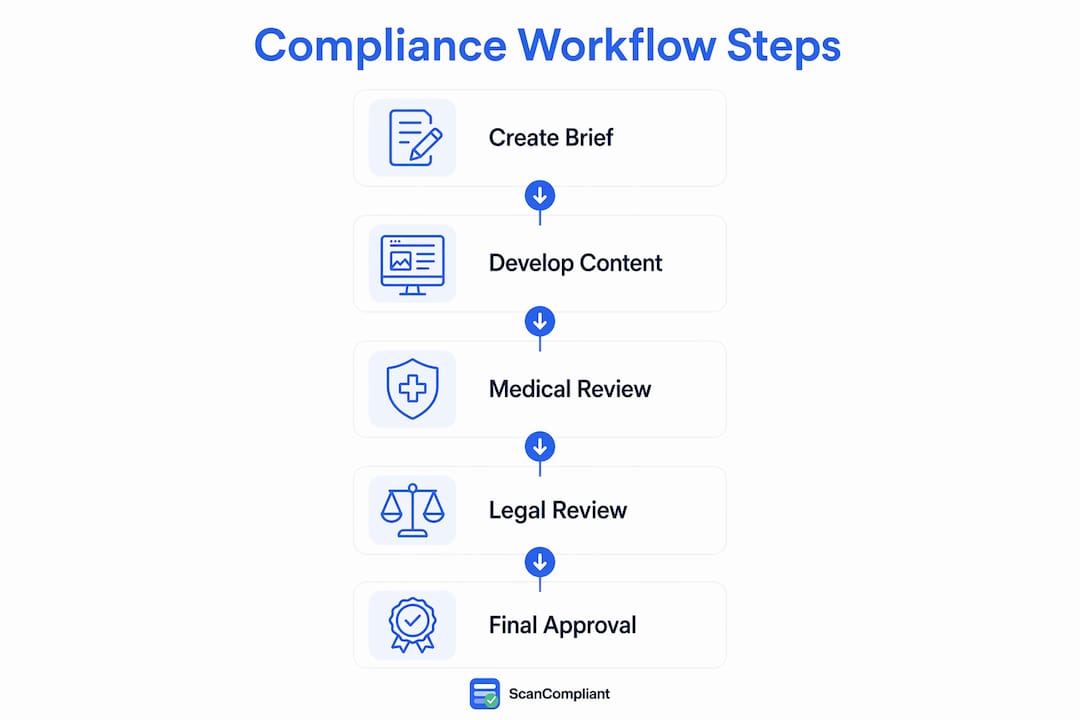
A structured MLR workflow follows a defined sequence. Each stage has a clear owner, a defined scope, and a deadline. The separation of medical and legal review roles reduces delays and improves efficiency. Here is how a standard workflow runs:
- Content creation. The marketing team drafts the asset using pre-approved claims where possible. Writers flag any new claims that require medical or legal review.
- Medical review. A medical officer or clinical reviewer checks factual accuracy, clinical substantiation, and any therapeutic claims. This stage produces written feedback, not verbal approval.
- Legal review. Legal counsel checks for liability exposure, intellectual property issues, and regulatory risk. Legal and medical review can run in parallel for low-risk content.
- Regulatory review. A regulatory affairs professional checks alignment with FDA, FTC, and applicable state rules. This stage also verifies that mandatory disclosures are present and correctly formatted.
- Final sign-off. A designated approval owner, typically a senior compliance or regulatory officer, issues formal written approval. No asset moves to publication without this sign-off.
- Archiving. The approved asset, all review comments, and the sign-off record are stored in a retrievable audit trail.
Marketing approval workflows in pharma and healthcare rely on structured role definitions and RACI-style responsibility mapping to clarify final approval authority and avoid redundant sign-offs. Without a formal governance model, teams duplicate effort and create conflicting approval records.
Pro Tip: Build a pre-approved claim library before campaign season. Separating claim development from final creative approval avoids late-stage regulatory conflicts and expensive content revisions. Modular claims can be assembled into new assets without restarting the full MLR cycle.
Risk-based routing is the other critical component. Simple content, such as a social post with no therapeutic claims, can move through review in 48 hours. Complex content, such as a clinical outcomes brochure, requires a longer review window. Healthcare compliance workflows use this risk-based routing to balance timely release with meeting compliance standards.
How do HIPAA and FTC rules shape compliant content release?
Regulatory requirements define the floor for what compliant content release must achieve. Two frameworks dominate healthcare marketing: HIPAA and FTC guidelines.
HIPAA requirements for marketing content:
- Marketing communications involving PHI require patient authorization before use or disclosure, particularly when third-party remuneration is involved.
- Exceptions exist for treatment communications and certain health promotion activities, but these exceptions are narrow and fact-specific.
- Marketing tools like forms and tracking pixels can inadvertently expose PHI, creating compliance breaches that originate in the technology stack, not the content itself.
- Vendor risk management requires Business Associate Agreements (BAAs) with any third-party tool that may access PHI during a campaign.
FTC requirements for healthcare marketing content:
- Social media posts by influencers or brand employees must disclose material connections clearly and conspicuously.
- Performance claims must be substantiated with competent and reliable scientific evidence.
- Testimonials that do not reflect typical results require a clear disclaimer.
- Social media compliance requires archiving all content, including deleted posts, as evidence that may need to be retrieved long after publication.
AI-assisted content adds a third layer of content compliance requirements. AI-generated healthcare content must include an AI disclosure, substantiation of any performance claims, and records such as generation dates and provenance metadata. Regular re-review schedules, such as quarterly audits, help maintain compliance governance as AI outputs evolve.
Pro Tip: Treat your compliance sign-off process as a legal document, not an internal formality. Date-stamped approvals with named signatories are your first line of defense in an enforcement inquiry.
What are common challenges and best practices for ensuring compliance without delays?
The most common failure in healthcare content compliance is treating review as an end-of-process check. When compliance teams receive a finished asset two days before the launch date, they face a binary choice: approve under pressure or delay the campaign. Neither outcome serves the brand.
| Approach | Risk level | Typical outcome |
|---|---|---|
| End-of-process compliance check | High | Late-stage rework, launch delays, or forced approval under pressure |
| Compliance integrated at brief stage | Low | Fewer revisions, faster final approval, cleaner audit trail |
| Pre-approved modular claim library | Low | Fastest time to publication, minimal MLR cycle needed |
| No formal sign-off owner | Critical | Conflicting approvals, no audit trail, regulatory exposure |
Incorporating compliance early in content development, with clear ownership and documentation, prevents costly rework. The brief stage is the right moment to flag regulatory constraints, not the final review stage.
Three additional best practices reduce bottlenecks without cutting corners. First, define deadlines by content type and communicate them to the marketing team before a campaign begins. Second, build a pre-approved social media content library for recurring content types such as awareness posts, appointment reminders, and general health tips. Third, maintain version control on every asset so reviewers can see exactly what changed between drafts. Version confusion is a leading cause of redundant review cycles.
A clear governance model with formal responsibility matrices avoids confusion over final approval authority. When two people believe they hold final sign-off, neither record is reliable in an audit.
How can technology and training support compliant content release?
Technology does not replace the MLR review process. It makes the process faster, more consistent, and fully auditable. The right platform eliminates the email chains, spreadsheet trackers, and informal approvals that create compliance gaps.
Key capabilities to look for in a compliance platform:
- Workflow management. The platform routes content to the correct reviewers based on content type and risk level. Reviewers receive notifications, submit feedback in a structured format, and record their approval in the system.
- Digital audit trails. Every review action, comment, and approval is time-stamped and stored. This record is retrievable for regulatory inquiries without manual reconstruction.
- AI content scanning. Platforms like Scancompliant scan marketing copy against a database of risk terms before the asset enters the formal MLR cycle. Scancompliant reports over 1,000 risk terms in its database and has protected more than 200 brands. Catching a problematic claim at the draft stage costs minutes. Catching it after publication costs far more.
- Role-based access. Medical, legal, and regulatory reviewers see only what they need to see. This separation preserves the integrity of independent review.
- Vendor risk controls. Any platform that touches PHI must operate under a BAA and pass a data security assessment.
Training is the other half of the equation. Technology without trained teams produces approvals that look correct but miss substantive issues. Healthcare marketing compliance training for both marketing and compliance staff should cover HIPAA marketing rules, FTC disclosure requirements, platform-specific social media rules, and the organization’s internal MLR workflow. Training records belong in the same compliance documentation system as content approvals.
Pro Tip: Run a quarterly content compliance audit on live assets, not just pre-publication reviews. Regulations change, and content that was compliant at publication may require updates within months.
Key Takeaways
Compliant content release requires early integration of medical, legal, and regulatory review into the content development process, supported by documented audit trails and trained teams.
| Point | Details |
|---|---|
| MLR review is the core process | Every healthcare marketing asset must pass medical, legal, and regulatory review before publication. |
| HIPAA and FTC set the compliance floor | PHI use requires patient authorization; social media claims require substantiation and disclosure. |
| Early integration prevents delays | Compliance built into the brief stage eliminates late-stage rework and forced approvals. |
| Audit trails are non-negotiable | Date-stamped, named sign-offs protect the brand in enforcement inquiries and regulatory audits. |
| Technology accelerates, training sustains | AI scanning tools catch risk terms fast; trained teams make the judgment calls that tools cannot. |
Compliance as a competitive advantage, not a bottleneck
The teams I see struggle most with compliant content release share one belief: compliance is the department that says no. That belief produces adversarial workflows where marketing submits finished assets and compliance returns red lines. Both sides lose time, and the brand loses agility.
The teams that move fastest treat compliance as a design constraint, not a final filter. They bring regulatory affairs into the campaign brief. They build claim libraries before creative work begins. They use AI scanning tools to catch obvious issues before the asset reaches a human reviewer. The result is a shorter MLR cycle, not a longer one.
The trend I watch most closely in 2026 is the rise of AI-generated content in healthcare marketing. The compliance requirements for AI content, including disclosure, substantiation, and provenance records, are not optional. Brands that build these requirements into their AI content workflows now will avoid the enforcement actions that are coming for brands that do not.
The uncomfortable truth is that most compliance delays are self-inflicted. They come from unclear ownership, late submission, and the absence of pre-approved building blocks. Fix those three things and the MLR cycle gets faster without any reduction in rigor. That is the version of compliance that actually protects the brand.
— Compliant Team
How Scancompliant supports your content release process
Healthcare marketing teams need a faster path from draft to approved, without cutting corners on regulatory review. Scancompliant was built for exactly that problem.

Scancompliant’s AI-powered platform scans marketing copy against more than 1,000 risk terms, flags problematic language before it enters the MLR cycle, and delivers prioritized findings in minutes. The platform supports role-based approvals, digital audit trails, and documented compliance records that hold up under FDA and FTC scrutiny. More than 200 brands already rely on Scancompliant to protect their content before publication. Review Scancompliant’s platform to see how it fits your team’s workflow, and check available pricing tiers to find the right plan for your organization.
FAQ
What does compliant content release mean in healthcare?
Compliant content release is the process of verifying that healthcare marketing materials meet all regulatory, legal, and internal requirements before publication. It includes MLR review, HIPAA authorization checks, FTC disclosure verification, and documented sign-off by a designated approval owner.
What is the MLR review process?
MLR review is a structured workflow where marketing content passes through medical, legal, and regulatory review before external distribution. Each reviewer checks a defined scope, and the process ends with formal written sign-off and archiving of all review records.
How does HIPAA affect healthcare marketing content?
HIPAA requires patient authorization before using Protected Health Information in marketing communications, especially when third-party payment is involved. Marketing tools like tracking pixels can also expose PHI, so vendor contracts and BAAs are part of HIPAA compliance.
How can teams speed up compliance review without increasing risk?
Teams reduce review time by integrating compliance at the brief stage, building pre-approved claim libraries, and using AI scanning tools to catch risk terms before formal MLR review begins. Review turnaround benchmarks show that risk-based routing, with faster tracks for simple content, cuts overall cycle time significantly.
Does AI-generated content require special compliance steps?
Yes. AI-assisted healthcare content requires an AI disclosure, substantiation of any performance claims, and records including generation dates and provenance metadata. Quarterly re-review schedules help maintain compliance as AI outputs change over time.