
A content compliance audit is the systematic evaluation of digital marketing materials against FDA regulations, FTC guidelines, HIPAA requirements, and internal brand policies to identify and correct violations before they create legal exposure. Healthcare marketing teams that skip this process face fines, ad rejections, and reputational damage that far outweigh the cost of a structured review. The formal industry term is “regulatory content audit,” though “content compliance audit” is now standard across compliance and marketing functions. Understanding how content compliance audits work gives your team a repeatable defense against the regulatory risks unique to healthcare communications.
How does a content compliance audit process work?
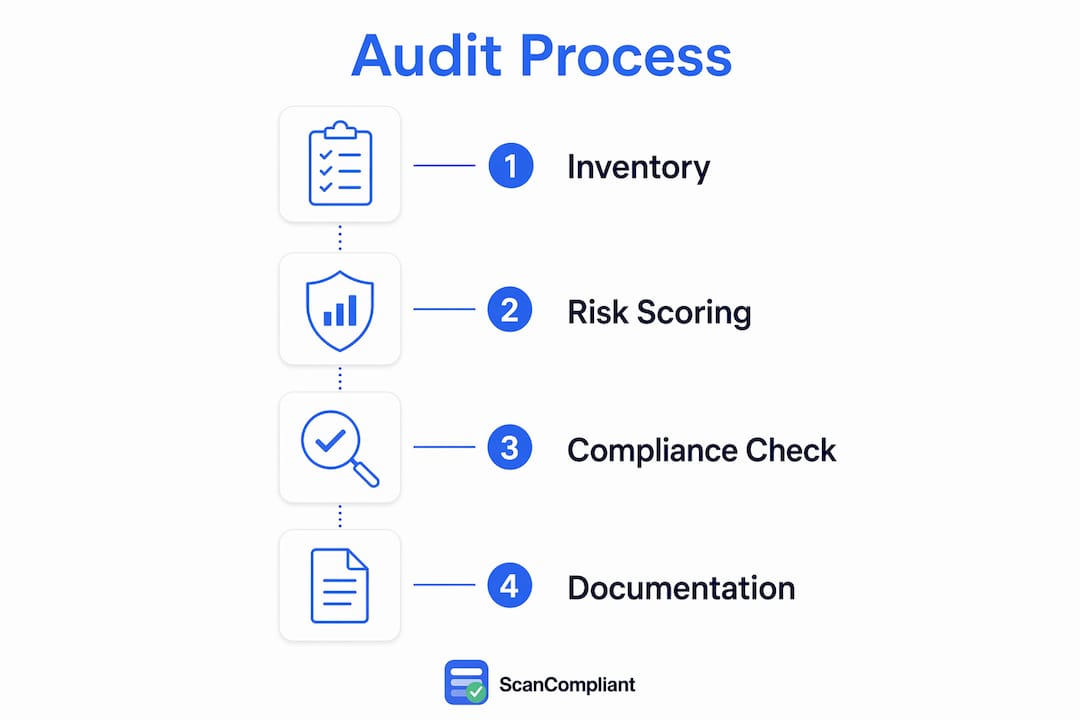
A content compliance audit follows four core stages: inventory, risk scoring, remediation, and documentation. Each stage builds on the last. Skipping inventory and jumping straight to quality review is the most common reason audits fail and waste resources.
Stage 1: Content inventory
Successful audit strategies start with a thorough content inventory that catalogs every digital asset before any quality evaluation begins. That means URLs, landing pages, email templates, social media posts, paid ad copy, and downloadable PDFs all get logged in a single master list. Without this catalog, high-risk pages get missed and audit effort scatters across low-priority content.

Stage 2: Risk scoring and prioritization
Once you have a complete inventory, rank each asset by two factors: regulatory risk level and traffic volume. A product page making unsubstantiated efficacy claims and receiving 50,000 monthly visitors ranks far above a low-traffic blog post with a minor disclaimer gap. This prioritization focuses legal resources on high-exposure content first, which is where audit prioritization delivers maximum compliance value.
Stage 3: Compliance checkpoints
Each asset then moves through a content compliance checklist covering claim substantiation, required disclaimers, HIPAA data references, FDA-regulated language, and FTC disclosure requirements. Common issues found at this stage include keyword cannibalization between condition pages, broken links to required disclosures, and orphan pages that bypass the approval workflow entirely.
Stage 4: Documentation and audit trail
Every finding, change, and approval gets recorded with a timestamp and the name of the reviewer. Documented accountability trails linking approvals to specific regulatory clauses are the difference between a defensible compliance record and a liability in legal discovery.
Pro Tip: Build your content compliance checklist directly from your regulatory risk register. Map each checklist item to a specific FDA, FTC, or HIPAA clause so reviewers know exactly which rule they are checking against.
How do AI tools change content compliance auditing?
AI-powered tools have fundamentally changed the speed and scale of compliance auditing. AI-driven tools scan text, images, and video for policy violations in seconds, compared to the hours or days a manual review team requires. That speed matters when a telehealth brand publishes dozens of new content pieces each week across multiple channels.
The table below shows where AI tools outperform manual review and where human judgment remains necessary.
| Capability | AI-powered tools | Manual review |
|---|---|---|
| Speed of violation detection | Seconds per asset | Hours to days |
| Scalability across large content libraries | High | Low |
| Contextual regulatory judgment | Limited | Strong |
| Audit trail generation | Automated | Manual logging required |
| Multi-language support | Available in leading platforms | Dependent on reviewer expertise |
| Metadata and provenance verification | Requires human oversight | Human-led |
AI tools accelerate compliance auditing by quickly identifying violations, but they require human expertise to verify context and confirm regulatory correctness. A tool may flag the phrase “clinically proven” as a risk term, but a human reviewer must determine whether the supporting evidence on file actually substantiates that claim under FDA standards.
Scancompliant operates on this exact model. Its database contains over 1,000 risk terms, and it has protected more than 200 brands by delivering prioritized findings in minutes. The platform generates a documented compliance trail automatically, which removes the manual logging burden from your team.
Pro Tip: Run AI scans on every new content draft before it enters the human review queue. This filters out obvious violations early and lets your compliance team focus their time on judgment calls that require regulatory expertise.
What compliance risks must healthcare content audits address?
Healthcare marketing carries a distinct set of regulatory obligations that general content audits do not cover. The content compliance process must account for all of the following:
- FDA claim substantiation. Any efficacy, safety, or comparative claim in a healthcare ad must be backed by competent and reliable scientific evidence. The most common FDA warning letter triggers include unsubstantiated disease claims, misleading before-and-after comparisons, and omitted risk information.
- FTC disclosure requirements. Paid endorsements, affiliate relationships, and sponsored content require clear and conspicuous disclosures. The FTC has increased enforcement against telehealth and DTC health brands specifically.
- HIPAA references in marketing copy. Any content that references patient outcomes, case studies, or testimonials must be reviewed for HIPAA compliance, including proper authorization documentation.
- EU AI Act transparency labeling. EU AI Act Article 50 requires transparency labeling for AI-generated commercial content, effective august 2, 2026, with penalties up to €15 million or 3% of global annual turnover. Brands operating in EU markets must audit AI-generated content for proper disclosure.
- Social media platform policies. Facebook, Instagram, and Google each maintain their own healthcare advertising policies that differ from FDA and FTC rules. Cross-channel compliance requires a separate checklist layer for each platform.
- Pre-launch AI content review. AI-generated content without human oversight creates a compliance gap that regulators are actively targeting. Metadata accuracy and content provenance must be verified before publication.
The operational consequences of non-compliance are concrete: ad account suspensions, consent decree investigations, civil monetary penalties, and the reputational cost of a public FDA warning letter. A regulatory review checklist built specifically for healthcare marketing reduces the chance that any of these risks slip through.
How can healthcare teams make compliance audits more efficient?
Compliance is a continuous management system, not a one-time project. The teams that run the most efficient audits treat compliance as a workflow layer, not a final gate. These five practices separate high-performing compliance teams from those perpetually in catch-up mode.
-
Embed compliance at the brief stage. Building compliance requirements into the brief prevents last-minute bottlenecks and expensive rejections. When writers know the regulatory constraints before they draft, the content arrives at review with fewer violations.
-
Segment audits by risk tier. Not every piece of content carries the same exposure. Paid ads making therapeutic claims require immediate legal review. A general wellness blog post with a minor formatting issue can wait. Tiered triage keeps your legal team focused on what matters most.
-
Separate legal issues from performance issues. Audit workflows should separate legal issues needing immediate action from brand or performance concerns that can be queued for later. Mixing the two creates confusion and slows down urgent remediation.
-
Require human review for all AI-generated content. Pre-launch checkpoints with human-in-the-loop review prevent compliance gaps and confirm that AI-generated content includes accurate metadata and proper provenance records. This step is non-negotiable under current and emerging transparency regulations.
-
Link every approval to a specific regulatory clause. A sign-off that says “approved” provides weak legal defense. An approval record that cites the specific FDA guidance or FTC rule the content satisfies is a genuine legal asset. The compliance sign-off process for healthcare teams should require this level of specificity as standard practice.
Pro Tip: Schedule a full content inventory review at least twice per year. Companies that audit twice annually maintain stronger domain authority and regulatory standing than those running ad hoc reviews.
Key Takeaways
A content compliance audit protects healthcare brands by systematically identifying regulatory violations, documenting approvals against specific legal clauses, and embedding compliance into every stage of the content workflow.
| Point | Details |
|---|---|
| Start with inventory | Catalog every digital asset before scoring risk or reviewing quality. |
| Prioritize by risk and traffic | Focus legal resources on high-exposure, high-traffic content first. |
| Use AI tools with human oversight | AI scans catch violations fast; human reviewers confirm regulatory context. |
| Document approvals to specific clauses | Link every sign-off to a named FDA, FTC, or HIPAA rule for legal defense. |
| Embed compliance at the brief stage | Define regulatory requirements before drafting to prevent late-stage rejections. |
The audit mindset most healthcare teams still get wrong
The biggest mistake I see healthcare marketing teams make is treating a content compliance audit as a cleanup project. They run one before a product launch or after receiving a warning letter, then consider the job done. That mindset is exactly what creates the next warning letter.
Compliance does not live at the end of the content process. It belongs at the beginning, the middle, and the end. The teams I have seen handle regulatory scrutiny well are the ones who can pull up an approval record for any piece of content and show exactly which regulatory clause it was reviewed against, who approved it, and when. That level of documentation does not happen by accident. It requires a workflow where compliance is a standing checkpoint, not an afterthought.
The rise of AI-generated content has made this even more urgent. Regulators are not waiting for the industry to self-regulate on transparency labeling. The EU AI Act deadline is real, and the FTC has made clear that “the algorithm wrote it” is not a compliance defense. Every piece of AI-generated content your team publishes needs a human reviewer who can verify its claims, its metadata, and its disclosure language before it goes live.
The teams that will stay ahead of this are the ones building compliance training into their culture now, not scrambling to retrofit it after a regulatory action.
— Compliant Team
See how Scancompliant handles this for healthcare brands
Healthcare marketing teams managing high content volume need more than a checklist. They need a system that catches risky language before it reaches a regulator.
Scancompliant is an AI-powered content scanning platform built specifically for telehealth and DTC health brands. It scans marketing copy against a database of over 1,000 risk terms, flags FDA and FTC violations in minutes, and generates a documented audit trail automatically. More than 200 brands have used it to reduce review cycle time and maintain a defensible compliance record. If your team is ready to move from reactive audits to a continuous compliance workflow, explore Scancompliant to see how it fits your review process. Transparent pricing plans are available for teams at every stage.
FAQ
What is content compliance in healthcare marketing?
Content compliance is the practice of ensuring all marketing materials meet FDA, FTC, and HIPAA requirements before publication. It covers claim substantiation, required disclosures, data privacy references, and platform-specific advertising policies.
How often should healthcare teams run content compliance audits?
Companies that audit at least twice per year maintain stronger regulatory standing than those running one-time reviews. High-volume publishers or brands running paid campaigns should conduct rolling audits on new content before each publication.
What does a content compliance checklist include?
A healthcare content compliance checklist covers claim substantiation evidence, required disclaimers, HIPAA authorization for patient references, FTC disclosure language, and platform-specific ad policy requirements. Each item should map to a specific regulatory clause.
Can AI tools replace human reviewers in a compliance audit?
AI tools identify violations fast and generate audit trails automatically, but they cannot replace human judgment on regulatory context. Human reviewers must confirm whether flagged claims are substantiated and whether disclosures meet the specific standard required by the relevant regulation.
What happens if healthcare marketing content fails a compliance audit?
Consequences range from ad rejections and account suspensions to FDA warning letters and FTC civil penalties. Brands without documented audit trails face greater legal exposure because they cannot demonstrate a good-faith compliance effort during regulatory review.
Recommended
- Healthcare Marketing Compliance Training Teams: 2026 Guide – scancompliant.com
- Regulatory Review Checklist for Healthcare Marketing – scancompliant.com
- Compliance Sign-Off Process: A Guide for Healthcare Teams – scancompliant.com
- Telehealth Email Marketing Compliance Tips for 2026 – scancompliant.com
4 Comments