
A compliance audit is an independent, evidence-based review that tests whether an organization’s policies and applicable regulations are effectively implemented. For healthcare and regulatory teams, understanding the compliance audit process is not optional. Frameworks like HIPAA, ISO 27001, and SOC 2 each carry audit obligations with real enforcement consequences. This article breaks down the full audit lifecycle, from pre-audit preparation through remediation verification, with specific attention to the evidence standards and regulatory expectations that define success in healthcare settings.
How compliance audits work: the standard process
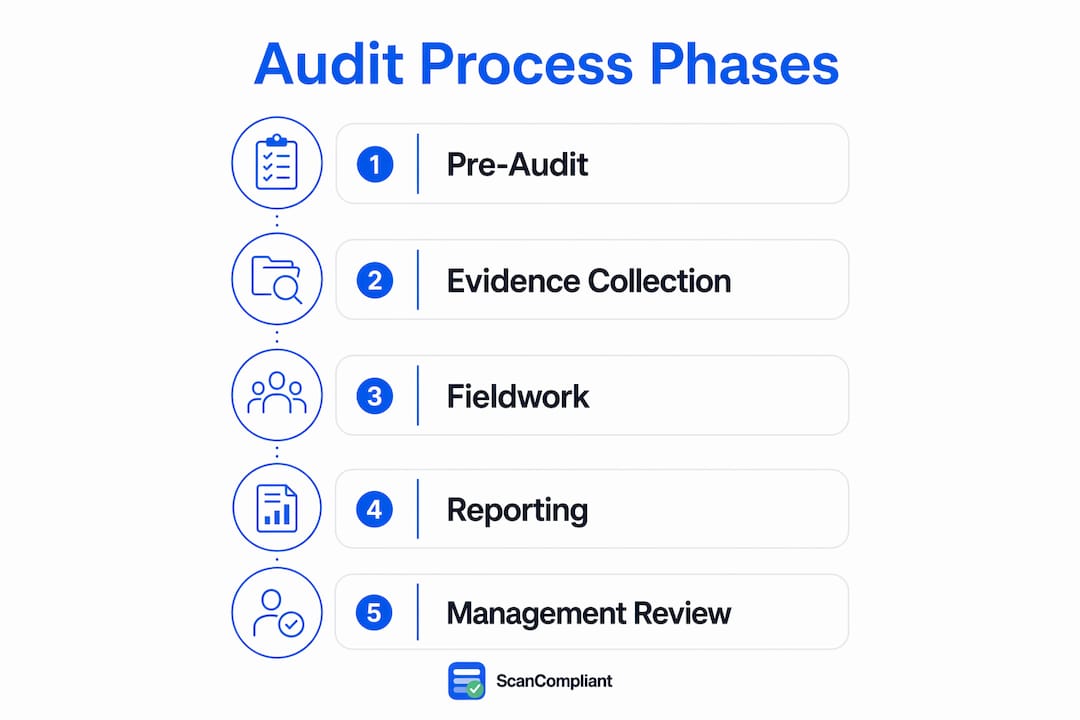
The compliance audit process follows four sequential phases: pre-audit readiness, evidence collection, fieldwork and control testing, and reporting. Each phase builds on the last, and skipping steps in any phase creates gaps that auditors will find.
Phase 1: Pre-audit readiness
Pre-audit readiness begins with defining the audit scope, the applicable framework, and the audit period under review. Regulatory teams conduct a gap assessment at this stage, comparing current controls against the target framework requirements. The goal is to identify deficiencies before the auditor does, not after.

Phase 2: Evidence collection window
The evidence collection window opens once the scope is set. Auditors request documentation including policies, system logs, training completion records, and access control reports. This phase typically spans several weeks, depending on the organization’s size and the complexity of the framework being audited.
Phase 3: Fieldwork and control testing
Fieldwork often includes a 2–4 week intensive testing window. Auditors verify that controls are not just designed correctly but are operating as intended. This distinction matters: a policy document proves design, but a log showing the policy was followed proves operation.
Phase 4: Reporting and management review
Draft reporting spans 2–6 weeks after fieldwork closes. Auditors issue a draft report, management reviews it for factual accuracy, and the final report is issued with a remediation roadmap. Follow-up audits or verification checks confirm that corrective actions were completed.
Pro Tip: Map your evidence to audit protocol requirements before the audit window opens. Teams that organize evidence by control ID rather than by internal department respond to auditor requests in hours, not days.
How do auditors gather and evaluate evidence?
ISO 19011 stipulates that auditors use multiple evidence collection methods, including interviews, direct observation, and document review, with justified sampling strategies. No auditor reviews every transaction or log entry. Sampling is the standard, and the sampling rationale must be documented.
The types of evidence auditors collect include:
- Policies and procedures: Written controls that define how the organization intends to operate
- System and access logs: Records proving that controls ran as designed during the audit period
- Training completion records: Proof that staff received required training within mandated timeframes
- Risk assessments: Documentation showing the organization identified and evaluated its risks
- Interviews and observations: Direct confirmation that staff understand and follow documented procedures
The critical distinction in evidence evaluation is control design versus control operation. A policy document proves that a control was designed. A log, a completed training record, or an observed process proves that the control actually ran. Auditors assess both dimensions, and organizations that only produce policy documents without operational evidence consistently receive findings.
Remote desk audits have become the dominant format in healthcare compliance. Desk audits focus heavily on documentation packages: policies, training logs, risk assessments, and access records submitted electronically. This format places a premium on organized, readily accessible evidence rather than in-person demonstrations.
Governance, risk, and compliance (GRC) platforms support continuous evidence collection by automatically capturing logs, tracking training completions, and generating audit-ready reports. Teams using GRC tools enter audit windows with evidence already assembled rather than scrambling to collect it.
Pro Tip: Triangulate your evidence. For any single control, collect at least two independent evidence types. An auditor who sees a policy backed by a log and a training record has no basis for a finding on that control.
How are audit findings reported and managed?
Audit findings connect to specific control IDs and are categorized by severity. A well-structured audit report contains three core components.
| Report component | Purpose |
|---|---|
| Executive summary | Provides leadership with a high-level view of overall compliance posture and critical findings |
| Findings register | Lists each finding mapped to a control ID, severity level, and supporting evidence reference |
| Remediation roadmap | Assigns ownership, target completion dates, and corrective action descriptions for each finding |
Management review follows draft report issuance. This step allows the organization to correct factual errors before the final report is issued. Factual corrections are appropriate; disputing audit methodology without evidence is not.
Remediation timelines vary by finding severity. Critical findings in HIPAA audits typically require immediate corrective action, while lower-severity observations may carry 90-day or longer remediation windows. The audit loop closes only when verification of corrective actions confirms that fixes are not just completed but effective in operation. Organizations that skip verification often face repeat findings in the next audit cycle.
What makes healthcare compliance audits different?
Healthcare compliance audits carry specific regulatory expectations that go beyond generic audit frameworks. The Office for Civil Rights (OCR) HIPAA audit protocol defines exactly what auditors expect to see, and the standard is operational proof, not document presence.
HIPAA OCR audits focus on contemporaneous evidence: audit logs, training completion records, and alignment with the HIPAA Audit Protocol. Policies without supporting logs or training records missing completion data are the most common sources of findings.
Key evidence categories that HIPAA auditors scrutinize include:
- Audit log generation and retention: Logs must exist, be retained for the required period, and show evidence of regular review
- Training completion records: Dated records showing each workforce member completed required HIPAA training
- Risk analysis documentation: A current, documented risk analysis covering all ePHI systems
- Business associate agreements (BAAs): Executed BAAs for every vendor with access to protected health information
- Incident response records: Documentation of any security incidents and the organization’s response
Audit logs are critical HIPAA Security Rule evidence. Auditors assess not just whether logs exist but whether they are actively reviewed on a defined cadence. Having logs without documented review can fail a HIPAA audit even when the logs themselves are complete. That is a finding most organizations do not anticipate.
FDA promotional compliance audits add another layer for telehealth and direct-to-consumer health brands. FDA audit trails must link promotional claims from draft scripts through to final approved outputs, documenting decision timelines, reviewers, and adherence to fair balance requirements. A regulatory review checklist for marketing content is the practical starting point for building this trail.
Enforcement scrutiny has increased in 2026. The FDA’s Office of Prescription Drug Promotion (OPDP) has issued a wave of untitled letters targeting direct-to-consumer advertising, signaling that promotional compliance audit readiness is no longer a back-burner concern for marketing teams.
Key Takeaways
A compliance audit succeeds or fails on the quality of operational evidence, not the volume of policy documents.
| Point | Details |
|---|---|
| Evidence over policy | Auditors require proof that controls operated, not just that they were designed. |
| Four-phase process | Pre-audit readiness, evidence collection, fieldwork, and reporting each require distinct preparation. |
| Healthcare specifics | HIPAA OCR audits demand contemporaneous logs, training records, and active log review cadence. |
| Findings management | Remediation verification closes the audit loop and prevents repeat findings in future cycles. |
| FDA marketing trails | Promotional content requires documented decision timelines and reviewer records to satisfy FDA audit standards. |
The evidence gap most teams discover too late
The most consistent pattern I see in healthcare compliance audits is not a lack of policies. Policies are rarely the problem. The gap is almost always in operational evidence, and teams discover it at the worst possible moment: when an auditor requests it.
A HIPAA audit does not reward the organization with the most thorough policy manual. It rewards the organization that can prove, with dated records, that every required control ran as intended during the audit period. Training records without completion dates, logs without review documentation, and risk assessments that have not been updated since the last audit cycle are the three fastest paths to a finding.
The organizations that perform best in audits treat evidence collection as a continuous process, not a pre-audit sprint. They map their evidence to the specific control IDs in the applicable framework, whether that is the HIPAA Audit Protocol, ISO 27001 Annex A, or SOC 2 Trust Services Criteria. When an auditor submits a document request, the response is a pre-organized package, not a search through shared drives.
For FDA promotional compliance, the evidence challenge is different but equally specific. Every marketing claim needs a traceable decision history: who reviewed it, when, what supporting evidence was cited, and whether fair balance requirements were met. Teams that build this trail during content creation rather than reconstructing it during an audit are in a fundamentally stronger position. A healthcare content compliance audit approach that embeds documentation into the review workflow is the only one that scales.
The last point I would stress is remediation verification. Most teams complete corrective actions and consider the audit closed. The audit is not closed until someone independently confirms that the fix works in operation. Skipping that step is how the same finding appears in three consecutive audit cycles.
— Compliant Team
How Scancompliant supports marketing compliance audit readiness
Healthcare marketing teams face a specific audit risk that general compliance tools do not address: promotional content that contains claims the FDA or FTC would flag. Scancompliant is built for exactly this problem.

Scancompliant scans marketing content against a database of over 1,000 risk terms, identifying language that could trigger regulatory findings before content is published. The platform generates a documented compliance trail for every piece of content reviewed, giving regulatory teams the audit evidence they need without manual reconstruction. More than 200 brands have used Scancompliant to reduce review cycle times and catch claims that human reviewers miss. For teams preparing for FDA promotional compliance audits, Scancompliant’s platform provides the audit trail and rapid findings that make the difference between a clean audit and a wave of findings.
FAQ
What is a compliance audit?
A compliance audit is an independent, evidence-based review that tests whether an organization’s policies and applicable regulations are effectively implemented. It culminates in a formal report with findings and required remediation steps.
What are the main steps in a compliance audit?
The compliance audit process follows four phases: pre-audit readiness and gap assessment, evidence collection, fieldwork and control testing, and reporting with management review. Follow-up verification confirms that corrective actions are effective.
What evidence do HIPAA auditors require?
HIPAA OCR auditors require contemporaneous operational evidence including audit logs with documented review cadence, dated training completion records, current risk analyses, executed business associate agreements, and incident response documentation.
How long does a compliance audit take?
Fieldwork typically spans 2–4 weeks, with draft reporting and management review adding another 2–6 weeks. Total audit duration varies by organization size and framework complexity.
Why do audit logs matter so much in HIPAA audits?
Audit logs must exist, be retained for the required period, and show evidence of active, regular review. Logs that exist but lack documented review cadence can still result in a HIPAA finding.
Recommended
- How Content Compliance Audits Work for Healthcare Teams – scancompliant.com
- Healthcare Marketing Compliance Training Teams: 2026 Guide – scancompliant.com
- Compliance Sign-Off Process: A Guide for Healthcare Teams – scancompliant.com
- Regulatory Review Checklist for Healthcare Marketing – scancompliant.com
1 Comment