
Compliance in investor due diligence is defined as the systematic review of whether an investment target adheres to applicable laws, regulations, and internal policies before a transaction closes. This process, formally called regulatory due diligence, protects investors from inheriting hidden liabilities, enforcement exposure, and structural legal defects. Frameworks like SEC Rule 206(4)-7 and OFAC’s sanctions rules set the floor for what investors must examine. Compliance officers and investors who treat this review as a checkbox exercise routinely discover costly surprises after closing.
What regulatory compliance elements are essential in investor due diligence?
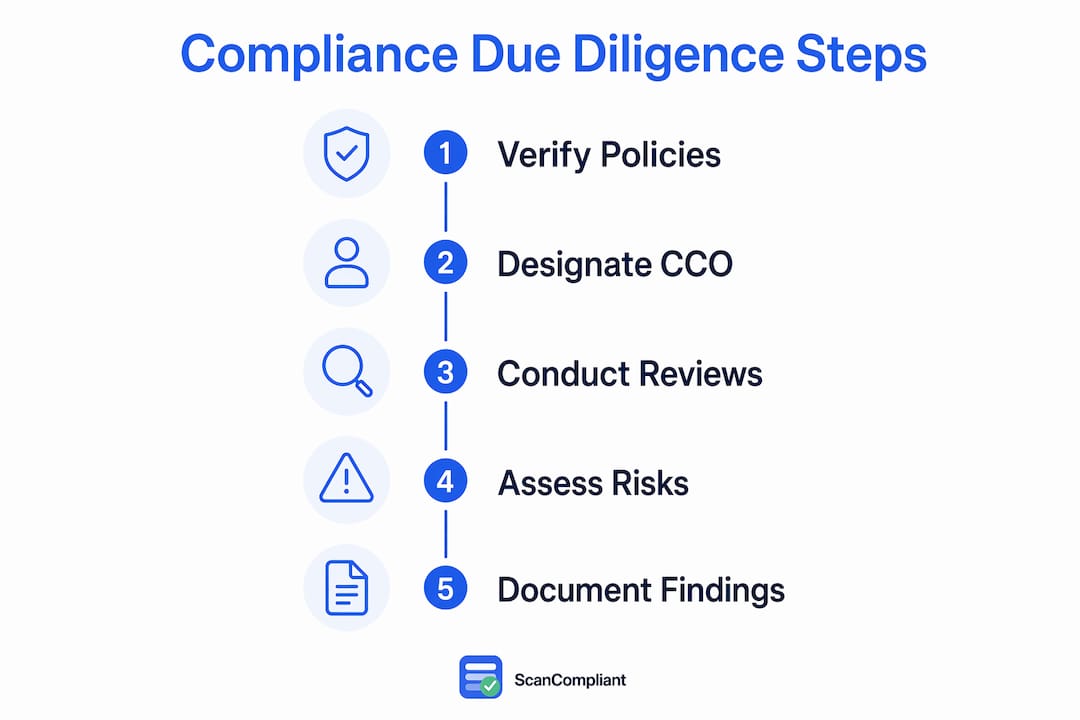
The role of compliance in investor due diligence begins with verifying that a target firm has documented, operational compliance controls, not just a policy binder on a shelf. SEC Rule 206(4)-7 requires registered investment advisers to adopt written policies and procedures reasonably designed to prevent violations, designate a Chief Compliance Officer, and conduct substantive annual reviews. That annual review must be evidence-based and operational, not a formality. Investors reviewing an advisory firm target should demand proof that these reviews actually happened.
Written policies and the CCO designation
A designated Chief Compliance Officer is the first governance signal investors look for. The CCO must have real authority and documented oversight responsibilities, not just a title. Compliance manuals, exception logs, and escalation records all serve as evidence that the CCO function is active. A firm with a CCO who cannot produce current exception reports is a red flag regardless of how polished the policy document looks.

Annual reviews and operational evidence
Regulators increasingly focus on whether compliance controls are actually run and tested for effectiveness annually, not just whether policies exist on paper. Investors should request the most recent annual review report, the methodology used, and any remediation actions taken. A review that identifies zero issues across all areas is itself a warning sign. Credible programs document findings, assign owners, and close gaps with dated evidence.
The core elements investors must examine during regulatory due diligence include:
- Written compliance policies and procedures aligned to the target’s business model and regulatory obligations
- CCO designation with documented authority, reporting lines, and access to senior management
- Annual review reports with findings, remediation timelines, and sign-off records
- Audit trails and exception logs showing that monitoring actually occurs
- Training records confirming staff awareness of compliance obligations
- Escalation and whistleblower procedures with evidence of use and resolution
Pro Tip: Request the last two annual review reports, not just the most recent one. Comparing them reveals whether the compliance program is improving, stagnant, or cycling through the same unresolved issues.
Compliance programs differ significantly by firm size. A small registered investment adviser with five employees will have a proportionally simpler program than a firm managing assets across multiple jurisdictions. Investors should calibrate expectations accordingly. The test is not complexity. The test is whether the program fits the firm’s actual risk profile and shows evidence of operation.
How do compliance considerations affect transaction risk and structure?
Compliance diligence directly shapes deal economics. Regulatory risk reports summarize the approvals a target holds, its enforcement history, and identified compliance gaps. These findings influence purchase price, transaction structure, and indemnification terms. A target with unresolved enforcement actions or missing licenses will face price adjustments or deal conditions that reflect that exposure.
Practitioners categorize compliance risks into three distinct types:
- Latent operational risks. These are ongoing violations or gaps in the target’s current compliance program that exist regardless of the transaction. Examples include unlicensed activity, unregistered personnel, or missing required disclosures.
- Transactional risks from change of control. Many regulatory approvals and licenses do not automatically transfer when ownership changes. A healthcare firm’s state operating licenses, for example, may require re-application or regulatory notification before the deal closes.
- Post-closing risks. These arise after the transaction completes and include successor liability, integration failures, and inherited enforcement exposure.
“Successor liability may hold buyers responsible for pre-close misconduct if wrongdoing persists or is concealed post-close. Knowledge and remediation are the key factors that determine exposure.” — Simmons Wagner
Successor liability is one of the most underestimated risks in transaction compliance work. If a buyer acquires a firm and continues operating in a way that perpetuates pre-close misconduct, courts and regulators treat that continuity as evidence of inherited liability. Disclosure, correction, and indemnity planning before closing are the primary defenses. Buyers who discover compliance issues during diligence and do nothing with that knowledge face the worst outcomes.
HIPAA compliance in healthcare M&A
Healthcare transactions illustrate how sector-specific compliance shapes deal structure. HIPAA compliance diligence must be performed before, during, and after a healthcare transaction because exposures can be inherited, particularly in stock purchases. Business Associate Agreements must be reviewed and updated. Protected health information transfer protocols require documentation. A healthcare buyer who skips this review does not avoid the liability. The liability transfers with the acquisition. Investors in healthcare deals should treat HIPAA compliance review as a non-negotiable pre-close requirement, not a post-integration task.
What are the nuances and challenges in compliance diligence?
Sanctions diligence is one area where surface-level screening consistently fails. OFAC’s 50% ownership rule treats any entity owned 50% or more by a blocked party as itself blocked, even if that entity does not appear on the Specially Designated Nationals list. Running a name check against the SDN list is not sufficient. Investors must map the full ownership chain and aggregate ownership percentages across all blocked parties before concluding that a target is sanctions-clean.
Common compliance diligence pitfalls
| Pitfall | What it signals |
|---|---|
| Stale policy library with no update dates | Compliance program is not actively maintained |
| Annual review reports with no findings | Review is superficial or not genuinely independent |
| No exception or incident logs | Monitoring is not occurring in practice |
| CCO with no documented authority | Compliance function lacks real organizational standing |
| Ownership structure not reconciled pre-close | Sanctions and beneficial ownership risks remain unresolved |
Investors look beyond documents to operational credibility during due diligence. The governance signals that carry the most weight include clear workflow ownership, consistent team responses to diligence questions, dated evidentiary support for all key controls, and controls that are proportionate to the firm’s actual risk. A compliance program that looks mature on paper but cannot produce current operating evidence is a liability, not an asset.
Pro Tip: Ask the target’s compliance team to walk you through a recent exception from identification through remediation. That single exercise reveals more about program quality than reviewing a hundred policy documents.
Stale or outdated compliance policies without auditable evidence trails consistently undermine credibility in due diligence. Investors want a limited set of current, well-documented artifacts: timestamps, owner designations, and remediation records. Firms that produce voluminous but undated documentation often signal that the compliance function is performative rather than operational. The goal is not to impress with volume. The goal is to demonstrate that the program actually runs.
How does compliance diligence improve deal outcomes?
Strong compliance programs enable quicker and more confident investment decisions by narrowing deal unknowns and reducing late-stage surprises. When a target can produce coherent compliance paperwork, current reporting, and clear control evidence, investors spend less time on remedial fact-finding and more time on valuation and integration planning. That efficiency has real economic value. Deals with clean compliance profiles close faster and with fewer contingencies.
The benefits of thorough compliance diligence extend well past closing:
- Cleaner integration planning. Knowing the target’s compliance gaps before closing allows the buyer to build remediation into the integration timeline rather than discovering problems after the deal is done.
- Stronger indemnification positions. Documented compliance findings give buyers the factual basis to negotiate specific indemnities rather than relying on general representations and warranties.
- Reduced regulatory exposure. Buyers who identify and remediate compliance issues pre-close demonstrate good faith to regulators, which matters in successor liability analysis.
- Better portfolio supervision. Compliance diligence outputs, including policy inventories, CCO contacts, and open remediation items, feed directly into post-investment governance frameworks.
Investors who treat compliance diligence as a one-time document collection exercise miss the ongoing value. A compliance sign-off process that continues post-investment, with regular monitoring and reporting, protects the investment throughout the holding period. The due diligence review establishes the baseline. Ongoing monitoring protects the value.
Key Takeaways
Compliance in investor due diligence is not a formality. It is the primary mechanism for identifying legal, regulatory, and operational risks before they become the buyer’s problem.
| Point | Details |
|---|---|
| Verify operational compliance, not just documents | Request dated evidence, exception logs, and remediation records, not just policy manuals. |
| Categorize risks before structuring the deal | Separate latent, transactional, and post-closing risks to inform price and indemnity terms. |
| Map ownership chains for sanctions diligence | OFAC’s 50% rule requires full ownership aggregation, not just SDN name screening. |
| Treat successor liability as a live risk | Post-close handling of pre-close misconduct determines whether liability transfers to the buyer. |
| Use compliance signals to assess governance quality | Workflow ownership, dated evidence, and proportionate controls indicate a credible program. |
Why compliance diligence has become the deciding factor in deals
Compliance diligence has shifted from a legal formality to a genuine deal driver, and I have watched that shift happen in real time. The firms that struggle most in diligence are not the ones with the most complex regulatory environments. They are the ones whose compliance programs look good on paper but cannot answer a single operational question without a two-week delay.
The most common mistake I see is treating the annual review as a document production exercise. Regulators and investors both now expect evidence that controls were tested, findings were documented, and gaps were closed. A review that produces a clean report with no findings is not reassuring. It is suspicious. Real compliance programs find issues because they are actually looking.
The SEC’s increasing focus on program effectiveness, not just policy existence, has raised the bar for what investors must examine. That trend will continue. Firms that invest in genuine compliance infrastructure, with real CCO authority, current evidence, and documented remediation, will close deals faster and on better terms. The ones that rely on outdated policy libraries will face price adjustments, deal conditions, or failed transactions. Compliance diligence is where investment risk gets priced. Treat it accordingly.
— Compliant Team
Scancompliant supports compliance-ready investment teams
Regulated firms facing investor scrutiny need more than a policy library. They need documented, current, and auditable compliance evidence that holds up under diligence review.

Scancompliant helps advisory and healthcare firms build the kind of compliance programs that investors actually trust. The platform scans content for regulatory risk, maintains a documented compliance trail, and supports the rapid review cycles that diligence timelines demand. With over 1,000 risk terms in its database and more than 200 brands protected, Scancompliant delivers findings in minutes rather than weeks. Teams preparing for investor review can use Scancompliant’s platform to produce the current, auditable evidence that compliance officers and investors require.
FAQ
What is the role of compliance in investor due diligence?
Compliance in investor due diligence is the process of verifying that an investment target adheres to applicable laws, regulations, and internal policies before a transaction closes. It identifies hidden legal risks, regulatory gaps, and enforcement exposure that affect deal structure and price.
What does SEC Rule 206(4)-7 require for investment advisers?
SEC Rule 206(4)-7 requires registered investment advisers to adopt written compliance policies, designate a Chief Compliance Officer, and conduct substantive annual reviews assessing the adequacy and effectiveness of their compliance programs.
How does OFAC’s 50% rule affect sanctions diligence?
OFAC’s 50% ownership rule treats any entity owned 50% or more by a blocked party as itself blocked, even if it does not appear on the SDN list. Investors must map full ownership chains and aggregate ownership percentages, not just run name-based screenings.
What is successor liability and why does it matter in M&A?
Successor liability holds buyers responsible for a target’s pre-close misconduct when wrongdoing continues or is concealed after the acquisition. Disclosure, remediation, and indemnity planning before closing are the primary tools for managing this exposure.
How do compliance findings affect deal terms?
Compliance diligence findings directly influence purchase price, indemnification clauses, and transaction structure. Targets with unresolved enforcement actions, missing licenses, or weak compliance programs face price adjustments or specific deal conditions that reflect the identified risk.
Recommended
- Top 3 Comply.com Alternatives in Marketing Compliance 2026 – scancompliant.com
- Healthcare Marketing Compliance Training Teams: 2026 Guide – scancompliant.com
- Compliance Sign-Off Process: A Guide for Healthcare Teams – scancompliant.com
- How Content Compliance Audits Work for Healthcare Teams – scancompliant.com