
Compliance databases are defined as structured data systems that capture regulatory obligations, evidence records, audit logs, and user roles in a single authoritative store. Understanding how compliance databases are built is the foundation of audit readiness for any telehealth or direct-to-consumer (DTC) health organization. Frameworks like HIPAA, GDPR, and SOC 2 each impose specific data requirements that must be reflected in the database schema from day one. Compliance officers who treat the database as an afterthought face costly retrofits, broken audit trails, and regulatory exposure that no policy document can fix.
How compliance databases are built: core structural components
A compliance database is built around five core data entities: ComplianceItem, Regulation, AuditLog, User, and Department. Each entity maps to a real business function, and the relationships between them define how obligations flow through an organization. AuditLogs must be immutable and never editable by end users. That single design decision separates a defensible audit trail from a liability.
The relational model matters enormously. ComplianceItems link to specific Regulations, which link to Departments, which link to named Users with ownership. Break any of those links and you lose traceability. The DORA Register of Information illustrates the scale this can reach: 15 tables, 200+ fields, and 117 validation rules, none of which can be reliably managed in a spreadsheet. That complexity is not unusual for regulated healthcare environments.
The most common structural pitfalls compliance officers encounter include:
- Broken referential integrity: Deleting a Department record without cascading rules orphans every ComplianceItem assigned to it.
- Missing ownership fields: Obligations without a named owner cannot be enforced or audited.
- Flat schema designs: Storing all compliance data in a single table makes cross-regulation reporting nearly impossible.
- No versioning on Regulation records: Regulations change. Without version history, you cannot prove which version of a rule applied at a given audit date.
Pro Tip: Map every regulatory obligation to a named department and a named individual before writing a single line of schema. Ownership gaps in the data model become accountability gaps in an audit.
What technical controls protect data integrity?

Data integrity in a compliance database is enforced at the schema level, not the application level. RESTRICT constraints on foreign keys prevent deletion of any record that another compliance artifact depends on. That means you cannot delete a Regulation record while active ComplianceItems still reference it. The database enforces the rule even if the application layer fails to.
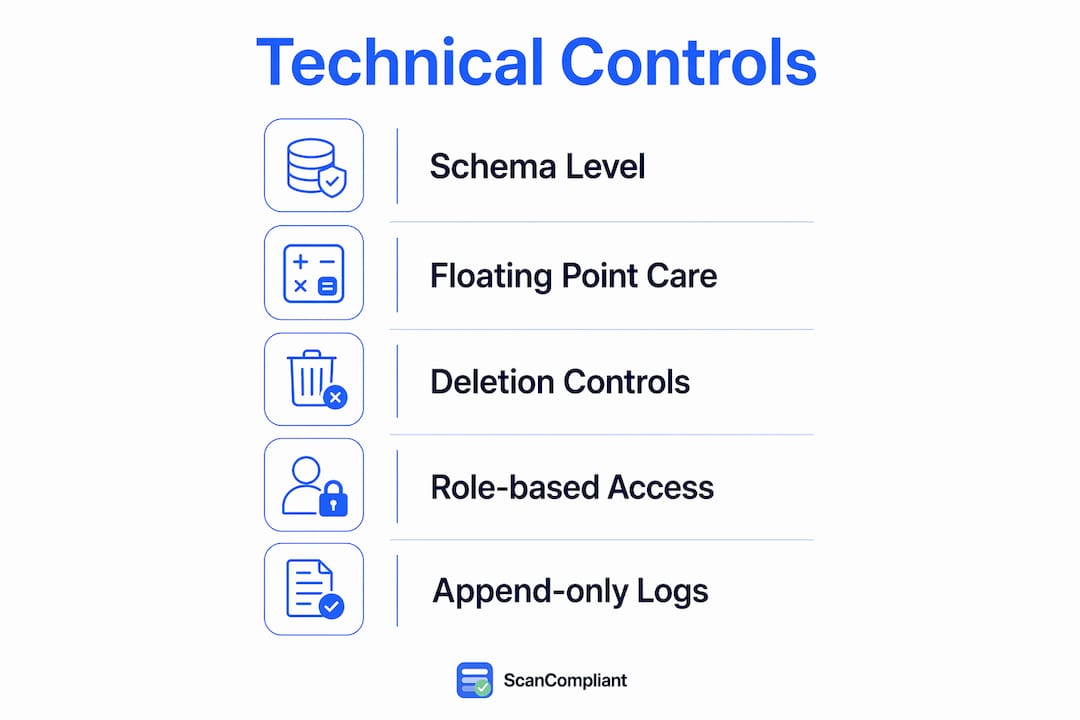
Financial data fields require equal care. Floating point types introduce rounding errors that regulators flag during audits. DecimalField types with check constraints are the correct choice for any monetary or quantitative compliance metric. The schema should also enforce valid state transitions, so a ComplianceItem cannot move from “pending” to “closed” without a logged evidence record attached.
Deletion controls deserve specific attention. False or soft deletion of critical compliance data must be avoided entirely. When a deletion request arrives, the correct response is a formally logged retention workflow, not a database flag. The retention event itself becomes part of the audit trail.
Role-based access control must be enforced at both the database and application layers. A user in the marketing department should not have write access to AuditLog tables. Structured JSON logging with event names, unique identifiers, and timestamps converts what would be a multi-hour compliance investigation into a precise, targeted query. That efficiency matters when a regulator gives you 48 hours to produce evidence.
Pro Tip: Never rely on application-layer logic alone to enforce immutability. Set AuditLog tables to append-only at the database level using role permissions or table-level triggers.
What architectures support scalable compliance systems?
Scalable compliance database architecture rests on three decisions: how evidence is collected, how it is stored, and how it is queried under audit conditions.
Automated evidence collection is the first pillar. Manual collection creates gaps. Scheduled automated workflows run on hourly, daily, or quarterly cycles depending on the control type. Each job must be idempotent, meaning running it twice produces the same result as running it once. Unique constraints in the schema prevent duplicate evidence records from polluting the audit trail. Error handling must include retry logic with exponential backoff, so a failed API call does not silently drop an evidence record.
Hybrid data storage is the second pillar. Raw evidence payloads arrive in many formats: JSON responses from third-party systems, PDF metadata, consent records. Hybrid compliance databases store the raw JSON payload in a JSONB column alongside materialized relational columns for indexing and querying. The raw payload preserves full fidelity for regulatory interpretation. The materialized columns make reporting fast. Neither approach alone is sufficient.
Jurisdiction-aware architecture is the third pillar. Telehealth organizations operating across state lines or internationally face data residency requirements that must be encoded in the database schema itself. Jurisdiction-aware RAG systems compartmentalize regulatory documents by metadata and enforce region-specific access at the database level. A compliance search for a California-based patient record should never return results governed by a Texas-only regulation. Governance enforced at the database level prevents that legal exposure.
The table below compares the two primary storage approaches for compliance evidence:
| Approach | Best for | Trade-off |
|---|---|---|
| Relational columns only | Fast reporting and structured queries | Loses raw evidence fidelity over time |
| JSONB raw storage only | Full audit fidelity and flexible schema | Slow queries without additional indexing |
| Hybrid (JSONB + relational) | Audit fidelity and query performance | Requires schema discipline to keep in sync |
How to apply these practices in telehealth and DTC health
Telehealth and DTC health organizations operate under a specific combination of regulatory frameworks: HIPAA for protected health information, FTC rules for marketing claims, and GDPR where European patients are involved. Each framework imposes distinct data requirements that must coexist in the same compliance database structure.
Consent management is the most critical area. Authoritative consent records must reside in the primary database alongside operational data, not in a third-party consent tool or a frontend log. A telehealth platform that stores consent in a marketing analytics tool cannot produce a defensible audit record. The consent event, the version of the consent language shown, the timestamp, and the user identifier must all be captured in a single immutable record.
Practical requirements for telehealth compliance databases include:
- HIPAA audit controls: Every access to a protected health record must generate an AuditLog entry with user ID, timestamp, and action type.
- Telehealth consent versioning: Store the exact text of the consent form shown, not just a flag indicating consent was given.
- Cross-functional access restrictions: Clinical staff, compliance officers, and marketing teams need different read and write permissions enforced at the schema level.
- Notification triggers: Workflow automation should fire alerts when a ComplianceItem approaches its review deadline or changes status without attached evidence.
- Regulatory reporting snapshots: Generate point-in-time snapshots of compliance status for healthcare audit readiness rather than relying on live data that may have changed since the audit period.
Compliance workflow automation reduces the manual burden on compliance officers by triggering evidence collection, status updates, and escalation notices automatically. The database becomes the enforcing layer, not just a record store.
Compliance management foundations require mapped obligations with named ownership and continuous evidence collection embedded as an operational process. Annual batch updates to a compliance database are a liability. The database must reflect the current state of obligations at all times.
Pro Tip: Build a dedicated consent artifact table separate from your general AuditLog. Consent records have unique retention and versioning requirements under HIPAA and GDPR that a generic log table cannot cleanly support.
Key Takeaways
Compliance databases built on immutable audit logs, relational ownership mapping, and jurisdiction-aware architecture give healthcare teams the strongest foundation for regulatory defense and audit readiness.
| Point | Details |
|---|---|
| Five core entities | Every compliance database needs ComplianceItem, Regulation, AuditLog, User, and Department with enforced relational links. |
| Immutable audit logs | AuditLog tables must be append-only at the database level; application-layer controls alone are not sufficient. |
| Hybrid storage model | Combine JSONB raw payloads with relational columns to preserve audit fidelity and maintain query speed. |
| Jurisdiction-aware design | Encode data residency rules in the schema to prevent cross-border regulatory exposure in telehealth environments. |
| Continuous evidence collection | Automated, idempotent workflows replace manual collection and eliminate the gaps that regulators find in annual batch updates. |
Why compliance-first engineering changes everything
The most expensive compliance database mistake I see is building the audit trail as a feature added after launch. Teams spend months building the product, then realize the database has no immutable log, no ownership mapping, and no evidence linkage. Retrofitting those structures into a live system with real patient data is painful, risky, and far more expensive than getting it right at the schema design stage.
The second most common mistake is ignoring data residency until a regulator asks about it. Telehealth organizations that operate across state lines or serve patients in GDPR jurisdictions need jurisdiction-aware architecture from the start. Adding it later means migrating data, rewriting queries, and rebuilding access controls under time pressure.
What I have found actually works is treating the compliance database as a product in its own right, with named owners, a release process, and continuous monitoring. The compliance trail is not a report you generate once a year. It is a living record that regulators can inspect at any time. Teams that internalize that reality build better systems from the start.
The future of compliance databases in healthcare points toward AI-driven search with local, auditable architectures. Jurisdiction-aware retrieval systems that enforce access at the database level will become standard. The organizations that build those foundations now will spend far less time in regulatory remediation later.
— Compliant Team
Scancompliant and your compliance database strategy
Building a defensible compliance database is only half the challenge. The content your telehealth or DTC health brand publishes must also meet FDA and FTC standards before it reaches patients.

Scancompliant provides an AI-powered content scanning platform that identifies risky marketing language before publication, with over 1,000 risk terms in its database and a documented compliance trail for accountability. More than 200 brands have used Scancompliant to catch subtle claims that human reviewers miss, completing review cycles in minutes rather than days. For compliance officers building out their healthcare compliance reporting infrastructure, Scancompliant connects content review directly to the audit record your database needs.
FAQ
What are the five core entities in a compliance database?
The five core entities are ComplianceItem, Regulation, AuditLog, User, and Department. Each maps to a distinct business function, and relational links between them create a traceable obligation chain.
Why must AuditLog tables be immutable?
AuditLog tables must be immutable because editable logs cannot serve as defensible evidence in a regulatory audit. Immutability must be enforced at the database level, not just the application layer.
What is a hybrid compliance database model?
A hybrid model stores raw evidence payloads in JSONB columns alongside materialized relational columns. This preserves full audit fidelity while keeping query performance fast enough for reporting.
How does jurisdiction-aware architecture protect telehealth organizations?
Jurisdiction-aware architecture encodes data residency rules directly in the database schema, preventing compliance searches or data access from crossing regulatory boundaries without authorization.
How often should compliance evidence be collected?
Evidence collection should run on automated schedules tied to each control type, ranging from hourly to quarterly. Each job must be idempotent to prevent duplicate records from corrupting the audit trail.
Recommended
- The Role of Compliance Documentation Systems in Healthcare – scancompliant.com
- How Cross-Functional Compliance Works for Healthcare Teams – scancompliant.com
- Compliance Risk Reporting for Healthcare Teams: 2026 Guide – scancompliant.com
- How Compliance Audits Work for Healthcare Teams – scancompliant.com