
A compliance trail is defined as a tamper-evident, chronological digital record that documents every action taken across a regulated process, capturing who acted, what changed, when it happened, and where it originated. In healthcare and marketing compliance, this record is the primary mechanism for proving regulatory adherence to bodies like the FDA and FTC. Understanding what is a compliance trail is not optional for regulatory teams. Audit trail gaps are among the most common contributors to costly data breaches and audit failures, with 78% of compliance audits flagging them as control deficiencies. The industry term most often used interchangeably is “audit trail,” though compliance trail emphasizes the end-to-end accountability dimension that regulators now demand.
What is a compliance trail and what components make it defensible?
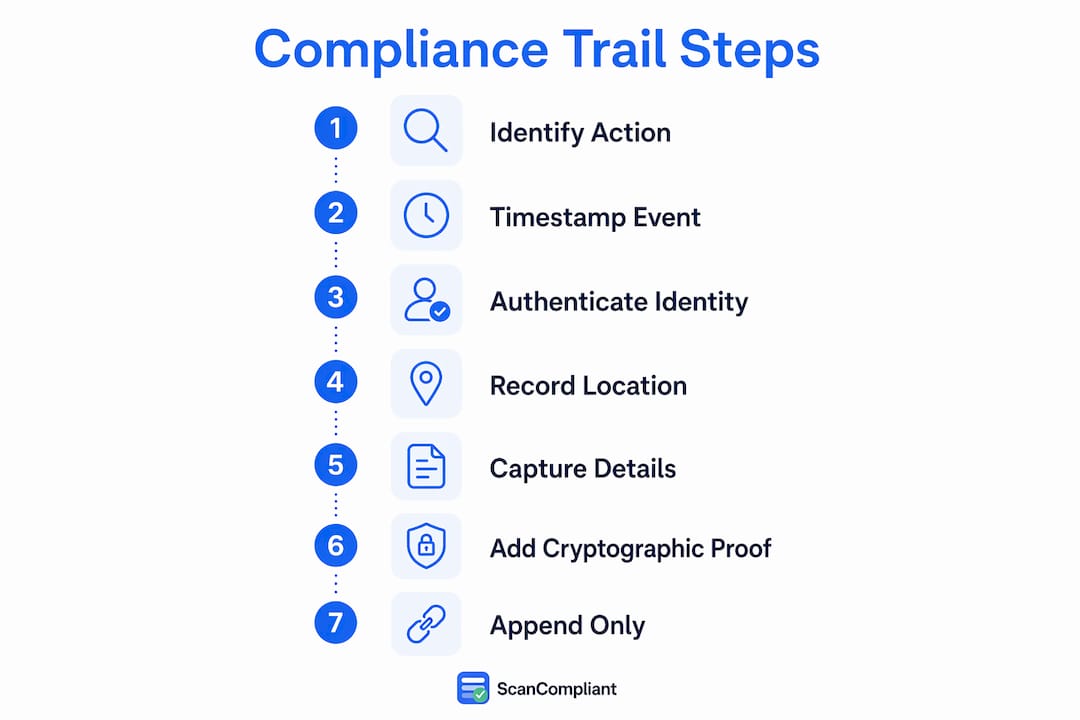
A legally defensible compliance trail must capture seven non-negotiable data points for every recorded event: identity, precise UTC timestamp, action performed, object acted on, version reference, originating context, and cryptographic integrity proof. Each element serves a distinct evidentiary function. Remove any one of them and the record loses its ability to reconstruct a business event under regulatory scrutiny.
The identity field answers who. It must link to a unique authenticated account, not a shared login. The UTC timestamp answers when, with enough precision to sequence events across systems in different time zones. The action field answers what was done, such as “approved,” “edited,” or “published.” The object field identifies what was acted on, for example a specific version of a marketing claim or a patient consent form. The version reference ties the action to the exact state of the document at that moment. The originating context captures where the action came from, such as an IP address, device ID, or application module.

The seventh element, cryptographic integrity proof, is what separates a true compliance trail from a simple log file. Hash-chaining and blockchain anchoring are the two industry-recognized technologies for this purpose. Hash-chaining links each record to the one before it so that any modification breaks the chain and becomes immediately detectable. Blockchain anchoring writes a hash of the record to an immutable public ledger. Both methods prevent undetected tampering, even by system administrators.
The structure of the trail must also be append-only. No record can be deleted or overwritten. New entries can only be added. This design principle is what gives regulators confidence that the record reflects reality.
| Component | Function |
|---|---|
| Identity | Attributes every action to a specific, authenticated individual |
| UTC timestamp | Sequences events precisely across systems and time zones |
| Action performed | Describes the exact operation executed on the record |
| Object and version | Identifies the specific document or data element in its exact state |
| Originating context | Records the system, device, or location of the action |
| Cryptographic proof | Detects any tampering through hash-chaining or blockchain anchoring |
Pro Tip: Build your seven-element record structure into your platform’s data schema from day one. Retrofitting cryptographic integrity controls after a system is live costs significantly more and often leaves gaps that fail the reconstructability test.
How do regulatory standards apply to compliance trails?
HIPAA, 21 CFR Part 11, and the ESIGN Act each impose specific audit trail requirements on healthcare and marketing teams, and they are not interchangeable. HIPAA governs protected health information and requires covered entities to maintain audit controls that record and examine activity in systems containing patient data. HIPAA requires at least 6 years of retention for audit trail records. That retention clock starts from the date of creation or the date the record was last in effect, whichever is later.
21 CFR Part 11, enforced by the FDA, applies to electronic records and electronic signatures in regulated clinical and manufacturing environments. It requires that audit trails be computer-generated, time-stamped, and protected against modification. Any direct-to-consumer health brand that submits electronic records to the FDA must meet this standard. The ESIGN Act and its state-level equivalent, UETA, govern the legal validity of electronic signatures and require that the audit trail supporting those signatures be retrievable and readable for the life of the agreement.
Retention requirements across frameworks cluster around the 6–7 year range. SOX often requires up to 7 years of retention for financial audit records. Healthcare marketing teams operating across multiple regulatory frameworks should default to the longest applicable retention period to avoid gaps.
Reconstructability is the test that most teams fail. Regulators expect a team to produce a complete, event-level audit trail for a specific business decision within 15–30 minutes of a request. Manual compilation from disparate systems does not meet this standard. A compliance trail that requires hours of manual assembly to produce is, functionally, a failed control.
| Regulatory standard | Retention period | Key audit trail requirement |
|---|---|---|
| HIPAA | 6 years | Activity logs for systems containing protected health information |
| 21 CFR Part 11 | Per FDA guidance | Computer-generated, time-stamped, tamper-evident electronic records |
| ESIGN Act / UETA | Life of the agreement | Retrievable audit trail supporting electronic signatures |
| SOX | 7 years | Financial record audit trails with access controls |
For healthcare marketing teams, compliance documentation systems that integrate these requirements natively are far more reliable than manual processes.
What are the most common misconceptions about compliance trails?
The most damaging misconception is that a raw system log equals a compliance trail. It does not. Raw logs are technical system events; audit trails are curated, verifiable reconstructions of business events. A server log that records a file access at a specific time is useful for IT troubleshooting. It does not tell a regulator who authorized the action, what version of the document was involved, or whether the action was part of an approved workflow.
A second common failure is incomplete trail coverage. Teams often build audit trails for document approvals but neglect to capture earlier workflow stages, such as content drafts, internal review comments, or claim revisions. Regulators reconstruct the full decision chain, not just the final approval. A trail that starts at the approval stage leaves the entire review process undocumented.
Common pitfalls that create compliance exposure include:
- Shared or generic accounts: These violate the ALCOA+ attributable principle, which requires that every action be traceable to a specific individual. Shared logins make attribution impossible.
- Manual log compilation: Pulling records from multiple systems after the fact introduces gaps and sequencing errors that fail the reconstructability test.
- Unreviewed trails: A compliance trail that no one reviews is a control that exists only on paper. Modern frameworks require designated independent reviewers and documented periodic monitoring.
- Retrofitted audit capabilities: Adding audit trail functionality to an existing platform after launch almost always produces incomplete coverage. Systems not designed for append-only logging often allow record modification by default.
Pro Tip: Assign a named, independent reviewer to your compliance trail review schedule before your first audit. The four-eyes principle requires that reviewers be distinct from system administrators. Document the review schedule in your SOPs so it survives personnel changes.
How to implement a compliance trail system for healthcare marketing
A well-implemented compliance trail system is built into the workflow, not bolted on afterward. The following steps reflect current best practices for healthcare and marketing compliance teams.
-
Map every regulated action in your workflow. Start with content creation, internal review, legal and regulatory sign-off, publication, and post-publication monitoring. Each stage must generate a trail entry. Compliance workflow automation tools can map these stages and trigger automatic logging at each transition.
-
Require unique authenticated logins for every user. Role-based access controls must restrict what each user can see and do. Multi-factor authentication is the current standard for systems containing regulated content. Shared accounts are a compliance violation, not just a security risk.
-
Select a storage architecture that enforces append-only logging. Cloud-based systems with write-once storage, or on-premise solutions with cryptographic hash-chaining, both meet this requirement. Verify that your vendor can demonstrate tamper-evidence through a third-party audit report.
-
Set automated retention and retrieval policies. Configure your system to retain records for the longest applicable period across your regulatory obligations. Build retrieval workflows that can produce a complete event-level trail for any specific action within 30 minutes.
-
Schedule independent trail reviews. Assign a reviewer who is not the system administrator. Document the review frequency, the criteria for anomaly detection, and the escalation path when an anomaly is found. Regular audit trail reviews catch control failures before regulators do.
-
Test reconstructability quarterly. Select a random business event from 90 days prior and attempt to reconstruct the full decision chain within 30 minutes. If you cannot, identify the gap and close it before your next external audit.
The operational discipline around compliance trails matters as much as the technology. A well-configured system run by undertrained teams still fails audits. Healthcare marketing compliance training for every team member who touches regulated content is a non-negotiable part of the implementation.
Key Takeaways
A compliance trail is only as defensible as its weakest component: missing cryptographic proof, shared logins, or unreviewed records each constitute a control failure that regulators will find.
| Point | Details |
|---|---|
| Seven required components | Every trail entry must capture identity, timestamp, action, object, version, context, and cryptographic proof. |
| Retention of 6–7 years | Default to the longest applicable retention period across HIPAA, 21 CFR Part 11, and SOX obligations. |
| Reconstructability within 30 minutes | Manual log compilation from disparate systems fails the regulatory reconstructability standard. |
| Append-only, tamper-evident design | Hash-chaining or blockchain anchoring must prevent modification by any user, including administrators. |
| Independent review is mandatory | Assign a named reviewer distinct from system administrators and document the review schedule in your SOPs. |
Why compliance trails deserve more operational attention than they get
The teams I see struggle most with compliance trails are not the ones who ignored the requirement. They are the ones who built something that looked right but was never stress-tested. A trail that captures approvals but skips the review stage, or one that logs actions under a shared account, passes a casual internal check and fails a real audit.
The shift toward cryptographic tamper-evidence is not a trend. It is a response to regulators who have seen too many “compliance records” that were actually reconstructed after the fact. Hash-chaining and blockchain anchoring exist because the old model of trusting database administrators to preserve records was not working. If your current system cannot prove that no one modified a record after it was written, you do not have a compliance trail. You have a document that looks like one.
The four-eyes principle deserves more attention in healthcare marketing specifically. Most teams assign compliance review to the same person who manages the platform. That person cannot independently verify their own actions. The principle is not bureaucracy. It is the only way to catch errors and misconduct that a self-reviewing system will always miss.
My strongest recommendation is to treat the compliance trail as a first-class system requirement, not a reporting feature. When you build it in from the start, every other compliance control becomes easier to demonstrate. When you retrofit it, you spend the rest of your compliance program’s life explaining gaps.
— Compliant Team
How Scancompliant supports compliance trail documentation
Healthcare marketing teams that need a documented, audit-ready compliance trail have a specific problem: content review cycles generate decisions that must be captured, timestamped, and retrievable on demand.

Scancompliant addresses this directly. The platform scans marketing content against a database of over 1,000 risk terms, flags risky language before publication, and generates a documented record of every review cycle for FDA and FTC accountability. More than 200 brands have used Scancompliant to reduce review time and maintain a clear compliance record. For teams building or improving their compliance trail management, Scancompliant provides the audit-ready documentation layer that manual review processes cannot reliably produce.
FAQ
What is the difference between a compliance trail and an audit log?
An audit log is a raw technical record of system events. A compliance trail is a structured, tamper-evident reconstruction of business events that meets regulatory standards for identity attribution, sequencing, and cryptographic integrity.
How long must a compliance trail be retained in healthcare?
HIPAA requires a minimum of 6 years of retention. Teams subject to multiple frameworks, such as HIPAA and SOX, should retain records for the longest applicable period, which is typically 7 years.
What makes a compliance trail tamper-evident?
Hash-chaining links each record to the previous one so any modification breaks the chain. Blockchain anchoring writes a hash to an immutable ledger. Both methods detect unauthorized changes, including those made by administrators.
Can a shared login invalidate a compliance trail?
Yes. Shared or generic accounts violate the ALCOA+ attributable principle, which requires every action to be traceable to a specific individual. Regulators treat shared-login records as unattributable and therefore non-compliant.
How often should a compliance trail be reviewed?
Modern regulatory frameworks require scheduled, documented reviews by an independent reviewer who is not the system administrator. Quarterly reviews are a common baseline, with more frequent reviews for high-volume or high-risk workflows.
1 Comment