
The fastest way to track content compliance status is to stop checking content once and start watching it continuously. That means one centralized platform that scans every published asset on a schedule, scores the evidence behind each pass or fail for freshness and relevance, and logs every reviewer decision in an auditable trail. If you’re still tracking approvals in spreadsheets, the next step is simple: assign one owner to a live compliance dashboard and run a 30-day pilot before your next audit cycle.
Three elements separate an efficient system from a reactive one:
- Continuous monitoring that rescans content automatically instead of waiting for a quarterly review.
- Evidence scoring that flags when supporting documentation goes stale.
- Integrated approvals that route flagged content to the right reviewer without a separate email chain.
Key Takeaways
Efficient content compliance tracking depends on continuous automated scanning, dynamic evidence scoring, and an auditable approval trail working together, not as separate steps.
| Point | Details |
|---|---|
| Automate the scan cycle | Rescan live content on a schedule instead of relying on one-time approvals. |
| Score evidence dynamically | Re-score supporting documentation when underlying systems or policies change. |
| Log reviewer rationale | Use append-only decision logs so auditors see context, not just pass/fail marks. |
| Measure the right KPIs | Track pass rate, review cycle time, and stale-evidence rate to prove ROI. |
| Consider Scancompliant | Its risk-term database and evidence scoring map directly to the workflow this article describes. |
Table of Contents
- What Does Tracking Content Compliance Status Mean?
- How Does an Efficient Compliance Tracking System Work?
- What Features Should a Compliance Tracking Tool Have?
- How Do You Roll Out a Compliance Tracking System Quickly?
- What Metrics Prove Compliance Tracking Is Working?
- Where Does Compliance Tracking Matter Most in Practice?
- What Does Research Say About Automating Compliance Tracking?
- What Do Compliance Teams Get Wrong When Setting This Up?
- How Scancompliant Keeps Content Compliance Status Current
- Sources
What Does Tracking Content Compliance Status Mean?
Tracking content compliance status means knowing, at any given moment, whether a live piece of content still passes the rules that governed it at publication. It’s not a one-time check. A product page cleared by legal in January can drift out of compliance by March if a claim becomes unsupported or a regulation shifts.
Picture a Facebook ad for a telehealth weight-loss program. Its tracked status includes the specific FTC rule it was checked against, the screenshot or citation used as evidence, the reviewer who signed off, and the timestamp of that decision. Four components make up a complete status record:
- The rule or policy applied
- The evidence attached to support the decision
- The reviewer of record
- The timestamp of the last check
How Does an Efficient Compliance Tracking System Work?
An efficient system runs as a loop, not a checklist. Here’s the typical lifecycle:
- Import policies — FDA, FTC, and platform-specific rules get loaded into a rule library.
- Automated scan — the platform reviews live content across your website, social channels, and product listings.
- Flagging and scoring — risky language gets flagged and evidence gets scored for relevance, freshness, and completeness.
- Reviewer action — a compliance officer or marketer resolves the flag or requests a rewrite.
- Approval and publish — cleared content moves forward with a documented sign-off.
- Continuous monitoring — the cycle repeats on a schedule instead of waiting for the next campaign.
Evidence scoring is where most manual processes fail. A screenshot proving a claim was accurate six months ago doesn’t mean much if the underlying policy page has since changed. Auto-collecting evidence from integrations and scoring it for relevance, freshness, and completeness turns audit readiness into a constant state instead of a scramble before inspection. The strongest systems connect directly to your CMS, digital asset manager, social publishing tools, and even CI/CD pipelines for product listing updates, so scans happen where content actually lives.
Pro Tip: Require an append-only decision log for every review. Once a reviewer’s rationale is written and timestamped, it should never be editable. That single habit is what turns a compliance record into something an auditor actually trusts.
What Features Should a Compliance Tracking Tool Have?
Not every feature on a vendor’s site sheet matters equally. Sort them into two buckets before you sign a contract.
Must-haves:
- Real-time scanning across your website, social media, and product listings, not just scheduled batch runs.
- Evidence scoring, so stale documentation gets flagged automatically.
- An immutable audit trail that can’t be edited after the fact.
- Built-in approval workflows that route flags to the right person without manual handoffs.
- A rule library covering FDA, FTC, and platform-specific policies.
- Native integrations with your CMS, DAM, and social tools.
- Reporting dashboards that show pass rates and outstanding risk at a glance.
Nice-to-haves:
- AI rewrite suggestions that propose compliant alternatives to flagged language.
- Custom brand-voice checks alongside legal rules, since combining brand-voice checks with regulatory rules reduces rework and off-brand messaging.
- Multi-entity rollups for teams managing several brands or regions.
- A dedicated auditor workspace for external reviewers.
Each must-have maps to a concrete benefit: real-time scanning catches drift before a regulator does, and an audit trail turns “we think we reviewed that” into a documented answer. Our guide to marketing compliance software features breaks these down in more depth if you’re building a vendor scorecard.
How Do You Roll Out a Compliance Tracking System Quickly?
Moving off spreadsheets doesn’t require a six-month IT project. A focused rollout looks like this:
- Set goals and scope: pick one product line or campaign type to start.
- Import your existing policies and risk terms into the rule library.
- Connect two or three source systems, such as your CMS and social publishing tool.
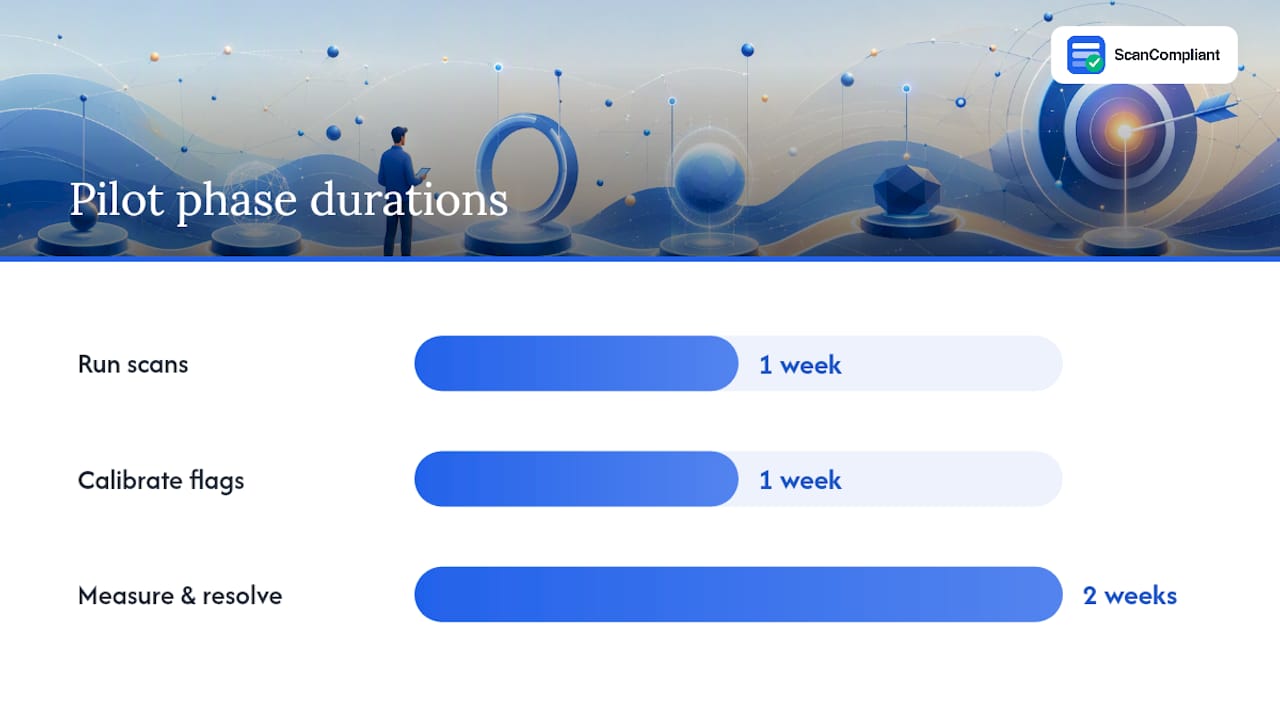
- Run a 30-day pilot and track pass rates weekly.
- Assign owners and set service-level agreements for flag resolution.
- Scale across additional channels once the pilot proves out.
A sample pilot might run scans in week one, calibrate flagged terms in week two, and measure resolution speed in weeks three and four, with success defined as a stable or improving pass rate and no unresolved flags older than five business days.
| Role | Responsibility |
|---|---|
| Compliance officer | Owns rule library and final sign-off on flagged content |
| Marketing lead | Reviews and resolves flags on owned campaigns |
| Content owner | Maintains source systems and connects new channels |
For a more detailed pilot structure, our regulatory review checklist for healthcare marketing walks through each phase.
What Metrics Prove Compliance Tracking Is Working?
Six numbers tell you whether your system is actually earning its keep:
- Time-to-publish, from draft to live approval.
- Average review cycle time per flagged asset.
- Percent of content with current evidence, not stale documentation.
- Pass rate across scanned assets.
- Audit readiness score, however your platform defines it.
- Stale-evidence rate, the share of evidence past its useful freshness window.
Centralizing these checks removes the manual labor of hunting down screenshots and approval emails before an audit. Regulatory compliance software that centralizes and automates evidence collection can cut manual testing time by up to 75%, turning what used to be a week of frantic document gathering into an ongoing background process.
Where Does Compliance Tracking Matter Most in Practice?
A few scenarios show the difference between reactive and continuous tracking:
- Regulated ad copy: a supplement brand’s paid social ads get rescanned whenever an FTC guidance update lands, not just at launch.
- Influencer disclosure monitoring: creator posts get checked for disclosure language automatically, since AI-native monitoring can substantially cut manual vetting time compared to manual spot-checks.
- Global campaign rollouts: the same core message gets checked against different regional rule sets before local launch.
- Product listing checks: marketplace listings get rescanned when ingredient claims or dosage language changes.
For telehealth and DTC health brands specifically, the stakes are higher because claims about efficacy sit closest to FDA scrutiny. Success in each case looks the same: fewer findings per scan cycle and faster time to approval. Our piece on how content review protects creators covers the influencer scenario in more detail.
What Does Research Say About Automating Compliance Tracking?
The time savings aren’t theoretical. Centralized, automated compliance workflows can reduce manual evidence-collection time by up to 75%, which for a marketing team often means the difference between a Friday afternoon audit prep and a weekend spent digging through old email threads. Beyond raw time savings, automated content-compliance agents keep a searchable, timestamped record of every review, so evidence exists before an auditor ever asks for it.

What Do Compliance Teams Get Wrong When Setting This Up?
Four mistakes show up again and again: over-customizing the rule library until it’s unmanageable, ignoring evidence freshness until an audit exposes it, logging pass/fail without capturing reviewer rationale, and leaving ownership vague across marketing and legal. Keep the rule library lean and require rationale, not just a checkbox, on every decision.
How Scancompliant Keeps Content Compliance Status Current
Scancompliant scans your website, social channels, documents, and product listings against a database of more than 1,000 risk terms, flags explicit and implied claims, and scores the supporting evidence for freshness and completeness, exactly the workflow described above.
Instead of waiting on a quarterly manual review, teams get prioritized findings in minutes, plain-English explanations, and AI-suggested rewrites that keep launches moving without waiting on a full legal cycle. The platform has already supported more than 200 brands across telehealth and DTC health marketing with faster review cycles and a documented compliance trail for every decision. If your team is still tracking approvals across spreadsheets and email threads, start a pilot on Scancompliant and see how quickly a live dashboard replaces the manual chase.
Sources
- Resolver — Regulatory compliance software
- RiskWatch — Compliance management software
- Compyl — Continuous compliance management
- Lyzr
This article is general information, not a substitute for advice from a qualified lawyer. Consult a qualified legal professional about your own circumstances before acting on anything here.
Recommended
- Integrating Compliance Checks Into Your Content Pipeline – scancompliant.com
- Pre-Publication Health Content Review Steps for Compliance Teams – scancompliant.com
- What Is a Compliance Trail? A Healthcare Guide – scancompliant.com
- Content Review Workflow Best Practices for Healthcare Teams – scancompliant.com