
Marketing compliance software features are specialized tools and functions designed to keep all marketing content aligned with applicable laws, brand guidelines, and regulatory standards, particularly in healthcare and telehealth. The right feature set covers content risk detection, workflow automation, consent tracking, and audit readiness. Regulatory bodies including the FDA, FTC, and HIPAA enforcement authorities set the rules that make these features non-negotiable. AI-powered scanning now manages the volume and complexity that human reviewers alone cannot handle, and platforms like Scancompliant have built their entire product around this reality.
1. What are the core types of marketing compliance software features?
The types of marketing compliance software features fall into five functional categories: content scanning, workflow automation, consent management, audit trail management, and post-publication monitoring. Industry consensus identifies 8–10 core features as standard, including audit logs, real-time alerts, and role-based approval workflows. That number reflects how much ground a compliant marketing operation must cover. Missing even one category creates a gap that regulators or auditors will find.
Pro Tip: Map your current workflow against these five categories before evaluating any platform. The gaps you find will tell you exactly which features to prioritize.

2. Centralized policy and rule repositories
A centralized policy repository is the single source of truth for every compliance rule your marketing team must follow. Without it, teams work from outdated email threads, local files, or memory, which produces inconsistent content and costly errors. A well-built repository stores FDA advertising rules, FTC guidelines, HIPAA requirements, and brand standards in one searchable location. Every reviewer works from the same version of the rules.
The repository also needs version control. When a regulation changes, the system records the old rule alongside the new one. That history matters when an auditor asks what standard was in effect when a specific ad was approved.
3. AI-powered pre-publication content scanning
AI-powered risk detection flags risky claims and required disclosures before content goes live, reducing review cycles in high-volume environments. This is the feature that catches what human reviewers miss under deadline pressure. Scancompliant’s database covers more than 1,000 risk terms, which means the system recognizes subtle language patterns that a legal reviewer reading quickly would overlook.
The scan runs in minutes, not days. That speed matters in telehealth marketing, where campaign cycles are short and the regulatory stakes are high. AI scanning does not replace legal review. It filters out the obvious problems so legal reviewers spend their time on genuine judgment calls.
Pro Tip: Run AI scans on content drafts, not final versions. Catching a risky claim at the draft stage costs far less time than revising approved copy.
4. Automated audit trails with timestamps
An automated audit trail records every approval, rejection, revision, and comment with a timestamp and the name of the reviewer who acted. Automated workflows that route content through legal and compliance teams reduce errors and improve approval efficiency. The audit trail is the evidence that those workflows ran correctly. Without it, you cannot prove to an FDA inspector or FTC investigator that your review process was followed.
The trail must be tamper-evident. Any system that allows retroactive edits to approval records is not audit-ready. Look for platforms that lock records after submission and generate exportable logs in standard formats.
5. Workflow automation and role-based routing
Structured approval sequences and role-based routing improve efficiency in highly regulated industries. Workflow automation assigns content to the right reviewer at the right stage without manual handoffs. A medical claim in a telehealth ad, for example, routes automatically to a medical reviewer before it reaches legal. That sequence is enforced by the system, not by someone remembering to forward an email.
Role-based access controls limit who can approve, edit, or publish content. A junior copywriter should not have the same permissions as a compliance officer. Separating those roles in the system prevents accidental or unauthorized approvals and creates a clear chain of accountability. You can read more about workflow automation use cases specific to healthcare teams.
6. Multi-channel consent tracking and synchronization
Effective platforms support multi-channel monitoring with full consent synchronization, making compliance with CAN-SPAM, GDPR, and CCPA enforceable across every channel. Consent collected on a website must propagate immediately to email, SMS, and social retargeting lists. A gap between channels is a compliance violation waiting to happen. Automatic removal from all active campaigns upon unsubscribe is not optional. It is mandatory under CAN-SPAM and CCPA.
Channel-specific rule enforcement adds another layer. An email campaign operates under different disclosure requirements than a paid social ad. The software must apply the right ruleset to each channel automatically. For telehealth teams managing email campaigns specifically, the telehealth email compliance tips published by Scancompliant cover the most common consent pitfalls in detail.
Pro Tip: Test your consent synchronization quarterly by simulating an unsubscribe across all active channels. If any channel still sends after 24 hours, your system has a gap.
7. Versioned policy history for audit defense
Audit readiness requires maintaining versioned histories of the policies active at the time of approval, which is critical for defending marketing decisions years after the fact. This feature is widely misunderstood. Teams assume that keeping current policies on file is sufficient. Auditors want to know what rule was in effect on the day a specific ad was approved, not what the rule says today.
Versioned history solves that problem by archiving each policy version with the date it was active. When a regulator questions a two-year-old campaign, you pull the policy version from that period and show exactly what standard the content was reviewed against. That documentation is often the difference between a warning and a fine.
8. Explainable AI flagging with override capability
Transparency in AI flagging allows human reviewers to override or adjust flagged issues with proper documentation, which maintains trust in the system. Opaque AI decisions reduce reviewer confidence and compliance accuracy. If a reviewer cannot see why a phrase was flagged, they cannot make an informed decision about whether to change it or override the flag.
Explainable flagging shows the specific rule or risk term that triggered the alert. The reviewer reads the explanation, makes a judgment call, and documents their reasoning. That override record becomes part of the audit trail. The system learns from documented overrides over time, which improves flagging accuracy.
9. Post-publication monitoring
Post-publication monitoring requires continuous content scanning and automated alerts. Many standard tools lack this capability, which creates compliance drift as content ages or regulations change. A landing page approved in january may contain a claim that becomes non-compliant when the FTC updates its guidance in june. Without ongoing monitoring, that page stays live and accumulates regulatory risk.
Continuous scanning checks live marketing assets against current rules on a scheduled basis. When a discrepancy appears, the system sends an alert to the responsible team member. This feature is complex to build and often underestimated in software evaluations. Treat it as a required capability, not a premium add-on.
10. Healthcare and telehealth-specific compliance features
Healthcare marketing compliance software requires HIPAA-compliant data handling and templates that reflect FDA and FTC regulations for ads and health claims. Generic compliance platforms apply general marketing rules. Healthcare teams need a system that understands the difference between a permissible wellness claim and an unsubstantiated disease claim under FDA standards.
Industry-specific templates and checklists reduce legal risk by giving marketing teams a pre-approved starting point. A telehealth brand promoting a prescription service, for example, needs templates that include required drug disclaimers, fair balance language, and FTC endorsement disclosures. Building those from scratch for every campaign is slow and error-prone. The regulatory review checklist from Scancompliant covers the specific items healthcare marketers must verify before publication.
Secure patient data handling is a separate but related requirement. Any platform that processes marketing data touching patient records must meet HIPAA’s technical safeguard standards, including encryption at rest and in transit, access logging, and breach notification protocols.
11. Evaluating and selecting the right feature set
Selecting the best compliance software for marketing starts with assessing integration capabilities. A platform that does not connect to your existing marketing stack creates manual workarounds, which defeat the purpose of automation. Check for native integrations with your email service provider, CMS, and social media management tools before committing.
Feature depth and ease of use must balance. A platform with every possible feature is useless if your marketing team cannot operate it without constant IT support. Prioritize platforms that offer onboarding training and in-product guidance. Content review workflow best practices for healthcare teams show that adoption rates drop sharply when training is inadequate.
Layered compliance tools combine AI scanners for pre-publication checks with compliance platforms for audit trail and policy tracking. Relying on a single tool creates bottlenecks or documentation gaps. Plan for a layered approach from the start, even if you begin with one primary platform.
Key takeaways
The most effective marketing compliance software combines AI-powered pre-publication scanning, versioned policy history, multi-channel consent synchronization, and post-publication monitoring to protect healthcare and telehealth brands from regulatory exposure.
| Point | Details |
|---|---|
| AI scanning is non-negotiable | Pre-publication AI scanning catches risky claims that human reviewers miss under deadline pressure. |
| Versioned history protects you | Keeping a record of which policy was active at approval time is the foundation of audit defense. |
| Consent must sync across channels | Unsubscribe actions must propagate to every active channel immediately to satisfy CAN-SPAM and CCPA. |
| Post-publication monitoring prevents drift | Continuous scanning of live assets catches compliance gaps as regulations change after approval. |
| Layer your tools | Combining an AI scanner with a compliance platform prevents both bottlenecks and documentation gaps. |
Why compliance software is governance infrastructure, not a gatekeeper
The framing most teams get wrong is treating compliance software as a checkpoint that slows marketing down. That framing produces adversarial relationships between marketing and compliance teams, and it leads organizations to buy the minimum viable tool rather than the right one.
Compliance software should function as governance infrastructure that enables marketing speed through pre-approved templates and automated guardrails. When the system is built correctly, compliant content moves faster than non-compliant content ever did. The AI scanner clears low-risk content in minutes. Pre-approved templates give writers a starting point that already passes review. Workflow automation routes the genuinely complex cases to the right expert without delay.
The pitfall I see most often is organizations that invest in one strong tool and assume the job is done. A great AI scanner with no audit trail is a liability. A solid audit trail with no pre-publication scanning is equally incomplete. The layered approach is not a luxury. It is the minimum viable architecture for a regulated marketing operation.
Training is the other underestimated variable. Software tuned to your specific risk terms and regulatory context performs far better than an out-of-the-box configuration. Invest in initial setup and schedule quarterly reviews to update your rule sets as regulations evolve. The teams that treat compliance software as a living system rather than a one-time installation consistently outperform those that do not.
— Compliant Team
Scancompliant: built for healthcare marketing compliance
Healthcare and telehealth marketing teams face a level of regulatory complexity that generic compliance tools were not designed to handle.
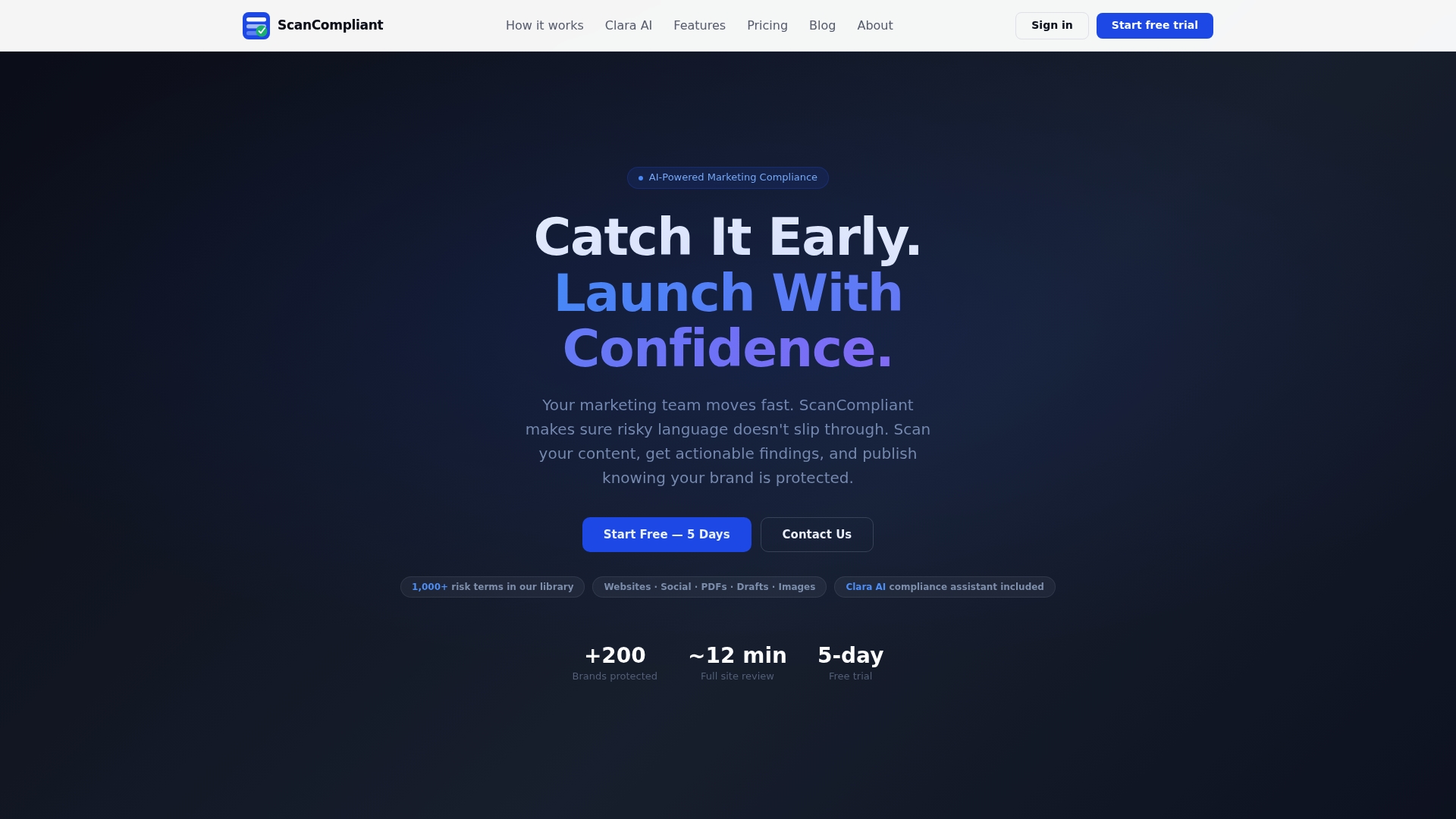
Scancompliant addresses that gap directly. The platform combines AI-powered content scanning with a database of more than 1,000 risk terms, centralized policy management, automated audit trails, and workflow approvals built specifically for FDA and FTC compliance. More than 200 brands have used it to accelerate content review cycles while maintaining a documented compliance record. If your team needs a marketing compliance platform that delivers findings in minutes rather than days, Scancompliant is built for exactly that. Teams evaluating budget and feature tiers can review Scancompliant’s pricing options to find the right fit.
FAQ
What is marketing compliance software?
Marketing compliance software is a platform that checks marketing content against applicable laws, regulations, and brand standards before and after publication. In healthcare, it enforces FDA, FTC, and HIPAA requirements across all marketing channels.
What features should healthcare marketers prioritize?
Healthcare marketers should prioritize AI-powered pre-publication scanning, HIPAA-compliant data handling, versioned policy history, and multi-channel consent synchronization. These four features address the highest-risk compliance gaps in regulated health marketing.
How does AI scanning improve compliance accuracy?
AI scanning flags risky claims and missing disclosures by matching content against a database of risk terms, which catches language patterns that human reviewers miss under time pressure. Scancompliant’s platform covers more than 1,000 such terms.
Why is post-publication monitoring necessary?
Regulations change after content is approved, which means a compliant page can become non-compliant without any action from your team. Continuous post-publication monitoring detects those gaps and alerts the responsible team before regulators do.
What is the difference between an audit log and an audit trail?
An audit log is a record of system events. An audit trail is a structured, tamper-evident sequence of every approval, revision, and rejection tied to a specific piece of content. The audit trail is what regulators examine during an investigation.
Recommended
- Top 3 Comply.com Alternatives in Marketing Compliance 2026 – scancompliant.com
- Compliant Content Release in Healthcare Marketing: 2026 Guide – scancompliant.com
- Healthcare Marketing Compliance Training Teams: 2026 Guide – scancompliant.com
- Regulatory Review Checklist for Healthcare Marketing – scancompliant.com