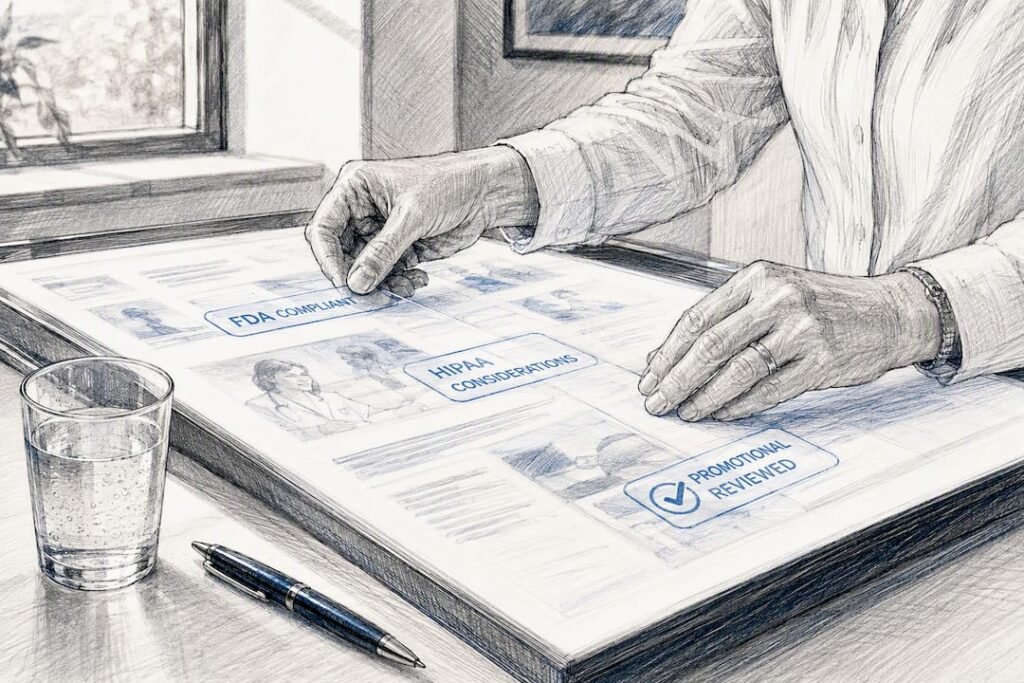
An AI-powered pre-publication scanner reads marketing content before it goes live, flags language that resembles known FDA and FTC violations, links each flag to the rule or enforcement pattern it matches, and hands your team a claim-level report to review. It doesn’t approve content, and it doesn’t replace medical, legal, or regulatory (MLR) review. It replaces the slow, manual first pass that used to eat hours of reviewer time.
For compliance teams at telehealth and DTC health brands, that means:
- Faster triage: a scan that takes minutes instead of a multi-day manual read
- Fewer avoidable enforcement triggers, since the tool catches patterns tied to real FDA warning letters
- A documented trail showing what was checked, against which rule, and when
Scanners like Scancompliant apply this logic against a database of over 1,000 risk terms, drawing on FTC substantiation standards to decide what counts as a red flag.
Key Takeaways
Pre-publication scanning works because it turns slow, manual claim review into fast, auditable triage that human MLR still approves.
| Point | Details |
|---|---|
| Scanner triages, humans approve | The scan flags claim-level risks with citations; MLR keeps final sign-off authority. |
| Rules must be deterministic | Pass/fail rule families for ISI, fair-balance, and on-label matching hold up under audit; probability scores alone don’t. |
| Enforcement patterns repeat | FDA warning letters to telehealth brands center on implied equivalence and missing risk disclosures. |
| Text scans miss images and pixels | Pair scanning with manual image review and a separate pixel/data-flow audit. |
| Scancompliant fits this workflow | Checks content against 1,000+ risk terms and has supported review cycles for 200+ telehealth and DTC health brands. |
Table of Contents
- How Pre-Publication Scanning Works for Creators and Compliance Teams
- What Pre-Publication Scanners Actually Check
- Where to Run Scans in Your Publishing Pipeline
- Who Owns What in a Defensible Review Process
- What Scanning Cannot Do on Its Own
- Why We Built Scanning Around Triage, Not Approval
- Get a Faster, More Defensible Review Cycle
- Where to Learn More
- Frequently Asked Questions
- Sources
How Pre-Publication Scanning Works for Creators and Compliance Teams
A scan runs in stages, and understanding each one is what lets you trust the output instead of treating it as a black box.
- Claim extraction. The scanner parses the draft, whether that’s website copy, an ad, a social post, or a product listing, and pulls out statements that read as health, efficacy, or comparative claims. It also reads basic image metadata and alt text, though it can’t see what’s actually depicted in a photo.
- Rule matching. Extracted claims run against deterministic rule families: fair-balance checks (is risk information proportionate to benefit claims?), ISI presence checks (is the Important Safety Information there and positioned correctly?), on-label match checks (does the claim match the approved use?), and reference substantiation checks (does a cited study actually say what the copy claims it says?).
- Severity scoring. Not every hit carries the same weight. A missing ISI is treated differently than a borderline comparative phrase, and the scanner ranks findings so reviewers see the riskiest items first.
- Evidence linking. Each finding ties back to a specific rule and, where applicable, a regulatory source, such as FTC substantiation guidance or a documented enforcement pattern.
The rule families themselves are pass/fail, which is what makes the output auditable. A model that generates a probability score for “riskiness” is useful for prioritization, but it isn’t defensible on its own in a regulatory response. A pre-check built correctly keeps the deterministic layer separate from the prioritization layer, so a reviewer can trace exactly why something got flagged.
The final output per claim looks like this: the claim text, the rule it triggered, a pass or fail verdict, a citation to the controlling standard, a severity level, and a plain-English remediation note.
Pro Tip: Ask any scanner vendor whether their rule verdicts are deterministic or model-generated. If they can’t answer clearly, you won’t be able to defend the output later.
What Pre-Publication Scanners Actually Check
Most flags trace back to a small set of recurring problems, and each one maps to a specific enforcement pattern regulators have already gone after.
- Implied equivalence to FDA-approved products. Language suggesting a compounded or off-label product works “just like” an approved drug is a top driver of recent FDA warning letters to telehealth companies, particularly around compounded GLP-1 marketing.
- Missing or misplaced ISI and fair-balance violations. Risk disclosures placed off-screen, in tiny type, or entirely absent are among the most common violations tied to warning letters, according to telehealth advertising compliance guidance.
- Unsubstantiated “clinically proven” language. The FTC requires adequate substantiation for health claims and defers to FDA determinations on what counts as scientific agreement. A claim without a matching citation is a fail, full stop.
- Misused third-party references, testimonials, and comparatives. Citing a study that doesn’t actually support the stated outcome, or running a testimonial that implies a typical result, both fall into this bucket.
- Tracking pixels and undisclosed data sharing. The FTC has penalized health companies for sharing sensitive health data with ad platforms in ways that contradicted their own privacy promises.
The FDA’s own enforcement wave against telehealth marketing included a batch of roughly 30 warning letters tied to compounded GLP-1 products, most citing implied equivalence and disclosure problems that a rule-based scan would catch before publication.
Where to Run Scans in Your Publishing Pipeline
Scanning works best when it happens early and often, not as a single gate right before launch.
- Draft stage. Run a scan as soon as a creator or copywriter produces a first draft, before it reaches design or legal. This catches obvious issues while they’re cheap to fix.
- Ad preflight. Scan again once copy is adapted for paid placements, since platform-specific formatting often strips or buries ISI text.
- CMS pre-publish. A final scan runs as a gate inside the content management system, before the publish button becomes active. The scan flags; it does not publish.
Findings should route by severity. High-severity hits (missing ISI, implied equivalence) go straight to compliance or legal. Medium hits (substantiation gaps) go to the marketing lead paired with a medical reviewer. Low hits (style or phrasing nudges) can often be resolved by the creator directly.
Every approval needs a recorded e-signature tied to a specific asset version, not a verbal “looks fine.” Engineering teams should wire the scan into CI/CD hooks so it runs automatically on content commits, with logs stored in a non-editable format.
Pro Tip: If your CMS lets someone publish before the scan completes, you don’t have a pre-publication check. You have a suggestion.
Who Owns What in a Defensible Review Process
Clear ownership is what turns a scan result into a defensible record instead of a shrug.
- Creators write and revise copy based on remediation notes.
- Marketing leads own timeline and prioritize which flagged items get fixed first.
- Compliance and legal own final interpretation of ambiguous or high-severity flags.
- Medical reviewers confirm clinical accuracy and on-label alignment.
- Ops and engineering maintain the audit infrastructure and access controls.
A defensible pre-publication process depends on claim-level findings, controlling citations, an immutable audit trail, and a reviewer e-signature tied to the exact asset version reviewed. Without all four, you have a scan result. With all four, you have evidence you can hand to a regulator or an internal auditor without scrambling.
If a warning letter or internal audit ever asks “who approved this and why,” these logs are the answer. Without that Part 11–style structure, you’re reconstructing a timeline from memory and email threads. Neither holds up well under scrutiny.
What Scanning Cannot Do on Its Own
A text-based scanner has real limits, and pretending otherwise is how gaps slip through.
- Image content. A scanner reading alt text won’t catch a misleading before-and-after photo or a visual implying a result the copy never states outright.
- Pixel and data-flow behavior. Tracking tags and ad-platform data sharing are invisible to a content scan and require a separate technical audit.
- Intake bot conversations. Chat-based intake flows can drift into off-label territory in ways no static content review ever sees.
Build a short manual checklist to run alongside every automated scan: check hero images and before/after visuals by eye, confirm pixel behavior with engineering quarterly, and escalate anything ambiguous to medical counsel rather than guessing. Keep timestamps, reviewer names, and rationale on every override decision.
Pro Tip: Treat a “pass” from the scanner as a floor, not a ceiling. It tells you the deterministic rules didn’t fail. It doesn’t tell you the ad is a good idea.
Why We Built Scanning Around Triage, Not Approval
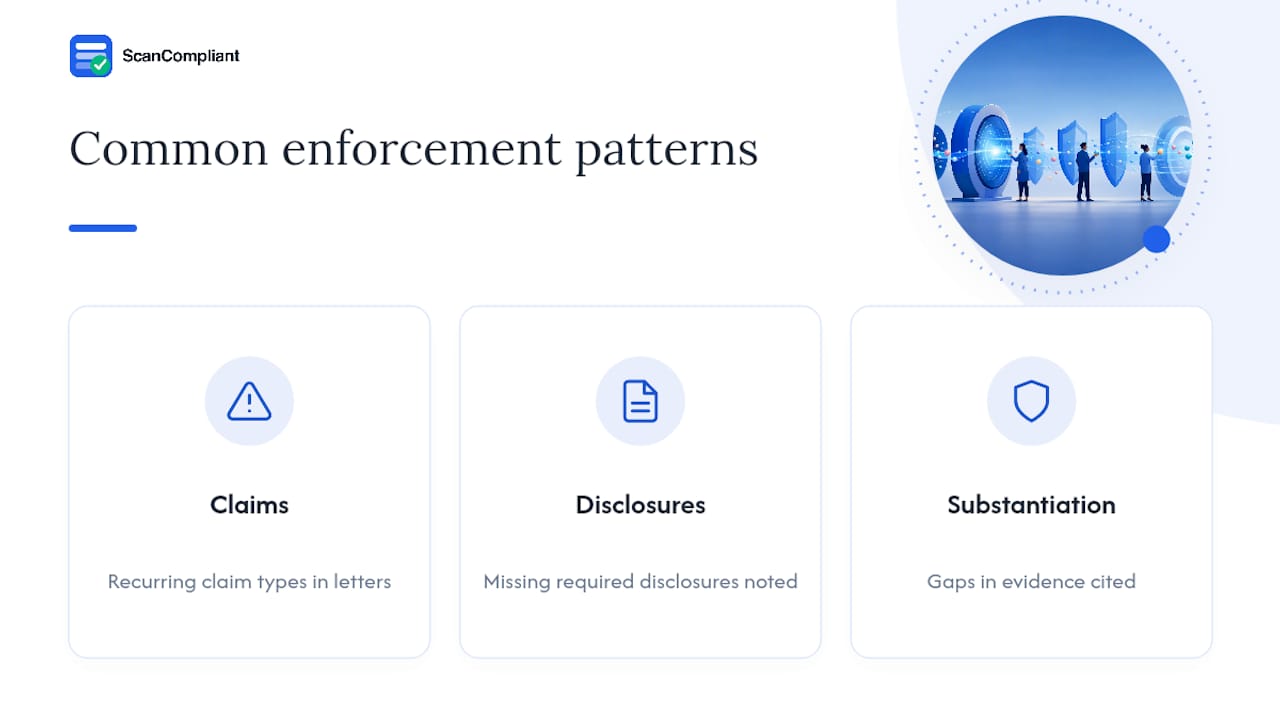
We built Scancompliant against a database of more than 1,000 risk terms because the pattern in enforcement letters is consistent: the same handful of claim types, missing disclosures, and substantiation gaps show up again and again. That repetition is exactly what a rule-based scan is good at catching, fast, and it’s why the platform has already worked through content for over 200 brands in telehealth and DTC health.
None of that replaces MLR. The scan triages. Your medical and legal reviewers still make the final call, and that division is by design, not a limitation we’re working around.
Get a Faster, More Defensible Review Cycle
Scancompliant scans websites, social content, documents, and product listings for the exact patterns FDA and FTC enforcement actions keep citing, then hands your team a prioritized, claim-level report instead of a wall of red ink. Regulatory, legal, and marketing teams get through first-pass review in minutes instead of days, with a documented trail attached to every finding.
If you’re managing content for a telehealth or supplement brand, particularly anything touching GLP-1 marketing, the GLP-1 compliance scanner applies these checks against the exact claim patterns named in recent warning letters. For teams evaluating fit more broadly, the pricing page lays out plan tiers for single teams and multi-brand agency workspaces. Start a pilot scan on your next campaign draft and see what surfaces before your reviewers ever open the file.
Where to Learn More
Start with the primary regulatory sources before relying on any secondary summary.
- FTC health-products compliance guidance, the controlling standard for substantiation
- Juncture’s explainer on pre-check architecture, covering what a pre-check should and shouldn’t do
- Foley & Lardner’s summary of FDA telehealth warning letters, for current enforcement context
- Scancompliant’s content review workflow guidance, for implementation specifics
Frequently Asked Questions
Does pre-publication scanning replace MLR review?
No. A scanner triages content and flags likely violations with citations, but a human medical, legal, and regulatory reviewer still gives final approval before publication.
How is pre-publication scanning different from a manual compliance check?
A manual check reads content once and relies on the reviewer’s memory of rules and past letters. A scan applies the same deterministic rule set every time, at speed, and produces a documented, auditable finding for each claim.
What causes false positives in pre-publication scanners?
Rules built for common patterns sometimes flag legitimate on-label language that reads similarly to a violation. Address this by reviewing flagged items against the actual regulation, not just the rule name, and by feeding confirmed false positives back into rule tuning.
How often should scanner rule sets be updated?
Rule sets need review whenever the FDA or FTC issues new guidance, whenever a new wave of warning letters reveals a fresh enforcement pattern, and whenever a platform (like Meta or Google) changes its health-ad policy.
Can a pre-publication scanner catch problems in images or tracking pixels?
Not on its own. Text-based scanners read copy and basic metadata, not visual content or pixel behavior. Both need separate audits run alongside the content scan.
This article is general information, not a substitute for advice from a qualified doctor. Consult a qualified healthcare professional about your own circumstances before acting on anything here.
Sources
- FTC health-products compliance guidance
- What an AI pre-check actually checks before MLR, and what it must never do · Juncture
- GLP-1 compliance: FDA targets telehealth marketing in 30 new warning letters — Foley & Lardner
- Protecting privacy & health information: FTC cases and takeaways
Recommended
- Pre-Publication Health Content Review Steps for Compliance Teams – scancompliant.com
- How Content Review Protects Creators in Telehealth Marketing – scancompliant.com
- Why Health Writing Carries Legal Risk for DTC Brands – scancompliant.com
- Benefits of Automated Compliance Screening for Telehealth – scancompliant.com