
Automated compliance screening delivers faster FDA and FTC risk detection, a continuously timestamped audit trail, consistent risk scoring across every content channel, and prioritized triage that lets reviewers focus on genuinely ambiguous claims rather than routine copy. For telehealth and DTC health brands, those four outcomes translate directly into fewer pre-publication violations, shorter review cycles, and audit evidence that is ready on demand rather than assembled in a panic.
The short version: automated screening catches risky health claims before they go live, documents every decision with a timestamp, and cuts the manual review burden so your team spends time on judgment calls, not keyword hunts.
Key benefits at a glance:
- Speed: findings delivered in minutes, not days
- Proactive assurance: continuous monitoring replaces periodic, point-in-time audits
- Timestamped audit trail: every scan, flag, and disposition is logged automatically
- Consistent risk scoring: the same rules apply to every piece of content, every time
- Prioritized triage: high-risk claims escalate; clean copy clears automatically
- Reduced audit prep: immutable, timestamped records are assembled continuously, not reconstructed before each audit cycle
Automated compliance screening shifts telehealth and DTC health teams from reactive, pre-audit scrambles to proactive, governance-by-design assurance — with a documented evidence trail regulators increasingly expect as the baseline standard.
Table of Contents
- Why telehealth and DTC health brands need automated screening now
- What your team actually gains operationally
- How automated screening works inside your content workflow
- How to run a pilot and define your success criteria
- Limitations you should plan for before you deploy
- How Scancompliant delivers these benefits for telehealth and DTC health brands
- Key Takeaways
- The compliance team’s honest take on what actually changes
- Ready to pilot automated screening with Scancompliant?
- Authoritative U.S. regulatory sources for health marketing compliance
Why telehealth and DTC health brands need automated screening now
The FDA and FTC apply overlapping scrutiny to health marketing. The FDA governs product claims, therapeutic representations, and labeling; the FTC enforces substantiation requirements for efficacy statements, testimonials, and comparative advertising. A single landing page for a telehealth service can trigger both agencies simultaneously if it contains an unsubstantiated efficacy claim or a patient testimonial that implies a clinical outcome.
Marketing channels multiply the exposure. A telehealth brand typically publishes across a website, paid search ads, social media, email, and app store listings. Each channel is a distinct regulatory touchpoint, and errors compound when copy is repurposed across them without a consistent review step. Telehealth email marketing, for instance, carries specific FTC disclosure requirements that differ from what a static web page needs.
The claims that draw the most scrutiny include: therapeutic or disease-cure language (“treats,” “cures,” “reverses”), unapproved drug or device representations, efficacy statements without adequate substantiation, testimonials that imply typical results, and missing required disclosures. Embedding screening into content workflows, what practitioners call governance-by-design, catches these before publication rather than after a complaint or warning letter.
What your team actually gains operationally
The operational case for compliance automation is concrete. Automated compliance tracking can reduce manual effort by up to 90% and cut audit preparation time by 40–60%. In a financial-services deployment, review time dropped by approximately 80% after automation was implemented, with the majority of inbound items handled within seconds by the system, freeing reviewers for the cases that genuinely needed judgment.

Triage is where the throughput gain is most visible. Layered screening logic filters low-confidence matches before they reach a human reviewer, shrinking queues of ambiguous cases from dozens to a handful per day. Reviewers stop spending the morning clearing obvious approvals and start spending it on the edge cases that actually require expertise.
| Metric | Typical improvement | Source |
|---|---|---|
| Manual compliance effort | Up to 90% reduction | [Benefits of Automated Compliance Tracking for Teams] |
| Audit prep time | 40–60% reduction | [Benefits of Automated Compliance Tracking for Teams] |
| Content review time | ~80% reduction | [How Workflow Automation Cut Financial Compliance Review Time by 80%] |
A less obvious benefit: automation preserves human judgment by removing high-volume, low-stakes tasks. Reviewers who spend less time on routine screening experience less fatigue and, over time, lower turnover — a real staffing consideration for compliance teams that are chronically understaffed.
Pilot metrics to track from day one:
- Time-to-first-find (target: minutes, not hours)
- Percentage of content auto-cleared without human review
- False-positive rate per content channel
- Reviewer throughput (items reviewed per hour)
- Audit-report generation time
How automated screening works inside your content workflow
A typical screening pipeline runs in four stages: ingest the content (draft, CMS entry, ad copy, or social post), run it against an NLP rules engine and a risk-term database, assign a confidence score to each flagged phrase, then route the output to either auto-clear or human review based on that score. Automation handles ingestion, database lookups, and initial risk scoring; humans retain final authority on nuanced decisions.
The scanner checks for:
- Therapeutic or disease claims (“cures,” “treats,” “reverses”) without substantiation
- Unapproved drug or device representations that imply FDA clearance not yet granted
- Efficacy statements that exceed what clinical evidence supports
- Problematic testimonials implying typical patient outcomes
- Missing disclosures required by FTC guidelines (material connections, results disclaimers)
- Comparative claims that lack a documented evidentiary basis
Integration points span the full content lifecycle: CMS draft review, ad-copy approval queues, paid-media platform pre-submission, email template review, and analytics hooks that track flag rates over time. Compliance workflow automation fits into existing approval steps rather than replacing them, so the human sign-off layer stays intact.
The output a reviewer sees typically includes the flagged phrase, the rule or risk term triggered, a confidence score, and a suggested rewrite or disclosure. Final interpretation remains with compliance or legal. Automation re-screens content automatically when the underlying risk-term database updates, so a claim that was acceptable under last quarter’s guidance gets re-evaluated without a manual trigger.
How to run a pilot and define your success criteria
A well-scoped pilot runs 4–6 weeks across three content channels and produces enough data to make a go/no-go procurement decision.
- Baseline first. Measure current average review time per content piece, error rate (claims flagged post-publication), and audit prep hours per quarter before you turn on automation.
- Define your content scope. Start with the highest-volume, highest-risk channels: website landing pages, paid search ad copy, and email campaigns.
- Run scans in parallel. Let the automated tool and your existing manual process run simultaneously for two weeks. Compare outputs to calibrate false-positive and false-negative rates.
- Set KPI targets. Time-to-first-find under 10 minutes; auto-approval rate above 60%; false-positive rate below 15%; audit-report generation under 30 minutes.
- Evaluate the audit trail. Confirm that every scan is logged with policy version, model confidence, and timestamp — the documentation supervisors need to reproduce decisions.
- Define human escalation rules. Any claim scoring below your confidence threshold goes to a named reviewer; that reviewer’s disposition is logged alongside the automated finding.
Pro Tip: Include audit-trail format requirements and PHI data-handling standards in your RFP language from the start. Vendors who cannot specify how they log policy versions and handle protected health information are not ready for a regulated healthcare environment.
A regulatory review checklist can help you map the specific claim types and disclosure requirements your pilot scope needs to cover before you write vendor requirements.
Limitations you should plan for before you deploy
Automation is not a substitute for a compliance program. These are the failure modes worth planning around:
- Overblocking: conservative risk-term databases flag acceptable claims, inflating reviewer queues. Mitigate with whitelist overrides that are logged and reviewed quarterly.
- False negatives: novel phrasing or indirect claims can slip past rule-based engines. Schedule model and rules reviews at least twice a year.
- Model drift: as marketing language evolves, a static risk-term database becomes less accurate. Require vendors to document update frequency and version history.
- Over-automation of judgment calls: roughly 90% of the work is assembly; the remaining 10% requires human judgment. Never route final legal determinations through an automated decision alone.
- Privacy and PHI handling: content submitted for scanning may contain patient-identifiable language. Confirm the vendor’s data-handling policy covers HIPAA obligations before onboarding.
One regulatory note: automation supports defensibility when it records policy and model versions, timestamps every action, and logs the verifying agent for each disposition. Without that documentation, the audit trail is incomplete regardless of how accurate the scanning is.
How Scancompliant delivers these benefits for telehealth and DTC health brands
Scancompliant embeds governance-by-design directly into content workflows, scanning marketing copy against a database of over 1,000 risk terms and returning prioritized findings in minutes. The platform has protected more than 200 brands, and its documented audit trail gives regulatory teams timestamped, auditor-ready evidence without any manual assembly.
The feature set maps directly onto the pilot requirements described above: risk-term database with customization options, confidence-scored findings with suggested fixes, CMS and ad-copy integrations, a human-review workflow for escalated cases, and a compliance trail that logs every scan, flag, and disposition. Teams that previously spent days on pre-publication review report faster publication cycles and a shorter path to audit readiness. The risk-prioritized approach means reviewers see the highest-severity claims first, not a flat list sorted by page order.
Key Takeaways
Automated compliance screening is the most direct path from reactive, periodic audits to continuous, audit-ready assurance for telehealth and DTC health brands.
| Point | Details |
|---|---|
| Speed and throughput | Automated screening returns findings in minutes and significantly reduces review time. |
| Audit trail quality | Continuous, timestamped logs replace manual evidence assembly and satisfy regulatory reproducibility standards. |
| Reviewer focus | Triage routes routine copy to auto-clear, so reviewers spend time on genuinely ambiguous claims. |
| Pilot KPIs | Measure time-to-first-find, auto-approval rate, false-positive rate, and audit-report generation time from week one. |
| Scancompliant | Over 1,000 risk terms, 200+ brands protected, prioritized findings in minutes, and a documented compliance trail built for FDA/FTC marketing review. |
The compliance team’s honest take on what actually changes
The shift that matters most is not the speed, though that is real. It is the change in what your reviewers are doing all day. Before automation, a compliance analyst at a mid-size telehealth brand might spend the majority of their time reading through landing page drafts looking for the word “cure” or checking whether a testimonial includes a results disclaimer. That work is important, but it is also the kind of work that burns people out and drives turnover in compliance departments that are already thin.
Once automated screening handles the high-volume, low-stakes triage, the same analyst is spending their time on the claims that genuinely require judgment: a novel therapy description that does not match any existing risk term, a comparative claim where the evidentiary basis is ambiguous, a patient story that sits right on the line between acceptable and problematic. That is the work that actually reduces regulatory exposure. The human-in-the-loop design is not a limitation of the technology; it is the point.
Ready to pilot automated screening with Scancompliant?
Catching a single FDA or FTC violation before it goes live is worth more than months of post-publication remediation. Scancompliant gives telehealth and DTC health teams exactly that: AI-powered content scanning against 1,000+ risk terms, prioritized findings in minutes, and a timestamped audit trail that holds up under regulatory scrutiny.
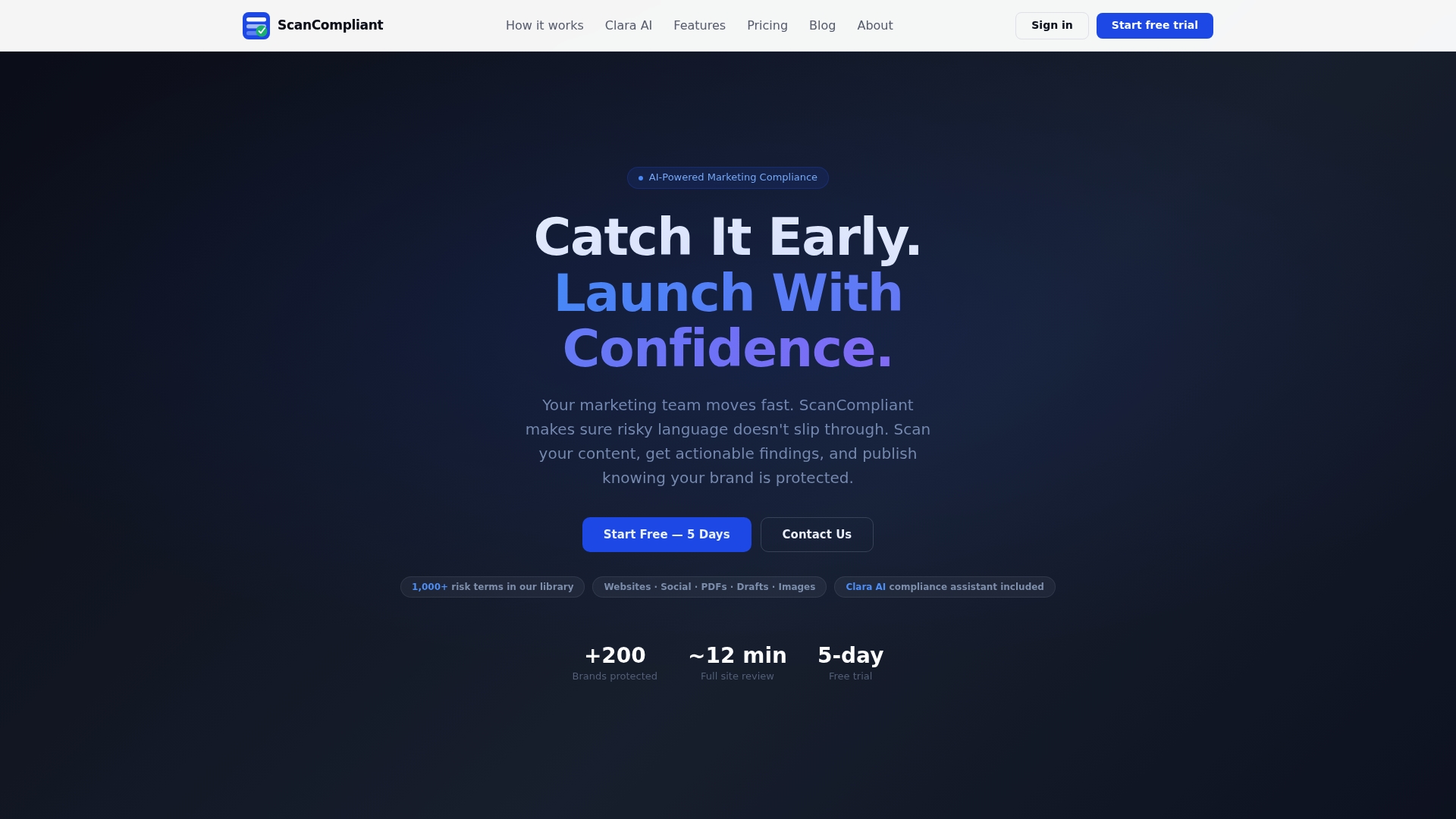
A typical pilot covers three content channels over four weeks, with parallel scanning alongside your existing review process so you can measure the improvement directly. Data security and PHI handling are covered under Scancompliant’s security and data policy, and transparent pricing means no surprises when you move from pilot to full deployment. Start your pilot at scancompliant.com.
Authoritative U.S. regulatory sources for health marketing compliance
- FDA — Advertising and Promotional Labeling: Governs permissible drug and device claims, labeling requirements, and the substantiation standard for therapeutic representations.
- FTC — Health Products Compliance Guidance: Sets the substantiation standard for efficacy claims, testimonial disclosure rules, and endorsement guidelines relevant to DTC health advertising.
- HHS Office for Civil Rights (OCR): Enforces HIPAA privacy and security rules; relevant when content workflows handle or reference patient data.
- FTC — .com Disclosures: Practical guidance on disclosure placement and format for digital advertising, including social media and email.
Recommended
- Telehealth Email Marketing Compliance Tips for 2026 – scancompliant.com
- Automating Marketing Compliance Review for Healthcare – scancompliant.com
- How Compliance Databases Are Built for Healthcare Teams – scancompliant.com
- Compliance Workflow Automation Use Cases for Healthcare Teams – scancompliant.com