
Risk-prioritized compliance is the process of scoring and ranking compliance risks by likelihood and impact to direct mitigation resources where they matter most. For compliance officers and healthcare marketers, this approach replaces static checklists with a dynamic, evidence-based system that satisfies regulatory frameworks including HIPAA, FDA, FTC, and GDPR. Scancompliant applies this same logic to marketing content, scanning for over 1,000 risk terms to flag the highest-severity language before it reaches publication. Understanding what is risk-prioritized compliance is no longer optional. Regulators now expect documented, prioritized risk registers as proof of a functioning compliance program.
What is risk-prioritized compliance and how does it work?
Risk-prioritized compliance is defined as a structured methodology that assesses each compliance risk on two dimensions: how likely it is to occur and how severe the impact would be if it did. The product of those two scores produces a single risk rating. That rating determines how quickly your team must act and how many resources to commit.
The formal industry term for this approach is a risk-based compliance program. The phrase “risk-prioritized compliance” describes the same concept from the practitioner’s perspective, emphasizing the output: a ranked list of risks with clear action priorities. Both terms are used interchangeably across regulatory guidance and compliance literature.
Risk prioritization follows the formula Risk = Threat × Vulnerability × Impact. Sorting your risk register by that score directs your team’s attention to the issues that carry the greatest potential for regulatory harm. This matters especially in healthcare marketing, where a single unsubstantiated claim can trigger an FDA warning letter or an FTC enforcement action.

How scoring methodologies rank compliance risks
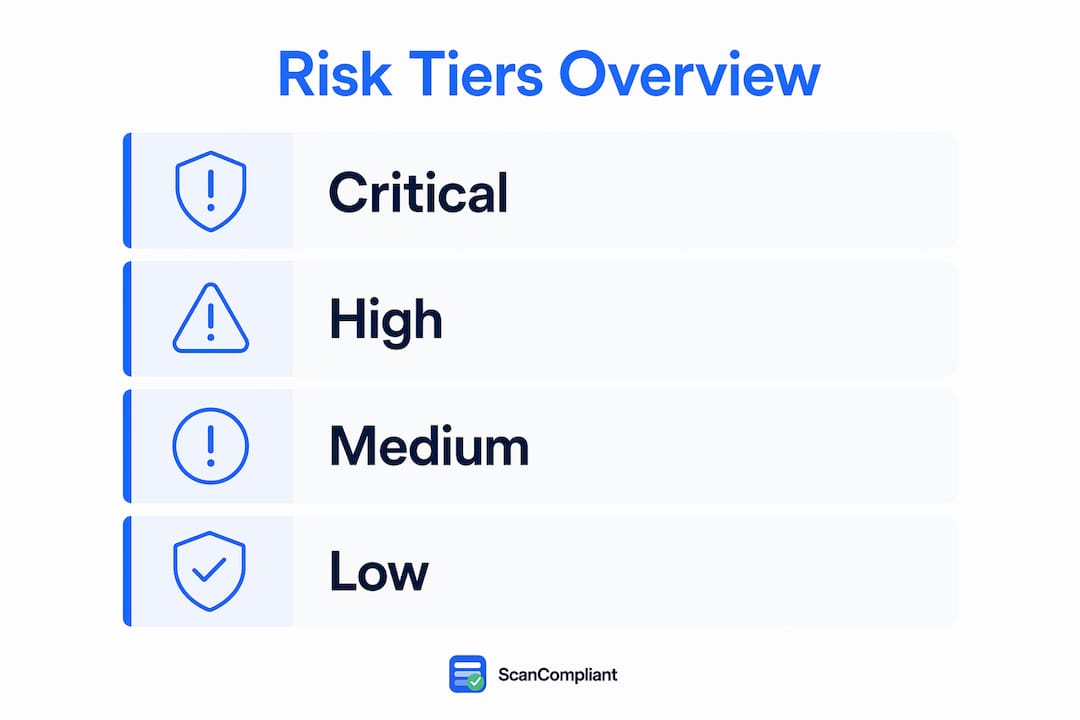
The most widely used scoring model assigns a likelihood score of 1–5 and an impact score of 1–5, then multiplies them to produce a combined score of 1–25. That range maps to four risk tiers, each with defined remediation expectations.
A 4-tier risk scoring system classifies risks as follows:
| Risk score | Classification | Required action |
|---|---|---|
| 1–4 | Low | Monitor; no immediate action required |
| 5–9 | Medium | Remediate within 60 days |
| 10–14 | High | Remediate within 30 days |
| 15–25 | Critical | Immediate escalation to board level |
A score of 15 or above demands immediate board escalation. That threshold exists because the combination of high likelihood and high impact creates exposure that no compliance team can absorb through routine monitoring alone.
For healthcare marketers, a claim like “clinically proven to cure” on a DTC product page would score high on both dimensions. The likelihood of regulatory scrutiny is high, and the impact of an FDA enforcement action is severe. That combination pushes the risk into the Critical tier, requiring immediate correction before publication.
Pro Tip: Consistent scoring criteria are the foundation of a defensible risk register. If two reviewers score the same risk differently, your register loses credibility with auditors. Document your scoring definitions and train every reviewer to apply them the same way.
How control effectiveness shapes residual risk
Identifying a risk and scoring it is only the first step. The score you calculate before accounting for any controls is called the inherent risk score. The score that remains after your controls are applied is the residual risk score. Residual risk is what regulators actually evaluate.
The residual risk formula is: Residual Score = Inherent Score × (1 – Control Effectiveness Reduction). Control effectiveness falls into three categories:
- Effective controls reduce inherent risk by 40–60%. Example: an automated content scanning platform that flags prohibited claims before publication.
- Partially effective controls reduce inherent risk by 20–40%. Example: a manual legal review process that catches most but not all risky language.
- Ineffective controls reduce inherent risk by 0–20%. Example: a style guide that exists but is rarely consulted by the marketing team.
A critical insight here is that the presence of a control does not imply mitigation. A policy document sitting in a shared drive does not reduce your residual risk score unless you can demonstrate it is actively applied and consistently followed. Auditors ask for evidence of control operation, not just evidence of control existence.
Pro Tip: Never equate a documented control with an effective one. Test each control periodically and record the results. That testing record is what turns a policy into a defensible mitigation.
Why regulatory frameworks require a risk-based compliance approach
HIPAA, SEC, GDPR, and OSHA all mandate a risk-based approach to compliance. None of these frameworks accept a static checklist as sufficient evidence of compliance. Each requires organizations to demonstrate that they have identified their specific risks, assessed their severity, and allocated resources accordingly.
The FATF risk-based approach reinforces this standard globally. Decisions must be documented with explanations of why specific risk levels were assigned and what measures were applied. That standard of evidence-based documentation now shapes regulatory expectations across industries, including healthcare marketing.
Checklist compliance fails because it treats every requirement as equally important. A healthcare marketer who checks the box on a general advertising policy but ignores the specific risk of unsubstantiated efficacy claims has technically completed a review. That review will not satisfy an FDA inspector who asks for evidence of a prioritized, documented risk assessment. The shift from checklist to risk register is not a preference. It is a regulatory requirement.
Failing to maintain a prioritized risk register carries real consequences. Regulators interpret the absence of documented risk prioritization as evidence that the organization does not understand its own compliance exposure. That interpretation accelerates enforcement timelines and reduces the credibility of any remediation plan offered after the fact.
Common pitfalls and best practices in risk-based compliance strategy
The most damaging mistake in compliance risk management is treating risk as binary. A risk is not simply “present” or “absent.” The score gradient dictates the response. A Medium risk requires a 60-day remediation plan. A Critical risk requires immediate board escalation. Collapsing those distinctions into a simple yes/no assessment produces a compliance program that misallocates resources and misses the highest-priority exposures.
A second common pitfall is applying a single scoring framework across fundamentally different risk categories. A separate scoring framework is often necessary for distinct risk types. Comparing a patient safety risk with a marketing copy risk on the same scale can artificially suppress the marketing risk score, making a high-severity regulatory exposure look manageable. Healthcare marketing teams should maintain a dedicated risk register for content and claims compliance, separate from operational or safety risk registers.
The table below contrasts the most common pitfalls with the corresponding best practices:
| Common pitfall | Best practice |
|---|---|
| Binary risk view (present/absent) | Use a 1–25 score scale with defined tier thresholds |
| One scoring framework for all risk types | Maintain separate registers for safety, operational, and marketing risks |
| Equating documentation with mitigation | Test controls regularly and record evidence of operation |
| No named owners for medium-to-critical risks | Assign named owners, target dates, and measurable closure criteria |
| Risk register updated annually | Review and update the register on a rolling or quarterly basis |
Medium-to-critical risks require documentation with named owners, target dates, and measurable closure evidence. Without that structure, a risk register becomes a static document rather than a living management tool. Compliance fatigue sets in when teams document risks but never close them. Closing risks requires evidence, not just effort.
Effective compliance risk reporting uses RAG (red-amber-green) ratings to show trends and remediation status at the board level. That format communicates risk posture quickly to executives who need a clear picture without technical detail. Healthcare marketing teams that produce board-ready risk reports demonstrate regulatory maturity and build internal credibility for compliance investments.
Compliance workflow automation addresses the execution gap that most organizations face. Risks get identified but never translated into prioritized, board-ready actions. Technology-enabled workflows close that gap by routing findings to the right owners with deadlines attached.
Pro Tip: Build your risk register in a format that can be exported directly into a board report. If your compliance data lives in a spreadsheet that requires hours of reformatting before each leadership meeting, the register will not get updated as often as it should.
Key Takeaways
Risk-prioritized compliance is the foundation of every defensible compliance program, requiring scored risk registers, tested controls, and named remediation owners to satisfy HIPAA, FDA, FTC, and GDPR expectations.
| Point | Details |
|---|---|
| Score every risk on a 1–25 scale | Multiply likelihood by impact to produce a tier that dictates remediation speed. |
| Residual risk reflects control quality | Apply the formula Residual = Inherent × (1 – Reduction) and test controls to prove effectiveness. |
| Regulatory frameworks require risk registers | HIPAA, GDPR, and FDA all expect documented, prioritized risk analysis, not checklists. |
| Separate registers for distinct risk types | Marketing compliance risks need their own scoring framework to avoid being minimized by comparison. |
| Named owners close risks | Every medium-to-critical risk needs an assigned owner, a target date, and measurable closure evidence. |
Risk prioritization is the baseline, not the benchmark
Most compliance teams I work with understand the theory of risk prioritization. The execution gap is where programs break down. Risks get identified but not translated into board-ready priorities, and leadership ends up making resource decisions without a clear picture of what is actually critical.
The uncomfortable truth is that static checklist-only models are now seen as insufficient by regulators. Risk prioritization is the baseline expectation in 2026, not a sign of a mature program. If your team is still treating compliance as a pass/fail exercise, you are already behind the standard regulators apply during audits.
For healthcare marketing teams specifically, the stakes are higher than in most industries. An unsubstantiated efficacy claim does not just create a compliance finding. It can trigger an FDA warning letter, an FTC investigation, or both. The speed at which marketing content moves in DTC health brands means that manual review cycles cannot keep pace with publication schedules. That is where technology-enabled prioritization becomes a practical necessity, not a luxury.
The leadership challenge is not identifying risks. It is communicating them in a way that drives decisions. A compliance officer who presents a 200-row spreadsheet to a board will not get the resources needed to close critical findings. A compliance officer who presents a RAG-rated summary with three Critical items, named owners, and 30-day deadlines will. The format of your risk communication is as important as the accuracy of your risk scores.
— Compliant Team
How Scancompliant supports risk-prioritized compliance in healthcare marketing
Healthcare marketing teams face a specific compliance challenge: content moves fast, and risky language is easy to miss under deadline pressure.

Scancompliant is built for exactly that environment. The platform scans marketing content against a database of over 1,000 risk terms, flags high-severity language before publication, and delivers prioritized findings in minutes. It has already protected more than 200 brands, giving regulatory and marketing teams a documented compliance trail that holds up during compliance audits. For teams that need to demonstrate a risk-based approach to FDA and FTC reviewers, Scancompliant turns content review from a manual bottleneck into a structured, evidence-based process. See how marketing compliance works with Scancompliant.
FAQ
What does risk prioritization mean in compliance?
Risk prioritization in compliance means ranking identified risks by their likelihood and potential impact so that the most severe exposures receive resources and remediation first. It replaces equal treatment of all risks with a tiered, score-driven approach.
What are the four risk tiers in a compliance risk assessment?
The four tiers are Low (scores 1–4), Medium (5–9), High (10–14), and Critical (15–25), each with defined remediation timelines ranging from ongoing monitoring to immediate board escalation.
How is residual risk calculated in a compliance program?
Residual risk is calculated as Inherent Score × (1 – Control Effectiveness Reduction), where effective controls reduce the score by 40–60%, partially effective controls by 20–40%, and ineffective controls by 0–20%.
Why do HIPAA and FDA require a risk-based compliance approach?
HIPAA, FDA, and similar frameworks require organizations to document their specific risks, assess their severity, and show prioritized remediation. A checklist alone does not satisfy this standard because it treats all requirements as equally important regardless of actual exposure.
What is the most common failure in risk-prioritized compliance programs?
The most common failure is identifying risks but not translating them into board-ready, prioritized action plans with named owners and deadlines. That execution gap leaves critical risks unresolved and creates significant regulatory exposure.
Recommended
- Compliant Content Release in Healthcare Marketing: 2026 Guide – scancompliant.com
- Healthcare Marketing Compliance Training Teams: 2026 Guide – scancompliant.com
- Regulatory Review Checklist for Healthcare Marketing – scancompliant.com
- Compliance Risk Reporting for Healthcare Teams: 2026 Guide – scancompliant.com