
Marketing compliance automation is defined as the use of AI-powered systems and structured workflows to evaluate, flag, and approve marketing content against regulatory standards before publication. For healthcare marketing and regulatory teams, automating the marketing compliance review process is no longer optional. The FDA and FTC have both intensified enforcement against telehealth and direct-to-consumer health brands, making manual review cycles a liability. AI-driven pre-screening, automated approval workflows, and audit-ready logs now form the operational backbone of compliant healthcare marketing programs.
What tools and technologies power automated compliance review?
The core of any automated compliance review system is AI-powered pre-screening built on natural language processing. NLP engines read marketing copy the way a trained compliance attorney would, scanning for promissory claims, missing disclosures, and language that violates FTC or FDA standards. The difference is speed and consistency. An NLP engine does not have a bad day or miss a footnote.
Automation tools support multi-format compliance screening and flag violations with on-content annotations, covering PDFs, images, emails, and social media posts. That breadth matters because healthcare marketing teams rarely work in a single channel. A campaign might run across a telehealth app, an email sequence, and a paid social ad simultaneously, each requiring the same regulatory scrutiny.
Computer vision adds a second layer of review for visual assets. It checks that required disclosures appear in readable font sizes, that imagery does not imply unauthorized health claims, and that branded visuals meet internal brand standards. This capability is often overlooked in early automation builds, but regulators do not limit their scrutiny to text.

The table below summarizes the feature categories every healthcare compliance team should evaluate when selecting an automation platform.
| Feature category | What it does |
|---|---|
| NLP content scanning | Reads copy for regulatory violations and missing disclosures |
| Computer vision | Reviews images and visual assets for compliance issues |
| Custom rule libraries | Encodes FTC, FDA, TCPA, and internal brand standards |
| On-content annotations | Flags specific text or image segments with corrective guidance |
| Audit trail generation | Logs every submission, decision, and approval with timestamps |
| Integration layer | Connects with existing marketing and legal review systems |
Effective marketing compliance software also requires explainability. Modern AI compliance platforms generate rationale tied to policy libraries and triggered text, so reviewers understand exactly why a flag was raised. That transparency is what makes automated findings defensible in a regulatory exam.
Pro Tip: When evaluating platforms, ask vendors to demonstrate how their system explains a flag. If the answer is just a risk score with no policy reference, the tool will create more confusion than clarity for your compliance team.
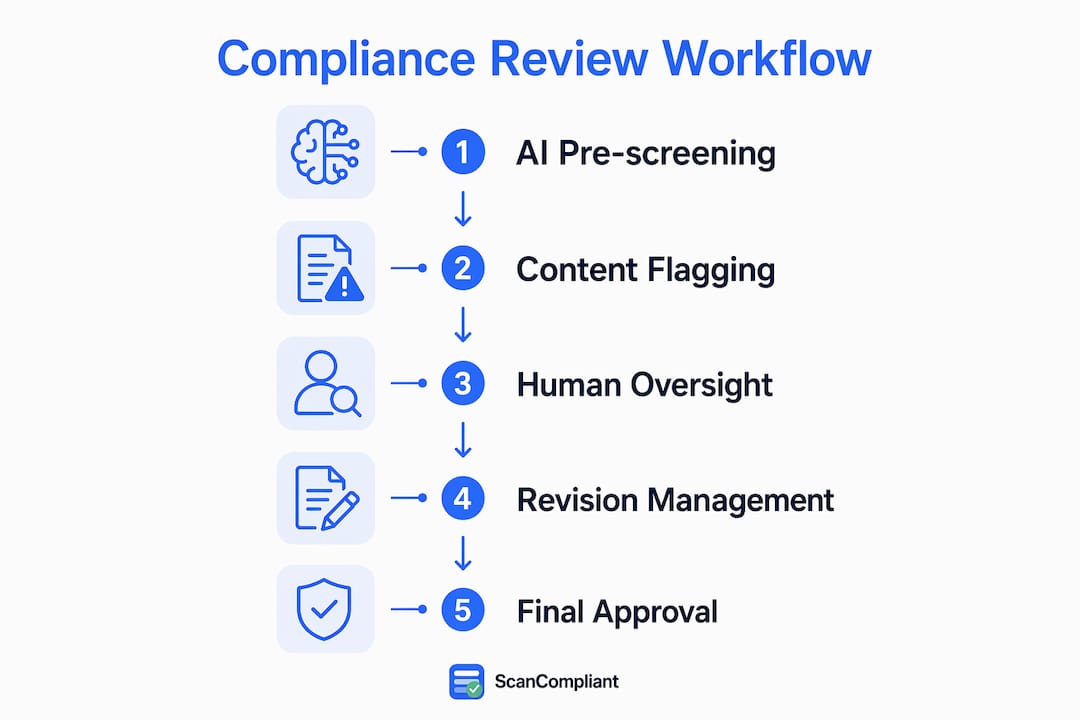
How to design an automated compliance review workflow that scales
A scalable automated compliance review workflow starts with a clear submission protocol. Every piece of marketing content needs a defined entry point, a content type label, and an assigned owner from the marketing team. Without that structure, AI pre-screening produces findings that no one knows how to act on.
The workflow stages below reflect compliance review best practices for healthcare marketing teams building or rebuilding their review process.
- Content submission. Marketing teams submit assets through a centralized intake system with metadata: channel, audience, product, and regulatory category.
- AI pre-screening. The platform scans content against the active rule library and returns prioritized findings within minutes, not days.
- Triage and routing. Low-risk content moves to a fast-track approval queue. Flagged content routes to the appropriate compliance or legal reviewer based on issue type.
- Corrective action. Reviewers act on annotated findings directly within the platform, revising copy or imagery and resubmitting for a second scan.
- Final approval. A compliance officer or designated approver signs off, and the platform logs the decision with a timestamp.
- Post-publication monitoring. AI monitors approved channels in near real-time to catch deviations from approved content after it goes live.
Automated pre-screening significantly reduces manual workload, shifting compliance teams from reviewing every item to focusing on triaged exceptions. That shift improves throughput by a factor of 5–10 compared to fully manual processes. It also reduces reviewer fatigue, which is one of the most underappreciated sources of compliance error in high-volume marketing environments.
Pro Tip: Assign a compliance workflow owner who sits between the marketing and legal teams. This person manages the rule library, monitors triage accuracy, and escalates edge cases. Without this role, automated workflows drift out of calibration within months.
Defining user roles is equally critical. Marketing contributors, compliance reviewers, legal approvers, and system administrators each need distinct permissions. Role-based access prevents unauthorized approvals and creates a clear chain of accountability that regulators expect to see during an audit. For teams building this from scratch, the compliance workflow automation use cases guide offers a practical starting framework.
What compliance challenges can automation help solve in healthcare marketing?
Healthcare marketing operates under a layered regulatory framework. FTC rules govern advertising claims and endorsements. FDA regulations apply to drug and device promotion. TCPA covers digital outreach and consent. State-level rules add another layer on top of federal standards. Multi-jurisdictional rules and frequent regulatory updates require custom rule libraries embedded in automation to stay current. A rule library that was accurate in january may be outdated by march after a new FTC guidance release.
The most common violations in healthcare marketing are not exotic. They are predictable and preventable.
- Promissory claims. Language like “guaranteed results” or “cures” that the FDA prohibits without clinical substantiation.
- Missing disclosures. Absent or buried disclaimers on testimonials, pricing, and risk information required by FTC rules.
- Dark patterns. Interface or copy designs that obscure cancellation terms or mislead consumers, now a specific FTC enforcement priority.
- False advertising. Comparative claims without adequate substantiation, a frequent trigger for both FTC action and competitor challenges.
- Inconsistent messaging. Different claims appearing across channels for the same product, creating a contradictory regulatory record.
Firms adopting rapid compliance workflows reduce penalties linked to dark patterns and false advertising regulated by the FTC and TCPA. The financial exposure from a single enforcement action far exceeds the cost of building a proper automated review system.
Automation also solves the consistency problem that manual review cannot. A human reviewer applies different judgment on a Friday afternoon than on a Tuesday morning. An AI engine applies the same rule library to every submission, every time. That consistency is what creates a defensible compliance record. For teams managing telehealth email marketing, where consent and disclosure requirements are especially strict, consistency is the difference between compliance and a regulatory inquiry.
How do you measure the performance of your automated compliance review process?
Measurement is what separates a compliance program from a compliance theater. The metrics below give healthcare marketing and regulatory teams a clear picture of whether their automation is working.
Review turnaround time is the most immediate indicator. Organizations report same-day compliance approval for submissions that previously took several days. A reduction from multi-day cycles to same-day processing is the baseline expectation for a properly configured automated system.
Revision rates measure how often content returns for a second or third review cycle. High revision rates signal that the rule library is not aligned with how the marketing team writes, or that pre-submission guidance is insufficient.
Violation frequency by content type identifies where your marketing process generates the most regulatory risk. If paid social ads consistently generate more flags than email copy, the root cause is usually a gap in channel-specific training or templates.
The table below compares manual and automated review benchmarks across key performance dimensions.
| Metric | Manual review | Automated review |
|---|---|---|
| Average turnaround time | 3–7 business days | Same day to 24 hours |
| Consistency across reviewers | Variable | Uniform rule application |
| Audit trail completeness | Partial, often manual | Full, timestamped, tamper-evident |
| Multi-format coverage | Limited by reviewer capacity | PDFs, images, email, social |
| Post-publication monitoring | Periodic sampling | Near real-time detection |
Advanced platforms maintain detailed timestamped audit trails to prove compliance during regulatory exams. That documentation is not just a nice-to-have. Regulators increasingly expect organizations to produce a complete record of how a piece of content was reviewed, revised, and approved. A content compliance audit without a complete audit trail is a compliance gap, not a compliance program.
The most common pitfall in automated compliance programs is over-reliance on the AI without human oversight of flagged exceptions. Effective automation balances AI review with human oversight for flagged content, preserving governance quality. Automation handles volume. Humans handle judgment calls on edge cases, novel claims, and regulatory gray areas.
Key Takeaways
Automating the marketing compliance review process in healthcare requires AI pre-screening, custom rule libraries, and timestamped audit trails working together to deliver consistent, defensible approvals at scale.
| Point | Details |
|---|---|
| AI pre-screening is the foundation | NLP and computer vision scan all content formats before human review begins. |
| Custom rule libraries drive accuracy | Encode FTC, FDA, TCPA, and state-level rules and update them as regulations change. |
| Audit trails are non-negotiable | Every submission, annotation, and approval must be timestamped and tamper-evident. |
| Human oversight preserves quality | Automated triage handles volume; trained reviewers handle flagged exceptions and edge cases. |
| Metrics reveal process health | Track turnaround time, revision rates, and violation frequency to identify and fix gaps. |
The uncomfortable truth about compliance automation in healthcare
Most healthcare marketing teams adopt automation to go faster. That is the right instinct, but it is also where things go wrong. Speed without calibration produces a faster path to the same mistakes.
The teams I have seen get this right treat the rule library as a living document, not a one-time setup task. They assign someone to own it, review it quarterly, and update it within days of a new FTC guidance release or FDA warning letter. The teams that struggle treat the platform as a black box and assume that because the tool is running, the program is compliant.
The other uncomfortable reality is that FTC enforcement has intensified specifically around the tactics that healthcare DTC brands use most: testimonials, before-and-after claims, and subscription terms. Automation that was calibrated two years ago may not catch the violations that regulators are prioritizing today. The AI in regulatory risk detection landscape has moved fast enough that a platform audit is worth doing annually, not just at implementation.
My honest recommendation: invest in automation early, but invest equally in the governance structure around it. The platform is the engine. The rule library, the workflow design, and the human oversight layer are the steering wheel. You need all of it.
— Compliant Team
How Scancompliant supports healthcare marketing compliance
Scancompliant is built specifically for telehealth and direct-to-consumer health brands that need fast, accurate compliance review without the bottlenecks of manual processes.
The platform scans marketing content against a database of over 1,000 risk terms, returning prioritized findings in minutes. It covers FDA and FTC regulatory standards and generates a documented compliance trail for every piece of content reviewed. More than 200 brands have used Scancompliant to catch risky language before it reaches consumers, reducing both revision cycles and regulatory exposure. For healthcare marketing and regulatory teams ready to move beyond manual review, Scancompliant’s platform delivers the speed and audit-ready documentation that modern compliance programs require.
FAQ
What is a marketing compliance review?
A marketing compliance review is the process of evaluating marketing content against applicable regulatory standards, such as FDA and FTC rules, before publication. The goal is to identify and correct violations before they reach consumers or regulators.
How does automating the compliance review process reduce risk?
Automated compliance review applies a consistent rule library to every submission, eliminating the variability and fatigue that cause human reviewers to miss violations. Automated pre-screening reduces manual workload and flags issues with specific policy references, making findings easier to act on.
What regulations apply to healthcare marketing content?
Healthcare marketing content is governed by FDA regulations for drug and device promotion, FTC rules on advertising claims and endorsements, and TCPA requirements for digital outreach and consumer consent. State-level rules add additional requirements depending on the market.
How long does automated compliance review take?
Organizations report same-day approval for content that previously required several days of manual review. Turnaround time depends on content volume and the complexity of flagged issues requiring human review.
Do automated compliance systems replace human reviewers?
Automated systems handle volume and consistency. Human reviewers remain responsible for flagged exceptions, novel claims, and regulatory gray areas where judgment is required. The most effective programs combine both.