
Artificial intelligence is defined as the primary mechanism for identifying regulatory risk patterns that manual review consistently misses at scale. The role of AI in regulatory risk detection has shifted from experimental to operational in 2026, with the FDA actively deploying platforms like Elsa 4.0 and HALO to flag compliance issues in promotional submissions. 84% of risk and compliance professionals agree AI offers significant advantages for regulatory oversight. That consensus reflects a field that has moved past debate and into implementation. For compliance professionals and healthcare marketers, the question is no longer whether to adopt AI. The question is how to govern it well.
How AI improves regulatory risk detection beyond manual review
AI detects regulatory risk through pattern recognition, anomaly detection, and continuous monitoring across data volumes that no human team can process manually. These capabilities fall under the broader industry term “automated risk detection,” which encompasses machine learning models trained on regulatory language, submission histories, and enforcement actions.

Traditional rule-based review works from fixed checklists. A reviewer checks whether a claim appears on a prohibited list. AI works differently. It identifies contextual risk, meaning it can flag a phrase that is technically compliant in isolation but problematic in combination with surrounding content. That distinction matters enormously in healthcare marketing, where subtle language shifts carry real enforcement consequences.
The FDA’s use of Elsa 4.0 and HALO makes this concrete. Elsa 4.0 functions as a core data synthesizer that reduces review times while requiring human verification to prevent error propagation. HALO supports inspectional planning and promotional material review on Form 2253. Both systems flag issues that a human reviewer scanning a 40-page submission might miss on a deadline.
Key capabilities that separate AI from manual review:
- Volume processing: AI analyzes thousands of submissions simultaneously without fatigue or inconsistency.
- Contextual flagging: Machine learning models detect risk in phrase combinations, not just isolated terms.
- Real-time monitoring: AI tracks regulatory changes and updates risk profiles continuously, not quarterly.
- Traceable outputs: AI-enhanced supervisory outputs are evidence-grounded and auditable, improving consistency over manual review.
Pro Tip: Map your highest-volume content types first. AI delivers the clearest return on investment where manual review creates the most backlog, typically email campaigns, landing pages, and social copy in direct-to-consumer health marketing.
What governance challenges come with AI in compliance monitoring?
AI in compliance monitoring introduces governance risks that are as serious as the risks it mitigates. The most underappreciated is regulatory deskilling.
Regulatory deskilling occurs when human reviewers rely on AI outputs so heavily that their own evaluative skills atrophy. A reviewer who stops reading submissions critically because AI flags the problems will eventually lose the judgment needed to catch what AI misses. This is not a theoretical concern. It is a documented pattern in fields where automation has displaced skilled human judgment over time.
A second governance failure is the hidden AI system. Un-inventoried AI systems create structural governance failures, not just documentation gaps. When a compliance team deploys an AI tool without logging it in a formal model inventory, that system operates outside any audit trail. If a regulator asks how a decision was made, the team cannot answer. The remediation cost, financial and reputational, is significant.
“An incomplete AI model inventory is a governance failure. Regulators do not distinguish between a system that was hidden intentionally and one that was simply forgotten.”
Governance frameworks for AI in regulatory review must address three non-negotiable requirements:
- Explainability: Every AI output must be traceable to a specific input and a documented decision logic.
- Audit trails: All AI-assisted decisions need timestamped records that survive regulatory inspection.
- Human-in-the-loop controls: Policy decisions must remain human-controlled for legal defensibility, even when AI handles workflow orchestration.
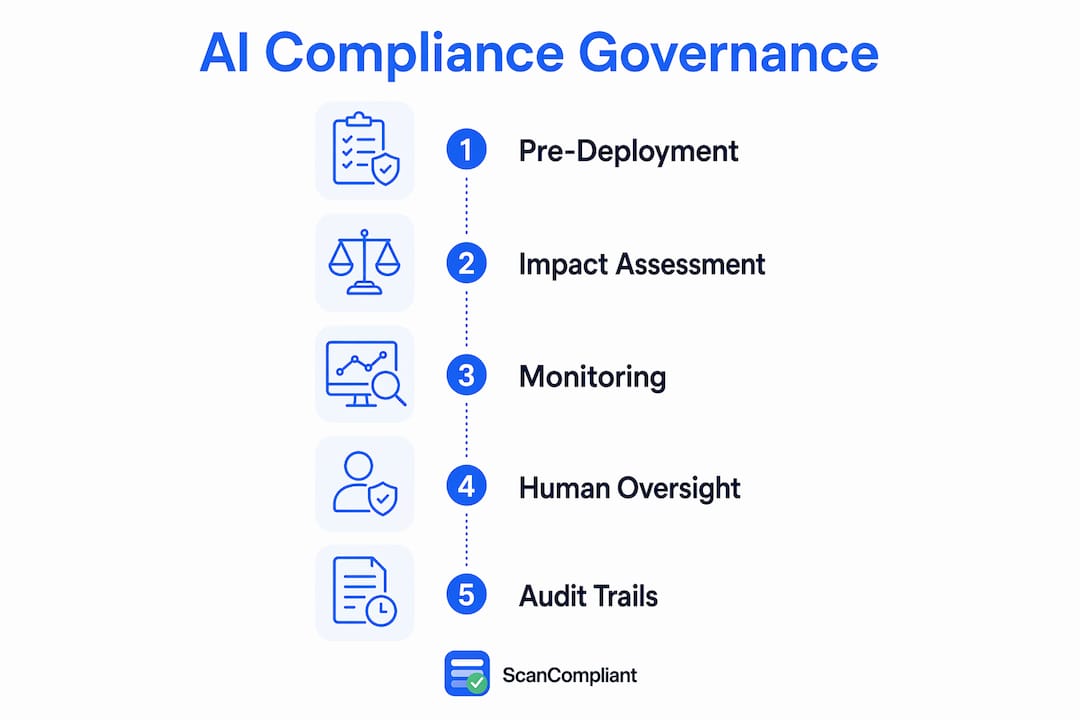
Governance demands include pre-deployment testing, impact assessment, ongoing monitoring, and human oversight at every stage. Teams that skip any of these steps create liability, not efficiency.
What regulatory trends are shaping AI implementation in 2026?
Regulatory agencies are not just regulating AI. They are using it. That shift changes the compliance calculus for every healthcare marketer and regulatory team.
The FDA’s deployment of Elsa 4.0 and HALO for promotional material review is the clearest example. The agency now uses AI to flag issues on Form 2253 submissions before a human reviewer ever opens the file. That means your submission is screened by an algorithm trained on enforcement history before it reaches a person. Knowing what that algorithm looks for is a competitive advantage.
Global regulatory bodies are following the same path. The U.K. Financial Conduct Authority and other international supervisors have adopted AI-enabled oversight to accelerate decision-making. AI-enabled adversarial attacks increased by 89% in the year leading up to april 2026. That figure signals that poorly governed AI systems are now a primary attack surface, not just a compliance gap.
| Regulatory body | AI tool or initiative | Primary function |
|---|---|---|
| FDA | Elsa 4.0 | Evidence synthesis and submission review |
| FDA | HALO | Inspectional planning and promotional review |
| U.K. FCA | AI-enabled supervision | Risk identification and decision acceleration |
| Global regulators | AI oversight programs | Submission screening and anomaly detection |
The practical implication for compliance teams is clear. Regulators are running AI on your submissions. Running the same type of analysis internally before you file is now a best practice, not an edge case.
How should compliance teams apply AI in their workflows?
Effective AI integration in regulatory compliance follows a specific sequence. Teams that skip steps create governance gaps that surface during audits.
-
Build a model inventory first. Document every AI tool in use across the compliance function, including tools adopted informally by individual team members. Most regulatory leaders underestimate the risk posed by untracked AI systems. An inventory is the foundation of every other governance control.
-
Run pre-filing AI analysis. Organizations that analyze submissions before filing preemptively identify issues their regulatory AI is likely to flag. This practice, sometimes called pre-gaming regulatory scrutiny, is now a documented best practice for submission defensibility.
-
Assign human reviewers to AI outputs, not raw submissions. AI handles volume. Humans handle judgment. Structure your compliance review workflow so that reviewers evaluate flagged items rather than scanning full documents from scratch.
-
Train your team on AI literacy. Human capacity remains a rate-limiting factor despite AI efficiency gains. Senior reviewers need enough AI literacy to recognize when an output is wrong, not just when it is right.
-
Use agentic AI for task orchestration only. The most successful AI deployments use agentic AI to manage multi-step workflows while keeping substantive decisions with humans. Agentic AI routes, summarizes, and prioritizes. Humans decide.
Pro Tip: Pair your AI risk detection tool with a formal content compliance audit process. The audit creates the documented trail that proves your AI outputs were reviewed and acted on by a qualified human.
The cultural shift matters as much as the technical one. Teams that treat AI as a replacement for human judgment will fail audits. Teams that treat it as a first-pass filter with mandatory human review will build defensible compliance programs.
Key Takeaways
AI in regulatory risk detection is most effective when it functions as a structured first-pass filter governed by human oversight, documented model inventories, and pre-filing analysis protocols.
| Point | Details |
|---|---|
| AI detects what manual review misses | Pattern recognition and contextual flagging catch subtle risks that checklist-based review overlooks. |
| FDA uses AI on your submissions | Elsa 4.0 and HALO screen Form 2253 filings before human review, making pre-filing AI analysis a best practice. |
| Hidden AI systems create governance failures | Every AI tool must appear in a formal model inventory or it becomes an audit liability. |
| Regulatory deskilling is a real risk | Human reviewers must stay actively engaged with AI outputs to preserve their own evaluative judgment. |
| Human control is non-negotiable | Policy decisions must remain with humans for legal defensibility, even when AI manages workflow steps. |
The uncomfortable truth about AI in compliance
The compliance industry has a tendency to treat AI adoption as a technology problem. Buy the right tool, deploy it, and the risk goes down. That framing is wrong, and I have seen it cause real damage.
The teams that struggle most with AI in regulatory workflows are not the ones with bad tools. They are the ones with good tools and no governance. They deployed AI quickly, skipped the model inventory, and never defined who owns the output. When a regulator asked how a flagged claim was resolved, nobody could produce a clear answer. That is not an AI failure. That is a process failure that AI made harder to hide.
The teams that get this right treat AI as a member of the review process, not the owner of it. They document what the AI flagged, what the human decided, and why. They run pre-filing analysis the same way they run legal review: as a required step, not an optional one. And they invest in keeping their human reviewers sharp, because a reviewer who cannot evaluate an AI output independently is a liability, not an asset.
The next two years will see regulatory frameworks catch up to AI adoption. The FDA’s use of Elsa 4.0 signals that agencies are not waiting for industry to lead. Compliance teams that build governance structures now will be positioned well. Teams that wait for formal guidance will spend those years in remediation.
AI literacy is not optional for compliance professionals in 2026. It is a core competency.
— Compliant Team
Scancompliant for healthcare marketing compliance
Healthcare marketers working under FDA and FTC scrutiny need more than a checklist. They need a system that catches risky language before it reaches a regulator.
Scancompliant is an AI-powered content scanning platform built specifically for telehealth and direct-to-consumer health brands. It screens marketing content against a database of over 1,000 risk terms, delivers prioritized findings in minutes, and creates a documented compliance trail for every review. More than 200 brands have used Scancompliant to catch subtle claims that human reviewers miss under deadline pressure. For teams that need to move fast without creating regulatory exposure, Scancompliant’s compliance platform fits directly into existing content workflows without adding review cycles.
FAQ
What is the role of AI in regulatory risk detection?
AI detects regulatory risk by analyzing large volumes of content for patterns, anomalies, and contextual language combinations that manual review misses. It functions as a first-pass filter that surfaces high-priority issues for human review.
How does the FDA use AI in regulatory review?
The FDA uses Elsa 4.0 for evidence synthesis and submission review, and HALO for inspectional planning and promotional material screening on Form 2253. Both platforms flag compliance issues before a human reviewer opens the file.
What is regulatory deskilling and why does it matter?
Regulatory deskilling occurs when human reviewers rely on AI outputs so heavily that their own evaluative judgment weakens over time. It requires active human-in-the-loop governance to prevent and is a documented risk in AI-assisted compliance workflows.
Why do hidden AI systems create compliance problems?
Un-inventoried AI systems operate outside any audit trail, making it impossible to explain how a compliance decision was made. Regulators classify an incomplete model inventory as a structural governance failure, not a documentation oversight.
How can healthcare marketers pre-game FDA regulatory AI scrutiny?
Teams can run marketing content through internal AI analysis before submission to identify issues the FDA’s own AI tools are likely to flag. This pre-filing practice is now a documented best practice for improving submission defensibility.