
Standard operating procedure compliance is the practice of ensuring that SOPs are documented, version-controlled, accessible at the point of use, and consistently followed by trained personnel. The industry term is “SOP compliance,” and it goes far beyond having a binder on a shelf. Regulatory bodies like the FDA and ISO require demonstrable control over how procedures are created, updated, and executed. SOP compliance rests on four pillars: procedures must be current, adequate, accessible, and actively followed. Healthcare and compliance teams that treat SOPs as living operational guides, rather than static documents, are the ones that pass audits and avoid enforcement actions.
What is standard operating procedure compliance in regulated industries?
SOP compliance is defined as the state in which an organization’s procedures are not only written but are controlled, current, and demonstrably practiced by trained staff. The distinction matters because auditors do not simply check whether an SOP exists. They check whether it reflects real operational conditions and whether personnel can prove they were trained on the current version.
The FDA mandates SOPs under 21 CFR Part 211 and Part 820 as legal requirements for pharmaceutical manufacturers and medical device makers. Non-compliance carries penalties that escalate for willful or repeat violations, up to and including criminal liability. That is not a theoretical risk. FDA Warning Letters frequently cite inadequate SOP control as a primary finding.

ISO 9001 adds a parallel requirement. The standard demands documented procedures with controlled creation, formal review, approval, and retirement processes. An SOP that was approved in 2019 and never reviewed since does not satisfy ISO 9001, regardless of how well it was written at the time.
SOPs function as legal and audit evidence, not just operational guidance. Undocumented procedures are treated by auditors as improvised and non-compliant. That framing shifts how compliance teams should think about every process they run without a written procedure.
What regulatory standards govern SOP compliance?
Multiple frameworks shape SOP requirements in healthcare and regulated industries. Understanding which ones apply to your organization determines what your SOPs must contain and how they must be managed.
- FDA 21 CFR Part 211 governs current good manufacturing practice for finished pharmaceuticals. It requires written procedures for every production and quality control activity, with deviations documented and investigated.
- FDA 21 CFR Part 820 covers quality system regulations for medical devices. It mandates documented procedures for design controls, production, corrective actions, and management review.
- FDA 21 CFR Part 11 applies when SOPs are maintained electronically. It requires audit trails, electronic signatures, and access controls that prove a document has not been altered without authorization.
- ISO 9001 requires “documented information” to be controlled, meaning organizations must manage creation, update, distribution, and obsolescence of all procedures.
- HIPAA requires covered entities to implement written policies and procedures for protecting patient health information. Failure to document and follow those procedures is itself a violation.
- OSHA mandates written safety procedures for hazardous operations. Inspectors look for evidence that workers were trained on current versions, not just that a document exists.
Auditors across all these frameworks assess SOP compliance through execution evidence, not documentation presence alone. A well-formatted SOP with no training records attached is a liability, not an asset.
What are the essential elements of a compliant SOP?
A compliant SOP is not defined by length or format. It is defined by whether it meets the criteria auditors use to assess operational control. Every SOP your organization relies on should satisfy the following requirements.
- Version control and formal approval. Each SOP must carry a version number, an effective date, and signatures from authorized reviewers. Without these, there is no way to prove which version was in use at a given time.
- Accessibility at the point of use. An SOP stored in a locked cabinet or a shared drive that field staff cannot access fails the accessibility test. Procedures must be available where and when the work happens.
- Training linkage. Auditors require training records tied to version-controlled SOPs. A training record that says “trained on SOP-001” without specifying version 3.2 does not prove the employee knows the current process.
- Step-by-step instructions with defined roles. Vague language like “process as appropriate” creates drift. Compliant SOPs name who does what, in what order, and under what conditions.
- Exceptions and done criteria. Every process has edge cases. A compliant SOP documents what to do when the standard path is not possible and defines measurable outputs that confirm the task is complete.
- Scheduled review cycles. Reviews every 6 to 12 months are necessary to keep procedures current with regulatory changes and operational realities.
One distinction that trips up many teams is the difference between a policy and an SOP. A policy states intent: “All patient data must be protected.” An SOP states execution: “Log into the system using your assigned credentials, select the patient record, and apply the restricted access flag before closing the session.” Auditors want the SOP, not the policy.
Pro Tip: When writing done criteria, ask: “How would a new employee know this task is finished?” If the answer requires tribal knowledge, the SOP is not complete.
What are common SOP compliance challenges and how do you avoid them?
The most frequent audit failures do not come from missing SOPs. They come from gaps between what is written and what is practiced. These are the pitfalls compliance teams encounter most often.
- Outdated procedures without formal change management. Regulations change. Processes evolve. An SOP that was accurate in 2022 may be non-compliant today. Lack of formal change management renders procedures obsolete and creates audit exposure.
- Tribal knowledge replacing documentation. When experienced staff carry process knowledge in their heads rather than in controlled documents, the organization is one resignation away from a compliance gap. Knowledge loss when employees leave is a documented legal and operational risk.
- Training records that do not specify SOP versions. Generic training logs fail audits. Records must show which employee was trained, on which SOP, at which version, and on what date.
- Missing exceptions and done criteria. SOPs that cover only the ideal scenario leave staff without guidance when things go wrong. Auditors look for evidence that edge cases are managed, not improvised.
- Skipped review cycles. Scheduled reviews get deprioritized under operational pressure. The result is a library of procedures that no longer reflect how work actually gets done.
The underlying pattern across all these failures is the same. SOP documents alone do not equal compliance. Regulatory bodies require demonstrable control over process execution and active training. Teams that treat SOP maintenance as a periodic administrative task rather than a continuous operational discipline are the ones that fail audits.
Pro Tip: Assign each SOP an owner by name and role, not just by department. Named ownership creates accountability for review cycles and change management.
How do you ensure effective SOP compliance in practice?
Sustaining SOP compliance requires a lifecycle approach, not a one-time documentation effort. The following steps reflect current expectations from FDA, ISO 9001, and HIPAA auditors in 2026.
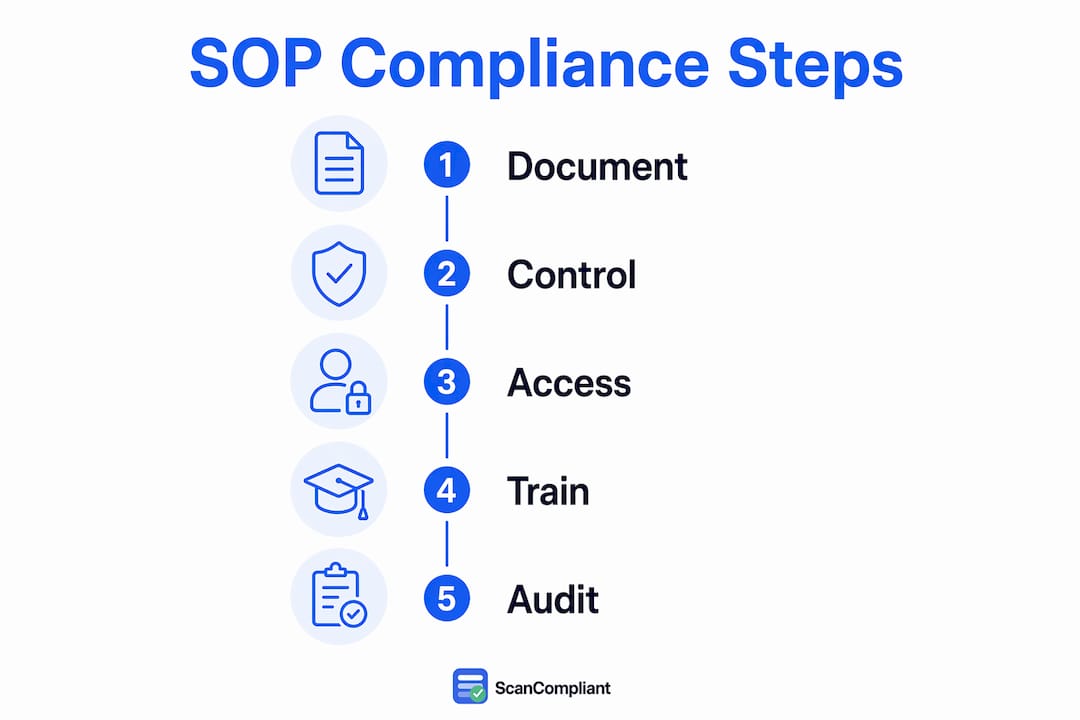
- Establish a document control system. Every SOP needs a unique identifier, version history, and a defined approval workflow before it goes live. Whether you use a paper-based system or a technology platform for compliance teams, the control structure must be consistent and auditable.
- Link training records to SOP versions. When an SOP is updated, the training program must update with it. Staff must be retrained on the new version, and that retraining must be documented with version-specific records. A healthcare compliance training guide can help teams build this linkage systematically.
- Build a review calendar. Schedule SOP reviews every 6 to 12 months and assign them to named owners. Tie review deadlines to regulatory change cycles where possible, such as after an FDA guidance update or a new ISO revision.
- Collect execution evidence. Auditors want to see that SOPs are used, not just filed. Checklists, sign-off logs, deviation reports, and corrective action records all serve as execution evidence. Understanding how compliance audits work helps teams collect the right evidence before an auditor asks for it.
- Run internal audits against your SOPs. Periodic internal reviews that test whether staff follow current procedures identify drift before it becomes a regulatory finding. Document the results and use them to trigger SOP updates.
The comparison between organizations that pass audits and those that do not usually comes down to one variable: whether SOP management is treated as an ongoing operational discipline or as a documentation project that ends at publication. Entry-level document management approaches often lack version control and training linkage. More mature compliance programs integrate SOP lifecycle management with training systems, change control workflows, and audit trail generation.
Key takeaways
SOP compliance requires current, controlled, accessible procedures linked to version-specific training records, not just written documents on file.
| Point | Details |
|---|---|
| Four pillars of SOP compliance | Procedures must be current, adequate, accessible, and actively followed by trained staff. |
| Regulatory frameworks | FDA 21 CFR Parts 211, 820, and 11, plus ISO 9001 and HIPAA, all mandate controlled SOP documentation. |
| Training linkage is non-negotiable | Audit failures most often trace back to missing version-specific training records, not missing SOPs. |
| Reviews every 6 to 12 months | Scheduled reviews keep SOPs current with regulatory changes and prevent process drift. |
| Done criteria prevent improvisation | Every SOP must define measurable outputs and exceptions so staff do not rely on tribal knowledge. |
Why SOP compliance is harder than it looks
Working with compliance teams across healthcare settings, the same pattern appears repeatedly. Organizations invest significant effort in writing SOPs and then treat the job as finished. Six months later, a process changes, the SOP does not, and the training records still reference version 1.0. When an auditor arrives, the gap is obvious.
The mindset shift that actually works is treating every SOP as a living operational guide with a named owner and a scheduled expiration date. Not a document that gets filed. A tool that gets used, tested, and updated. The teams that pass FDA inspections without findings are not the ones with the most polished formatting. They are the ones where every employee can pull up the current SOP version, confirm they were trained on it, and show a log that proves it.
The compliance sign-off process is where this discipline becomes visible. When sign-offs are tied to specific SOP versions and stored in an auditable trail, the organization can answer any auditor question in minutes rather than hours. That speed is not just convenient. It signals to regulators that the organization is in control of its processes, which is the entire point of SOP compliance.
The uncomfortable truth is that most compliance gaps are not caused by ignorance of the rules. They are caused by operational pressure crowding out the maintenance work that keeps SOPs current. Building that maintenance into standard operations, rather than treating it as a separate compliance task, is what separates organizations that consistently pass audits from those that scramble before every inspection.
— Compliant Team
How Scancompliant supports SOP compliance for healthcare teams
Healthcare and compliance teams managing SOP documentation, training linkage, and audit readiness face real operational pressure. Scancompliant is built for exactly that environment.

Scancompliant’s AI-powered platform has already protected more than 200 brands by scanning content against over 1,000 risk terms, delivering prioritized findings in minutes rather than days. For teams managing FDA and FTC regulatory requirements, that speed creates a documented compliance trail that holds up under audit scrutiny. If your team needs faster review cycles and a system that catches what human reviewers miss, explore Scancompliant’s compliance platform to see how it fits your workflow. Review pricing options to find the right plan for your organization’s size and compliance scope.
FAQ
What is SOP compliance in healthcare?
SOP compliance in healthcare means that standard operating procedures are current, version-controlled, accessible to staff at the point of use, and linked to documented training records. Regulatory bodies like the FDA and HIPAA require this level of control, not just written documentation.
What is the difference between an SOP and a policy?
A policy states organizational intent, while an SOP provides step-by-step instructions for executing a specific task. Auditors require SOPs because they show how work is actually performed, not just what the organization intends.
How often should SOPs be reviewed for compliance?
SOPs should be reviewed every 6 to 12 months to remain current with regulatory changes and operational realities. Formal change management processes must document any updates, and affected staff must be retrained on the new version.
What causes most SOP compliance audit failures?
The primary cause of audit failures is not missing SOPs but the inability to link personnel to current SOP versions through documented training records. Auditors require version-specific evidence of active compliance, not just a document library.
Which FDA regulations require SOP compliance?
FDA 21 CFR Part 211 covers pharmaceutical manufacturing, Part 820 covers medical devices, and Part 11 governs electronic records and signatures. All three require written, controlled procedures with documented evidence of execution and training.
1 Comment