
A regulatory review workflow (also called an MLR review) is the formal, auditable process that routes marketing content through Medical, Legal, and Regulatory approval with traceable, 21 CFR Part 11-compliant e-signatures before publication. If you run marketing or compliance for a telehealth or DTC health brand, the single action to take right now is this: require a completed submission checklist before any content enters the review queue. That one gate eliminates the most common source of delay and creates the first link in your audit chain.

The stakes are concrete. The MLR review process is the formal internal framework life sciences and health companies use to ensure promotional materials meet FDA and FTC standards. While no single regulation mandates it by name, regulators hold brands responsible for every claim they publish, making a documented workflow the practical difference between a warning letter and a clean audit.
Table of Contents
- What does a compliant regulatory review workflow require?
- What does 21 CFR Part 11 actually require from your system?
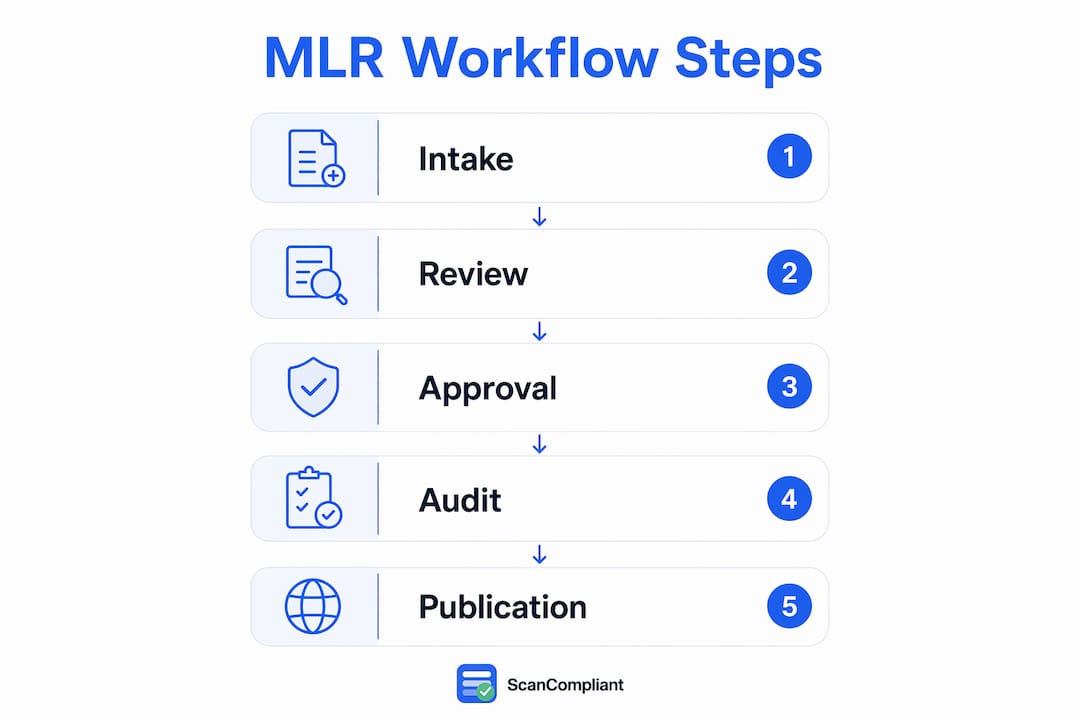
- How does a stage-by-stage MLR workflow actually run?
- How do you build a governance matrix by content type?
- What causes the most common MLR bottlenecks, and how do you fix them?
- Where does automation fit into an MLR workflow?
- What KPIs tell you whether your workflow is actually working?
- How do you roll out an improved MLR workflow in 8–12 weeks?
- What will auditors actually ask to see?
- Key Takeaways
- The part most teams get backwards
- Scancompliant cuts review time before your first human reviewer opens the file
- Useful sources
What does a compliant regulatory review workflow require?
Every defensible MLR process shares the same structural skeleton regardless of company size. Miss one component and the whole chain becomes unauditable.
Roles
- Author/Content creator: Drafts the asset and assembles the submission package (copy, evidence sources, citations, disclaimers, version history).
- Medical reviewer: Validates clinical accuracy and substantiation of health claims.
- Legal reviewer: Checks for liability exposure, IP issues, and FTC advertising compliance.
- Regulatory reviewer: Confirms FDA promotional compliance, required disclosures, and labeling alignment.
- Approver: Provides the binding sign-off, typically a senior regulatory or medical affairs lead.
- QA: Spot-checks SOP adherence and audit-trail completeness.
- Records steward: Manages retention, access controls, and export readiness.
Artifacts every submission package needs
- Final draft with version number and change log
- Evidence sources and citations for every claim
- Required disclaimers and risk disclosures
- Completed submission checklist (signed by the author)
- Prior approval references for reused claims
Minimum system capabilities
A single source of truth with role-based access controls, immutable audit trails, and version locking is non-negotiable. Email threads fail the moment an auditor asks for a decision chain from two years ago. Under 21 CFR Part 11, systems must also support unique electronic signatures, secure logins, and time-stamped computer-generated audit logs. Those aren’t optional features; they’re the technical floor for any content review workflow used in regulated health marketing.
What does 21 CFR Part 11 actually require from your system?
Part 11 translates into five concrete system capabilities your tooling must pass before you rely on it for binding approvals.
| Requirement | What to validate | Why it matters |
|---|---|---|
| Unique electronic signatures | Each signer has a distinct credential tied to their identity | Prevents shared logins from invalidating approval records |
| Time-stamped audit trail | System auto-generates immutable logs (who, what, when) | Audit trail completeness is the primary evidence auditors request |
| Secure access controls | Role-based permissions; no shared accounts | Limits who can approve and creates a traceable chain |
| System validation | Documented IQ/OQ/PQ or equivalent vendor validation | Proves the system performs as intended under 21 CFR Part 11 |
| Exportable records | Full audit trail and signed documents exportable on demand | Required to respond to FDA or FTC document requests |
A document is legally final only after designated approvers provide verified electronic signatures that create a permanent, unalterable record. If your current tool cannot produce that export in under an hour, it will fail you during an inspection.
Pro Tip: Run a test export of your audit trail before you go live. Reproduce the full decision chain for one asset, including who reviewed, what comments were made, and when each signature was applied. If you cannot reconstruct that chain cleanly, your system is not Part 11-ready.
How does a stage-by-stage MLR workflow actually run?
Here is a copyable workflow template. Map each stage to your SOP and drop the responsibility table into your RACI.
- Submission intake: Author submits the completed package (draft, evidence, disclaimers, checklist). A QA or records steward runs a completeness check. Incomplete submissions are returned immediately, not routed.
- Automated pre-scan: An AI content scanner flags risky language, missing disclaimers, and unapproved claims before human reviewers open the file. This removes the most repetitive checks from expert review time.
- Parallel review (design-only changes): Medical, Legal, and Regulatory reviewers work simultaneously when no new clinical claims are introduced. Target window: a short period of a few business days.
- Sequential review (new claims or clinical data): Medical reviews first, then Legal, then Regulatory. Each reviewer sees the prior comments. Target window: several business days depending on complexity.
- Consolidated feedback: All comments are merged in the workflow system, not emailed separately. The author addresses each comment and resubmits a tracked-changes version.
- Final edits and re-review: Reviewers confirm their comments are resolved. Minor edits (punctuation, formatting) skip full re-review if the SOP permits it.
- Part 11 e-signature: The designated approver applies a verified electronic signature. The system locks the document and timestamps the approval.
- Publish: Content is released. The workflow system logs the publication date and links it to the signed approval record.
- Post-publish monitoring: Evergreen pages are flagged for periodic re-review (quarterly for high-risk claims, annually for standard content). See iterative compliance review for scheduling guidance.
Responsibility table (paste into your RACI)
| Stage | Responsible | Accountable | Consulted | Informed |
|---|---|---|---|---|
| Submission intake | Author | Records steward | QA | Regulatory lead |
| Pre-scan | Automation/QA | Regulatory lead | Medical | Author |
| Parallel/sequential review | Medical, Legal, Regulatory | Approver | Subject matter experts | Marketing |
| Final e-signature | Approver | Regulatory lead | Legal | QA |
| Post-publish monitoring | Records steward | Regulatory lead | QA | Marketing |
Parallel review is appropriate for design-only changes, copy edits to pre-approved claims, and format updates. Sequential review is required whenever new clinical data, new efficacy claims, or new indication language appears.
How do you build a governance matrix by content type?
Governance frameworks that define approval authority by content type are what separate fast teams from teams that argue about who has veto power on every asset.
| Content type | Required reviewers | Approval threshold | Escalation owner | SLA |
|---|---|---|---|---|
| Webpages (new claims) | Medical, Legal, Regulatory | Unanimous | Chief Medical Officer | 10 business days |
| Paid ads | Legal, Regulatory | Unanimous | VP Regulatory | 5 business days |
| Social posts | Regulatory | Designated approver | Regulatory lead | 3 business days |
| Influencer copy | Legal, Regulatory | Unanimous | Legal counsel | 5 business days |
| Email campaigns | Regulatory | Designated approver | Regulatory lead | 3 business days |
| Packaging/labeling | Medical, Legal, Regulatory | Unanimous | Chief Medical Officer | 15 business days |
Codify three things in your SOP for each row: what constitutes a complete submission, who owns escalation when the SLA is missed, and what documentation is required before the approver signs. A documented RACI and escalation paths prevent process disagreements from becoming approval delays.
What causes the most common MLR bottlenecks, and how do you fix them?
Fragmented data, email chains, and manual handoffs create the bulk of delays, not the regulations themselves. The fixes are mostly structural.
- Incomplete submissions: Require a structured submission form with a mandatory checklist before routing. No checklist, no review.
- Email-based feedback: Move all comments into the workflow system. A compliance review handoff process that runs through email is unauditable and slow.
- Repetitive re-reviews of the same claims: Build a pre-approved claim library. Reusing previously approved language avoids full reviews for every new asset.
- Siloed reviewer data: Centralize all submissions, comments, and approvals in one system. Reviewers should never need to ask “which version is current?”
- Unclear authority: The governance matrix above resolves this. If it isn’t written down, it doesn’t exist.
Pro Tip: The single fastest time-to-impact fix is the submission completeness gate. Returning an incomplete package before it enters the queue saves more reviewer hours than any other single change.
Where does automation fit into an MLR workflow?
Automation handles the checks that are rules-based and repeatable. Human reviewers handle judgment calls. Mixing them up wastes both.
| Task | Automation handles | Human reviewer handles |
|---|---|---|
| Risky language detection | Flags terms against a risk-term database | Evaluates context and clinical nuance |
| Disclaimer verification | Checks required disclosures are present | Confirms accuracy and placement |
| Pre-approved claim matching | Compares draft against approved library | Approves new claims not in the library |
| Version comparison | Highlights changes between drafts | Assesses whether changes require re-review |
| Deadline triggers | Sends SLA alerts and escalation notices | Decides whether to escalate or extend |
| Periodic re-scan | Flags evergreen pages for re-review | Conducts the actual re-review |
Scancompliant slots into stage 2 of the workflow above: it scans content before human reviewers open the file, flags risky language against a database of over 1,000 risk terms, and produces a prioritized findings report with a documented audit trail. For GLP-1 pages and telehealth provider claims, where FDA warning letter exposure is highest, running an automated scan before routing to Medical review removes the most common flag categories before an expert spends a single minute on the file. Teams using automated marketing compliance review report faster cycle times and cleaner first-pass submissions. A documented case study found that periodic review automation reduced the time required for a manual task, bringing it down to about 15 minutes per client review.
What KPIs tell you whether your workflow is actually working?
| KPI | What it measures | Target direction |
|---|---|---|
| Cycle time by content type | Days from submission to approval | Decreasing |
| Approval touch count | Number of review rounds per asset | Decreasing |
| Submission return rate | % returned for missing evidence | Decreasing |
| Time-to-resolution for escalations | Days to close an escalated dispute | Decreasing |
| Audit findings count | Deficiencies found per audit | Decreasing |
Present cycle time and return rate weekly to your compliance committee. Monthly trend reports should show direction, not just snapshots. For review turnaround benchmarks by content type, use those figures to set your internal baseline before your first pilot review.
How do you roll out an improved MLR workflow in 8–12 weeks?
- Weeks 1–2: Map your current state. Document every handoff, tool, and role. Identify the three biggest delay points.
- Weeks 3–4: Define governance. Draft your approval matrix, SOP, and RACI. Get sign-off from Medical, Legal, and Regulatory leads.
- Week 5: Select 1–2 content types for the pilot (social posts and paid ads work well for speed). Configure your workflow tool and run Part 11 validation.
- Week 6: Train all reviewers. Cover SOP requirements, system use, and escalation paths. Log training completion for each participant.
- Weeks 7–9: Run the pilot. Enforce the submission completeness gate from day one. Collect cycle time, return rate, and reviewer satisfaction data.
- Weeks 10–11: Review pilot metrics against your KPI targets. Identify remaining gaps in SOP adherence or audit-trail completeness.
- Week 12: Decision gate. If KPI targets are met and audit trail is clean, expand to all content types. If not, iterate on the specific failure points before scaling.
What will auditors actually ask to see?
| Evidence type | What auditors request | How to store it |
|---|---|---|
| Timestamped audit trail | Full log of submissions, comments, versions, approvals | Exportable from workflow system; retained per SOP |
| Signed final versions | Part 11-compliant e-signature on each approved asset | Locked in document management system |
| Submission completeness records | Completed checklist for each asset | Attached to the asset record in the workflow system |
| Reviewer qualifications | Training logs, role assignments, credential records | HR or LMS system, linked to workflow records |
| SOPs and RACI | Current versions with version history | Document control system |
| Change logs | Record of every revision and who made it | Auto-generated by workflow system |
Workflows that exist only through informal communication are not defensible during an audit. Retention periods vary by organization and content type; follow your legal counsel’s guidance and align with FDA’s general expectation of records availability for the product’s lifecycle. Validate your e-signature system by running a test export and reproducing the full decision chain for one asset before any audit window opens.
Key Takeaways
A compliant MLR workflow requires a submission completeness gate, a Part 11-validated system, a documented governance matrix, and automation inserted before human review to reduce cycle time and audit risk.
| Point | Details |
|---|---|
| Start with the submission gate | Require a completed checklist before routing; this single fix reduces the most reviewer hours. |
| Validate Part 11 compliance | Confirm your system produces unique e-signatures, immutable audit trails, and exportable records. |
| Build a governance matrix | Map approval authority and SLAs by content type so reviewers know exactly when they have veto power. |
| Insert automation before human review | AI scanning removes rules-based flags before experts open the file, cutting first-pass return rates. |
| Scancompliant for telehealth and DTC brands | Scancompliant scans content against 1,000+ risk terms, produces prioritized findings, and generates a documented audit trail for FDA and FTC readiness. |
The part most teams get backwards
Most regulatory and marketing teams treat the workflow as a compliance tax: something to endure before publishing. That framing produces the exact bottlenecks they complain about. When the process is designed as a series of evidence checkpoints rather than approval gates, something shifts. Reviewers stop being gatekeepers and start being collaborators who need specific inputs to do their job. The submission completeness check stops feeling like bureaucracy and starts functioning as the thing that actually protects the reviewer’s time.
The other underestimated issue: teams invest in workflow tooling before they understand where their manual process breaks down. A platform does not fix a broken SOP; it just automates the chaos faster. The teams that get the most out of automation, including AI scanning tools, are the ones that have already mapped their failure points and know exactly which stage they’re inserting the tool into.
For telehealth and DTC health brands specifically, the risk profile is not generic. GLP-1 claims, telehealth provider scope-of-practice language, and before-and-after imagery all carry elevated FDA and FTC scrutiny. A workflow that treats a social post and a GLP-1 landing page as the same review type is not a workflow; it’s a liability.
Scancompliant cuts review time before your first human reviewer opens the file
Telehealth and DTC health brands that have already built their MLR governance still face one stubborn problem: first-pass submissions arrive with avoidable flags that eat expert reviewer time. Scancompliant solves that specific problem.
The platform scans marketing content against a database of over 1,000 risk terms, identifies risky language and missing disclaimers, and delivers a prioritized findings report in minutes. That report goes to your regulatory reviewer before they open the file, so their time is spent on judgment calls, not pattern-matching. Every scan produces a documented compliance trail that feeds directly into your audit record. More than 200 brands have used Scancompliant to protect their content and accelerate review cycles.
The recommended pilot: start with your highest-volume content type (paid ads or social posts) and run Scancompliant scans at stage 2 of your workflow for four weeks. Measure how often submissions are returned for revision before and after the pilot. The audit trail is built automatically.
Start your pilot or review pricing to find the plan that fits your team’s volume.
Useful sources
- 21 CFR Part 11 (FDA): The primary federal regulation governing electronic records and electronic signatures in FDA-regulated environments. Required reading for any team selecting or validating a workflow tool.
- FTC Advertising Guidance: The FTC’s business center covers endorsement rules, substantiation requirements, and health claim standards directly applicable to DTC health marketing.
- FDA Guidance on Prescription Drug Promotion: FDA’s resource hub for promotional material standards, including warning letter examples and submission requirements.
- DIA RIM Reference Model: The Drug Information Association’s framework for Regulatory Information Management, including MLR review process definitions and submission tracking standards.
- SOP for Regulatory Operations Workflow Management: A practical SOP template covering workflow initiation, in-process controls, verification, and record-keeping for regulatory affairs teams.
- MLR Review Process Guide: Covers MLR governance, pre-approved claim libraries, and approval matrix design with practical examples.
- Compliance Bottleneck Analysis: Explains why manual workflows, not regulations, cause most review delays, with practical fixes.
Recommended
- Regulatory Review Process Efficiency Tips for Healthcare Teams – scancompliant.com
- Content Review Workflow Best Practices for Healthcare Teams – scancompliant.com
- Regulatory Review Checklist for Healthcare Marketing – scancompliant.com
- Iterative Compliance Review for Healthcare Teams – scancompliant.com