
AI shortens marketing review cycles for telehealth and DTC health brands by automating continuous scanning, classification, and prioritized routing while keeping humans in the decision loop for every final compliance call. The result: faster time-to-publish, fewer missed risk terms, and a documented audit trail regulators can actually inspect.
The core mechanisms that produce those gains:
- NLP-based content scanning flags risk terms and unsupported efficacy claims before a human reviewer ever opens the file
- Pattern matching and classification sorts assets by risk level and regulatory category automatically
- Confidence scoring routes high-certainty findings to auto-flag and low-certainty edge cases to human review
- Automated task creation assigns flagged items to the right owner without a manual handoff
Scancompliant’s database covers a comprehensive number of risk terms and has protected many brands. The OECD recommends moving from a “regulate-and-forget” posture to an “adapt-and-learn” model, and AI is what makes that shift practical at scale for teams managing FDA and FTC obligations.
Table of Contents
- 1. How AI speeds regulatory workflows: the core mechanisms
- 2. Where telehealth and DTC health teams see the biggest gains
- 3. Human-in-the-loop: when AI acts and when humans decide
- 4. How to pilot an AI-assisted regulatory workflow
- 5. Metrics and ROI to track
- 6. U.S. governance, HIPAA, and recordkeeping requirements
- 7. What to ask vendors before you sign
- 8. Your 4–8 week pilot checklist
- 9. How Scancompliant speeds marketing compliance reviews
- Key Takeaways
- What early pilots actually teach you
- Scancompliant makes faster reviews defensible, not just faster
- Useful sources and further reading
1. How AI speeds regulatory workflows: the core mechanisms
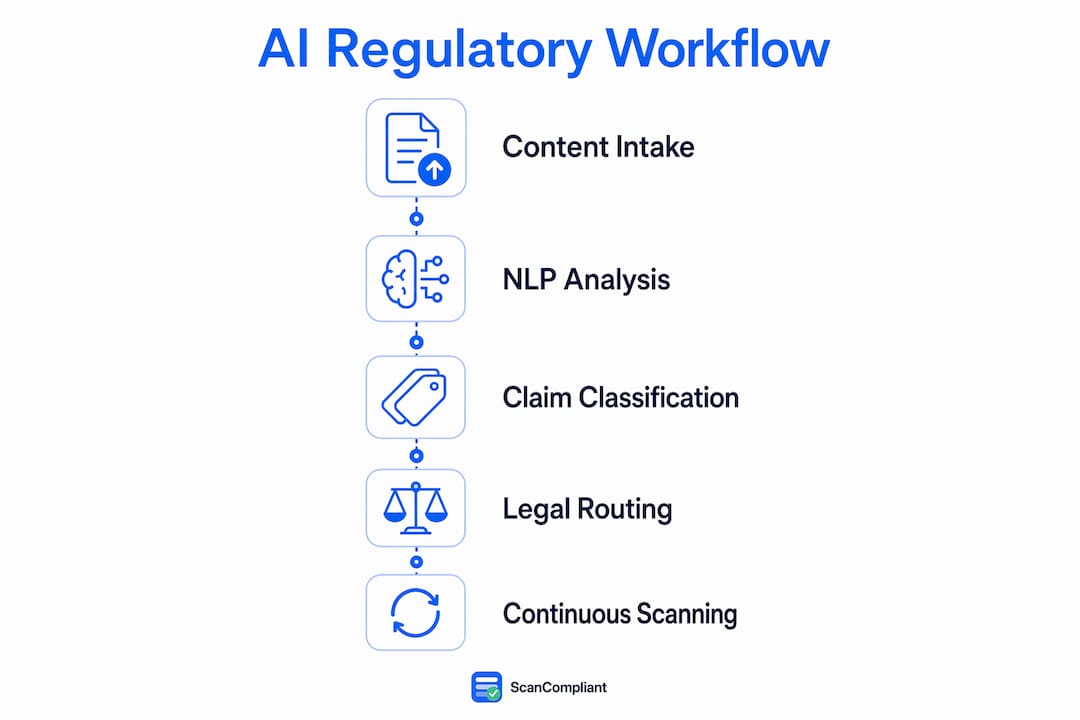
Manual triage is where review cycles die. A reviewer reads a landing page, decides whether a claim needs legal sign-off, writes a note, emails it, and waits. AI compresses that chain by handling ingestion, classification, and routing in seconds.

The pipeline works like this: content enters the system (via API, CMS connector, or file upload), NLP models parse the text for risk terms, regulatory references, and claim structures, then a classifier assigns each finding a category (e.g., unsubstantiated efficacy claim, prohibited testimonial, missing disclaimer). A confidence score determines whether the finding goes to auto-flag or human review. Automated task creation then assigns the exception to the right owner with context already attached.
Continuous horizon scanning runs the same logic against regulatory feeds 24/7, so your team sees only the changes that actually apply to your product category and jurisdiction.
Pro Tip: Better context beats longer prompts every time. Feed the model your approved style rules, past rulings, and accepted claim language via a searchable repository. The quality of that ground-truth library determines output quality far more than any prompt tweak.
2. Where telehealth and DTC health teams see the biggest gains
Content pre-publish scanning is the highest-volume use case. Every product page, email, and paid ad goes through the scanner before it goes live. The system flags phrases like “clinically proven,” “cures,” or unlinked outcome claims that violate FTC’s substantiation standard or FDA’s drug-claim rules.
Claims detection with regulatory mapping links each flagged phrase to the specific FDA guidance or FTC policy it implicates, so the reviewer knows exactly what rule applies rather than hunting through guidance documents.
Adverse-event and complaint triage catches early warning language in customer-facing content and support scripts, routing potential safety signals before they become reportable events.
Horizon scanning for product pages and landing pages monitors regulatory feeds and alerts teams when a rule change affects live content. For high-risk categories such as GLP-1 therapeutics, Scancompliant’s GLP-1 marketing compliance scanner lets teams run a pre-launch site review against the current FDA warning letter pattern.
AI-assisted review reduced average processing time from 47 to 12 minutes per regulatory update in a controlled compliance study, a 3.9× reduction confirmed by paired statistical testing across 96 updates.
Pro Tip: Start horizon scanning with your highest-traffic pages first. A rule change that hits your homepage or a top-converting landing page before you catch it costs far more than the scanning infrastructure.
3. Human-in-the-loop: when AI acts and when humans decide
AI handles routine triage. Humans hold the final compliance position. That boundary is not optional for FDA- and FTC-regulated marketing.
Agentic AI is mature for feed ingestion, classification, control mapping, and drafting structured impact assessments. It is not mature for interpreting ambiguous claims, making legal determinations, or signing off on a compliance position. Those stay with a qualified reviewer.
Confidence thresholds define the line in practice:
- High confidence (above threshold): auto-flag, log, route to owner with suggested remediation
- Medium confidence (near threshold): flag with context, require human review before routing
- Low confidence or novel pattern: escalate to senior reviewer, log the escalation reason
Every decision, automated or human, needs a versioned record: what was flagged, what confidence score it carried, who reviewed it, and what action was taken.
“AI should perform scanning, pattern matching, and initial mapping while humans keep final interpretive authority.” — SureCloud on agentic AI in regulated industries
Pro Tip: Set your confidence threshold conservatively at first, then tighten it as you accumulate human override data. Track override frequency weekly. A falling override rate is the clearest signal your model is calibrating correctly.
4. How to pilot an AI-assisted regulatory workflow
- Define pilot scope. Pick high-volume, low-judgment tasks: content pre-check, risk-term flagging, and claim categorization. Avoid starting with adverse-event triage or final sign-off.
- Centralize ground truth. Collect approved claim language, past legal rulings, style guides, and FTC/FDA reference documents in one searchable repository before the pilot starts.
- Integrate read-only first. Connect the AI to your CMS or content source with read-only access. Validate outputs against human decisions for two weeks before granting any write or routing permissions.
- Set baseline metrics. Measure current review time per asset, handoff count, and false-positive rate before the pilot begins. You cannot calculate ROI without a baseline.
- Run weekly sampling audits. Pull a random sample of AI decisions each week and have a human reviewer score them. Feed disagreements back as training signal.
- Define go/no-go gates. Agree on acceptance criteria before the pilot starts: accuracy threshold, false-negative cap, and maximum exception rate.
- Expand after validation. Once the pilot clears its gates, extend scope to additional content types or channels, not all at once.
| Pilot phase | Duration | Owner | Gate |
|---|---|---|---|
| Scope and baseline | Week 1 | Regulatory lead | Metrics documented |
| Read-only integration | Weeks 2–3 | IT + Regulatory | Zero write errors |
| Sampling audit | Weeks 4–5 | Regulatory + Legal | Accuracy ≥ target |
| Go/no-go review | Week 6 | All stakeholders | Gate criteria met |
| Controlled expansion | Weeks 7–8 | Marketing + Regulatory | Exception rate stable |
Pro Tip: Workflow redesign, not task automation, is what moves the ROI needle. Before expanding the pilot, map the full review workflow and remove at least one handoff. Parallelizing variant reviews and moving humans to exceptions alone can cut cycle time more than any model upgrade.
5. Metrics and ROI to track
The metrics that matter for marketing compliance workflows:
- Time-to-publish: total elapsed time from content submission to approved publication
- Review time per asset: human-hours spent per piece of content
- Handoff count: number of people or systems that touch a review before it closes
- Exception rate: share of AI decisions escalated to human review
- False-positive rate: flagged items that human review clears as compliant
- False-negative rate: items that passed AI review but were later found non-compliant
- Audit time saved: hours recovered from manual log compilation per quarter
To convert review-time savings into business terms: if AI reduces per-asset review time by 30 minutes and your team processes 200 assets per month, that is 100 hours per month recovered. At a fully loaded cost of $75 per hour for a compliance specialist, that is $7,500 per month in recovered capacity, before counting risk-avoidance value.
| Metric | Baseline | Target | Measurement frequency |
|---|---|---|---|
| Time-to-publish | Measure in pilot week 1 | 30% reduction | Weekly |
| Review time per asset | Measure in pilot week 1 | — | Weekly |
| Handoff count | Count in current workflow | Reduce by 1–2 | Monthly |
| Exception rate | N/A (new metric) | — | Weekly |
| False-positive rate | N/A (new metric) | — | Weekly |
| Audit time saved | Measure current log time | 50% reduction | Quarterly |
6. U.S. governance, HIPAA, and recordkeeping requirements
The FDA expects documented evidence that promotional content was reviewed against applicable regulations. The FTC requires substantiation for health claims. Neither agency cares whether a human or an AI flagged the issue. What they care about is whether you can show the review happened and what it found.
Governance requirements to address before going live:
- Model validation: document the model’s accuracy on your content type, not just vendor benchmarks
- Drift monitoring: schedule quarterly accuracy audits and compare against your baseline
- Audit trail: every flagged item, confidence score, human decision, and remediation action must be logged with a timestamp and version reference
- Retention: keep review logs for at least as long as your FDA recordkeeping obligations require for the content category
Data privacy checklist for HIPAA compliance:
- Confirm the AI system never ingests PHI from patient records, support tickets, or CRM data
- Redact or exclude any content that contains patient identifiers before it enters the scanning pipeline
- Review your vendor’s Business Associate Agreement (BAA) requirements before connecting any system that could touch PHI
- Start with marketing content only, which typically does not contain PHI, and add content types only after legal review
The OECD’s adapt-and-learn model positions AI as an enabler for continuous regulatory learning, not a replacement for human governance structures.
Pro Tip: Start with non-PHI marketing content and read-only integrations. This keeps your HIPAA exposure at zero during the pilot and lets you build governance documentation before any sensitive data is in scope.
This article is general information, not legal or compliance advice. Confirm current FDA, FTC, and HIPAA requirements with qualified legal counsel for your specific situation.
7. What to ask vendors before you sign
Security and data handling:
- What encryption standards apply to data in transit and at rest?
- Do you hold SOC 2 Type II or ISO 27001 certification? Can you share the report?
- How is customer data segregated? Can your team access our content?
- What are your data retention and deletion policies?
Coverage and model quality:
- Which regulatory sources do you ingest (FDA, FTC, state-level)?
- How frequently is the risk-term database updated when new guidance drops?
- What is your documented accuracy rate on health marketing content specifically?
- Can we see a model evaluation report or audit log sample?
Integration and operations:
- Do you offer a documented, versioned API?
- Can we start with read-only access and expand permissions incrementally?
- What CMS and GRC connectors do you support out of the box?
- What are your SLAs for uptime and flagging latency?
- Can we author custom rules for our specific product categories?
| Vendor question | Why it matters |
|---|---|
| SOC 2 Type II evidence | Confirms security controls are independently audited |
| Regulatory source list | Determines whether FDA/FTC guidance is actually covered |
| Custom rule authoring | Lets you encode brand-specific claim standards |
| Read-only pilot option | Reduces risk during validation phase |
| BAA availability | Required if any PHI could enter the system |
Scancompliant’s security and data policy covers encryption, access controls, and data handling for healthcare marketing teams.
8. Your 4–8 week pilot checklist
- Week 1: Define scope (content pre-check only), assign owners (marketing lead, regulatory lead, IT), and document baseline metrics
- Week 2: Collect 50–100 sample assets with known compliance decisions for validation; build your ground-truth repository
- Week 3: Complete read-only integration; run first batch through the scanner and compare against ground truth
- Week 4: Conduct first sampling audit; log all disagreements and feed back to vendor
- Week 5: Review exception rate and false-positive rate against acceptance criteria; adjust confidence thresholds if needed
- Week 6: Go/no-go decision with all stakeholders; document the outcome and rationale
- Weeks 7–8: If approved, expand to one additional content type or channel with the same audit cadence
Pro Tip: Before the pilot starts, ask every team member to share any AI prompts they are already using for compliance tasks. Shadow AI is already in your workflow. Harvesting those prompts gives you real training signal and prevents ungoverned use from continuing in parallel with your official pilot.
Stakeholder checklist:
- Marketing lead: content sample selection, time-to-publish baseline
- Regulatory lead: ground-truth decisions, threshold setting, audit sign-off
- Legal: BAA review, HIPAA scope confirmation, recordkeeping requirements
- IT: API integration, access controls, data flow documentation
- GRC/Compliance: audit trail format, retention policy, drift monitoring schedule
9. How Scancompliant speeds marketing compliance reviews
Scancompliant runs continuous scanning against a database of more than 1,000 risk terms, flags prioritized findings in minutes, and routes each item to the right owner with a documented audit trail. For a DTC health brand publishing product pages, emails, and paid ads at volume, that means reviewers spend time on genuine edge cases rather than reading every line of every asset.
Scancompliant has protected many brands by catching subtle claims that human reviewers miss, delivering findings rapidly and maintaining a documented compliance trail for every decision.
Capabilities that map directly to the pilot and governance recommendations in this guide:
- Continuous scanning against FDA and FTC risk terms, updated as guidance evolves
- Confidence-scored findings with automated routing to asset owners
- Versioned audit trail for every flagged item and human decision
- GLP-1 and high-risk category scanners for DTC health verticals
For teams in high-risk therapeutic marketing, the GLP-1 compliance scanner lets you run a pre-launch site review against the current FDA warning letter pattern before a single page goes live. The AI in regulatory risk detection guide covers implementation patterns and pilot planning in more detail.
Key Takeaways
AI speeds regulatory workflows by automating scanning, classification, and routing while humans retain final compliance authority, producing measurable cycle-time reductions and a defensible audit trail.
| Point | Details |
|---|---|
| Start read-only | Connect AI to your content source with read-only access first; validate outputs before granting routing permissions. |
| Human-in-the-loop is non-negotiable | AI handles triage and flagging; a qualified reviewer must hold the final compliance position for FDA- and FTC-regulated content. |
| Measure before you pilot | Document review time per asset, handoff count, and false-positive rate before the pilot starts or ROI is unmeasurable. |
| Governance before PHI | Build your audit trail, retention policy, and BAA review before any content that could contain PHI enters the pipeline. |
| Scancompliant as your starting point | Scancompliant’s 1,000+ risk-term database, confidence-scored routing, and documented audit trail map directly to the pilot and governance steps in this guide. |
What early pilots actually teach you
The teams that get the most from AI compliance tools are not the ones with the most sophisticated models. They are the ones who did the unglamorous work first: documenting their ground-truth decisions, mapping their actual review workflow, and agreeing on what “accurate enough” means before the pilot started.
The conventional wisdom says the hard part is picking the right vendor. It is not. The hard part is knowing what you are trying to measure. Teams that skip baseline metrics end up with a tool that feels faster but cannot prove it. Teams that skip workflow mapping end up automating a broken process and wondering why cycle time did not change.
The other thing pilots consistently reveal: shadow AI is already there. Someone on your marketing team is already pasting ad copy into a general-purpose AI tool and asking whether the claims look risky. That is not a problem to eliminate. It is a signal to formalize. Harvest those prompts, bring them into a governed workflow, and you have a head start on your training data.
AI in regulatory compliance works best when the team treats it as a workflow redesign project, not a software purchase. The technology is ready. The question is whether your process is.
Scancompliant makes faster reviews defensible, not just faster
Most marketing compliance tools speed review by cutting corners on documentation. Scancompliant does the opposite: findings arrive in minutes, and every flagged item carries a confidence score, an owner assignment, and a timestamped log entry that holds up under regulatory scrutiny.
For telehealth and DTC health brands managing FDA and FTC obligations, that combination of speed and documentation is the actual product. Scancompliant’s 1,000+ risk-term database covers the claim patterns regulators flag most often, continuous scanning keeps your live content current as guidance evolves, and the audit trail gives your legal team something concrete to point to. Data handling meets the security standards healthcare teams require. See how it works for your content volume at scancompliant.com or review plan options to match your team’s review load.
Useful sources and further reading
Primary sources cited in this guide:
- OECD: AI in Regulatory Design and Delivery — policy framework for adaptive, AI-enabled regulatory practice
- SureCloud: Agentic AI in Regulatory Change Management — automation boundaries, confidence scoring, and human-in-the-loop design
- Onspring: How AI Helps GRC Teams Respond to Regulatory Change — continuous horizon scanning and analyst noise reduction
- RTS Labs: AI Workflow Optimization — API-first integration strategy and read-only pilot sequencing
- Kuse: AI Workflow Optimization Practical Guide — ground-truth repositories, context quality, and review loop design
- Jakob Nielsen: Redesigning Workflows for AI — four redesign moves that unlock system-level throughput gains
- ComplianceNLP research (arXiv) — production evidence for analyst efficiency gains from AI-assisted regulatory review
- Scancompliant: AI in Regulatory Risk Detection Guide — implementation patterns and pilot planning for healthcare marketing teams
- Scancompliant: GLP-1 Marketing Compliance — FDA warning letter context and targeted scanner for high-risk DTC health marketing
For U.S. regulatory citations, consult FDA’s guidance on prescription drug promotion and OTC advertising, and FTC’s Guides Concerning the Use of Endorsements and Testimonials in Advertising (16 CFR Part 255) directly. Both are updated periodically and the primary source always supersedes secondary summaries.