
Brand risk management is defined as the practice of identifying, assessing, and mitigating threats to a brand’s reputation, regulatory standing, and market trust before those threats cause measurable harm. Healthcare brand risk teams now use AI tools to do this work faster, at greater scale, and with far more consistency than manual review allows. The FDA and FTC both hold healthcare marketers to strict content standards, and a single non-compliant claim can trigger enforcement action. Platforms like Scancompliant show how AI-powered scanning catches risky language before it reaches the public, protecting brands that operate in the most regulated marketing environment in the country.
How brand risk teams use AI tools to monitor digital channels
AI-driven brand monitoring is the continuous, automated scanning of digital content across platforms to detect off-brand, risky, or non-compliant material in real time. This is the foundation of modern brand risk assessment with AI, and it goes far beyond keyword alerts.
Enterprise-grade systems now use multimodal AI that analyzes audio, video, images, and text across 75+ languages and 25+ digital platforms. That coverage matters because healthcare brands publish content across websites, social media, email, and video simultaneously, and a risk can surface in any format.
The core capabilities these systems provide include:
- Real-time flagging of brand mentions, visual assets, and claims that deviate from approved messaging
- Automated prioritization of alerts by severity, so compliance teams address high-risk findings first
- Cross-platform coverage that catches risks on channels human reviewers rarely audit consistently
- Multimodal analysis that reads visual claims in images and transcribes audio from video content
Manual review simply cannot match this speed or breadth. A compliance team reviewing content by hand will always lag behind the volume of digital output a healthcare brand produces in a week.
Pro Tip: Set alert thresholds by risk category, not just keyword match. A claim flagged as a potential FDA violation should trigger a different workflow than a minor brand tone issue. Tiered prioritization cuts alert fatigue and keeps teams focused on what matters.
How do AI agents support proactive influencer and partner vetting?
Proactive brand risk assessment with AI means catching problems before a partnership goes live, not after a controversy surfaces. AI agents now make this possible at a scale that was not realistic with manual audits.

AI agents scan vast historical influencer content across multimedia channels quickly, surfacing risk signals critical for proactive mitigation prior to partnerships. For a healthcare brand, that means an agent can review years of an influencer’s posts, videos, and public statements in the time it would take a human reviewer to check a single month.
A practical vetting workflow for healthcare marketing teams looks like this:
- Submit the influencer profile to the AI agent with defined risk parameters, including FDA guideline violations, off-label promotion history, and brand tone mismatches.
- The agent audits historical content across social platforms, flagging past controversies, legal issues, and patterns of non-compliant health claims.
- A risk score is generated with specific findings attached, giving the compliance team a documented basis for approval or rejection.
- Continuous monitoring begins after the partnership launches, with the agent tracking new content for emerging risk signals.
- Alerts route to workflow tools so the compliance team can act quickly if a new post raises a concern.
This process removes the guesswork from partnership decisions. It also creates an audit trail, which matters when a regulator asks how a brand vetted its third-party content contributors.
Pro Tip: Do not limit AI vetting to influencers. Apply the same process to agency partners, co-marketing collaborators, and any third party publishing content on your brand’s behalf. The FDA does not distinguish between owned and partner content when assessing liability.
In what ways does AI enforce brand consistency during content creation?
The most effective AI applications for brand analysis do not wait for content to be published. They enforce brand rules inside the creation workflow itself, before a writer or designer submits a draft for review.
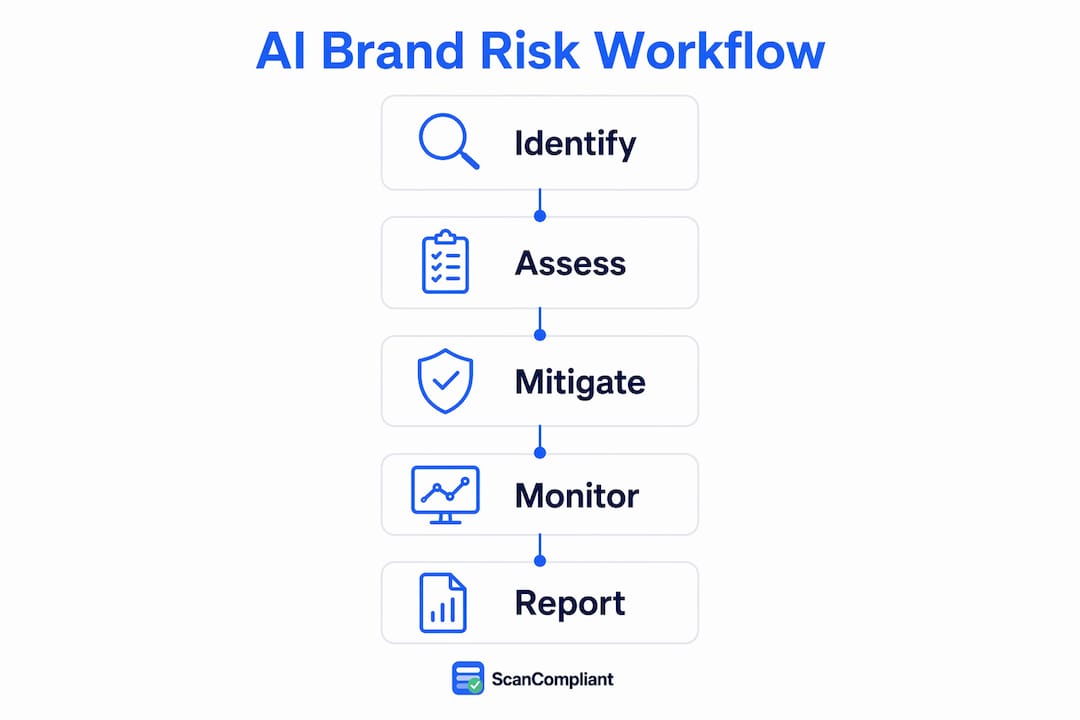
Brand intelligence evolves by learning from decision traces, including comments, edits, and approvals, turning tribal knowledge into real-time brand validation. This is a meaningful shift from static brand guides that sit in a shared drive and rarely get read.
The difference between old and new approaches is significant:
| Approach | Method | Limitation |
|---|---|---|
| Static brand guide | PDF or document stored centrally | Rarely consulted during creation |
| Rules-based checker | Keyword blocklists and templates | Misses context and nuance |
| AI brand ontology | Continuously learns from human edits and approvals | Requires initial training investment |
| Integrated AI validation | Embedded in tools like Canva or ChatGPT | Catches issues at the point of creation |
Integrating AI governance directly with content creation tools saves teams over 4 hours weekly in manual reviews and is associated with a 23% revenue increase tied to brand consistency. That figure reflects what happens when compliance stops being a bottleneck and starts being a built-in feature of the workflow.
For healthcare brands, this matters most in claims language. A writer drafting a telehealth ad inside a connected platform gets a real-time flag if a phrase crosses into unapproved efficacy territory. The fix happens before the content ever reaches a compliance reviewer.
Pro Tip: Move your brand governance from passive documentation to active enforcement. If your brand rules only exist in a PDF, they are not governing anything. Embed them in the tools your teams use every day.
What governance models do brand risk teams need for agentic AI?
Agentic AI requires explicit control models specifying allowed actions, blocked actions, and approval paths to avoid structural brand risk beyond content errors. This is the part of AI risk management that most compliance teams underestimate.
Content moderation catches bad outputs. Governance controls what the AI is permitted to do in the first place. These are different problems, and treating the first as a substitute for the second creates serious exposure.
Effective governance frameworks for AI-driven brand risk include:
- Explicit control models that define what each AI agent can publish, flag, escalate, or act on autonomously
- Audit-ready logging that captures every decision trace, including what the AI recommended, what a human approved, and why
- Policy exception documentation so that deviations from standard rules are recorded and defensible
- Automated hallucination monitoring that runs brand queries through major AI engines and flags inaccurate or outdated information
- Rapid-response workflows that move from detection to corrective content publishing within defined timeframes
Automating LLM output monitoring and maintaining rapid-response workflows is the standard for teams that take AI brand risk seriously. Manual spot checks cannot keep pace with the volume and speed of AI-generated content.
The governance gap is especially dangerous in healthcare. An AI agent that publishes a health claim without human approval, even a technically accurate one, can still violate FDA promotional guidelines if it lacks the required context or disclosures. The control model must make that approval step mandatory, not optional.
How do healthcare brand risk teams apply AI to regulatory compliance?
Healthcare brands face a compliance environment that is stricter than almost any other industry. The FDA governs promotional claims for drugs, devices, and telehealth services. The FTC enforces truth-in-advertising standards for direct-to-consumer health marketing. AI tools built for healthcare content compliance address these requirements directly.
The specific applications where AI delivers the most value for healthcare risk teams include:
- Pre-publication content scanning that checks marketing copy against a database of risk terms before any material goes live
- Regulatory review automation that maps content against FDA and FTC guidelines and flags specific violations with remediation guidance
- Compliance audit support that generates documented findings for internal review and external reporting
- Telehealth marketing checks that catch claims specific to virtual care services, which carry their own regulatory nuances
- Training reinforcement that surfaces real examples of flagged content to help marketing teams learn compliance patterns over time
Scancompliant addresses this directly. The platform carries over 1,000 risk terms in its database and has protected more than 200 brands by delivering prioritized findings in minutes. That speed matters because healthcare marketing teams operate under tight deadlines, and a slow compliance review creates pressure to skip steps.
The regulatory review checklist approach works well when combined with AI scanning. The checklist defines what must be reviewed. The AI does the reviewing at scale, flagging items that need human judgment while clearing low-risk content automatically.
Key Takeaways
AI tools give healthcare brand risk teams the speed, scale, and audit documentation that manual compliance review cannot match.
| Point | Details |
|---|---|
| Multimodal monitoring | AI scans audio, video, images, and text across 75+ languages and 25+ platforms simultaneously. |
| Proactive influencer vetting | AI agents audit years of historical content to surface risk signals before partnerships launch. |
| Embedded content enforcement | AI integrated into creation tools catches non-compliant claims before content reaches a reviewer. |
| Agentic AI governance | Control models with audit-ready logging prevent structural brand risk beyond content errors. |
| Healthcare-specific scanning | Platforms like Scancompliant check content against FDA and FTC standards with over 1,000 risk terms. |
The governance gap is the real risk
— Compliant Team
After working with healthcare brands on compliance workflows, the pattern I see most often is not a failure of tools. It is a failure of governance. Teams invest in AI monitoring and then assume the monitoring is the governance. It is not.
Monitoring tells you what happened. Governance determines what is allowed to happen. The brands that get into regulatory trouble with AI-assisted marketing are almost always the ones that skipped the control model step. They deployed AI agents without defining approval paths, and they published content without a documented decision trace. When a regulator asks for evidence of a compliance review, “the AI checked it” is not a sufficient answer.
The teams that do this well treat AI as a workflow participant with defined authority, not a magic filter. They specify what the AI can flag, what it can approve, and what must go to a human. They log every decision. They run their own brand queries through major AI engines to catch hallucinations before a patient or a regulator does.
The other thing I would push back on is the idea that compliance and marketing are naturally in conflict. The best-performing healthcare brands I have seen treat compliance as a speed advantage. When AI handles the routine checks, the compliance team spends its time on judgment calls, not keyword hunts. That is a better use of expertise, and it produces faster content cycles, not slower ones.
Cross-functional collaboration between compliance and marketing is not a soft recommendation. It is the structural requirement for AI-driven brand governance to work. The AI learns from human decisions. If the humans making those decisions are siloed, the AI learns the wrong patterns.
— Compliant Team
Scancompliant for healthcare brand risk management
Healthcare compliance teams need a tool built for their specific regulatory environment, not a general-purpose content checker adapted for health marketing.
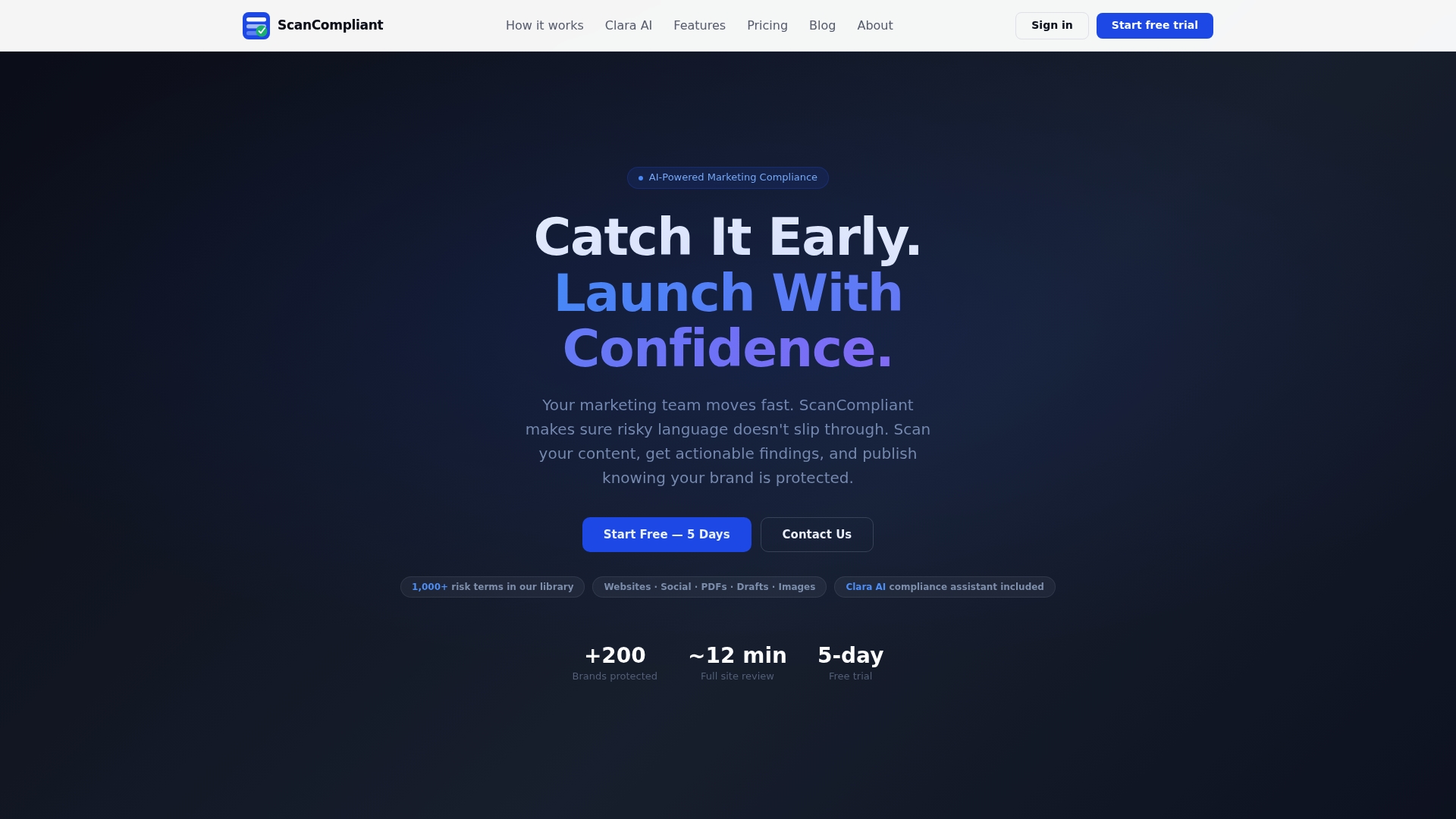
Scancompliant is an AI-powered content scanning platform built for telehealth and direct-to-consumer health brands. It scans marketing copy against a database of over 1,000 risk terms, delivers prioritized findings in minutes, and generates a documented compliance trail for every review. More than 200 brands have used it to catch risky language before publication, reducing both regulatory exposure and review cycle time. For compliance teams that need to move fast without cutting corners, Scancompliant’s platform connects directly to the workflows where content is created and reviewed. Teams that want to understand plan options and pricing can review them directly on the site.
FAQ
What is brand risk management with AI?
Brand risk management with AI is the use of automated tools to detect, assess, and mitigate threats to a brand’s reputation and regulatory standing across digital channels. AI enables this at a scale and speed that manual review cannot match.
How do AI tools help healthcare brands stay FDA compliant?
AI platforms scan marketing content against databases of regulated terms and FDA promotional guidelines, flagging non-compliant claims before publication. Scancompliant, for example, carries over 1,000 risk terms and delivers findings in minutes.
What is an AI control model in brand governance?
An AI control model is a defined framework specifying what actions an AI agent is permitted to take, what requires human approval, and what is blocked entirely. Agentic AI systems require these models to prevent structural brand risk beyond content-level errors.
How does AI-driven influencer vetting work?
AI agents audit years of an influencer’s historical content across platforms, flagging past controversies, non-compliant health claims, and brand tone mismatches. Continuous monitoring then tracks new content after a partnership launches.
Why is audit logging important in AI brand risk management?
Audit logging captures every AI decision trace, including what was flagged, what was approved, and by whom, creating a defensible record for regulatory review. Without it, compliance teams cannot prove that a review process actually occurred.