
The compliance review handoff process is the formal, documented transfer of compliance responsibilities and knowledge between healthcare teams, ensuring continuous regulatory adherence and operational readiness. Poor handoffs create audit gaps, fragment accountability, and expose organizations to regulatory liability. The 2026 Joint Commission standard NPSG.02.05.01 requires interactive, bidirectional communication during every handoff, with retrievable, contemporaneous documentation. Retrospective notes and verbal summaries alone do not meet accreditation requirements. Compliance teams and project managers who treat handoffs as a structured process, not an afterthought, protect their organizations from costly findings.
What does a strong compliance review handoff process require?
A compliance review handoff is only as strong as the preparation behind it. The most common failure point is not the handoff itself. It is the absence of structured prerequisites that leaves receiving teams without the context they need to maintain compliance continuity.
Identify stakeholders and acceptance criteria early
Planning handoffs at project initiation prevents undocumented risks from being dumped on closing teams. Identify the receiving team and define acceptance criteria before the project reaches its final phase. This gives both parties time to align on what “ready to receive” actually means.

Assemble the core documentation package
Every handoff package must include the following:
- Upcoming compliance deadlines and audit schedules
- Corrective action registers with current status and owners
- Issue logs with open items, expiry dates, and escalation paths
- Scope rationale documents explaining why certain controls were included or excluded
- Informal contacts and vendor relationships that do not appear in formal records
- Access permissions, file locations, and approval authority maps
Assign a documentation owner during project delivery, not at the end. That person is responsible for keeping records current throughout the project lifecycle, so the handoff package reflects real conditions rather than a rushed summary.
Use standardized handoff templates
Standardized templates make a measurable difference. A healthcare study tracking 600 handoff notes found that I-PASS element usage increased from 0% to 63% within six months of introducing a structured template, with template usage reaching 82%. That result shows that format drives behavior. Teams using the I-PASS framework (Illness severity, Patient summary, Action list, Situation awareness, Synthesis) can adapt its elements for compliance reviews by substituting compliance risk severity, control summaries, pending actions, exception awareness, and synthesis of open items. Scancompliant’s standardized review templates align with this approach and support Joint Commission documentation requirements.
Pro Tip: Assign the documentation owner on day one of the project, not the week before handoff. Teams that wait until the end spend the first two weeks of handoff prep reconstructing decisions that should have been recorded months earlier.
How to execute a structured compliance handoff step by step
Execution is where most handoff procedures compliance plans break down. A clear sequence prevents gaps and gives both teams a shared record of what was transferred, verified, and accepted.
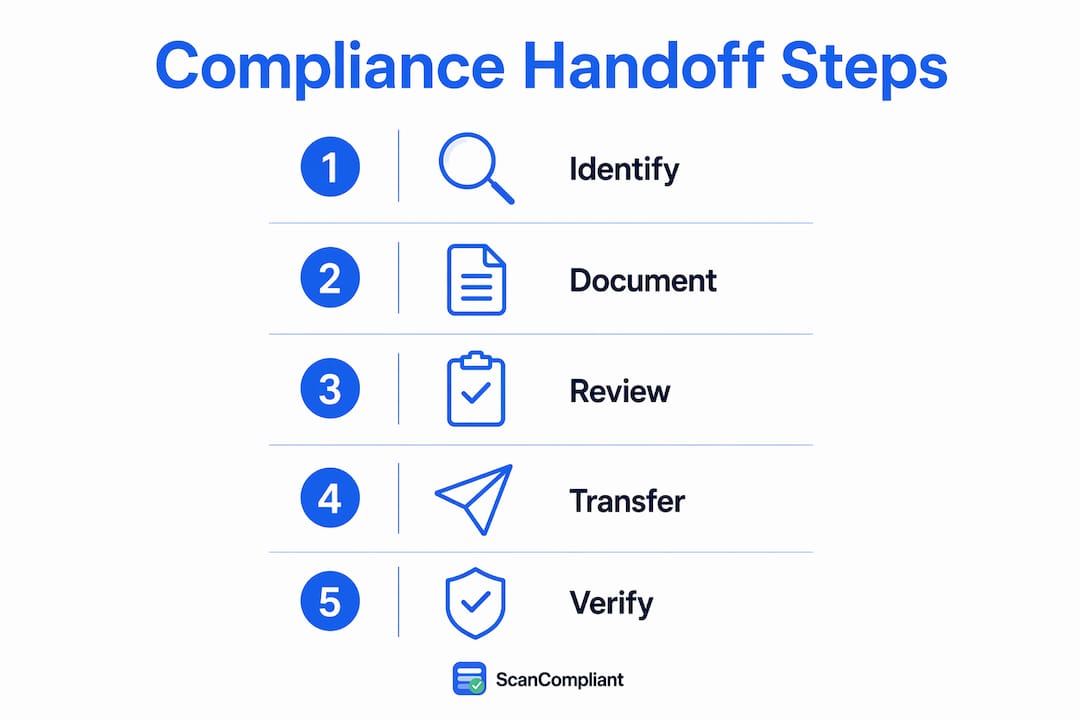
Step-by-step execution sequence
- Start the countdown period 4–6 weeks before handoff. Schedule at least 10–15 hours of direct knowledge transfer between outgoing and incoming owners. This window allows at least one joint review of the full compliance system and audit preparation cycle.
- Run a shadowing period. Have the incoming owner observe the outgoing owner during an internal audit or control review. Shadowing during live audits transfers tacit knowledge that documentation cannot capture, including how reviewers interpret ambiguous controls and which stakeholders hold informal authority.
- Conduct a tollgate review. Require the delivery team to present documented evidence against each acceptance criterion before the formal handoff proceeds. Tollgate reviews prevent premature transfer and surface hidden compliance gaps before they become audit findings.
- Verify access and authority. Confirm that the incoming team has correct file access, system permissions, and documented approval authority. Do not assume permissions transfer automatically with role changes.
- Document handoff outcomes. Record whether each item received a full approval, a conditional approval with remediation steps, or a block requiring resolution before transfer. Conditional approvals must include a named owner and a deadline.
- Define the hypercare period. Agree on a post-handoff support window during which the outgoing team remains available for questions. Specify the duration, the communication channel, and the escalation path if a critical issue surfaces.
The table below shows how each phase maps to its primary output and the team responsible.
| Phase | Primary output | Responsible party |
|---|---|---|
| Countdown period | Knowledge transfer log | Outgoing owner |
| Shadowing | Observation notes | Incoming owner |
| Tollgate review | Evidence package | Delivery team |
| Access verification | Permissions sign-off | IT and compliance lead |
| Outcome documentation | Handoff record | Both parties |
| Hypercare period | Issue resolution log | Outgoing owner |
Pro Tip: Record the tollgate review meeting. A short video or transcript gives the incoming team a reference they can return to when a control question surfaces three months later, long after the outgoing owner has moved on.
What are the most common compliance handoff challenges?
Even well-prepared teams encounter problems during handoffs. The issues below appear repeatedly across healthcare compliance review workflows, and each has a documented fix.
- Fragmented accountability. When multiple people share ownership of a control, no one owns it. A RACI model with a single accountable person per control eliminates ownerless work and closes audit gaps. Multiple team members can be responsible for execution, but accountability must be singular.
- Undocumented verbal approvals. Ad-hoc verbal approvals without documented authority create major compliance failure points. Handoffs must document stop authority and sign-off rights explicitly. Undocumented delegation transfers liability without transferring power.
- Incomplete issues lists. Transferring a control register without its associated issues log leaves the incoming team blind to known risks. Every open item must carry an owner, a status, and an expiry date.
- Lost operating memory. Scope rationales, informal vendor contacts, and open exceptions rarely appear in formal records. Without them, the incoming team makes decisions without the context that shaped the original controls.
- Premature handoffs. Handing over before the receiving team demonstrates readiness creates a false sense of completion. Readiness assessments must be evidence-based, not calendar-based.
Maintaining an exceptions list with expiry dates and a live issues log is the single most effective way to preserve operating memory across compliance team transitions. Without it, audit findings resurface on risks that were already identified, managed, and then forgotten during the handoff.
The fix for most of these problems is a structured documentation quality check conducted before the tollgate review. Assign a reviewer who was not involved in creating the handoff package. That person will find gaps that the outgoing team has normalized. For a detailed look at how RACI models support accountability in healthcare compliance reviews, the framework applies directly to handoff ownership structures.
Pro Tip: Run a live walkthrough of the compliance system with the incoming team before the formal tollgate. If they cannot explain a control’s purpose without prompting, the documentation is not complete enough.
How do teams sustain compliance integrity after the handoff?
The handoff is not the finish line. Post-handoff ownership requires active management to prevent compliance drift.
The table below outlines the core post-handoff activities and their recommended frequency.
| Activity | Frequency | Owner |
|---|---|---|
| Document control review | Quarterly | Compliance lead |
| Corrective action register update | Monthly | Control owners |
| Issues log review | Bi-weekly | Incoming compliance owner |
| Audit schedule confirmation | Annually or per cycle | Project manager |
| Exceptions list expiry check | Monthly | Compliance lead |
Beyond the schedule, teams need structural tools to maintain compliance continuity:
- Evidence maps that link each control to its supporting documentation, so auditors can trace accountability without interviewing staff
- Control registers that show current status, last review date, and next action for every active control
- Corrective action registers that track findings from internal audits through to verified closure
- Clear ownership assignment for every recurring activity, with named backups for each role
Documenting an exceptions list with expiry dates prevents recurring audit findings on risks that were known but not formally tracked. That single practice closes more post-handoff audit gaps than any other documentation habit. Automated workflow tools can flag overdue reviews and route corrective actions to the right owner, reducing the manual tracking burden on compliance teams. The compliance sign-off process for healthcare teams provides a practical framework for maintaining approval workflows after the initial handoff is complete.
Key Takeaways
A structured compliance review handoff process requires documented prerequisites, evidence-based tollgate reviews, singular accountability, and active post-handoff ownership to prevent audit gaps and regulatory findings.
| Point | Details |
|---|---|
| Start planning at project initiation | Identify receiving teams and acceptance criteria early to prevent last-minute risk transfers. |
| Use standardized templates | I-PASS-adapted templates increased critical element usage from 0% to 63% in healthcare settings. |
| Run tollgate reviews | Require documented evidence before handoff proceeds to prevent premature transfer and hidden gaps. |
| Assign singular accountability | A RACI model with one accountable person per control eliminates ownerless audit gaps. |
| Maintain post-handoff records | Active issues logs, exceptions lists, and control registers prevent compliance drift after transfer. |
What I have learned from watching compliance handoffs succeed and fail
The teams that handle handoffs well share one habit: they treat the handoff as a project deliverable, not a final task. They plan for it at the start, assign a documentation owner on day one, and build the handoff package incrementally rather than assembling it in the final week.
The teams that struggle do the opposite. They treat handoffs as an administrative formality. The outgoing owner sends a folder of documents, schedules one meeting, and considers the job done. Three months later, the incoming team discovers an open corrective action that was never formally transferred, or an exception that expired without anyone noticing.
Tollgate reviews changed my perspective on what “ready” actually means. Before I saw them used consistently, I assumed that a complete documentation package was sufficient. It is not. The incoming team needs to demonstrate that they understand the controls, not just that they have received the files. That distinction matters enormously when an auditor asks why a specific scope decision was made two years ago.
Shadowing periods are underused and undervalued. The informal knowledge that an experienced compliance lead carries, which vendor relationships actually work, which auditors ask follow-up questions on specific controls, which exceptions have a history, cannot be written down completely. It transfers through observation. One joint internal audit review is worth more than a week of document handover meetings.
The hardest lesson is about accountability. Fragmented ownership feels collaborative. It is not. When three people share responsibility for a control, the control has no owner. A single accountable person, supported by a clear RACI structure, is the only model that holds up under audit pressure.
— Compliant Team
Scancompliant for healthcare compliance handoff workflows
Healthcare compliance teams need more than a checklist. They need a system that maintains documentation, tracks approvals, and creates an audit trail that survives team transitions.

Scancompliant supports healthcare teams with tools designed for exactly this challenge. The platform provides compliance documentation and approval workflows that align with Joint Commission requirements, including retrievable sign-off records and structured review templates. Teams can establish clear accountability for every control, track corrective actions through to closure, and maintain audit readiness between handoffs. With over 1,000 risk terms in its database and more than 200 brands already protected, Scancompliant gives compliance teams the audit trail they need to hand off with confidence.
FAQ
What is a compliance review handoff process?
A compliance review handoff is the formal, documented transfer of compliance responsibilities, knowledge, and authority between healthcare teams. It includes control registers, issues logs, approval authority documentation, and a structured knowledge transfer period.
What does Joint Commission require for compliance handoffs?
The 2026 Joint Commission standard NPSG.02.05.01 requires interactive, bidirectional communication with retrievable, contemporaneous documentation. Verbal summaries and retrospective notes alone do not satisfy accreditation requirements.
How long should a compliance handoff take?
Best practice calls for a 4–6 week countdown period with 10–15 hours of direct knowledge transfer. This window allows at least one joint review of the full compliance system before the incoming owner assumes independent responsibility.
What is a tollgate review in a compliance handoff?
A tollgate review requires the outgoing team to present documented evidence against each acceptance criterion before the handoff proceeds. Unresolved items escalate rather than transfer, preventing hidden compliance gaps from moving to the incoming team.
How do teams prevent compliance drift after a handoff?
Teams prevent drift by maintaining active issues logs, corrective action registers, and exceptions lists with expiry dates. Assigning named owners to every recurring activity and scheduling quarterly document control reviews keeps compliance current between formal audits.
Recommended
- Compliance Sign-Off Process: A Guide for Healthcare Teams – scancompliant.com
- Compliance Review Turnaround Time Benchmarks: 2026 Guide – scancompliant.com
- Compliance Risk Reporting for Healthcare Teams: 2026 Guide – scancompliant.com
- How Compliance Audits Work for Healthcare Teams – scancompliant.com