
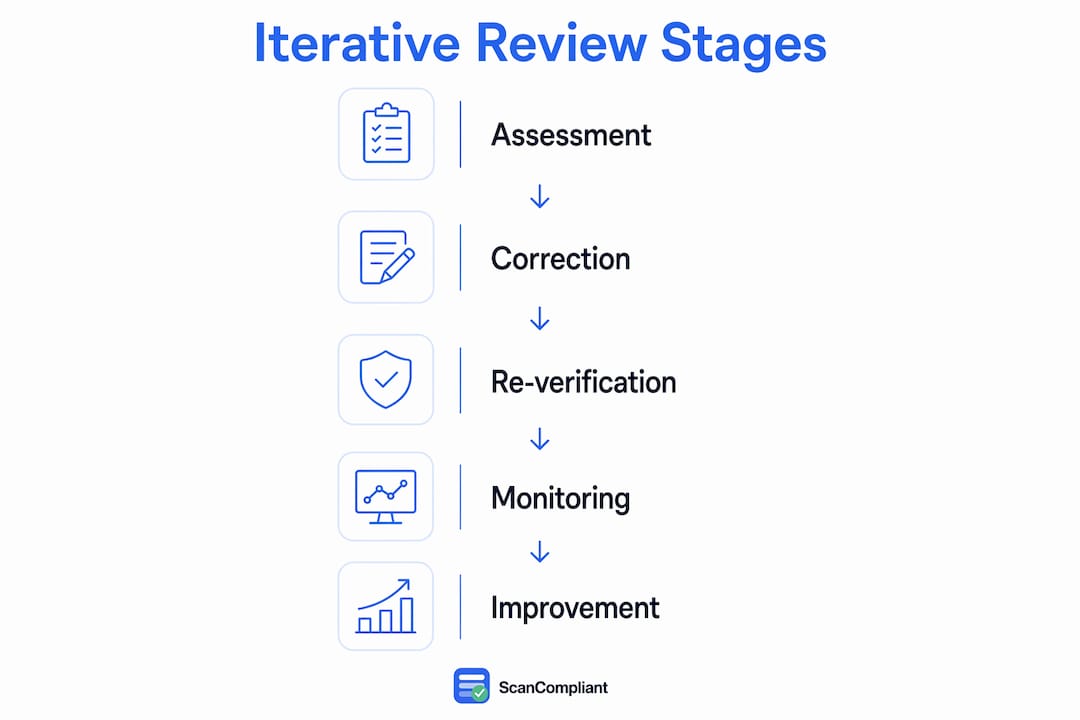
Iterative compliance review is defined as a cyclical, data-driven methodology that replaces singular audit events with repeated cycles of assessment, adjustment, and re-verification. Unlike a traditional one-time audit, this process treats compliance as a living system rather than a scheduled event. Compliance officers in telehealth and healthcare organizations face FDA and FTC regulations that shift faster than annual reviews can track. The iterative review process closes that gap by building correction directly into the review cycle, catching errors before they become enforcement actions.
What is iterative compliance review and why does it matter?
Iterative compliance review is the industry’s recognized answer to the limits of static auditing. The formal term used across governance frameworks is “continuous compliance monitoring,” and iterative review is its practical execution method. Each cycle produces findings, triggers corrective actions, and feeds directly into the next round of assessment.
The Department of Justice evaluates compliance programs through continuous iterative monitoring, and effective ongoing oversight can reduce an organization’s culpability score by up to 3 points under federal sentencing guidelines. That reduction matters because it directly affects enforcement outcomes and penalty calculations. For telehealth organizations operating under both FDA marketing rules and FTC truth-in-advertising standards, this is not a theoretical benefit.
A single review pass is statistically insufficient to catch all errors. Verification is probabilistic, meaning the first pass misses a predictable portion of non-conformities. The second independent round catches the majority of what the first missed. That statistical reality is the core argument for iterative review over traditional audits.
How iterative review improves regulatory adherence in healthcare
The primary operational advantage of iterative compliance review is real-time error detection. Each cycle surfaces new findings while confirming that prior corrections held. This creates a feedback loop that a one-time audit structurally cannot replicate.

Iterative auditing shifts from periodic static checks to continuous verification that adapts to emerging risks and performance data. For telehealth teams, this matters because regulatory guidance from the FDA and FTC updates frequently, and marketing content published last quarter may not meet current standards. A living assurance system catches that drift before regulators do.
The benefits of iterative compliance review over traditional audits include:
- Real-time deficiency detection across content, processes, and documentation rather than point-in-time snapshots
- Reduced culpability exposure through demonstrated ongoing oversight, which the DOJ weighs favorably
- Faster corrective action cycles because findings are addressed within the review loop, not months later
- Documented improvement trails that show regulators a pattern of good-faith remediation
- Adaptability to regulatory changes without waiting for the next scheduled audit
Pro Tip: Map your iterative review cycles to your content publication calendar. If your telehealth brand publishes new marketing assets monthly, schedule a review round to follow each publication batch. This keeps your compliance review workflow synchronized with your actual risk exposure.
What are the stages of an iterative compliance review?
The iterative review process follows a structured sequence that repeats across multiple rounds. Each round builds on the findings of the last, narrowing the gap between current practice and full compliance.
- Opening meeting. Clear early communication sets expectations, defines methodology, and establishes how findings will be reported. This step prevents operational surprises and aligns remediation planning before fieldwork begins.
- Document analysis. Reviewers examine policies, marketing content, clinical protocols, and prior audit records. In telehealth, this includes website claims, app store descriptions, and patient-facing communications.
- Fieldwork and interviews. Reviewers test controls, observe workflows, and interview staff. This phase surfaces gaps between written policy and actual practice.
- Findings documentation. Each non-conformity is logged with severity, responsible owner, and a deadline for corrective action. Documentation quality here determines the quality of the next cycle.
- Corrective action implementation. Responsible teams address findings within the agreed timeline. Clear accountability is non-negotiable at this stage.
- Re-verification. Reviewers confirm that corrections were made and held. This is the step that separates iterative review from a one-time audit.
- Cycle reset. The next round begins, focused on new risks and any findings that did not fully resolve.
Industry frameworks recommend 2 to 5 iterative review rounds, capturing up to 75% of reachable compliance improvements in the first two cycles. Beyond five rounds, returns diminish and reviewer fatigue increases. Tracking the number of new findings per round tells you when you have reached convergence and can safely reduce cycle frequency.
Pro Tip: In rounds two and beyond, focus each review cycle only on areas that changed since the prior iteration. Reviewing unchanged, already-verified content wastes reviewer time and accelerates fatigue without improving detection accuracy.
How does iterative compliance review differ from traditional audits?
The core difference is structural. Traditional compliance audits are scheduled events with a defined start and end. Iterative compliance review is a continuous loop with no permanent end state.
A common misconception is that a single thorough review suffices. Verification is inherently probabilistic, and multiple passes are required for high-confidence results. A single-pass audit leaves a statistically predictable volume of errors undetected. Those errors do not disappear. They accumulate until the next scheduled audit or until a regulator finds them first.
| Feature | Traditional audit | Iterative compliance review |
|---|---|---|
| Frequency | Annual or periodic | Continuous, multi-round cycles |
| Error detection | Single pass, point-in-time | Multiple passes, probabilistic improvement |
| Corrective action | Post-audit remediation | Built into each cycle |
| Regulatory signal | Reactive | Proactive, demonstrates ongoing oversight |
| Documentation trail | Snapshot record | Living record of improvement |
| Adaptability | Low, fixed scope | High, adjusts to new risks each round |
Technology plays a direct role in making iterative review practical at scale. Compliance review turnaround benchmarks show that teams using automated tracking tools complete review cycles significantly faster than those relying on manual processes. Speed matters because a slow cycle defeats the purpose of continuous monitoring.
What challenges come with implementing iterative compliance review?
Reviewer fatigue is the most underestimated obstacle. When the same team reviews the same content repeatedly, attention degrades and detection accuracy falls. The solution is to scope each round tightly and rotate reviewer assignments where possible.
Operational overhead is the second barrier. Iterative review requires dedicated time from compliance staff, legal counsel, and operational managers across every cycle. Organizations that treat compliance as a part-time function struggle to sustain the cadence. Building review cycles into team calendars as fixed commitments, not ad hoc tasks, is the practical fix.
Key strategies for sustaining iterative compliance review include:
- Define corrective action ownership clearly. Every finding needs a named owner and a deadline. Ambiguous accountability is the fastest way to stall a cycle.
- Track findings per round. When new findings drop to near zero, you have reached convergence. This data tells you when to reduce cycle frequency without losing coverage.
- Maintain a findings log across all cycles. A longitudinal record demonstrates good-faith improvement to the DOJ and other regulators. It also surfaces recurring issues that point to systemic gaps.
- Engage legal counsel before the first cycle. Legal privilege over compliance documentation can protect sensitive review findings from regulatory discovery. Establishing that privilege from the start is far easier than trying to apply it retroactively.
Pro Tip: Involve your legal team in structuring the review program before fieldwork begins. Proper documentation practices and attorney-client privilege designations protect your findings from compelled disclosure in enforcement or litigation contexts.
What tools support iterative compliance review in healthcare?
Governance, risk, and compliance software with continuous controls monitoring features is the foundation of a technology-supported iterative review program. These platforms automate finding tracking, assign corrective actions, and provide real-time visibility into cycle status. Without that infrastructure, iterative review quickly becomes an unmanageable spreadsheet exercise.
For telehealth compliance teams specifically, the 2026 regulatory environment requires tools that can flag FDA and FTC risk terms in marketing content before publication. Manual review of every asset across every cycle is not realistic at the pace telehealth brands publish content. Automation fills that gap.
Features to prioritize when evaluating compliance review tools:
- Automated risk term detection across marketing content, covering FDA drug claims, FTC substantiation requirements, and off-label promotion risks
- Workflow tracking that assigns findings to owners, sets deadlines, and logs resolution status across cycles
- Audit trail generation that produces a documented record of each review round for regulatory purposes
- Integration with content publishing workflows so review happens before publication, not after
- Configurable risk libraries that update as FDA and FTC guidance evolves
Scancompliant addresses this directly. The platform scans content with a database of over 1,000 risk terms, delivers prioritized findings in minutes, and has protected more than 200 brands from regulatory exposure. That speed makes it practical to run review cycles at the cadence iterative compliance requires.
Key Takeaways
Iterative compliance review outperforms traditional audits because it builds correction into every cycle, creating a documented improvement trail that regulators recognize as evidence of good-faith oversight.
| Point | Details |
|---|---|
| Definition | Iterative compliance review is a repeated cycle of assessment, correction, and re-verification, not a one-time event. |
| Optimal cycle count | Industry frameworks recommend 2–5 rounds, capturing the majority of improvements in the first two cycles. |
| DOJ alignment | Continuous iterative monitoring can reduce an organization’s culpability score by up to 3 points under federal sentencing guidelines. |
| Legal privilege | Engage legal counsel before the first cycle to protect review documentation from regulatory discovery. |
| Technology requirement | GRC software with automated tracking and risk term detection makes iterative review sustainable at scale. |
Why compliance officers should stop treating audits as finish lines
The teams I have seen struggle most with compliance are not the ones with bad intentions. They are the ones who treat a passed audit as a closed case. That mindset is the real compliance risk.
Iterative compliance review changes the mental model from “did we pass?” to “what did we miss this time?” That shift is uncomfortable at first. It means accepting that your program will always have open findings. But that discomfort is exactly what regulators want to see. The DOJ does not expect perfection. It expects evidence that you are actively looking for problems and fixing them.
For telehealth compliance officers specifically, the pace of regulatory change makes the iterative model non-negotiable. FDA guidance on digital health marketing and FTC enforcement on health claims both moved significantly in 2025. A team running annual audits is always reviewing yesterday’s standards. A team running iterative assessment cycles is reviewing today’s.
The cultural shift matters as much as the process. When compliance becomes a continuous practice rather than a periodic event, teams stop hiding problems and start surfacing them early. That behavioral change is worth more than any single audit finding.
— Compliant Team
How Scancompliant supports your iterative review cycles
Compliance officers running iterative review programs need tools that match their pace. Scancompliant was built for exactly that workflow.

The platform scans healthcare and telehealth marketing content against a database of over 1,000 FDA and FTC risk terms, returning prioritized findings in minutes rather than days. That speed makes it practical to run a review round every time your team publishes new content, not just once a quarter. Scancompliant has already protected more than 200 brands and produces a documented compliance trail that supports DOJ expectations for active oversight. Visit Scancompliant to see how the platform fits your iterative compliance program.
FAQ
What is iterative compliance review in simple terms?
Iterative compliance review is a repeated cycle of assessing, correcting, and re-verifying compliance rather than conducting a single periodic audit. Each round builds on the last, narrowing gaps between current practice and regulatory requirements.
How many review rounds does an iterative compliance program need?
Industry frameworks recommend 2–5 rounds, with the first two cycles capturing the majority of reachable compliance improvements. Beyond five rounds, diminishing returns and reviewer fatigue outweigh the detection benefits.
How does iterative compliance review help with DOJ expectations?
The DOJ evaluates compliance programs through continuous monitoring and can reduce a company’s culpability score by up to 3 points when active oversight is demonstrated. Iterative review creates the documented improvement trail that satisfies that standard.
What is the role of legal privilege in compliance review documentation?
Legal privilege can protect sensitive compliance review findings from being compelled in regulatory or litigation proceedings. Engaging legal counsel before the first review cycle is the most reliable way to establish that protection.
How does iterative compliance review apply to telehealth marketing?
Telehealth marketing content faces both FDA and FTC scrutiny, and regulatory guidance in this space updates frequently. Iterative review cycles tied to content publication schedules catch non-compliant marketing claims before they reach regulators or consumers.
Recommended
- Content Review Workflow Best Practices for Healthcare Teams – scancompliant.com
- How Content Compliance Audits Work for Healthcare Teams – scancompliant.com
- Compliance Review Turnaround Time Benchmarks: 2026 Guide – scancompliant.com
- Compliance Review Handoff Process for Healthcare Teams – scancompliant.com