
Compliance review stages are the structured, repeatable steps an organization follows to verify that its operations, content, and controls meet regulatory and internal standards. For healthcare and marketing teams, these stages cover everything from initial scoping through evidence collection, control testing, finding classification, reporting, and remediation. Frameworks like HIPAA, FDA regulations, and FTC guidelines each demand a documented process. A well-documented compliance program can reduce an organization’s culpability score under federal sentencing guidelines, directly lowering financial exposure when violations occur.
What are the compliance review stages every team should know?
Most compliance reviews follow six core stages: planning and scoping, evidence collection, control testing, finding classification, reporting, and remediation tracking. Each stage has a defined purpose and produces specific deliverables. Skipping or rushing any stage creates gaps that regulators and auditors will find.
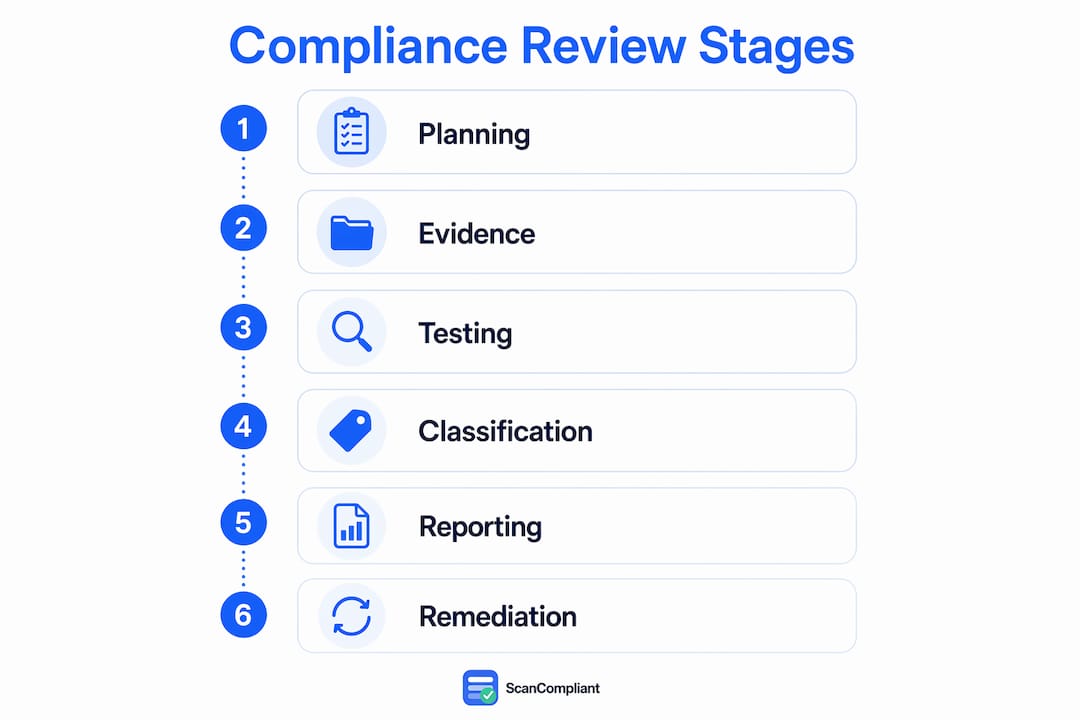
Stage 1: Planning and scoping. This stage defines what the review will cover, which regulations apply, and who owns each control. The deliverable is a written audit plan that names the regulatory framework (HIPAA, FDA 21 CFR Part 11, FTC Act) and sets the timeline.

Stage 2: Evidence collection. Teams gather documentation that proves controls are operating. For healthcare marketing, this includes content approval records, consent logs, and promotional material archives. Technical reviews require version-pinned evidence with chain-of-custody tracking to validate that a specific release met the applicable standard.
Stage 3: Control testing. Reviewers test whether each control actually works as designed. A policy that says “all marketing claims are reviewed before publication” must be backed by timestamps, reviewer names, and approval records. Absence of that evidence is a control failure, regardless of intent.
Stage 4: Finding classification. Each gap or failure gets rated by severity, typically as critical, high, medium, or low. This rating drives remediation priority and determines what goes into the executive summary.
Stage 5: Reporting. The report translates technical findings into business language. A good compliance report states the finding, the regulatory citation it violates, the risk level, and the recommended fix. Vague reports produce vague remediation.
Stage 6: Remediation and follow-up. Open findings get assigned to owners with due dates. Tracking closure is as important as finding the gap in the first place. A well-designed compliance checklist standardizes this entire cycle and prevents items from falling through the cracks.
Pro Tip: Build your audit plan template before the review starts. Teams that enter fieldwork without a written scope routinely discover mid-review that critical controls were never assigned to an owner.
What are compliance review KPIs teams should track monthly?
Compliance KPIs are quantitative measures of how well your review program is performing right now. As of 2026, COOs should monitor seven primary compliance metrics monthly to catch operational drift before it becomes a regulatory finding. Those seven metrics are: overdue reviews, open remediation items, evidence freshness, unresolved exceptions, vendor review coverage, control ownership gaps, and audit response turnaround times.
Each metric tells a different story. Overdue reviews signal that your review calendar is slipping. Open remediation items show how many known gaps remain unresolved. Evidence freshness measures whether your documentation is current or stale. Unresolved exceptions reveal controls that have been waived without proper authorization. Vendor review coverage tracks whether third-party partners, a major risk area in healthcare marketing, are being reviewed on schedule.
KPIs and KRIs are not interchangeable. KPIs measure current program performance, while KRIs are predictive signals that flag emerging risks before they materialize into violations. Confusing the two leads teams to report on what already happened while missing what is about to go wrong.
The most mature compliance programs use both. KPIs tell you where you stand. KRIs tell you where you are heading. For healthcare and marketing teams operating under FDA and FTC scrutiny, that forward-looking view is the difference between catching a risky claim before publication and receiving a warning letter after it.
Moving from descriptive to predictive compliance metrics reduces audit response times and improves overall compliance posture. Teams that track only lagging indicators, such as the number of violations found, are always reacting. Teams that track leading indicators, such as the percentage of content reviewed before publication, are managing proactively.
For a deeper look at how to structure your reporting around these metrics, the compliance risk reporting guide from Scancompliant covers healthcare-specific benchmarks in detail.
How do internal and external compliance reviews differ?
Internal and external compliance reviews serve different purposes, and using the wrong type at the wrong time creates blind spots. Understanding the distinction is a core part of any mature compliance review process.
| Feature | Internal review | External review |
|---|---|---|
| Who conducts it | In-house compliance or legal team | Independent third-party auditor |
| Frequency | Ongoing or quarterly | Annual or triggered by regulation |
| Regulatory weight | Operational visibility | Higher credibility with regulators |
| Best use case | Continuous monitoring | Pre-audit preparation, certification |
| Cost | Lower | Higher |
Internal compliance reviews provide ongoing operational visibility, but external reviews by independent bodies carry more regulatory weight. External reviewers have no vested interest in the outcome, which makes their findings more credible to the FDA, FTC, and other regulatory bodies. That independence is exactly why regulators trust external audit reports more than self-assessments.
For healthcare marketing teams, the practical answer is to run both. Internal reviews catch issues continuously and keep the team sharp. External reviews validate that your internal process is actually working and provide the independent documentation that regulators expect.
A common mistake is treating internal reviews as a rehearsal for external ones. They are not. Internal reviews should be rigorous enough to find real problems. If your internal review never surfaces a finding, that is a red flag, not a success metric.
Pro Tip: Schedule your internal review at least 60 days before any anticipated external audit. That gap gives your team time to close findings before an independent reviewer sees them.
For healthcare teams specifically, the compliance audits guide from Scancompliant breaks down how these two review types interact in practice.
What are the most common pitfalls in managing compliance review stages?
The most damaging mistakes in compliance reviews are not technical. They are process failures that compound over time.
- Undefined scope at the start. Opening meetings are critical for setting expectations on scope, methodology, communication channels, and reporting timelines. Teams that skip a formal kickoff meeting routinely discover mid-review that key stakeholders had different assumptions about what was being reviewed.
- Weak evidence collection. Collecting evidence without version control or timestamps creates disputes during reporting. For technical reviews, chain-of-custody tracked evidence is the standard. For marketing reviews, that means dated screenshots, approval emails, and named reviewers.
- Stale remediation tracking. Finding a gap and assigning it to an owner is not the same as closing it. Teams that do not track remediation weekly let open items age past their due dates. Regulators view aged open findings as evidence of a non-functional compliance program.
- No link between findings and regulations. Every finding in your report should cite the specific regulation it violates. “Marketing claim lacks substantiation” is weak. “Marketing claim lacks substantiation under FTC 16 CFR Part 255” is a finding that drives action.
- Manual processes in high-volume environments. Healthcare marketing teams publishing content at scale cannot rely on manual checklists alone. Automated workflow tools reduce human error and create a consistent, auditable trail across every piece of content.
Pro Tip: Use a regulatory review checklist built specifically for healthcare marketing. Generic checklists miss FDA and FTC-specific requirements that are common failure points in DTC health content.
The role of technology in compliance teams has expanded significantly. AI-powered scanning tools now catch risky language patterns that human reviewers routinely miss, especially in high-volume content environments where reviewer fatigue is a real factor.
Key Takeaways
A compliance review process only works when all six stages are executed in sequence, tracked with KPIs, and supported by documented evidence at every step.
| Point | Details |
|---|---|
| Six core stages | Every review must cover planning, evidence collection, control testing, finding classification, reporting, and remediation. |
| KPIs vs. KRIs | KPIs measure current performance; KRIs predict future risk. Track both monthly to stay ahead of violations. |
| Internal vs. external reviews | Run internal reviews continuously and external reviews annually to satisfy both operational and regulatory requirements. |
| Opening meeting discipline | Define scope, methodology, and timelines at the start to prevent costly misalignments during fieldwork. |
| Documentation reduces penalties | A well-documented compliance program lowers culpability scores under federal sentencing guidelines. |
What I’ve learned about compliance reviews that most guides won’t tell you
Most compliance guides treat the review process as a checklist exercise. After working with healthcare and marketing teams across dozens of review cycles, the pattern is clear: the teams that struggle are not missing knowledge. They are missing discipline.
The opening meeting is the single most undervalued moment in any compliance review. Teams rush through it or skip it entirely, then spend the next three weeks arguing about what was in scope. Setting expectations on scope, methodology, and reporting format in the first 30 minutes of a review saves more time than any automation tool.
The KPI conversation also gets oversimplified. Teams report on findings counts and call it compliance measurement. That is a lagging indicator. The teams that genuinely manage their compliance posture track evidence freshness, vendor coverage, and control ownership gaps every month. Those metrics tell you where the next violation is coming from before it arrives.
The technology shift is real, but it is not magic. AI-powered scanning tools like Scancompliant catch risky language patterns at a scale and speed that human reviewers cannot match. But the tool only works if the underlying review process is sound. Automating a broken process just produces faster broken results.
The most important mindset shift is from audit response to program management. Compliance reviews are not events you survive. They are the mechanism by which you prove your program works. Teams that internalize that distinction stop dreading reviews and start using them as genuine management data.
— Compliant Team
How Scancompliant supports your compliance review workflow
Compliance review stages generate a high volume of content decisions, and each one carries regulatory risk. Scancompliant is built for exactly that pressure point.
Scancompliant’s AI-powered platform scans marketing content against a database of over 1,000 risk terms, flagging language that violates FDA and FTC standards before it reaches publication. For healthcare and DTC health brands, that means every piece of content enters your review cycle pre-screened, with prioritized findings delivered in minutes rather than days. The platform creates a documented compliance trail that supports every stage of your review process, from evidence collection through remediation tracking. More than 200 brands already rely on Scancompliant to reduce review cycle times and catch the subtle claims that human reviewers miss. See how it works and explore pricing options that fit your team’s review volume.
FAQ
What are the six stages of a compliance review?
The six stages are planning and scoping, evidence collection, control testing, finding classification, reporting, and remediation tracking. Each stage produces specific deliverables that feed into the next.
What is a compliance review checklist?
A compliance review checklist is a standardized document that lists every required step, control, and evidence item for a given review. A well-designed checklist covers scope definition, requirements review, evidence collection, control testing, risk rating, reporting, and remediation tracking.
How do compliance review KPIs differ from KRIs?
KPIs measure how well your compliance program is performing right now, while KRIs are predictive signals that flag risks before they become violations. Effective programs track both metrics monthly.
How often should compliance reviews be conducted?
Internal reviews should run continuously or quarterly, while external reviews typically occur annually or when triggered by a regulatory requirement or significant operational change.
Why does documentation matter so much in compliance reviews?
A well-documented compliance program can reduce an organization’s culpability score under federal sentencing guidelines, which directly lowers potential financial penalties when violations occur.