
Before you publish any patient-facing marketing, run a pre-publish compliance check and fix any high-risk flags before the asset goes live. Then collect the approval record. That single habit, an automated scan paired with human triage, catches most of what gets telehealth and DTC health brands in trouble.
Three risks deserve an automatic stop:
- Implied FDA approval or equivalence to a branded prescription drug
- Missing fair-balance or safety copy anywhere a prescription benefit is mentioned
- Unqualified “clinically proven” language or platform-triggering visuals (before/after shots, rapid-cut video edits)
None of this matters if you can’t prove you caught it. A defensible audit trail, timestamped approvals, linked evidence, reviewer names, is what lets your team respond to a regulator or a platform within days instead of weeks.
Key Takeaways
A defensible pre-publish compliance check pairs an automated scan with prioritized human review, and it succeeds only when every approval leaves a timestamped, evidence-linked record.
| Point | Details |
|---|---|
| Scan before publishing | Run every webpage, social post, and ad through an automated check plus human triage on high-risk flags. |
| Watch the top three risks | Stop implied drug-equivalence claims, missing fair-balance copy, and unqualified “clinically proven” language immediately. |
| Substantiate every claim | Map each claim to evidence with relevant endpoints and a matching study population before it ships. |
| Document the approval trail | Retain versioned copy, reviewer notes, evidence links, and timestamps to respond fast to regulators or platforms. |
| Automate the first pass | Scancompliant scans against 1,000+ risk terms, turning a manual review into a prioritized list in minutes. |
Table of Contents
- What Does a Pre-Publish Compliance Check Cover?
- Pre-Publish Compliance Checklist Teams Should Run Before Every Publish
- How Do You Evaluate Claims Against FTC Evidence Standards?
- What Design and Platform Triggers Get Marketing Flagged?
- How Should Teams Structure a Defensible Review Workflow?
- What Happens After a Flag or Enforcement Notice Arrives?
- What Privacy and Security Rules Apply to Telehealth Marketing?
- How Do You Verify Testimonials and Endorsements Before Publishing?
- What Changes When Marketing Targets Multiple Countries?
- What Does Compliant Claim Language Actually Look Like?
- How Do You Meet ADA Accessibility Standards in Marketing Materials?
- The Checklist Habit That Actually Prevents Enforcement
- How Scancompliant Puts This Checklist Into Practice
- Frequently Asked Questions
- Sources
What Does a Pre-Publish Compliance Check Cover?
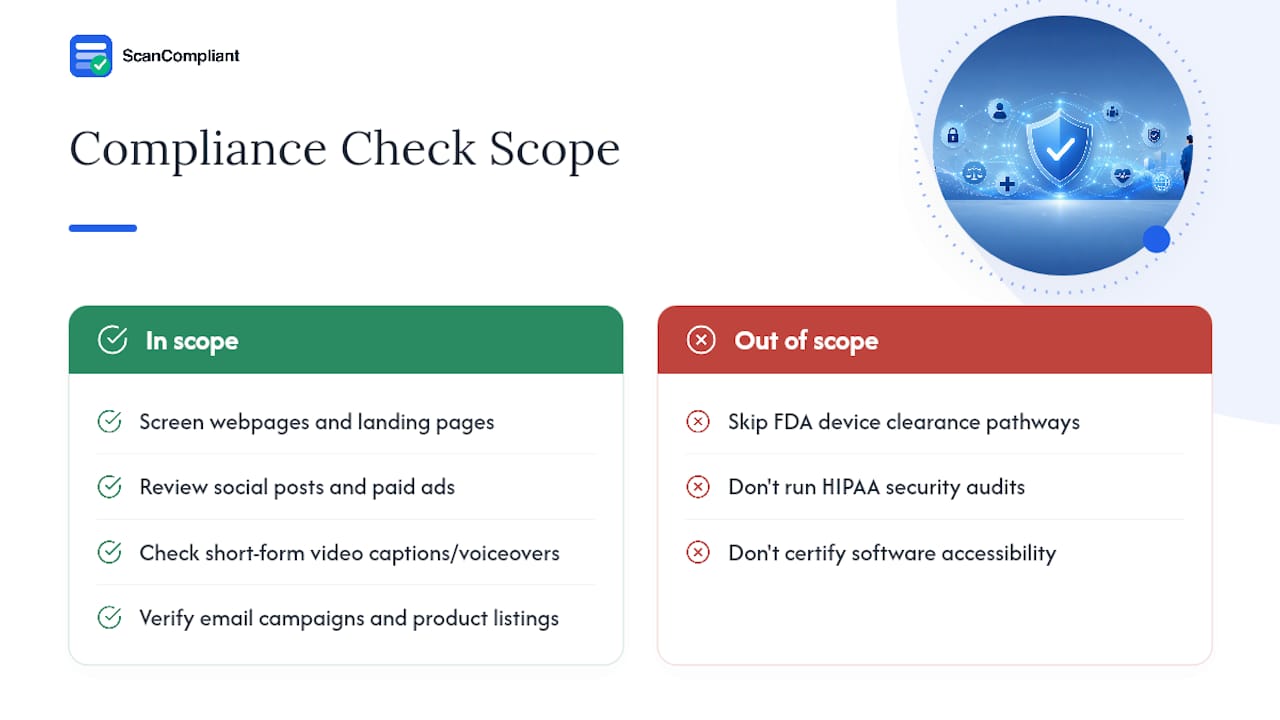
A pre-publish compliance check in digital health marketing screens the content your brand is about to publish, not the software or device behind it. That distinction matters because it’s easy to confuse this with SaMD (software as a medical device) certification or health IT accreditation. Those are engineering and clinical processes. This is a marketing review.
In scope: webpages, landing pages, social posts, paid ad copy, short-form video captions and voiceovers, email campaigns, and product listings. Out of scope: FDA device clearance pathways, HIPAA security audits of your app infrastructure, and accessibility certification of your software itself (though marketing materials have their own accessibility duties, covered later).
Two federal agencies split the oversight. The FTC’s Health Products Compliance Guidance governs advertising claims and requires substantiation behind them. The FDA steps in when marketing implies a drug claim, omits fair balance, or misbrands a product. Platforms add a third layer of policy on top of both. Consequences stack fast: ad account suspension, formal warning letters, and short response windows that leave little room to scramble.
Pre-Publish Compliance Checklist Teams Should Run Before Every Publish
Run this sequence on every asset, not just the ones that feel risky. The riskiest content is usually the piece nobody thought to flag.
- Identify every claim, explicit and implied, and rank its risk level. A headline that says “clinically proven” is explicit. A before/after photo next to a product name is implied, and implied claims get missed constantly.
- Map each claim to its evidence. Note the study type, the endpoints measured, and whether the study population matches who you’re marketing to.
- Insert fair-balance and safety copy wherever a prescription or medical benefit appears. For short-form video, that means both an audible disclosure and an on-screen one, timed to when the claim is made, not buried in a description field.
- Check the design and user experience for hidden disclosures. A disclaimer that requires a click, a hover, or a scroll past three screens of marketing copy is a dark pattern regulators notice.
- Verify vendor relationships and sourcing transparency. If a compounding pharmacy, affiliate, or influencer has a financial stake in the outcome, that relationship needs disclosure, not omission.
- Capture the approval artifact before anything goes live. Who reviewed it, what evidence they checked, and a timestamp. No signoff, no publish.
- Skip a step and you inherit its risk. Skip step 6 and you have no defense at all.
Pro Tip: Build the checklist into your CMS as a required field, not a separate document nobody opens. If publishing is blocked until the compliance fields are filled, the checklist runs itself.
How Do You Evaluate Claims Against FTC Evidence Standards?
The FTC requires “competent and reliable evidence” behind health claims, which in practice means randomized controlled trials with endpoints that actually match what you’re claiming, not a proxy measure dressed up to sound impressive. A study on weight loss in a general population doesn’t substantiate a claim about a specific condition or age group. The FTC’s guidance draws a hard line between qualified claims, worded to reflect real limitations, and bare assertions that overstate what the science shows.
A few working rules help reviewers move fast without missing the nuance:
- The study population has to resemble your target customer, not a different demographic entirely.
- Endpoints need clinical relevance. A statistically significant lab value that patients would never notice isn’t the same as a meaningful health outcome.
- One small study doesn’t support a sweeping claim, and cherry-picking the one favorable result out of several trials is its own violation.
The FTC also evaluates the “net impression” of an ad, meaning the headline, adjacent images, and layout all combine to create a claim, even if no single sentence states it outright. A stock photo of a doctor’s coat next to a supplement bottle implies medical endorsement whether or not the copy says so. Reviewers who only read the text miss this constantly.
What Design and Platform Triggers Get Marketing Flagged?
Regulators and platforms increasingly rely on automated review tools that scan visual and formatting elements, not just body copy, so a clean paragraph sitting under a risky image still gets caught.
Common triggers worth scanning for on every asset:
- Before/after images with no disclaimer about typical results or individual variation
- Visual or verbal cues that imply equivalence to an FDA-approved branded drug
- Short-form video missing a synchronous safety disclosure, either audio or on-screen text timed to the claim
- Disclosures rendered in tiny type or low-contrast color that a reviewer (or a screen reader) can barely detect
Dark patterns compound the problem: an overlay that hides safety language until a user taps through, or a disclaimer that auto-dismisses after two seconds. The fix is usually simple. Make disclosures conspicuous, sized and colored to match the surrounding copy, keep audio disclosures in sync with the claim being made, and choose alternative imagery when a before/after shot can’t carry an adequate disclaimer.
How Should Teams Structure a Defensible Review Workflow?
A workflow only holds up under scrutiny if the roles are clear and the timeline is short enough to actually follow under pressure.
- Submitter drafts the content and runs it through an automated scan first, catching the obvious flags before anyone else spends time on it.
- Compliance reviewer triages the scanner’s output, resolving low-risk flags directly and escalating anything high-risk.
- Legal counsel reviews any claim tied to a prescription benefit, a comparative claim, or a testimonial with financial ties.
- Final signoff happens only after every flag is resolved and documented, not before.
Retain, at minimum: a versioned copy of the published asset, reviewer notes explaining each decision, links to the substantiating evidence, and a timestamp with reviewer identity attached to each approval. When a scanner flags dozens of items and a deadline is tight, triage by severity first, resolve the high-risk items personally, and let lower-risk flags move through a faster secondary review.
Pro Tip: Treat the scanner’s flagged output as the first draft of your audit trail, not a separate step. Exporting it directly into your approval record saves the reconstruction work later.
What Happens After a Flag or Enforcement Notice Arrives?
Pause the asset immediately and preserve the original file, don’t edit it in place, save a copy first. Gather the substantiation you already documented and draft a corrective plan with a clear timeline. The FDA’s recent warning letters to telehealth companies gave recipients roughly 15 days to respond with corrective action, which is not enough time to build a defense from scratch.
- Pause and archive the flagged asset before making any edits.
- Compile the evidence trail you already have; don’t scramble to find it after the fact.
- Draft a one-page remediation plan showing exactly what changed and why.
- Loop in legal counsel the moment a claim touches a prescription benefit or a comparative statement.
Platform appeals move faster when you can show a documented review process. A clear approval trail signals good-faith compliance and shortens reinstatement timelines that otherwise drag on for weeks.
What Privacy and Security Rules Apply to Telehealth Marketing?
HIPAA governs protected health information, and marketing content touches it more often than teams assume. A landing page retargeting pixel that fires after someone submits a symptom quiz, a chat widget that logs a patient’s condition, or an email list segmented by diagnosis all process health data that may fall under HIPAA if a covered entity or business associate is involved.

The practical fix is to inventory every tracking pixel, analytics tool, and third-party script running on patient-facing pages before publishing, and confirm a business associate agreement (BAA) is in place wherever one is legally required. This is a separate compliance gap from claim language. A page can have perfectly compliant copy and still leak protected health information through an untracked marketing pixel.
Testimonials and case studies carry their own privacy layer: get written authorization before publishing any patient story, and scrub identifying details unless the patient explicitly consented to their inclusion. Marketing teams should also confirm that any lead-gen form collecting health information routes through infrastructure with appropriate encryption and access controls, not a generic email inbox.
Security review belongs in the same pre-publish gate as claims review. A security and compliance framework built for handling sensitive health signals is worth studying even outside your own vendor relationships, because the standard for “appropriate protection” keeps rising across the industry. Treat tracker inventory as a checklist line item, not an afterthought handled by a different team on a different timeline.
How Do You Verify Testimonials and Endorsements Before Publishing?
Every testimonial, influencer post, and clinician endorsement needs a paper trail before it goes anywhere near a publish button. Start by confirming the endorser actually used the product or service as described. Some enforcement actions cite endorsements from people with no verifiable connection to the brand at all.
Document material connections, payment, free product, an ongoing partnership, and disclose them clearly, not in a hashtag buried at the end of a caption. If a doctor or clinician appears in the content, verify their license status and confirm they haven’t been excluded from federal healthcare programs. A quick license lookup takes minutes and prevents a much larger problem down the line.
Typical results claims tied to a testimonial need the same evidentiary backing as any other health claim. “I lost 40 pounds” from one customer doesn’t establish what a typical customer should expect, and the ad needs to say so plainly rather than let the anecdote imply a general outcome. If the testimonial describes a health outcome, treat it as a health claim requiring substantiation, not as a customer quote exempt from scrutiny.
Keep signed releases, disclosure records, and verification notes in the same audit trail as your claims review. When a testimonial gets flagged, the ability to produce that documentation within days, rather than reconstructing it after the fact, is what separates a quick resolution from a prolonged one.
What Changes When Marketing Targets Multiple Countries?
A claim that’s compliant for a domestic audience can become a violation the moment it reaches a reader in a different regulatory jurisdiction. The EU, UK, Canada, and Australia each maintain their own advertising standards for health and pharmaceutical claims, and several restrict direct-to-consumer prescription drug advertising far more tightly than U.S. rules allow.
Before running the same asset across borders, identify which jurisdiction each audience segment sits in and map the applicable claim standards for each. A “clinically proven” claim that clears FTC substantiation standards domestically may still fail a different country’s stricter advertising code. Geotargeting matters here as much as copywriting: if you can’t guarantee an asset only reaches one jurisdiction, write it to the strictest applicable standard rather than the most permissive.
Data protection adds another layer. GDPR governs how EU visitor data gets collected through marketing pages, separate from any HIPAA obligations that apply domestically. A cookie banner that satisfies U.S. norms often falls short of GDPR’s consent requirements.
Build a jurisdiction tag into your compliance workflow so reviewers know which ruleset applies to a given asset before they start checking claims. Treating “international” as a single category is how contradictory local rules slip through unnoticed.
What Does Compliant Claim Language Actually Look Like?
Specific wording choices separate a defensible claim from an actionable one. A few patterns worth building into your style guide:
- Instead of “clinically proven to reduce symptoms,” use “in a clinical study, participants reported a reduction in symptoms” and link the study.
- Instead of “as effective as [branded drug],” avoid direct comparison entirely unless you have head-to-head trial data; describe your product’s own studied outcomes instead.
- Instead of an unqualified “lose weight fast,” pair any speed claim with the actual study timeframe and average result, not the best-case outlier.
- Instead of a bare testimonial quote implying typical results, add “individual results vary” in text large enough to read, not a five-point disclaimer at the bottom of the page.
The common thread across all of these: qualify what needs qualifying, cite what needs a source, and never let a single unqualified phrase carry more certainty than the underlying evidence supports. Reviewers should read each claim as if a regulator will ask “show me the study,” because eventually, one will.
How Do You Meet ADA Accessibility Standards in Marketing Materials?
Accessibility compliance belongs in the same pre-publish gate as claims review, not a separate audit run months later. Marketing pages need sufficient color contrast on disclosure text, alt text on every image conveying claim-relevant information, and captions on video content, not just for hearing-impaired viewers but because captions also carry your safety disclosures where audio alone might get muted or skipped.
Screen reader compatibility matters especially for disclaimers. A disclosure buried in a tooltip or triggered only by hover interaction is invisible to both keyboard navigation and screen readers, which creates an ADA gap on top of the regulatory one. Test every landing page with a screen reader before publishing, not after a complaint arrives.
Video content needs synchronized captions that include the safety and fair-balance language, timed to match the audio disclosure rather than compressed into a rushed end-card. PDF product inserts and downloadable materials need tagged headings and readable text layers, not scanned images of text that a screen reader can’t parse at all.
The Checklist Habit That Actually Prevents Enforcement
Most compliance advice treats regulatory review as a legal exercise: read the guidance, interpret the rule, apply judgment. That’s necessary but incomplete. The FDA’s recent wave of warning letters over compounded GLP-1 marketing didn’t target brands with bad lawyers. It targeted brands that never ran a systematic check on marketing volume moving faster than any legal team could review line by line.
The gap isn’t legal knowledge. It’s throughput. A single marketing manager publishing a dozen social posts a week, three landing pages a month, and constant ad variations cannot manually apply FTC substantiation standards to every asset before it ships. Something has to triage the obvious risks so human judgment gets spent where it actually matters, ambiguous claims, borderline testimonials, jurisdiction conflicts.
What gets underestimated is how much risk hides in design choices rather than copy: a before/after image, a font size on a disclaimer, a caption that drops the safety line halfway through a video. Teams that only proofread text miss most of what regulators and platforms actually flag.
Prioritize building the audit trail before you worry about writing perfect copy. Perfect copy with no documentation is still a liability the moment a regulator asks how you arrived at a claim.
How Scancompliant Puts This Checklist Into Practice
Running this checklist by hand, across every webpage, social post, and ad variation your team publishes, isn’t realistic once volume climbs past a handful of assets a week. Scancompliant automates the first pass: it scans your content against a database of more than 1,000 risk terms, flags implied claims and missing fair-balance language, and hands your reviewer a prioritized list instead of a blank page to start from.
The platform has already protected numerous brands across telehealth and DTC health, and it delivers findings in minutes rather than the days a manual legal review often takes. Every scan generates the timestamped record this article keeps coming back to: what was flagged, what evidence was checked, who signed off. That record is exactly what shortens a platform appeal or a regulator response window. Scancompliant’s integrated AI assistant also suggests compliant rewrite options directly against each flag, so your reviewer edits instead of starting from scratch.
If your team is publishing faster than your review process can keep up with, start a trial and run your next asset through it before it goes live. You can also review the platform’s security and data handling practices if that’s part of your vendor evaluation.
Frequently Asked Questions
What is a pre-publish compliance check in digital health marketing?
It’s a screening step, automated scan plus human review, applied to marketing content (webpages, social posts, ads, product listings) before publication, to catch FDA misbranding risk, FTC substantiation gaps, and platform-policy violations.
How long do we have to respond to an FDA warning letter?
Recent FDA warning letters to telehealth companies have given recipients roughly 15 days to respond with corrective action, which is why pre-publish documentation matters so much.
What counts as “competent and reliable evidence” for a health claim?
The FTC generally expects randomized controlled trials with endpoints that match the claim, conducted on a population resembling your actual customers, not a proxy measure or an unrelated demographic.
Do social media posts need the same fair-balance copy as a webpage?
Yes. Any format mentioning a prescription or medical benefit needs the same safety and fair-balance obligations, adapted to the format, meaning short-form video needs both audible and on-screen disclosures synced to the claim.
Can a testimonial alone trigger enforcement?
Yes, particularly when it implies a typical result without disclosure, involves an undisclosed financial relationship, or comes from someone whose license status or program eligibility hasn’t been verified.
Does accessibility compliance actually affect marketing content, not just software?
Yes. Color contrast on disclosures, alt text on claim-relevant images, and synchronized video captions all fall under ADA obligations for marketing materials, separate from any software accessibility requirements.
This article is general information, not a substitute for advice from a qualified doctor. Consult a qualified healthcare professional about your own circumstances before acting on anything here.
Sources
- FDA warns 30 telehealth companies against illegal marketing for compounded GLP‑1s
- Health Products Compliance Guidance | Federal Trade Commission
- FDA takes aim at drug ads: what it means for compounding pharmacies, medspas and telehealth companies
- FDA crackdown on telehealth advertising: compliance risks for compounded GLP‑1 marketing
Recommended
- Pre-Publication Health Content Review Steps for Compliance Teams – scancompliant.com
- Regulatory Review Checklist for Healthcare Marketing – scancompliant.com
- How Content Review Protects Creators in Telehealth Marketing – scancompliant.com
- Telehealth Email Marketing Compliance Tips for 2026 – scancompliant.com
2 Comments