
Firms must submit promotional labeling and advertisements to the FDA at the time of initial dissemination or publication, using Form FDA 2253. The agency does not generally pre-approve promotional materials for prescription drugs before they run. That surprises a lot of people new to this space, but it’s the operating reality: FDA relies on after-the-fact submission and enforcement rather than a gatekeeping model.
There are exceptions worth knowing before you build a launch timeline:
- Voluntary advisory comments let sponsors get FDA feedback before dissemination, though nothing obligates the agency to respond on any particular schedule.
- Pre-dissemination review is mandatory in narrow cases, most notably certain direct-to-consumer TV ads under section 503B, which carries a 45-day submission window.
- Core launch materials get priority attention during the first 120 days after approval, with a 5-business-day administrative screen before substantive review even begins.
OPDP (the Office of Prescription Drug Promotion) processes over 70,000 promotional submissions a year, almost all through Form FDA 2253 filed after the fact, not before. Electronic filing is now the expectation for most submissions, following eCTD Module 1 conventions, though FDA still accepts certain non-eCTD electronic formats and, in limited transition scenarios, paper. The administrative screening step happens first and simply checks whether your submission package is complete enough for a reviewer to actually evaluate it.
Key Takeaways
FDA generally reviews promotional materials after they’re submitted at initial dissemination via Form FDA 2253, not before they run, except in narrow pre-dissemination cases like certain TV ads under section 503B.
| Point | Details |
|---|---|
| Submit at initial dissemination | File Form FDA 2253 with a specimen, current PI, and supporting references the same day material first runs. |
| No standard pre-approval | FDA doesn’t pre-clear most promotional materials; voluntary advisory comments and 503B review are the main exceptions. |
| Screening happens first | Core launch submissions get a 5-business-day administrative screen before substantive review starts. |
| Annotation prevents delays | Tie every claim to its supporting label page or reference so reviewers can verify quickly. |
| Automate the first pass | Scancompliant flags risky phrasing and implied claims before submission, cutting review cycles and building an audit trail. |
Table of Contents
- What Promotional Materials Does the FDA Regulate?
- Submission Mechanics: Form FDA 2253 and Postmarketing Rules
- eCTD, Non-eCTD Formats, and How to Annotate Materials
- When Should You Seek FDA Feedback Before Launch?
- How Does FDA Actually Review a Submission?
- Planning Your Launch Timeline Around FDA’s Review Clock
- What Are the Most Common FDA Promotional Violations?
- Building a Submission-Ready Internal Workflow
- Where Enforcement Trends Are Heading and What That Means for Your Checklist
- A Faster Path to Submission-Ready Promotional Content
- Key FDA Resources for Promotional Review
- Sources
What Promotional Materials Does the FDA Regulate?
FDA draws a line between “labeling” and “advertising,” and that distinction matters more than most marketing teams realize when they’re deciding what needs a 2253 filing.
Labeling covers anything that accompanies the product, including package inserts, patient brochures, and materials handed out at point of sale. Advertising covers promotional messages disseminated through media: print ads, broadcast spots, banner ads, sponsored search results, branded websites, promotional emails, and social media posts, all of which are important channels explored in Telemedicine Marketing: What Healthcare Providers Must Know. Sales aids used by reps, leave-behinds, and detail pieces fall under labeling in most cases, even though they feel like advertising in practice.
The full range of regulated material includes:
- Print advertisements in medical journals and consumer publications
- Broadcast and streaming video ads, including pre-roll and connected TV placements
- Branded and unbranded websites, landing pages, and microsites
- Promotional emails and text campaigns sent to healthcare providers or patients
- Social media posts, including organic content and paid placements
- Sales aids, detail pieces, and leave-behind materials used by field reps
- Trade show booths, banners, and exhibit materials
Audience matters too. Prescription drug promotion falls under FDA’s jurisdiction almost entirely, while over-the-counter drug advertising is split: FDA regulates OTC labeling, but the Federal Trade Commission oversees OTC advertising claims. That split trips up teams that assume one regulator covers everything a brand publishes.
One classification error shows up constantly: disease-awareness campaigns. A truly unbranded, disease-state education piece that never names a product and never links visually or contextually to one specific therapy generally sits outside FDA’s promotional review requirements. The moment a campaign implies a product connection through timing, branding cues, or a “talk to your doctor about [condition]” tagline paired with heavy brand presence elsewhere, it usually gets treated as promotional. Regulatory teams should document that reasoning in writing whenever they classify something as non-promotional, because that judgment call is exactly the kind of thing an enforcement letter will second-guess later.
Submission Mechanics: Form FDA 2253 and Postmarketing Rules
The legal requirement lives in 21 CFR 314.81(b)(3)(i): firms must submit specimens of promotional labeling and advertisements to FDA at the time of initial dissemination or publication. That’s a postmarketing reporting obligation attached to the approved application, not a pre-clearance step, and the distinction shapes how regulatory teams should structure their workflow.
Here’s what a compliant submission actually requires:
- Complete Form FDA 2253, identifying the application number, the material’s title, and the date of first use.
- A specimen of the actual material as it will appear to the audience, including all visual and audio elements for broadcast pieces.
- Current package insert or approved labeling, since reviewers cross-check every claim against what the label actually supports.
- Supporting references for any clinical or comparative claim that isn’t drawn directly from the label itself.
- Annotations tying specific statements in the material to the specific page or section of labeling or literature that supports them.
Firms sometimes confuse the three main channels for interacting with OPDP: 2253 specimen submissions (the mandatory postmarketing filing), general correspondence (used for advisory comment requests or informational questions), and complaints (used to flag a competitor’s potentially misleading promotion). Each goes through a different intake process, and mixing them up delays everything.
Rejected or incomplete filings create real friction. If a non-eCTD component fails, such as a video file that won’t play or a corrupted attachment, FDA guidance has historically required the entire 2253 submission to be resubmitted rather than patched piecemeal. That means a single broken file can force you to refile the whole package, PI attachment and all. Build a quality control check into your process, ideally someone who opens every file exactly as a reviewer would, before anything goes out the door.
Amendments matter too. If you revise a piece of promotional material after initial submission, even a minor risk-statement font change, you generally need to submit the revised version under its own 2253, referencing the original where relevant. Treat every material version as its own discrete submission event.
eCTD, Non-eCTD Formats, and How to Annotate Materials
FDA guidance directs firms toward using eCTD Module 1 for administrative submissions, referencing the current backbone specification for how files are organized and tagged. Paper submissions still get accepted in some transition scenarios, but the agency has been steadily narrowing those windows, and most regulatory teams should assume electronic-only is the near-term default.
Practical formatting notes that save time:
- Submit specimens exactly as the audience will see or hear them; a storyboard mockup isn’t a substitute for the final broadcast cut.
- Use accepted electronic non-eCTD formats when eCTD isn’t feasible, but confirm the format against current guidance before you build your submission pipeline around it.
- Keep file naming and folder structure consistent across submissions so internal teams and reviewers can trace version history without guesswork.
- Test every video and audio file the way a reviewer would open it, since one broken component can force a full resubmission.
Annotation is where a lot of otherwise-solid submissions fall apart. Every substantive claim in a promotional piece needs a clear line back to its support, whether that’s a specific page of the package insert or a cited study. For TV and radio, that means an annotated storyboard: each visual frame or audio line gets a footnote or margin note pointing to exactly where in the labeling or reference list that statement is justified.
Pro Tip: Build your annotation as you write the copy, not after. Trying to retrofit citations onto finished creative almost always reveals gaps in claim support that force a rewrite right before your submission deadline.
Adequate annotation does more than satisfy a formatting checklist. It gives OPDP reviewers a fast path to verifying your claims, which tends to shorten the review conversation. Sparse or vague annotation, by contrast, often triggers a request for additional information that adds weeks to the process.
When Should You Seek FDA Feedback Before Launch?
Sponsors aren’t required to get FDA’s input before running most promotional materials, but plenty choose to anyway, because a voluntary advisory comment request lowers the odds of an enforcement letter landing after the campaign is already live. There’s no guaranteed turnaround on advisory comments, so treat this as a risk-reduction tool, not a scheduling certainty.
Three review pathways matter most for planning purposes:
- Voluntary advisory submissions. Send materials to OPDP before dissemination and request comments. Nothing obligates FDA to respond in time for your launch date, so this only works if your timeline has real buffer built in.
- Core launch materials. FDA gives priority attention to the first wave of promotional materials tied to a new approval, generally within the first 120 days post-approval. If you’re launching a new product, expect your initial campaign to get closer scrutiny than routine maintenance materials would.
- Pre-dissemination review under section 503B. Certain DTC television ads must go through mandatory review before airing. Sponsors should submit a complete package no later than 45 days before intended dissemination, and that 45-day clock only starts once FDA has everything it needs, not the day you hit send.
A complete 503B package includes an annotated storyboard, the current package insert, and the supporting references for every substantive claim in the spot. Missing any one of those elements resets your clock to zero, since FDA won’t start counting down against an incomplete submission.
How Does FDA Actually Review a Submission?
Every core launch submission goes through administrative screening first: a 5-business-day check confirming the package is complete enough to review. If it passes, substantive review begins on the sixth business day. If it doesn’t, FDA notifies the sponsor before that window closes, and the screening clock restarts once the corrected package arrives. That single mechanic explains why so many launch delays trace back to a paperwork gap rather than a substantive claims problem.
Substantive review looks at several things at once:
- Whether efficacy and safety claims are supported by adequate and well-controlled studies, not cherry-picked data or anecdote.
- Whether risk information gets comparable prominence, size, and clarity to benefit claims. This is the fair balance requirement, and it’s judged on presentation, not just content.
- Whether comparative claims (superiority, “better than,” head-to-head framing) are backed by the kind of direct comparative evidence the claim implies.
- Whether comparisons involving biosimilars accurately reflect licensure status and study context, since implying clinical equivalence beyond what’s licensed is a recurring problem area.
Cross-center consultations happen when a submission touches areas outside OPDP’s core lane, like a device-drug combination product or a claim that intersects with another center’s jurisdiction. Those consultations add real time to the process, so if your product straddles categories, build extra weeks into your internal expectations rather than assuming a standard turnaround.
Planning Your Launch Timeline Around FDA’s Review Clock
The review clock starts only when FDA has a complete submission in hand, not when you press send. An incomplete package doesn’t pause the clock, it resets it entirely once the screening notification goes out and you resubmit with corrections.
For teams building internal launch calendars, a few milestones matter more than others:
- Day zero is complete-package day, not submission day. If your 2253 filing or 503B package is missing a required element, the clock doesn’t start until the gap is fixed.
- The 5-business-day screen applies to core launch submissions before substantive review even begins, per OPDP’s own FAQ guidance.
- The 45-calendar-day window for 503B TV ad review is a floor, not a target. Submitting exactly at 45 days leaves zero margin if the package turns out incomplete.
- If FDA doesn’t respond within the 503B window, a sponsor can choose to air the ad, but doing so ends FDA’s 503B review and the firm then carries full enforcement risk for that ad going forward.
Build in contingency time beyond the statutory minimums. A reasonable internal target is submitting core launch and 503B packages 60 to 75 days ahead of the planned air date, giving room for one round of corrections without blowing the launch schedule. If your team decides to proceed without FDA comments on a voluntary advisory submission, document that decision internally, including who approved it and why, since that record becomes relevant if enforcement questions come up later.
What Are the Most Common FDA Promotional Violations?
Four violation patterns show up in FDA enforcement letters again and again, and recognizing them in your own drafts before submission is far cheaper than fixing them after a warning letter arrives.
- Overstated efficacy. Claims that extrapolate beyond what the studied population or endpoint actually supports, or that imply a broader benefit than the label allows.
- Omitted or minimized risk information. Risk statements in smaller font, lower contrast, or buried at the end of a piece while efficacy claims dominate the visual hierarchy.
- Unsubstantiated superiority claims. “Better than,” “faster than,” or “more effective than” language without head-to-head data supporting that specific comparison.
- Poor fair-balance presentation. Even factually accurate statements can violate fair balance through layout choices: font size, bullet formatting, and white space distribution can make risk information functionally invisible even when it’s technically present.
When FDA identifies a violation, it typically starts with an untitled letter, the lower-severity notice that flags the issue and requests a response without necessarily alleging a violation as serious as a Warning Letter would. A Warning Letter signals a more serious violation and generally demands specific corrective action within a defined timeframe. Both get posted publicly, which means your competitors, your investors, and your own sales force can all see the letter the same day you do.
Corrective action typically means running corrective advertising to affirmatively address the misleading impression left by the original piece, not just pulling the original down. Speed matters here more than most teams expect: a firm that pulls the flagged material immediately, drafts a corrective response, and documents the remediation internally tends to fare better in follow-up FDA correspondence than one that argues the point first. Recent enforcement trends around GLP-1 and weight-loss marketing show just how fast this category has become a priority focus, and that pattern of rapid escalation isn’t likely to slow down.
Building a Submission-Ready Internal Workflow
Getting materials submission-ready consistently comes down to who reviews what, in what order, and what gets attached before anything leaves the building. A workable review workflow generally runs through this sequence:
- Medical review confirms clinical claims are consistent with the data and the current label.
- Regulatory review checks the submission against 2253 requirements, annotation completeness, and eCTD formatting.
- Legal review flags comparative claims, testimonials, and anything touching intellectual property or competitor references.
- Marketing sign-off confirms the final creative matches what was actually reviewed, not an earlier draft.
- Quality assurance opens every file exactly as a reviewer or viewer would, checking that videos play, links resolve, and annotations are legible.
Each gate should produce a documented sign-off, not just a verbal “looks good.” That paper trail is what protects you if a piece gets questioned months later and nobody remembers who approved the final risk statement wording.
Your submission packaging checklist should include the annotated material itself, the complete Form FDA 2253, current package insert, full reference list for every substantiated claim, and files in an accepted electronic format matching current eCTD directory conventions. Missing any one of these is the single most common reason submissions bounce back at the screening stage.
Pro Tip: Run an automated scan for risky claim language before your committee review starts, not after. Catching a vague superiority claim or an unsubstantiated implied claim at the drafting stage saves an entire review cycle compared to catching it in legal’s final pass.
This is exactly where automated content scanning earns its place in the workflow. A tool that flags risky phrasing, maps claims to their supporting label language, and keeps a timestamped record of every review decision gives your committee something concrete to work from and gives auditors a clear trail if anyone asks how a specific piece got approved.

Where Enforcement Trends Are Heading and What That Means for Your Checklist
Enforcement attention has concentrated hard on a handful of categories lately, and weight-loss and GLP-1 marketing sits near the top of that list. Teams working in high-scrutiny categories should assume every efficacy claim, every before-and-after visual, and every implied timeline for results will get read literally against the label, not against the marketing intent behind it.
The bigger shift, though, is less about any single category and more about what regulators and internal legal teams now expect as proof of diligence. A documented review workflow with a searchable audit trail isn’t overhead you tolerate to stay compliant, it’s the thing that turns a fast-moving enforcement inquiry into a five-minute conversation instead of a weeks-long scramble through old email threads and Slack messages.
Committee review catches what a checklist is designed to catch: claim support, fair balance, format compliance. What it consistently misses is the subtle stuff, an implied claim buried in a headline, a comparative phrase that reads as innocuous language to a marketer but as a red flag to a reviewer trained on enforcement letters. Pairing structured committee review with automated scanning for risky phrasing closes that gap, and it does it before the material ever reaches a Form FDA 2253 submission.
— Compliant Team
A Faster Path to Submission-Ready Promotional Content
Committees and checklists catch structural problems. What they miss most often is the language itself, the subtle implied claim or comparative phrase buried in a headline that a human reviewer skims past a dozen times before catching it, if they catch it at all. Scancompliant scans your websites, social posts, emails, and sales materials against a database of over 1,000 known risk terms, flagging exactly the phrasing that tends to trigger an untitled letter or a Warning Letter, and it does it in minutes instead of the days a manual pass usually takes.
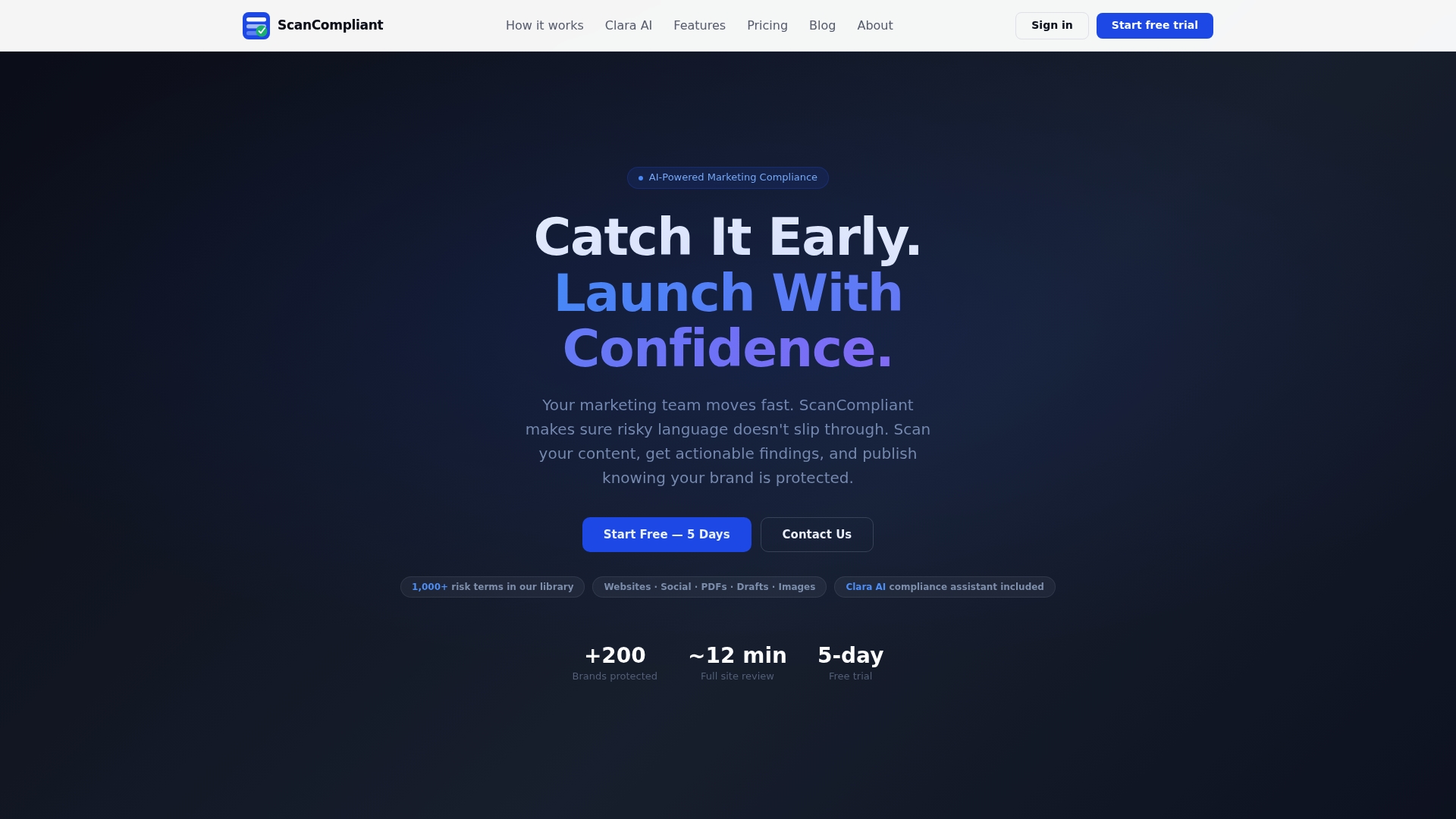
Every flagged item comes with a plain-English explanation and a suggested rewrite, so your regulatory reviewers spend their time on judgment calls instead of hunting for problems line by line. That prioritized findings list, paired with a timestamped record of what was flagged and fixed, becomes the exact kind of documented audit trail your committee needs when a piece of content gets questioned six months after it went live. Teams using Scancompliant report faster review cycles precisely because the obvious issues get caught before the material ever reaches medical, legal, or regulatory sign-off.
If you want to see how it handles your own promotional content, start with a free trial scan of a live campaign or a piece already in your review queue. For teams evaluating vendor security posture as part of procurement, Scancompliant’s security and data policy page covers what you need for that review.
Key FDA Resources for Promotional Review
Bookmark these before your next submission cycle:
- OPDP advertising and promotional labeling Q&A: the core reference for submission obligations and Form FDA 2253.
- eCTD and electronic submission guidance: required reading for packaging and format rules.
- OPDP FAQs: clarifies screening timelines and common procedural questions.
- Pre-dissemination review guidance for TV ads: details the 503B package requirements and 45-day clock.
- Drug promotion resource page: explains fair balance with real enforcement examples.
This article is general information, not a substitute for advice from a qualified lawyer. Consult a qualified legal professional about your own circumstances before acting on anything here.
Sources
- Advertising and promotional labeling: Questions and answers (FDA)
- Providing regulatory submissions in electronic and non-electronic format—promotional labeling and advertising materials for human prescription drugs (FDA)
- OPDP frequently asked questions (FDA)
- Guidance on pre-dissemination review packages for TV ads and section 503B (FDA draft guidance PDF)
- Drug promotion (FDA Drug Info Rounds)