
If your post implies a product treats, prevents, or cures a disease, it risks triggering FDA regulation and FTC enforcement simultaneously. That’s the core rule. The FDA governs what claims you can make about food, supplements, and drugs. The FTC governs how you disclose paid relationships and whether your advertising is deceptive. Both agencies can act on the same post.
Here’s what that means in practice, right now:
- Do disclose any material connection (payment, free product, affiliate link) clearly and conspicuously, before the reader has to click anything.
- Do stick to structure/function language (“supports immune health”) for supplements, not disease claims (“treats infections”).
- Don’t use words like “cures,” “prevents,” “diagnoses,” or “treats” for any food or supplement product.
- Don’t bury your #ad disclosure at the end of a caption or inside a hashtag pile.
- Don’t assume a disclaimer fixes a claim that was already made.
The Office of Prescription Drug Promotion (OPDP) enforces these rules for prescription drugs specifically, while the FTC’s Disclosures 101 for Social Media Influencers sets the disclosure floor for all paid endorsements. Both are worth reading before you publish a single sponsored post.
Key Takeaways
Content creators in the food and health sectors face simultaneous FDA and FTC exposure: FDA governs what you claim a product does, and FTC governs how you disclose that you were paid to say it.
| Point | Details |
|---|---|
| Three FDA claim categories | Health claims require pre-authorization; nutrient content claims must meet 21 C.F.R. § 101.13 thresholds; structure/function claims need substantiation and a label disclaimer. |
| Both agencies can act on one post | A single influencer post can trigger an FDA warning letter and an FTC enforcement action simultaneously. |
| Implied claims count | Visuals, imagery, and context can constitute a regulated claim even when the caption uses no disease language. |
| MLR workflow is non-negotiable | Every script, caption, overlay, and thumbnail must be reviewed and approved before posting, with records retained. |
| Scancompliant for pre-publish scanning | Scancompliant scans content against 1,000+ risk terms and suggests compliant rewrites, giving teams a documented audit trail before content goes live. |
Table of Contents
- What FDA claim restrictions mean for your content
- Who enforces what: FDA or FTC?
- Common claim mistakes creators make and why they trigger enforcement
- How to make compliant statements in short-form content
- Practical controls for brands and creators: contracts, MLR, and recordkeeping
- What enforcement looks like and what to do if content is flagged
- How to scale content review with automation and checklists
- Scancompliant catches what manual review misses
- Sources
What FDA claim restrictions mean for your content
The FDA recognizes three distinct claim categories for foods and dietary supplements, and each one carries different rules, different evidence requirements, and different consequences for getting it wrong. The Label Claims for Conventional Foods and Dietary Supplements guidance is the primary reference.
Health claims
A health claim describes a relationship between a food substance and a disease or health-related condition. These require either FDA pre-authorization or a qualified health claim petition. You cannot invent one.
- Authorized example: “Diets low in sodium may reduce the risk of high blood pressure.”
- Overstep: “This supplement lowers blood pressure.” That’s a drug claim.
Nutrient content claims
These describe the level of a nutrient in a food. Terms like “low,” “high,” “free,” and “reduced” are tightly defined under 21 C.F.R. § 101.13, which specifies the exact conditions each term requires.
- Acceptable: “Low sodium” (if the product meets the regulatory threshold).
- Overstep: “Virtually sodium-free” when the product doesn’t meet the “free” threshold.
Structure/function claims
These describe how a nutrient or ingredient affects normal body structure or function. They don’t require FDA pre-approval, but they must be truthful, substantiated, and accompanied by a specific disclaimer on the label.
- Acceptable: “Calcium builds strong bones.”
- Overstep: “Calcium prevents osteoporosis.” That crosses into a health claim and requires authorization.
| Claim Type | Pre-Approval Required? | Substantiation Standard | Example |
|---|---|---|---|
| Health claim | Yes (or qualified petition) | Significant scientific agreement | “May reduce risk of heart disease” |
| Nutrient content claim | No, but must meet CFR definitions | Must meet 21 C.F.R. § 101.13 thresholds | “Low fat,” “High fiber” |
| Structure/function claim | No | Competent and reliable scientific evidence | “Supports digestive health” |
The line between structure/function and health claim is where most content creator FDA claim restrictions violations happen. “Supports heart health” is generally acceptable. “Reduces your risk of heart attack” is not.
Who enforces what: FDA or FTC?
Both agencies can reach your content, but they come at it from different angles. Understanding which one is watching for what determines how you structure every post.
The FDA focuses on the claim itself: what the product is said to do, particularly whether the language implies a drug use (treating, curing, mitigating, or preventing disease). If a supplement brand’s influencer post says the product “fights cancer,” the FDA sees a drug claim on an unapproved drug. The FDA’s guidance on promotional labeling and interactive media makes clear that firms are responsible for content posted by agents acting on their behalf, which includes paid creators.
The FTC focuses on the relationship and the honesty of the ad: Was the sponsorship disclosed? Is the testimonial representative of typical results? Is the claim substantiated? The FTC’s Disclosures 101 guidance requires that disclosures be “clear and conspicuous,” meaning they must be placed where a viewer will actually see them, not buried in a caption or hidden behind a “more” link.
When both apply simultaneously, a single post can generate a warning letter from the FDA and an FTC enforcement action. That’s not a hypothetical.
| Post Element | Likely Regulator | Compliance Trigger |
|---|---|---|
| “Treats anxiety” (supplement) | FDA | Disease/drug claim on unapproved product |
| “Clinically proven to reduce fat” | FDA + FTC | Unsubstantiated efficacy claim + deceptive ad |
| Paid post with no #ad disclosure | FTC | Material connection not disclosed |
| Patient testimonial implying cure | FDA + FTC | Implied disease claim + unrepresentative testimonial |
| “Low calorie” on a product that doesn’t qualify | FDA | Nutrient content claim violation (21 C.F.R. § 101.13) |
| Before/after weight loss photo | FDA + FTC | Implied drug/disease claim + substantiation requirement |
For prescription drugs specifically, OPDP has issued warning letters to brands whose influencer partners posted content that omitted required risk information or made unbalanced efficacy claims. The brand, not just the creator, received those letters.
Regulatory experts note that fair-balance interpretation is case-by-case, and that even nonverbal content, including imagery and music, can be read as an implied health claim. See the industry analysis from MM+M for specific examples of how FDA reviewers evaluate visual context.
Common claim mistakes creators make and why they trigger enforcement
Most enforcement risk doesn’t come from creators who are trying to deceive anyone. It comes from language that sounds natural in conversation but reads as a regulated claim on a label or in a sponsored post.
High-risk phrases to avoid:
- “This product cured my chronic pain.” (Disease claim, implied drug use)
- “Clinically proven to boost metabolism.” (Substantiation claim requiring competent scientific evidence)
- “Doctors recommend this for inflammation.” (Implied therapeutic indication)
- “I stopped taking my medication after starting this.” (Implies treatment of a condition)
- “Works faster than prescription options.” (Comparative drug claim)
- “Helps your body fight cancer cells.” (Disease claim, full stop)
Implied claims from visuals are just as risky. A before/after photo showing dramatic weight loss next to a supplement bottle implies a therapeutic effect even if the caption says nothing. An influencer shown in a hospital gown holding a product implies medical endorsement. Regulatory experts confirm that FDA reviewers evaluate the totality of the communication, meaning the image, the audio, the caption, and the overlay text together.
For a deeper look at how these patterns show up in real DTC content, the misleading health claims guide for DTC brands breaks down the most common violations with specific language examples.
Pro Tip: Before posting, read your caption aloud and ask: “Would a reasonable person think this product treats a medical condition?” If the answer is “maybe,” rewrite it. The FDA asks the same question.
Third-party certifications and seals (like “NSF Certified” or “USP Verified”) can add credibility, but they don’t authorize disease claims. A product being certified for purity doesn’t mean you can claim it treats anything.
How to make compliant statements in short-form content
Short-form content creates a specific problem: you have limited space to make a claim and include the risk information or disclaimers that claim requires. The FDA’s character-space guidance addresses this directly. If the format can’t carry fair balance, the benefit claim shouldn’t run in that format.
What must appear in every sponsored post
- A clear, upfront disclosure of the material connection (“Ad,” “#Sponsored,” or “Paid partnership with [Brand]” in the first line of the caption or spoken aloud within the first few seconds of video).
- No disease or drug claims for food or supplement products.
- Any structure/function claim must be truthful and substantiated.
- For prescription drug promotions, risk information must accompany benefit claims in the same communication, with a link to the full prescribing information.
Substantiation: what evidence each claim type requires
- “Supports immune health” (structure/function): Competent and reliable scientific evidence, which typically means well-designed studies. Anecdotes don’t qualify.
- “Clinically shown to…”: Requires at least one well-controlled clinical study directly supporting the specific claim. “Clinically shown” is not a synonym for “we have some data.”
- “May reduce the risk of…” (qualified health claim): Requires FDA authorization or a qualified health claim petition with supporting scientific evidence.
- “Low in saturated fat” (nutrient content): Must meet the specific thresholds in 21 C.F.R. § 101.13.
Do and don’t for short-form posts
Do:
- Place disclosures before the “more” cutoff in captions.
- Use plain language: “Ad” or “Sponsored” outperforms “#sp” buried in hashtags.
- Link to full product labeling or prescribing information when required.
- Review the compliant content release guide for platform-specific guidance.
Don’t:
- Run a benefit claim in a 15-second story if you can’t include meaningful risk information.
- Use superlatives (“the most effective,” “the only product that”) without substantiation.
- Assume a disclaimer at the end of a video negates a disease claim made at the beginning.
- Treat a creator’s personal testimonial as exempt from these rules because it’s “just their opinion.”
Pro Tip: For prescription drug content, the FDA’s interactive media guidance recommends including a direct link to the full prescribing information in every promotional post. Make that link part of your standard caption template.
Practical controls for brands and creators: contracts, MLR, and recordkeeping
The operational reality is that most enforcement risk is preventable with the right contracts and workflow. A creator who ad-libs a disease claim because no one told them not to is still the brand’s problem.
Pre-engagement vetting checklist
Before signing any creator, review:
- Past posts for disease claims, unsubstantiated efficacy language, or undisclosed sponsorships.
- Audience demographics (are they reaching the intended population?).
- Platform history for prior FTC or platform-level enforcement.
- Whether the creator has worked with competing products and what they said.
Ongoing monitoring matters just as much. Brands can be responsible for influencer posts even when no formal payment exists; sending free product creates a material connection and potential liability. Monitor gifted advocates on the same cadence as paid ones.
Contract clauses that reduce risk
- Pre-approval requirement: All scripts, captions, overlays, and thumbnails must be approved by the brand’s MLR team before posting.
- No ad-libbing clause: The creator may not deviate from approved language, add claims, or modify disclosures.
- Disclosure specification: The exact disclosure language and placement are written into the contract, not left to the creator’s judgment.
- Takedown obligation: The creator must remove non-compliant content within a specified timeframe (typically 24 hours of notice).
- Indemnity clause: The creator indemnifies the brand for claims arising from unauthorized statements.
- Record retention: The creator agrees to retain all approved scripts, communications, and posting records for a defined period.
The MLR workflow
The content pipeline should follow this sequence:
- Script/brief development (brand or agency)
- MLR review (medical, legal, regulatory sign-off on all claims and disclosures)
- Creator production (using only approved language)
- Final cut review (confirm no unauthorized claims were added)
- Pre-publish approval (documented sign-off before posting)
- Post-publish monitoring (check for edits, comments, or platform modifications)
- Archive (retain approved version and posting record)
The regulatory review checklist for healthcare marketing provides a template for each stage of this workflow.
Pro Tip: Build a cleared-claims library: a living document of pre-approved phrases for each product. Creators pick from that list rather than writing from scratch. It cuts MLR review time and eliminates most ad-lib risk.
What enforcement looks like and what to do if content is flagged
FDA warning letters and FTC enforcement actions are public. They name brands, describe the violation, and set a response deadline. For prescription drug promotions, OPDP publishes its warning letters online, which means a violation becomes a public record.
Typical enforcement pathways
- FDA warning letter: Describes the violative claim, cites the applicable regulation, and requires a written response within 15 business days. The brand must describe corrective actions taken or planned.
- OPDP notice: Specific to prescription drug promotion; may require immediate takedown and corrective messaging.
- FTC civil investigative demand or complaint: Can result in consent orders, civil penalties, and mandatory compliance programs. Repeat violations carry higher penalties.
Remediation checklist
If content is flagged or you receive an inquiry:
- Immediately take down the content across all platforms where it appeared.
- Preserve records: Save the original post, all versions, approval documents, and communications. Do not delete anything.
- Notify legal and regulatory counsel before responding to any agency inquiry.
- Draft a written response that acknowledges the issue, describes corrective actions, and commits to a timeline.
- Issue corrective messaging if required by the agency (this may include a follow-up post clarifying that the original claim was not accurate).
- Audit related content for the same creator and similar claims across your portfolio.
- Update contracts and SOPs to prevent recurrence.
For a detailed breakdown of liability exposure, the health content liability guide for telehealth and DTC brands covers both FDA and FTC exposure in practical terms.
FDA investigations can take months. FTC consent order negotiations can take longer. The 15-business-day response window for warning letters is firm, and missing it compounds the problem.
How to scale content review with automation and checklists
Manual MLR review works for low-volume campaigns. At scale, with dozens of creators posting across multiple platforms, it breaks down. Automated scanning fills the gap between “we reviewed everything” and “we actually reviewed everything.”
Where automated scanning fits in the pipeline
- Pre-draft: A cleared-claims library and risk-term blocklist embedded in the brief template.
- Pre-approval: Automated scan of the script and caption before MLR review, flagging high-risk terms so reviewers focus on judgment calls rather than obvious violations.
- Post-publish monitoring: Continuous scanning of live posts for edits, new claims, or comment-section statements that could create liability.
Benefits of automated scanning
- Flags explicit and implied risk terms faster than a manual read.
- Creates a documented audit trail showing what was reviewed, when, and what was found.
- Applies consistent risk vocabulary across reviewers and campaigns.
- Reduces the volume of items that need full legal review by surfacing clear violations early.
| Scancompliant capability | What it does for your team |
|---|---|
| 1,000+ risk terms in database | Catches explicit and subtle claim language human reviewers often miss |
| 200+ brands protected | Proven at scale across telehealth, supplements, and DTC health categories |
| Plain-English risk explanations | Reviewers understand why a term is flagged, not just that it is |
| Compliant rewrite suggestions | Speeds revision cycles without requiring a legal rewrite from scratch |
Automation doesn’t replace MLR judgment. It handles the volume so your reviewers can focus on the cases that genuinely require interpretation. For guidance on embedding these checks into your existing workflow, the compliance pipeline integration guide walks through the specific insertion points.

Pro Tip: Run automated scans on post-publish content at least weekly. Creators sometimes edit captions after approval, and those edits are not covered by the original MLR sign-off.
A compliance practitioner’s perspective
The most common mistake I see in creator campaigns isn’t reckless disregard for the rules. It’s a gap between what the brand’s legal team approved and what actually went live. A creator improvises one line in a video. A caption gets edited after posting. An overlay gets added in a platform’s native editor after the MLR-approved version was submitted. Each of those is a new piece of promotional copy that was never reviewed.
Here’s what actually prevents escalation: treat every element of a creator’s output as promotional copy. The script, the caption, the on-screen text, the thumbnail, the pinned comment. If it’s visible to the audience and it mentions the product, it needs to go through the same review gate as a TV spot.
Pro Tip: Place disclosures “above the fold” in captions and within the first three seconds of video. A disclosure that requires the viewer to click “more” or watch past the main message doesn’t meet the FTC’s “clear and conspicuous” standard.
Pro Tip: When a creator is promoting a prescription product, require the risk information to be read aloud in the video, not just linked in the caption. The FDA’s interactive media guidance treats audio and visual as part of the same communication.
One campaign I reviewed had a creator who added the phrase “my doctor switched me to this” in a live Q&A comment response, three weeks after the original post was approved. That single comment, because the brand had sent the product and was monitoring the account, created a material connection and an implied therapeutic claim. The fix was simple: a contract clause requiring the creator to notify the brand before responding to any product-related questions in comments, and a 48-hour review window for those responses. The clause added two sentences to the contract and eliminated the risk.
Scancompliant catches what manual review misses
Catching a risky claim before it goes live is worth more than any remediation plan after the fact. Scancompliant is built specifically for regulatory and marketing teams at telehealth companies, supplement brands, and DTC health businesses who need to move fast without creating enforcement exposure.
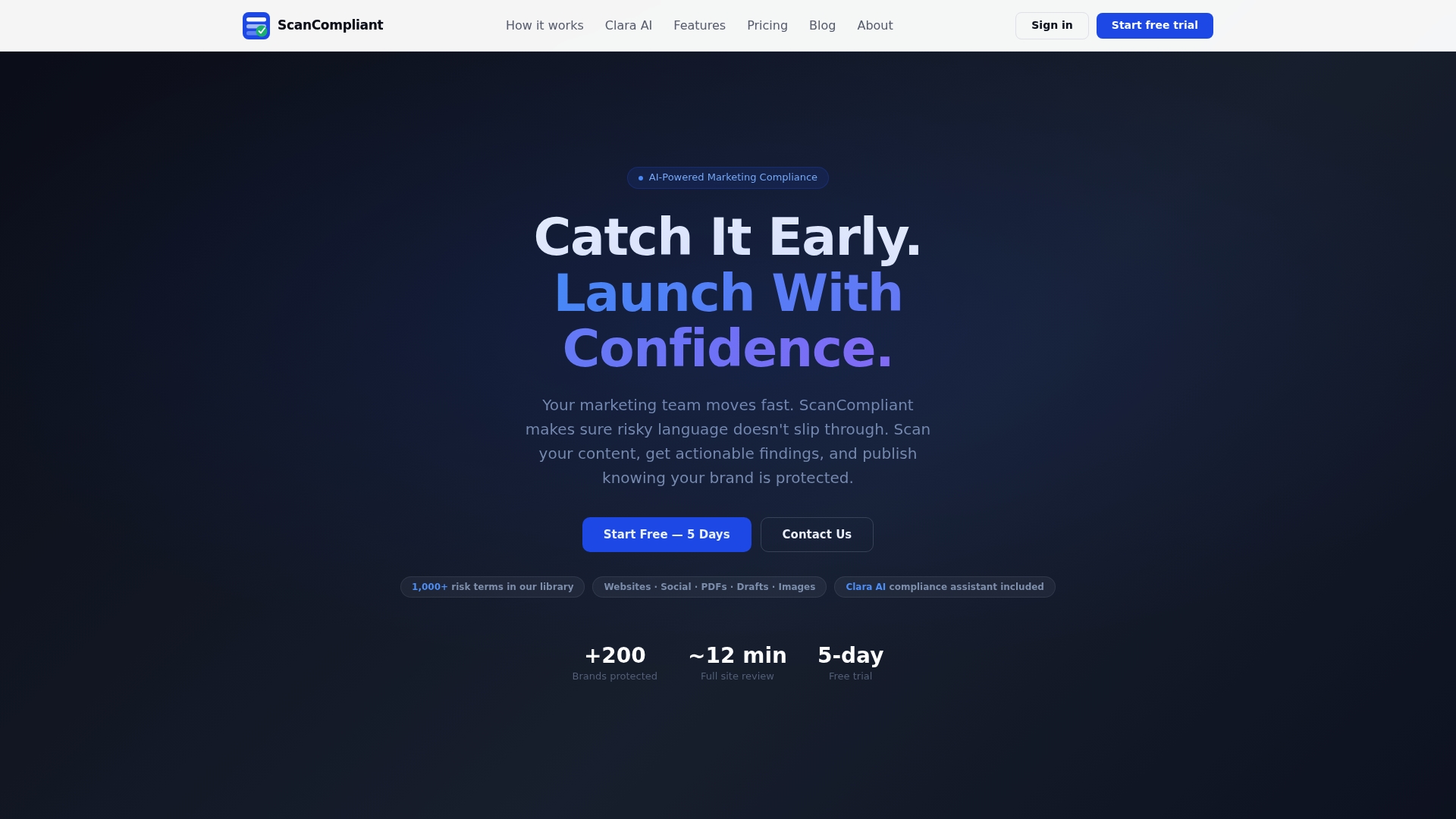
The platform scans websites, social media content, documents, and product listings against a database of more than 1,000 risk terms, flags explicit and implied claims, and delivers plain-English explanations so your team understands the risk, not just the flag. It also suggests compliant rewrites, which cuts revision cycles significantly. With more than 200 brands already protected, Scancompliant has a documented track record across the exact categories where FDA and FTC enforcement is most active.
For teams managing GLP-1 or other high-scrutiny product categories, the GLP-1 compliance scanner is purpose-built for that enforcement environment.
Start a free trial at Scancompliant and run your first scan before your next creator post goes live.
Sources
These are the primary references every creator and compliance team should have bookmarked. For case-specific questions, contact qualified legal counsel or your MLR team.
- Disclosures 101 for Social Media Influencers (FTC)
- Office of Prescription Drug Promotion (OPDP)
- What regulatory experts want pharma marketers to know about influencers
- 21 C.F.R. § 101.13 – Nutrient content claims
For training your team on these rules, the healthcare marketing compliance training guide covers how to build and maintain creator compliance programs as FDA and FTC guidance continues to evolve.
This article provides general information about FDA and FTC regulations and is not a substitute for legal or regulatory advice. Consult qualified legal counsel or your MLR team for guidance specific to your products and campaigns.
Recommended
- Why Health Writing Carries Legal Risk for DTC Brands – scancompliant.com
- Misleading Health Claims: A Compliance Guide for DTC Brands – scancompliant.com
- The 7 Most Common FDA Warning Letter Triggers in Supplement Marketing — ScanCompliant Blog
- GLP-1 Marketing Compliance in 2026: What the FDA Warning Letter Wave Means for Your Brand — ScanCompliant