
Yes. Comparative claims advertising is legal in the United States when it is truthful, clear, and not deceptive, which is the exact standard the Federal Trade Commission applies to any other advertising claim. The catch isn’t the comparison itself. It’s whether you can prove it.
- Substantiate every objective claim (price, performance, safety) before the ad runs, and keep the documentation.
- Know your two enforcement lanes: FTC action for deceptive practices, and Lanham Act suits from competitors who think you crossed a line.
Key Takeaways
Comparative claims advertising is legal in the U.S. only when the underlying claim is truthful, substantiated before publication, and documented well enough to survive an FTC inquiry or a competitor’s Lanham Act suit.
| Point | Details |
|---|---|
| FTC standard governs | Comparative ads face the same deception test as any other ad under 16 CFR 14.15, not a higher bar. |
| Evidence must predate the ad | Price, performance, and survey claims all need contemporaneous documentation, not after-the-fact justification. |
| “Best” and “#1” carry the most risk | These claims imply category-wide superiority and demand the broadest evidentiary support. |
| Disclosures narrow, they don’t rescue | A misleading headline claim isn’t fixed by a footnote; the claim itself needs narrowing. |
| Scancompliant shortens the review cycle | Its risk-term database and audit trail flag risky comparative language and document substantiation before publish. |
Where to Verify the Legal Text Yourself
- FTC Statement of Policy on Comparative Advertising
- 16 CFR 14.15 (eCFR)
- SMU law review repository on comparative advertising law
- FTC advertising and marketing guidance
This article is general information, not a substitute for advice from a qualified lawyer. Consult a qualified legal professional about your own circumstances before acting on anything here.
Table of Contents
- What Federal and State Laws Govern Comparative Advertising Claims?
- What Evidence Do You Need Before Running a Comparative Claim?
- What Comparative Claims Carry the Highest Legal Risk?
- How Do You Build a Pre-Publish Compliance Workflow?
- What Happens If a Comparative Claim Gets Challenged?
- How Scancompliant Reduces Comparative Claims Risk
- How Do Foreign Competitors Change U.S. Comparative Advertising Risk?
- Do You Need Disclaimers on Comparative Claims?
- Sources
What Federal and State Laws Govern Comparative Advertising Claims?
Three legal layers matter here, and they don’t always move in sync. The FTC sets the floor, the Lanham Act gives competitors a sword, and state law adds a second (sometimes sharper) blade.
The FTC’s Statement of Policy Regarding Comparative Advertising, codified at 16 CFR 14.15, has stood since 1979: the agency actively encourages naming competitors because it helps consumers make informed choices, and it evaluates comparative ads under the same deception test as any other ad. That test asks one question: does the claim have the capacity to mislead a reasonable consumer? The policy also pushes back on ad-industry self-regulatory bodies that try to impose a higher substantiation bar on comparative claims than on ordinary ones, a point worth knowing if outside counsel or a network’s standards department tells you comparisons need “extra” proof.
The Lanham Act, 15 U.S.C. § 1125(a), is where most real fights happen. It lets a competitor sue you directly for false or misleading advertising, without waiting on a federal agency to act. Typical disputes center on:
- Unverified “better” or “faster” performance claims made without matching test conditions.
- Price comparisons that omit the time frame or product configuration behind the number.
- Survey-based preference claims built on flawed sampling or leading questions.
State unfair and deceptive acts and practices (UDAP) statutes run alongside federal law and often let state attorneys general or private plaintiffs pursue claims that never reach the FTC’s desk, sometimes with different remedies or lower burdens of proof.
What Evidence Do You Need Before Running a Comparative Claim?
The rule of thumb: your proof has to exist before the ad runs, not after someone challenges it. The FTC and Lanham Act plaintiffs both look for contemporaneous evidence, meaning documentation created at or near the time you made the claim, not reconstructed later.
- Price claims need time-stamped records: the exact dates compared, the specific SKUs or configurations, and the geography the price applied to.
- Performance claims need lab or field test data using accepted methodology, ideally matching the conditions a typical consumer would experience.
- “Better” or preference claims (“most people prefer us”) need a properly designed consumer survey, with defensible sampling, neutral question wording, and appropriate controls, following standards like those in Advertising Standards Canada’s comparative advertising guidelines, which map closely onto what US courts expect from survey evidence.
- Safety claims need testing that meets the standard a regulator or judge would expect for that specific product category.
Retention matters as much as creation. Keep raw data, methodology notes, test dates, sign-off records, and the exact creative crop used for each version of the ad, since platform truncation often strips qualifiers that mattered at approval time.
Pro Tip: Assign one named person, not a department, to own the evidence file for every comparative campaign. “Legal reviewed it” isn’t a defense two years later; a dated file with their signature is.
What Comparative Claims Carry the Highest Legal Risk?
Some claim types generate a disproportionate share of Lanham Act suits and FTC inquiries. Here’s where the exposure concentrates, and how to defuse it in the copy itself.
- Bare price comparisons (“40% cheaper than [Competitor]”) without a date or product match. Fix: add the qualifier directly in the claim, like “as of March 2026, based on the standard 30-day plan.”
- Unqualified performance superiority (“outperforms every competitor”) when your data covers one metric under one condition. Fix: narrow the claim to what you tested, such as “loads pages 22% faster in our lab benchmark on standard broadband.”
- “Best” and “#1” claims, which courts and the FTC treat as carrying the heaviest evidentiary burden because they imply comprehensive superiority across an entire category, not just the one dimension you actually measured.
- Health and safety comparisons, where FDA rules layer on top of ad law. A claim like “clinically proven safer than [Competitor]” for a supplement or telehealth product needs sign-off from regulatory or medical affairs before marketing runs with it, not after.
The FTC’s advertising guidance is blunt about one thing here: a disclaimer cannot rescue a claim that is misleading on its face. If the headline overreaches, a footnote in six-point type will not fix it in litigation or in an FTC inquiry.
How Do You Build a Pre-Publish Compliance Workflow?
Most comparative-claims disputes trace back to a rushed process, not bad intent. A workable pre-publish sequence looks like this:
- Draft the claim and flag the specific comparison being made (price, performance, preference, safety).
- Identify the evidence type required and confirm it already exists or can be generated before the launch date.
- Route the claim and its evidence packet to legal or compliance for review.
- Confirm disclosures are clear, adjacent to the claim, and not dependent on a click-through or hover state.
- Get documented sign-off from a named reviewer, not a team inbox.
- Publish, then archive the full packet, including every creative variant and platform crop.
Before anything goes live, check for:
- Matching methodology behind the claim and the claim’s actual wording.
- Disclosures that survive social media cropping and app-store character limits.
- Platform-specific ad policy conflicts (many networks restrict named-competitor claims beyond what the law requires).
Build in at least a few business days between evidence completion and publish date. Rushed comparative claims are the ones that get challenged first, because competitors monitor each other’s campaigns closely.
Pro Tip: If a competitor sends a demand letter after launch, pull the ad down or revise it immediately while your evidence packet is reviewed. Fast voluntary correction is often the single biggest factor in whether a dispute settles quietly or escalates to a lawsuit.
Scancompliant’s regulatory review checklist walks through a version of this exact sequence for healthcare marketing teams specifically.
What Happens If a Comparative Claim Gets Challenged?
Two very different processes can start once a claim draws scrutiny, and they carry different stakes.
FTC investigations typically begin with an inquiry letter, move to a consent order in most resolved cases, and can include injunctive requirements to change or discontinue the claim. Civil penalties are possible but less common than negotiated compliance terms.
Private Lanham Act suits move faster and hit harder financially. A competitor plaintiff has to show the claim was false or misleading and that it caused (or is likely to cause) consumer confusion or competitive injury. Remedies include:
- Preliminary or permanent injunctions halting the ad.
- Monetary damages, sometimes including the defendant’s profits.
- Corrective advertising, ordered in some cases to undo consumer confusion already created.
State attorneys general can pursue UDAP claims independently, and a pattern of deceptive comparative claims across a large customer base can trigger class-action exposure. Settling early, before discovery costs pile up, is usually the more economical outcome once a claim’s weaknesses become apparent.
How Scancompliant Reduces Comparative Claims Risk
Manual review catches obvious problems. It misses the subtle ones, like an implied superiority claim buried in an image caption or a price comparison missing its date qualifier three edits later.
Scancompliant scans marketing copy against a database of more than 1,000 risk terms and has already protected more than 200 brands from exactly this kind of exposure. For comparative claims specifically, that means:
- Flagging unqualified superiority language before it reaches legal review.
- Surfacing price and performance claims missing their required qualifiers.
- Attaching evidence notes directly to flagged claims, so reviewers see the gap immediately.
- Creating a timestamped audit trail that documents exactly what was reviewed and when.
Running a scan at the draft stage, before the workflow’s legal review step, catches most of the errors that otherwise surface only after a competitor complains. Scancompliant’s guide on automating compliance review covers how that integration typically works.
How Do Foreign Competitors Change U.S. Comparative Advertising Risk?
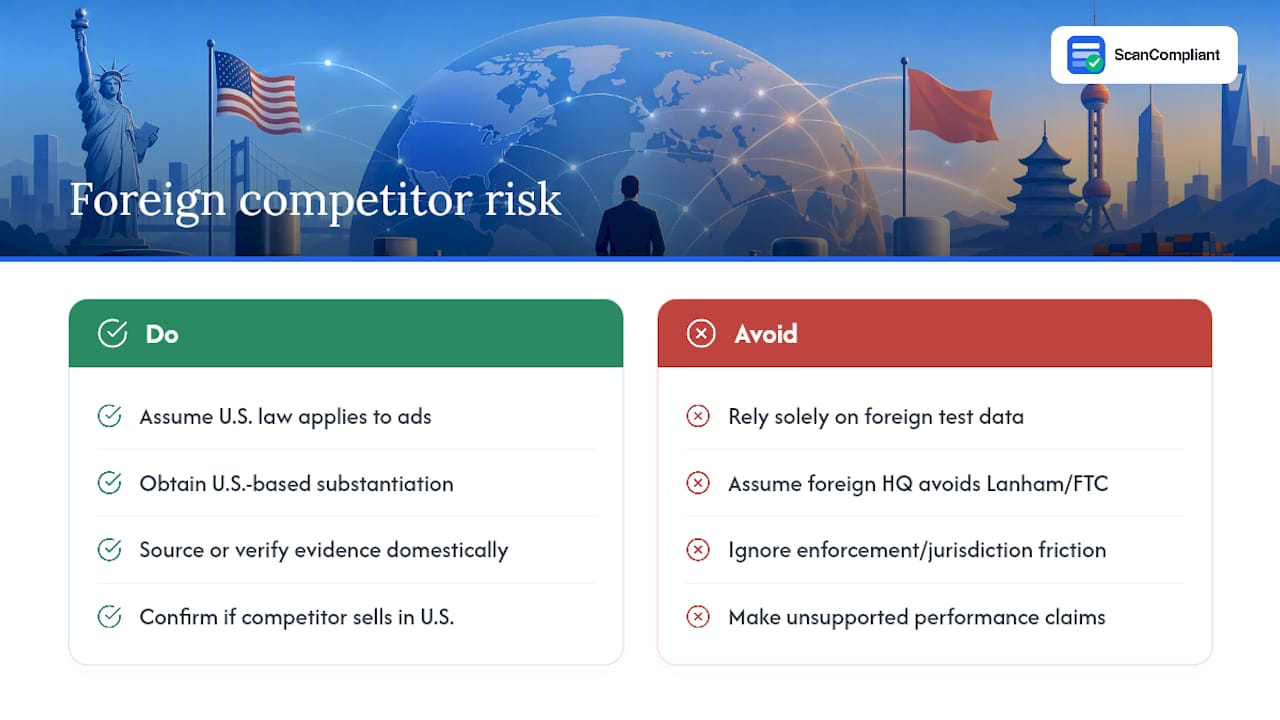
Comparing your product to a foreign competitor’s inside the U.S. market doesn’t change the underlying legal test. The FTC and Lanham Act both apply based on where the ad runs and who sees it, not where the competitor is headquartered. If your ad reaches U.S. consumers, U.S. advertising law governs it regardless of whether the company you’re naming operates out of Seoul, Toronto, or Berlin.
The practical complications show up elsewhere. Foreign competitors often price, package, and test their products under different regulatory regimes, which makes head-to-head comparisons harder to substantiate cleanly. A performance claim against a European competitor’s product tested under EU standards may not hold up if a U.S. court expects domestic testing conditions or FDA-aligned methodology for a health product.
Jurisdiction over the foreign competitor itself can also get complicated if they choose to sue back or if you want to enforce a judgment against them. U.S. courts generally have jurisdiction over the advertising conduct (since it happened here), but collecting damages from or serving process on a company with no U.S. presence adds real friction.
The safer approach: treat any comparison involving a foreign competitor’s product as needing its own independent U.S.-based substantiation, sourced or verified domestically, rather than relying on foreign test data or foreign regulatory approvals as your evidentiary basis. If the foreign competitor also imports and sells into the U.S. market, remember they retain the same Lanham Act standing to sue you that a domestic competitor would.
Do You Need Disclaimers on Comparative Claims?
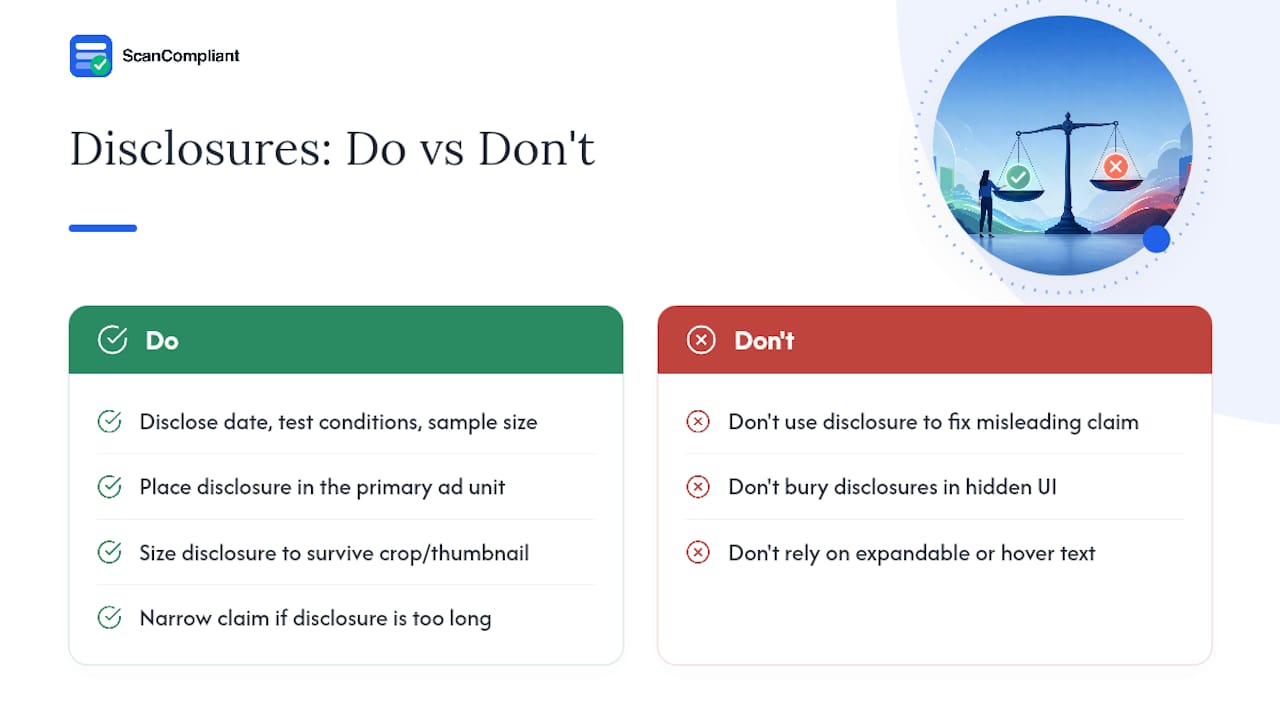
Disclosures support a comparative claim; they cannot fix one that misleads on its face. That distinction trips up more legal reviews than almost anything else in this space, because marketing teams sometimes treat a footnote as a substitute for narrowing the actual claim.
A disclosure works when it clarifies scope the headline claim couldn’t fit: the specific date range for a price comparison, the test conditions behind a performance number, or the sample size behind a survey-based preference claim. It fails when it tries to walk back something the main claim already implied, like a bold “#1 in customer satisfaction” headline followed by a tiny disclosure limiting that ranking to one narrow subcategory the average reader would never guess from the headline.
Placement and durability matter as much as wording. A disclosure buried in a linked terms page, absent from the actual ad unit, doesn’t count for the FTC’s purposes, and it certainly doesn’t count once a competitor’s attorney pulls up the ad as it actually displayed on a phone screen. Digital formats make this worse: a disclosure that lives in expandable text, hover states, or a “learn more” link a user never clicks is treated as if it doesn’t exist for deception analysis.
Build disclosures into the primary ad unit itself wherever possible, sized and positioned so they survive whatever platform crop or thumbnail version the ad ends up running as. If a claim needs a disclosure that long, that’s often a signal the underlying claim needs to be narrowed instead. Scancompliant’s guide on misleading health claims covers this exact disclosure-versus-claim-narrowing tension for regulated health products.
A Practical Note From the Compliant Team
The friction is almost never legal ambiguity. It’s speed versus proof. Marketing wants the claim live Monday; legal wants the survey data first. Pre-approved claim templates and mandatory evidence attachments resolve that faster than another round of review meetings.
— Compliant Team
Cut Your Comparative Claims Review Time Without Cutting Corners
Every workflow step above, drafting, evidence collection, legal review, sign-off, retention, takes real hours when it’s done manually across spreadsheets and email threads. Scancompliant compresses that into a single pass: scan the copy against its risk-term database, see flagged comparative language with plain-English explanations, attach your substantiation evidence directly to the flagged claim, and keep a timestamped audit trail without building one by hand.
That audit trail is exactly what you want on file if a competitor sends a demand letter six months after launch. Instead of reconstructing who approved what and when, you pull the record. Start a trial and run your next comparative campaign through Scancompliant before it goes live, or check the pricing page to see which plan fits a team your size.
Sources
- Statement of Policy Regarding Comparative Advertising | Federal Trade Commission
- eCFR / 16 CFR 14.15 (policy text)
- The Law of Comparative Advertising in the United States and around the World: A Practical Guide for U.S. Lawyers and Their Clients (SMU repository)
- FTC — Advertising and Marketing guidance for businesses
Recommended
- Corrective Advertising Requirement: What Legal Teams Need – scancompliant.com
- Misleading Health Claims: A Compliance Guide for DTC Brands – scancompliant.com
- Health Content Liability for Telehealth and DTC Brands – scancompliant.com
- How Content Creators Face FTC Rules: Pre-Publish Playbook – scancompliant.com