
Before any health-related content goes live, your team must map every express and implied claim, hold competent and reliable scientific evidence for each one, and document that evidence before dissemination. That obligation flows directly from the FTC Health Products Compliance Guidance and is exactly what the NextMed enforcement action exposed when those steps were skipped.
Start here:
- Claim inventory. List every objective health claim in the asset, including those created by imagery, layout, or comparison phrasing.
- Competent evidence. Attach the study or data file that supports each claim before the asset is approved.
- Disclosures. Confirm material connections, pricing terms, and membership conditions are clear and conspicuous.
- Recordkeeping. Timestamp sign-offs, retain evidence files, and store influencer contracts so every decision is auditable.
An auditable pre-dissemination record is your single strongest defense if a regulator opens an inquiry.
Key Takeaways
Pre-publication evidence mapping, clear disclosures, and an auditable sign-off trail are the three non-negotiable requirements for FTC-compliant health marketing at telehealth and DTC brands.
| Point | Details |
|---|---|
| Map claims before publishing | Build a claim registry entry for every express and implied claim before any asset goes live. |
| Match evidence to the claim strength | RCTs are expected for objective treatment claims; observational data requires explicit qualifiers in copy. |
| Disclose in the same modality | Visual claims need visual disclosures; audio claims need audible ones; interactive media disclosures must be unavoidable. |
| Negative Option compliance | Disclose recurring charges, obtain affirmative consent, and provide an easy cancellation path before enrollment is complete. |
| Scancompliant for audit-ready workflows | Scancompliant scans copy for implied claims, links evidence, and timestamps sign-offs to create a defensible pre-publication record. |
Table of Contents
- How content creators face FTC rules: the legal framework
- What counts as adequate substantiation for health claims
- How to inventory express and implied claims across channels
- What the FTC requires for endorsements and testimonials
- Pricing transparency, membership bundles, and the Negative Option Rule
- Pre-publish compliance workflow: roles, checklist, and tooling
- NextMed enforcement: what went wrong and what to fix
- Sample compliant claim language and disclosure templates
- Regulatory risks, likely remedies, and FDA coordination
- The compliance mindset that actually prevents enforcement
- Scancompliant cuts the time between draft and defensible
- Sources
How content creators face FTC rules: the legal framework
The FTC enforces truthful, non-deceptive advertising under Section 5 of the FTC Act and expects substantiation to exist before an ad is published. The FDA, by contrast, holds primary responsibility for product labeling. In practice, the same asset can trigger both agencies: the FDA reviews the label; the FTC can act on the ad copy. The Health Products Compliance Guidance explains this coordination and makes clear that FTC jurisdiction can still reach labeling claims where deception exists.
A claim is “deceptive” when it is likely to mislead a reasonable consumer and the misleading element is material, meaning it affects purchasing decisions. That standard applies across every channel your team touches:
- Website copy and landing pages: hero headlines, benefit bullets, and comparison tables.
- Social media: captions, Stories, Reels, and pinned comments.
- Paid ads: search headlines, display banners, and video pre-rolls.
- Packaging and inserts: any printed claim that mirrors or extends ad language.
- Membership and checkout pages: pricing language, auto-renewal terms, and cancellation copy.
For prescription products, 21 CFR § 202.1 adds a “fair balance” requirement: risks must appear with comparable prominence to efficacy claims, and broadcast formats must include a major statement. That layer sits on top of FTC’s general deception standard, not instead of it.
What counts as adequate substantiation for health claims
The FTC’s standard is “competent and reliable scientific evidence” calibrated to the strength of the claim. For objective treatment or outcome claims, the FTC’s 2022 blog post on the updated Guidance confirms that randomized controlled trials are often expected. Observational data may support a more qualified claim, but only when the qualification is visible in the copy.
When reviewing a study for claim support, check every one of these:
- Randomization and a control group.
- Sample size adequate for the endpoint.
- Statistical significance and clinical meaningfulness (a statistically significant effect that is too small to matter to a patient does not support a strong claim).
- Peer review and publication in a relevant journal.
- Population and product relevance: the study subjects and formulation must match what you are selling.
Pro Tip: Watch for p-hacking signals: multiple endpoints tested with only the favorable one reported, subgroup analyses run post-hoc without pre-registration, or p-values clustered just below 0.05. A single study with these features is not “competent and reliable” evidence for a strong claim.
How to inventory express and implied claims across channels
Every published asset needs a claim registry entry. The FTC expects teams to assess both what a claim says explicitly and what a reasonable consumer would take away from the combination of copy, imagery, and layout.
A claim registry entry should capture:
- Asset ID and publication channel.
- Express claim text verbatim.
- Implied consumer takeaway (write it out as a plain sentence: “A consumer would understand this to mean…”).
- Evidence references with document links or file names.
- Reviewer sign-off with name, role, and timestamp.
- Publish date and version number.
Consider a before-and-after weight-loss image paired with the headline “Real results in 30 days.” The express claim is the headline. The implied claim is that the pictured result is typical and achievable in 30 days. Both require substantiation. If the result is atypical, a clear and conspicuous disclaimer is required, and the disclaimer must be as prominent as the image itself.
Claim triggers to audit in every asset: headlines, subheads, captions, before/after imagery, price language, badges (“clinically proven,” “doctor-recommended”), comparison phrasing, and any reviewer quote used in promotional context.
What the FTC requires for endorsements and testimonials
Endorsements must reflect the endorser’s actual experience, and any material connection between the endorser and the brand must be disclosed clearly and conspicuously. The FTC’s endorsement resources cover the 2023 updates, which extended these obligations explicitly to social media and influencer content.
Deceptive practices the FTC targets: fabricated testimonials, paid actors presented as real patients, cherry-picked reviews that suppress negative feedback, and undisclosed compensation.
Operational controls your team needs:
- Influencer contracts that require disclosure language, specify placement (not buried in hashtags), and prohibit claims the brand cannot substantiate.
- Attestation records confirming each endorser’s experience is genuine and that they actually used the product.
- Monitoring logs showing periodic checks that disclosures remain visible and compliant after posting.
- Retention policy covering contracts, payment records, and screenshots of live posts.
Pro Tip: For social posts, “Ad” or “#ad” at the start of the caption satisfies the conspicuousness test far better than a disclosure buried after several lines of copy or hidden among a string of hashtags.
Pricing transparency, membership bundles, and the Negative Option Rule
Price claims must reflect the full consumer cost when omitted elements are material. Membership auto-renewal practices must comply with the FTC’s Negative Option Rule: consumers must give informed, affirmative consent before being charged a recurring fee, and cancellation must be as easy as sign-up. FTC enforcement patterns show increasing scrutiny of bundled membership models, hidden fees, and cancellation friction in telehealth marketing.
Negative-option compliance checklist:
- Disclose the recurring charge amount, frequency, and next billing date before the consumer completes enrollment.
- Obtain a separate, affirmative consent action (a pre-checked box does not qualify).
- Provide a simple, immediate cancellation mechanism.
- Send a confirmation of cancellation with a reference number.
- Retain consent records and cancellation logs.
“From $X/month” language that omits mandatory fees or conditions a lower price on a multi-month commitment is a common trigger. If the $X price requires a 12-month prepayment, that condition must appear adjacent to the price claim, not in a footnote.
Pre-publish compliance workflow: roles, checklist, and tooling
Institute a pre-publication gating workflow that pairs claim-level evidence mapping with formal sign-off and retains an immutable audit trail. No asset should publish without a completed claim registry entry and documented approval. Integrating compliance checks into your content pipeline from the draft stage is far less costly than remediating a live campaign.
Role matrix:
- Content owner drafts copy and flags every objective claim for review.
- Regulatory reviewer maps each claim to evidence, confirms substantiation meets the FTC standard, and records findings.
- Medical reviewer (for prescription or clinical claims) confirms accuracy and fair balance per 21 CFR § 202.1.
- Legal sign-off reviews for deception risk, disclosure adequacy, and pricing compliance.
- Publishing owner confirms all sign-offs are complete before scheduling.
Pre-publish checklist:
- Claim registry entry completed for every objective claim.
- Evidence files attached and dated.
- Disclosure copy drafted and placement confirmed (visual and audible parity where required).
- Influencer contract reviewed and attestation on file.
- Pricing and membership terms reviewed against Negative Option requirements.
- FDA Form FDA-2253 submitted for applicable prescription drug promotional materials within required windows.
- Final sign-off metadata recorded with timestamps.
Pro Tip: Align your content release calendar with your FDA submission calendar. For prescription drug DTC materials, Form FDA-2253 submission windows are regulatory deadlines, not editorial suggestions.
Compliance software should provide automated claim scanning, risk-term highlighting with plain-English explanations, evidence-linking fields, versioned audit trails, and a full feature set that supports multi-reviewer workflows.
NextMed enforcement: what went wrong and what to fix
The FTC’s complaint against NextMed illustrates three failure modes that appear repeatedly in telehealth DTC enforcement: unsubstantiated outcome claims, manipulated testimonials, and deceptive pricing and membership terms.
The central allegations: NextMed advertised average weight-loss results it could not substantiate, used testimonials that did not reflect typical consumer experience, and presented pricing in ways that obscured the true recurring cost and cancellation terms.
Remediation checklist drawn from NextMed:
- Audit every average or typical-result claim and either attach RCT-level evidence or add a clear, prominent disclaimer that results are not typical.
- Validate every testimonial: confirm the reviewer used the product, the result is genuine, and the connection is disclosed.
- Itemize all costs on the enrollment page and test the cancellation flow for friction.
- Remove or qualify any claim that cannot be matched to competent evidence within 30 days.
If a regulator opens an inquiry, the response protocol matters as much as the underlying compliance record. Immediately preserve all relevant records (ad copy versions, evidence files, contracts, sign-off logs). Suspend the implicated campaign pending legal review. Assign a single internal communication channel for regulator correspondence. Do not delete or alter records after notice of an inquiry.
The FDA’s March 2026 wave of warning letters targeting compounded GLP-1 telehealth marketing shows the same pattern: promotional language implying equivalence or approval for unapproved compounded products triggered misbranding allegations. For GLP-1 brands, understanding the FDA warning letter landscape is now a baseline requirement.
Sample compliant claim language and disclosure templates
Compliant copy is specific, qualified where the evidence requires it, and places disclosures where consumers will actually see them before acting.
Channel-specific examples:
- Website hero: “In a 12-week clinical study, participants lost an average of 8 lbs. Individual results vary.” (Claim tied to a specific study; disclaimer adjacent and same font size.)
- Social caption: “Ad. Our GLP-1 program is prescribed by licensed clinicians. Results depend on individual health factors and adherence.”
- Paid ad headline: “Clinician-prescribed weight management. See if you qualify.” (No outcome claim; no unsubstantiated average.)
- Testimonial caption: “Paid partnership. [Name] lost 14 lbs in 10 weeks. Results are not typical.”
Disclosure sizing and placement rules: disclosures must be in the same modality as the claim. A visual claim needs a visual disclosure. An audio claim in a video needs an audible disclosure. In interactive media, disclosures must be unavoidable, not hidden behind a “see more” tap.
Influencer contract fields to capture in writing: compensation terms, required disclosure language and placement, prohibited claim types, attestation of actual product use, content approval rights, and record retention obligations.
Regulatory risks, likely remedies, and FDA coordination
Enforcement outcomes for FTC violations can include administrative complaints, consent orders, monetary remedies, and injunctions requiring affirmative disclosures or program changes. Where prescription drugs are implicated, FDA can add misbranding actions under the FDCA, and the two agencies coordinate. Collateral consequences include state AG enforcement, private litigation, and platform-level content removal.
Common remedies and collateral risks:
- Consent orders requiring prior substantiation for future claims.
- Civil penalties for violations of prior orders.
- Redress or refund obligations to consumers.
- State consumer protection actions running parallel to FTC proceedings.
- Platform removals triggered by advertiser policy violations.
Involve legal counsel and medical operations as soon as a regulator makes contact. The records that matter most in joint FTC/FDA scrutiny: the claim registry, evidence files with timestamps, sign-off logs, influencer contracts, and any internal communications discussing the claim’s evidentiary basis. After receiving an inquiry, the sequence is: preserve, suspend the implicated content, remediate, and notify relevant internal stakeholders through a single designated channel.
The compliance mindset that actually prevents enforcement
Most teams treat compliance as a final-stage gate, a last review before the publish button. That framing is the problem. By the time copy reaches legal review, the creative brief has been approved, the influencer has been briefed, and the pricing page has been built. Reversing any of those decisions is expensive and slow.
The teams that avoid enforcement are the ones that treat claim substantiation as a design constraint, not a checkpoint. Evidence mapping starts when the brief is written, not when the asset is finished. Disclosure placement is a creative decision, not an afterthought. Influencer contracts are drafted before the campaign concept is finalized.

Three priorities that separate proactive programs from reactive ones: pre-publication evidence mapping for every objective claim, an auditable record that survives personnel changes, and a monitoring cadence that catches post-publication drift. Building that capability into your team is the difference between a defensible program and a paper one.
Scancompliant cuts the time between draft and defensible
Regulatory and marketing teams at telehealth and DTC health brands spend hours manually reviewing copy for implied claims, weak evidence links, and disclosure gaps. Scancompliant automates that scan in minutes, surfacing risk-flagged language with plain-English explanations and suggested rewrites so reviewers spend their time deciding, not hunting.
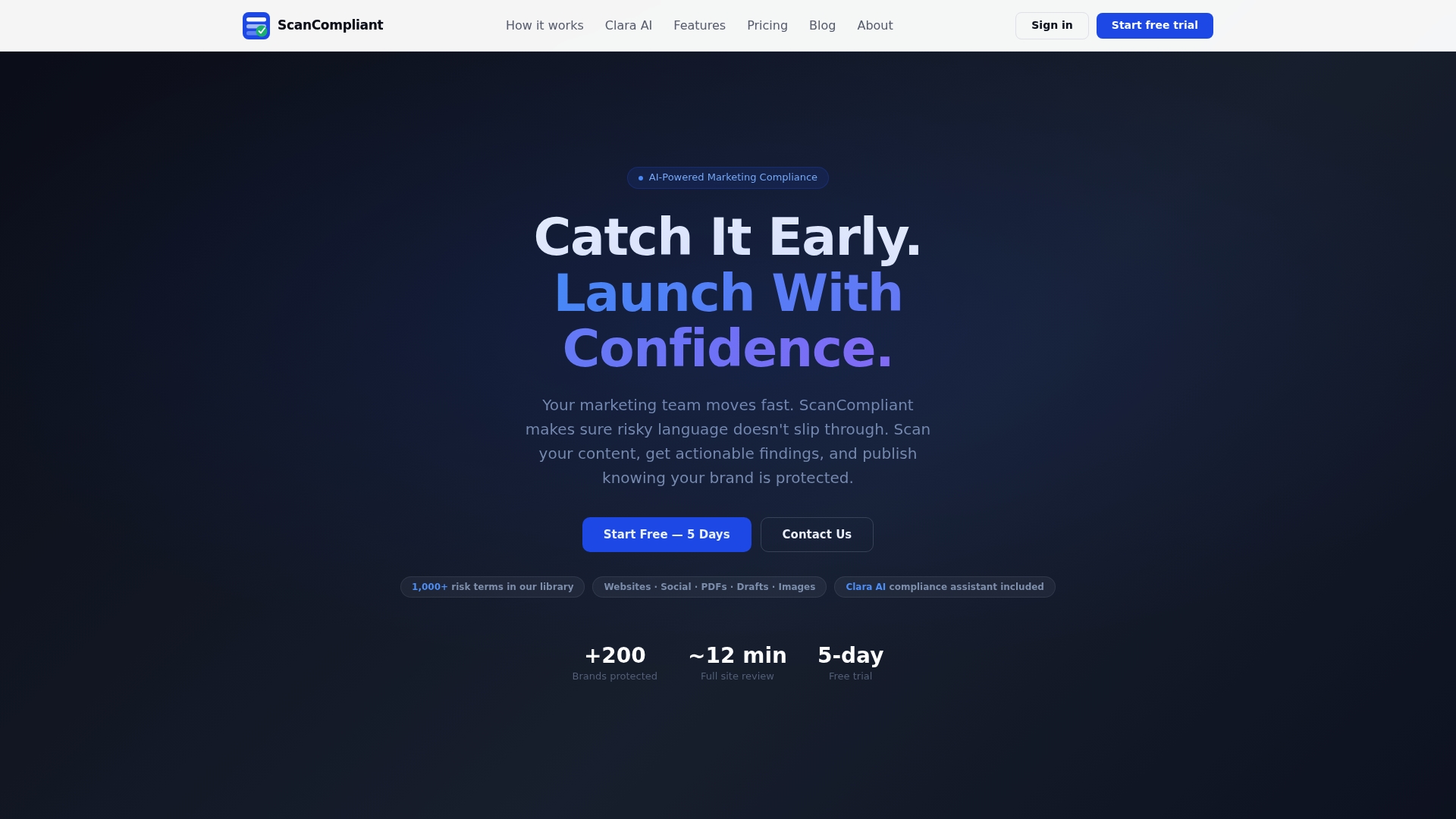
The platform scans websites, social copy, ads, and product listings against more than 1,000 risk terms, flags both express and implied claims, and lets reviewers attach evidence files and record sign-offs directly in the workflow. Every action is timestamped, creating the auditable trail that matters when a regulator asks what you knew and when. More than 200 brands have used Scancompliant to automate their compliance review and reduce the cycle time between draft and approved copy. See how the platform works at Scancompliant.
Sources
Save these primary references and cite them in internal policies and audit reports by document title, issuing agency, and date:
- Health Products Compliance Guidance | Federal Trade Commission
- Complaint: NextMed (FTC)
- Promotional labeling and advertising for human prescription drugs and biologics | FDA (guidance pdf)
- 21 CFR § 202.1 – Prescription-drug advertisements. | Electronic Code of Federal Regulations (e-CFR) | LII / Legal Information Institute
When citing these in internal audits, record the document title, URL, and the date your team accessed or reviewed it. That timestamp establishes that your substantiation review was current at the time the content was approved.
This article provides general compliance information and does not constitute legal advice. Confirm current FTC and FDA requirements with qualified legal counsel before publishing health-related marketing content.
This article is general information, not a substitute for advice from a qualified doctor. Consult a qualified healthcare professional about your own circumstances before acting on anything here.
Recommended
- Pre-Publication Health Content Review Steps for Compliance Teams – scancompliant.com
- Integrating Compliance Checks Into Your Content Pipeline – scancompliant.com
- Compliant Content Release in Healthcare Marketing: 2026 Guide – scancompliant.com
- How Healthcare Brands Prevent Enforcement Actions – scancompliant.com
2 Comments