
Amazon now requires third-party Testing, Inspection, and Certification (TIC) verification for dietary supplement listings, delivered directly from an accredited lab to Amazon through the Manage Your Compliance dashboard. If you have a flagged ASIN, your single next action is to open that dashboard, select “Add or appeal compliance,” and initiate a testing request. Listings that miss the compliance deadline can be removed without further notice.
Before you do anything else, pull together these three document categories:
- Current GMP certificate issued within the last 12 months, covering the manufacturing facility for each flagged product
- Clear label images showing the full Supplement Facts panel, all ingredient declarations, and any structure/function claims
- ASIN, GTIN/UPC, and manufacturer/facility name and address for each product you are submitting
Pro Tip: Create a shared folder with these three document types for every ASIN before you log into Manage Your Compliance. Onboarding stalls most often because sellers start the workflow and then scramble for a GMP certificate that expired six months ago.
Key Takeaways
Amazon’s supplement policy now requires third-party lab-to-Amazon verification for dietary supplement ASINs, with testing and certification valid for 12 months and all submissions managed through the Manage Your Compliance dashboard.
| Point | Details |
|---|---|
| Start in Manage Your Compliance | Initiate all testing requests through the dashboard; submissions outside it do not create the required auditable trail. |
| Three documents required upfront | GMP certificate (issued within 12 months), clear label images, and ASIN/GTIN/UPC with facility details are mandatory for every submission. |
| NSF/ANSI 173 and NSF 229 auto-qualify | Products certified to either standard are automatically accepted by Amazon without a separate testing submission. |
| 12-month validity cycle | Testing and certification expire after 12 months; build renewals into your product calendar at least 60 days before expiration. |
| Scancompliant reduces pre-test failures | Scanning labels and listings for FDA, FTC, and Amazon risk terms before testing prevents label-claim rejections and retest costs. |
Table of Contents
- How Amazon’s supplement policy changed from 2024 to 2026
- Exact documentation and testing Amazon requires for each supplement ASIN
- How to start the compliance workflow in Seller Central
- When to choose point testing vs. full product certification
- How to pick an Amazon-approved TIC provider or certifier
- What laboratory panels actually test for, by product type
- What timelines and costs actually look like
- Why supplement listings fail compliance checks and how to fix them
- How to appeal a flagged or removed supplement listing
- FDA and FTC rules that intersect with Amazon’s supplement policy
- The compliance bar has moved permanently, and most sellers are not ready for it
- Catch label and marketing risks before they reach a lab reviewer
- Sources
How Amazon’s supplement policy changed from 2024 to 2026
The shift did not happen overnight. Amazon announced the policy update effective April 2024, requiring third-party TIC verification and ending the previous model where sellers could upload their own Certificates of Analysis (CoAs). The change moved accountability from the seller to an accredited lab: labs now deliver CoAs directly to Amazon, creating an auditable trail that seller-uploaded documents simply cannot replicate.
Through 2025 and into 2026, Amazon expanded the program’s reach. The rollout prioritized higher-risk categories first, with weight-loss, sexual enhancement, and sports nutrition supplements among the earliest affected. The expectation across the industry is that the program will continue expanding to additional supplement categories, so sellers in adjacent categories should treat this as a matter of when, not if.
A few specifics on scope and notification:
- Amazon notifies sellers on a per-ASIN basis through Manage Your Compliance, specifying exactly which products require action and by what date
- Sellers typically receive approximately 90 days to submit verification after notification, though the window can vary
- Products already certified to NSF/ANSI 173 or NSF 229 are treated as automatically compliant and do not require separate testing submission
- The program applies to both new listings and existing ASINs already live on the marketplace
A 2024 NSF study found consumers are willing to pay about 11% more for supplements carrying recognized third-party certifications. That figure matters beyond compliance: it signals that the investment in certification can pay back through pricing power, not just listing preservation.
Exact documentation and testing Amazon requires for each supplement ASIN
Getting this list right before you start saves weeks. Amazon’s product review process collects a specific set of documents and test results, and missing any one of them stalls the entire submission.
Required documents
- GMP certificate: Must be current, issued within the last 12 months, and cover the specific manufacturing facility producing the product. The underlying federal standard is 21 CFR Part 111, which governs current Good Manufacturing Practice for dietary supplements.
- Manufacturer/facility name and address: Must match the GMP certificate exactly.
- ASIN, GTIN, and UPC: Required for each product submitted.
- Clear label images: Full Supplement Facts panel, all claims, net quantity, and contact information must be legible.
Testing and review components
Label-claim verification follows a risk-based model described by NSF: the first five claims on a label are tested at 100% coverage, and for every additional 1–5 claims beyond five, one more claim is added to the testing scope. A product with eight label claims, for example, requires testing of six of them. This directly affects how many assays your lab needs to run and, by extension, your cost.
Beyond label claims, the program requires contaminant and adulterant panels, with microbial, mycotoxin, and pesticide screens applied where relevant to the product type.
Accepted standards and auto-acceptance
Products certified to NSF/ANSI 173 (the dietary supplement standard) or NSF 229 (the supplement content testing standard) are automatically accepted by Amazon without a separate testing submission. This is the fastest path through the compliance gate for brands already holding those certifications.
Validity
Testing and certification results are generally valid for 12 months. After that window closes, you need to renew before Amazon’s next review cycle catches the expiration.
Testing requirements by type
| Test type | What it covers | When it applies |
|---|---|---|
| Label-claim verification | Ingredient identity and potency vs. label declarations | All supplements; scope scales with claim count |
| Contaminant/adulterant panel | Heavy metals (lead, arsenic, cadmium, mercury), prohibited substances | All supplements |
| Microbial screen | Salmonella, E. coli, total aerobic count, yeast/mold | Botanicals, proteins, probiotics, and high-risk raw materials |
| Mycotoxin screen | Aflatoxins, ochratoxin A | Botanical and grain-based supplements |
| Pesticide screen | Organochlorines, organophosphates, pyrethroids | Botanical and plant-derived supplements |
How to start the compliance workflow in Seller Central
The Manage Your Compliance dashboard is the only path that produces an auditable lab-to-Amazon trail. Emailing documents directly or uploading CoAs outside this workflow will not satisfy the requirement and can delay relisting significantly.
- Log into Seller Central and open Manage Your Compliance. Navigate to the Performance menu or search “Manage Your Compliance” in the help bar. Flagged ASINs appear here with their required actions and deadlines.
- Select “Add or appeal compliance” for each flagged ASIN. Work through ASINs one at a time or in batches if the dashboard supports it. Note the deadline for each.
- Initiate a testing request and select a provider. Amazon may assign an approved TIC provider or present options. If you already hold NSF/ANSI 173 or NSF 229 certification, you can submit that certification evidence here instead of initiating a new test.
- Submit product metadata. Enter the ASIN, GTIN/UPC, manufacturer name, facility address, and upload your GMP certificate and label images. Accuracy here matters: mismatches between the GMP certificate and the facility name you enter are a common cause of submission rejection.
- Track status in the dashboard. Once submitted, the lab coordinates sample collection and testing. Results flow directly from the lab to Amazon. You can monitor progress in Manage Your Compliance without needing to chase the lab for a report to upload yourself.
- Respond to any Amazon follow-up requests promptly. Amazon may request additional documentation (batch records, corrected labels) during review. Delays in responding extend the review window and increase removal risk.
Pro Tip: Prepare a batch metadata spreadsheet with ASIN, GTIN/UPC, facility name, facility address, and GMP certificate expiration date for every supplement SKU you sell, not just flagged ones. When the next wave of notifications arrives, you can move immediately instead of spending days gathering information.
When to choose point testing vs. full product certification
The right answer depends on how many SKUs you have, where you sell beyond Amazon, and how much administrative overhead you can absorb each year.
Certification (NSF/ANSI 173 or NSF 229) covers the product and the manufacturing facility through a structured audit and ongoing surveillance program. Once certified, the product is automatically accepted by Amazon until the 12-month expiration. It also travels well: major retailers, distributors, and healthcare buyers recognize these marks independently of Amazon’s program. For brands with more than a handful of SKUs or any multi-retailer ambitions, certification reduces the per-ASIN administrative burden substantially over time.
Point testing (one-off lab testing for a specific ASIN) is appropriate when you have a single product to remediate, a limited SKU count, or a cost constraint that makes full certification impractical right now. It satisfies Amazon’s requirement for that ASIN for 12 months, but it does not carry over to other retailers and requires a fresh submission for each renewal cycle.
Key differences to weigh:
- Scope: Point testing covers label claims and contaminant panels for one product. Certification covers the product, the facility, and includes ongoing surveillance audits.
- Turnaround: Point testing can move faster for a single ASIN (2–6 weeks depending on panel complexity). Full certification takes longer upfront due to facility audits but eliminates future per-ASIN submissions for certified products.
- Cost structure: Point testing has lower upfront cost but accumulates per-ASIN, per-cycle. Certification has higher initial cost but spreads across all SKUs under that certification.
- Amazon administrative ease: Certified products submit once and are auto-accepted. Tested products require a new submission each 12-month cycle.
- Multi-retailer value: Certification is recognized broadly. Point testing results are typically Amazon-specific.
A 2024 NSF consumer study found buyers pay roughly 11% more for certified products, which shifts the ROI calculation for brands that can display the certification mark on packaging.
| Factor | Point testing | Full certification (NSF/ANSI 173 or 229) |
|---|---|---|
| Scope | Label claims + contaminant panels, single ASIN | Product + facility audit + ongoing surveillance |
| Typical turnaround | 2–6 weeks | Several weeks (initial); faster on renewal |
| Cost drivers | Number of claims, panel complexity, per-ASIN | Audit fees, number of SKUs, annual surveillance |
| Amazon auto-acceptance | No (submission required each cycle) | Yes, until 12-month expiration |
| Multi-retailer recognized | Generally not | Yes (NSF/ANSI 173 and NSF 229 widely accepted) |
How to pick an Amazon-approved TIC provider or certifier
Not every accredited lab has experience with Amazon’s specific submission workflow. Picking the wrong one costs you weeks.
Selection criteria
- ANAB accreditation or equivalent: The ANAB (ANSI National Accreditation Board) accredits labs and certification bodies against ISO/IEC standards. An ANAB-accredited lab confirms appropriate laboratory competence and consistent assay practices. Do not engage a lab that cannot demonstrate this.
- Demonstrated Amazon onboarding experience: Ask specifically whether the lab has completed submissions through Manage Your Compliance for dietary supplements. Experience with the workflow matters more than general supplement testing capability.
- Direct lab-to-Amazon reporting: Amazon now requires labs to deliver CoAs directly to Amazon. A lab that asks you to download the report and upload it yourself is operating on the old model and will not satisfy the current requirement.
- Panel coverage matching your product type: Confirm the lab runs the specific panels your product category requires (botanical pesticide screens, mycotoxin panels, microbial potency for probiotics, etc.) before signing an agreement.
- Turnaround time commitments: Get a written estimate for sample scheduling window, lab processing time, and result delivery. Vague answers here are a warning sign.
Questions to ask during onboarding
- What is your current scheduling window for sample pickup or receipt?
- Which contaminants and adulterants do you screen for, by product type?
- Do you assist with label-claim mapping before testing begins?
- How do you handle a result that is out of specification?
- What is your pricing structure: flat fee, per-analyte, or per-panel?
Red flags
- Labs that accept seller-uploaded CoAs or offer to “submit on your behalf” by forwarding your document rather than generating their own lab-to-Amazon report
- Unclear or undocumented data submission processes for the Manage Your Compliance workflow
- No ANAB or equivalent accreditation documentation available on request
What laboratory panels actually test for, by product type
Amazon’s program uses risk-based panels, meaning the specific analytes tested depend on what the product is, not a single universal checklist. Label-claim verification applies to all supplements; contaminant and organism screens are layered on based on product category and ingredient risk profile.

Panel breakdown by category
Botanical supplements carry the broadest panel requirements. Pesticide residue screens (organochlorines, organophosphates, pyrethroids) are standard because plant-derived ingredients accumulate agricultural chemicals. Microbial screens (Salmonella, E. coli, total aerobic count, yeast and mold) and mycotoxin panels (aflatoxins, ochratoxin A) apply because raw botanical materials are susceptible to contamination during harvest and storage.
Mineral and elemental supplements (calcium, magnesium, zinc, iron formulas) require heavy metal panels as a priority. Lead, arsenic, cadmium, and mercury are the four core analytes, and the limits are strict because these products are often taken daily in meaningful doses.
Probiotics require microbial potency testing (confirming the declared CFU count at the time of testing, not just at manufacture) and pathogen screens to confirm the absence of harmful organisms in what is, by design, a live-culture product.
Protein powders combine label-claim verification for protein content and amino acid profile with contaminant panels for heavy metals and, where plant-based, pesticide residues.
Label-claim testing scope
The risk-based model means claim count directly drives assay count. For every additional 1–5 claims above five, one more claim enters the testing scope. A product with 12 label claims requires testing of seven of them. Plan your label accordingly: every claim you add beyond five increases testing cost and complexity.
| Analyte category | Key analytes | Triggered by |
|---|---|---|
| Heavy metals | Lead, arsenic, cadmium, mercury | All supplements (priority for minerals/elements) |
| Microbial pathogens | Salmonella, E. coli | Botanicals, proteins, probiotics |
| Microbial indicators | Total aerobic count, yeast, mold | Botanicals, proteins, probiotics |
| Mycotoxins | Aflatoxins B1/B2/G1/G2, ochratoxin A | Botanicals, grain-based supplements |
| Pesticide residues | Organochlorines, organophosphates, pyrethroids | Botanical and plant-derived supplements |
| Label claims | Ingredient identity and potency | All supplements; scope scales with claim count |
What timelines and costs actually look like
Testing and certification validity runs on a 12-month cycle. That is the hard clock you are managing. From the moment you initiate a testing request to the moment Amazon marks your ASIN compliant, expect the following:
- Sample scheduling: 1–3 weeks depending on lab capacity and whether you are shipping samples or the lab is coordinating pickup
- Lab processing and testing: 2–6 weeks depending on panel complexity (a simple label-claim-only test moves faster than a full botanical panel with pesticide and mycotoxin screens)
- Result review and Amazon submission: 1–2 weeks for the lab to finalize the report and deliver it to Amazon
- Amazon review: Variable; typically a few business days to a few weeks
Total elapsed time from initiating a request to a resolved ASIN status: 4–12 weeks in most cases. If you receive a 90-day compliance window, starting immediately is not optional.
Main cost drivers
- Number of label claims: More claims mean more assays under the risk-based model
- Panel complexity: A botanical supplement requiring pesticide, mycotoxin, and microbial screens costs more than a single-ingredient mineral supplement
- Number of SKUs: Each ASIN requires its own submission; costs multiply with SKU count
- Certification audit fees: Full NSF/ANSI 173 or NSF 229 certification adds facility audit costs on top of product testing
- Sample preparation: Some products require destructive testing or specialized preparation that increases lab time
Costs are not flat. A single-ingredient supplement with five label claims and a basic contaminant panel sits at a very different price point than a 20-ingredient botanical blend with a full pesticide screen. Get itemized quotes from at least two ANAB-accredited labs before committing.
Seasonal planning matters. Lab capacity tightens in Q4 and around major holidays. If your GMP certificate or test results expire in November or December, schedule renewal testing in September to avoid backlogs that push you past your compliance deadline.
Why supplement listings fail compliance checks and how to fix them
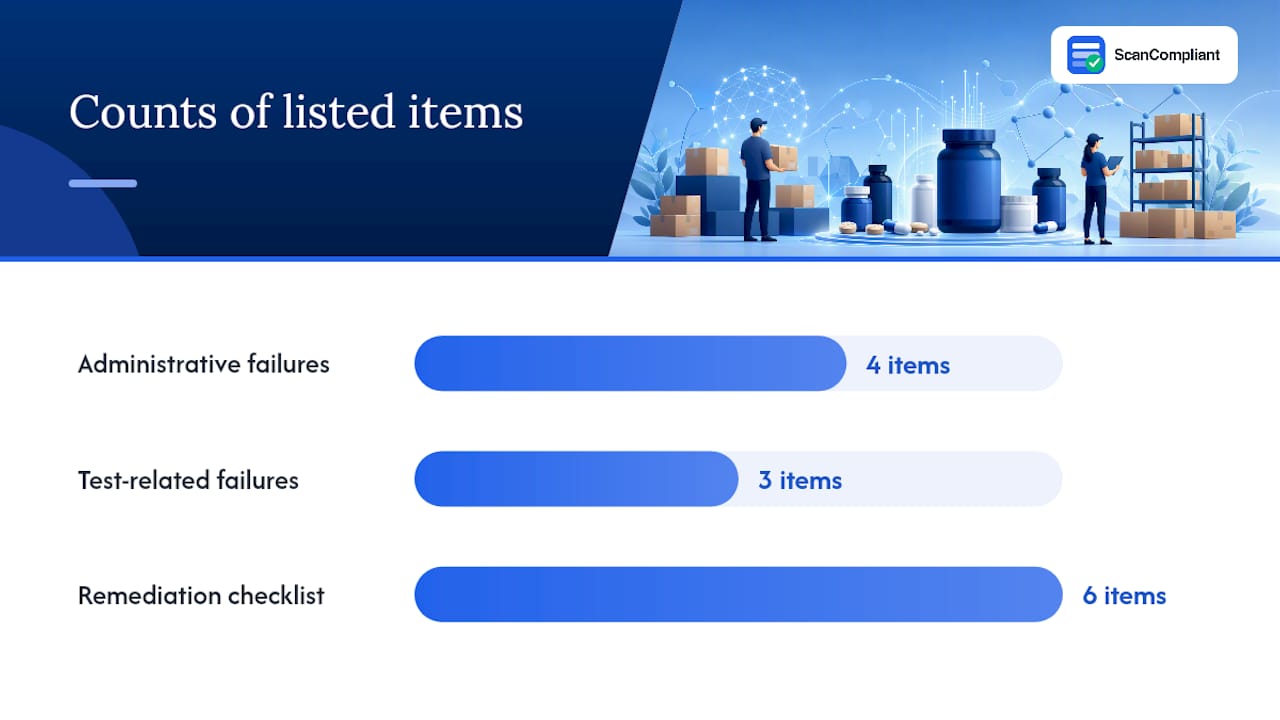
Most failures fall into two buckets: administrative gaps and test-related findings. The administrative ones are faster to fix.
The most common administrative failures:
- Expired GMP certificate. Check the issue date and expiration on every certificate before submitting. A GMP certificate issued more than 12 months ago will be rejected. Contact your manufacturer immediately for a current certificate; if they cannot provide one, that is a supply-chain problem that needs to be resolved before you can list.
- Facility name mismatch. The name and address on your GMP certificate must match exactly what you enter in Manage Your Compliance. Abbreviations, DBA names, and address formatting differences all cause rejections.
- Unclear label images. Blurry, cropped, or low-resolution label photos that obscure the Supplement Facts panel or ingredient list will stall your submission. Use a flatbed scanner or a high-resolution camera with the label fully unfolded.
- Missing GTIN or UPC. Every ASIN submission requires a valid GTIN. If your product does not have one, resolve this before initiating the compliance workflow.
Test-related failures:
- Out-of-spec contaminants. If heavy metals, microbial counts, or pesticide residues exceed acceptable limits, the product itself needs to be addressed, not just the paperwork. Work with your manufacturer to identify the contamination source (raw material supplier, processing environment) and retest a new batch after corrective action.
- Label claim discrepancies. If tested potency falls below the declared amount on the label, you have two options: reformulate to meet the claim, or revise the label to reflect what the product actually contains. Both require a new test after the change.
- Adulterant detection. Finding an undeclared substance in a product, particularly in weight-loss or sexual enhancement categories, is a serious finding. It requires a full supply-chain investigation, reformulation, and retesting before any appeal can succeed.
Immediate remediation checklist:
- Verify GMP certificate issue date and certifier accreditation
- Confirm facility name and address match across all documents
- Re-examine every label claim against your current formulation
- Schedule a retest with the same or a different ANAB-accredited lab
- Document the chain of custody for the batch being tested
- Prepare a corrective action summary before submitting an appeal
How to appeal a flagged or removed supplement listing
An appeal without lab-to-Amazon verification will not succeed. Amazon’s current model requires the lab to deliver results directly; a seller-assembled document package submitted through a generic appeal channel does not satisfy the requirement.
Follow this sequence:
- Confirm the lab has delivered the CoA or certification evidence directly to Amazon through Manage Your Compliance. If the result is pending, wait for delivery before initiating an appeal.
- Verify your GMP certificate is current. An expired certificate invalidates the submission regardless of test results.
- Prepare a root-cause and corrective action statement. Amazon expects to understand what caused the compliance gap, what you did to fix it, and what you have put in place to prevent recurrence. Keep this concise: one to two paragraphs covering the root cause, the corrective action taken, and the preventive measure now in place.
- Compile the full appeal document package before submitting:
- Lab CoA or certification report (delivered to Amazon by the lab, not uploaded by you)
- Current GMP certificate
- Corrected label images (if label claims were the issue)
- Batch records, if Amazon requested them
- Corrective action plan
- Submit through the Manage Your Compliance workflow, not through a generic Seller Central appeal channel. The dashboard is the auditable path; submissions outside it do not create the lab-to-Amazon trail Amazon requires.
- Monitor the dashboard for follow-up requests. Amazon may ask for additional documentation within the review window. Respond within 24–48 hours to avoid extending the removal period.
For ongoing compliance record-keeping and audit preparation, a structured approach to content compliance audits reduces the scramble when Amazon requests documentation on short notice.
FDA and FTC rules that intersect with Amazon’s supplement policy
Amazon’s label-claim review does not operate in isolation. The FDA and FTC both have enforcement authority over supplement marketing, and a claim that triggers an Amazon rejection often signals a broader regulatory risk.
The core rule: avoid disease claims and use structure/function language that is substantiated. Under DSHEA and FDA guidance, manufacturers are responsible for ingredient safety and truthful labeling. Amazon’s label review enforces this at the platform level, but FDA and FTC enforcement can follow independently.
Risky vs. safer phrasing
| Risky claim | Safer alternative | What substantiates it |
|---|---|---|
| “Prevents colds” | “Supports immune function” | Structure/function; requires competent and reliable scientific evidence |
| “Treats joint pain” | “Supports joint comfort and flexibility” | Structure/function; requires substantiation on file |
| “Cures anxiety” | “Promotes a calm mood” | Structure/function; requires substantiation; avoid “anxiety” as a disease term |
| “Lowers blood sugar” | “Helps maintain healthy blood sugar levels already in the normal range” | Structure/function with scope qualifier; requires substantiation |
| “Fights cancer” | Not usable as a supplement claim | Disease claim; prohibited regardless of phrasing |
The pattern is consistent: disease names and treatment verbs (“treats,” “cures,” “prevents,” “fights”) trigger both Amazon’s label review and FDA/FTC scrutiny. Structure/function language (“supports,” “promotes,” “helps maintain”) is the permitted lane, but it still requires substantiation on file.
Practical EE-A-T steps before testing
- Pre-screen every label and marketing asset against a compliance checklist before sending samples to the lab. A label-claim failure discovered during testing costs you weeks and a retest fee.
- Retain citation-level evidence (published studies, systematic reviews) for every structure/function claim. Amazon may request substantiation during a review, and FDA can request it independently.
- Keep records of every label version, claim change, and substantiation document in a centralized system. This documentation supports both Amazon appeals and any regulatory inquiry.
Pro Tip: Run your label copy and product listing through a compliance scan before submitting for testing. Catching a disease claim or an unsupported potency statement at the copy stage costs nothing. Catching it after a lab rejection costs you the test fee, the retest fee, and weeks of listing downtime. Scancompliant’s platform scans for over 1,000 FDA, FTC, and platform-specific risk terms and flags them before they reach a lab reviewer.
For a deeper look at the most common FDA warning letter triggers in supplement marketing, the Scancompliant blog covers the specific claim patterns that draw enforcement attention.
The compliance bar has moved permanently, and most sellers are not ready for it
The sellers who treat Amazon’s supplement policy as a one-time paperwork exercise are going to keep getting caught. The 12-month validity cycle means this is a recurring operational commitment, not a box you check once. And the expansion of the program to additional categories means that if your SKUs are not flagged yet, they likely will be.
What actually separates sellers who handle this well from those who scramble is not the quality of their products. It is operational readiness: centralized documents, a compliance calendar with renewal dates built in 60 days ahead of expiration, and a relationship with an ANAB-accredited lab that already knows your product portfolio.
Certification is worth the investment for any brand selling more than a handful of SKUs or planning to expand beyond Amazon. The upfront cost is real, but the per-ASIN administrative burden drops substantially, and the NSF/ANSI 173 or NSF 229 mark opens doors at retailers and distributors that point testing cannot. A brand that has been through a full certification audit also has a much cleaner story to tell in an Amazon appeal or an FDA inquiry.
For sellers just entering compliance, the priority order is straightforward: fix the ASINs Amazon has already flagged first, then build the infrastructure to prevent the next wave from becoming a crisis. High-volume SKUs and products in the originally targeted categories (weight-loss, sexual enhancement, sports nutrition) deserve the most immediate attention.
The sellers who will struggle are those waiting for Amazon to make the process easier. It will not get easier. The bar will keep rising, and the sellers with documented, auditable compliance programs will be the ones still listing when it does.
Catch label and marketing risks before they reach a lab reviewer
Label failures during Amazon’s testing process are expensive in two ways: the retest fee and the listing downtime while you wait for results. Most of those failures are preventable if you catch the risky claim before the sample ever ships.
Scancompliant scans product labels, Amazon listings, and marketing copy against a database of over 1,000 FDA, FTC, and platform-specific risk terms, flagging disease claims, unsupported potency statements, and prohibited phrasing before they reach a reviewer. The platform delivers prioritized findings in minutes, with plain-English explanations and suggested rewrites, so your regulatory or marketing team can resolve issues in a single review cycle rather than after a lab rejection. More than 200 brands have used it to shorten review cycles and build a documented compliance trail for appeals. See what it flags on your listings at Scancompliant, or review pricing plans to find the right fit for your team.
Sources
These are the primary references sellers should consult when verifying requirements, confirming GMP obligations, or researching accepted certification standards.
- Amazon Seller Central help: Dietary supplements (external)
- Amazon’s Dietary Supplements Policy 2024: What You Need To Know | NSF
- Amazon updates its dietary supplements seller’s policy
- Ecfr
This article is general information, not a substitute for advice from a qualified lawyer. Consult a qualified legal professional about your own circumstances before acting on anything here.