
Regulatory scrutiny for health brands is defined as formal oversight by agencies like the FDA and FTC that evaluates whether your marketing claims, labeling, and product communications meet legal standards. Responding to regulatory scrutiny as a health brand requires precise, timely, and coordinated action. The FDA gives brands 15 business days to respond to Warning Letters. Missing that window signals to regulators that your organization is not taking the matter seriously. This guide walks marketing professionals through every stage of an effective response, from the moment a Warning Letter arrives to the long-term work of protecting brand equity.
What regulatory scrutiny means for health brand marketing
Regulatory scrutiny is not a background legal matter. For health brands, it is a direct challenge to your marketing claims, your credibility with retailers, and your standing with investors.
The FDA issues Warning Letters when it finds that a product’s marketing makes unauthorized disease claims, uses misleading structure/function language, or omits required disclosures. The FTC pursues enforcement when advertising lacks adequate substantiation for health benefit claims. Both agencies publish their actions publicly, which means the reputational exposure begins the moment a letter is issued, not when a fine is paid.
Common triggers for health brand scrutiny include:
- Unsubstantiated claims like “clinically proven” or “treats [condition]” without FDA-cleared evidence
- Testimonials that imply disease treatment without proper disclaimers
- Ingredient claims that exceed what the product’s regulatory classification allows
- Social media posts by brand ambassadors that carry implied endorsements without disclosures
The consequences extend well beyond fines. Regulatory breaches cause multi-percentage point drops in analyst revenue forecasts and permanent valuation declines, even after enforcement is resolved. That financial damage reflects how investors interpret a compliance failure: as a sign of deeper organizational risk, not a one-time mistake.
What do you need before drafting a response?
Preparation determines whether your response resolves the matter or deepens it. A disorganized reply signals to regulators that the underlying problem is systemic.

The first step is assembling a cross-functional task force. A regulatory response requires legal, PR, marketing, and compliance working from a single coordinated narrative. Each team owns a different piece of the response: legal owns the regulatory citations, marketing owns the claim corrections, PR owns the external messaging, and compliance owns the documentation trail.
| Preparation element | Why it matters |
|---|---|
| Regulatory defense counsel | Prevents inadvertent admissions that broaden the scope of violations |
| Revised SOPs | Demonstrates systemic correction, not just surface fixes |
| Updated labeling or ad copy | Shows immediate corrective action with documented evidence |
| Internal communication brief | Aligns all departments on a single, consistent narrative |
| Substantiation evidence file | Supports any claims you intend to retain in your marketing |
Documentation is the currency of a credible response. Regulators reject vague commitments and require documented corrective actions with specific milestones. Gathering revised standard operating procedures, updated labels, and evidence files before you write a single word of your formal reply gives you a defensible foundation.
Pro Tip: Engage regulatory defense counsel before you review the Warning Letter internally with your marketing team. Early counsel involvement prevents off-the-cuff internal discussions from creating statements that could be used against you.
How do you respond to an FDA Warning Letter step by step?
A structured response process protects your brand and gives regulators exactly what they need to close the matter. Improvised replies almost always create new problems.
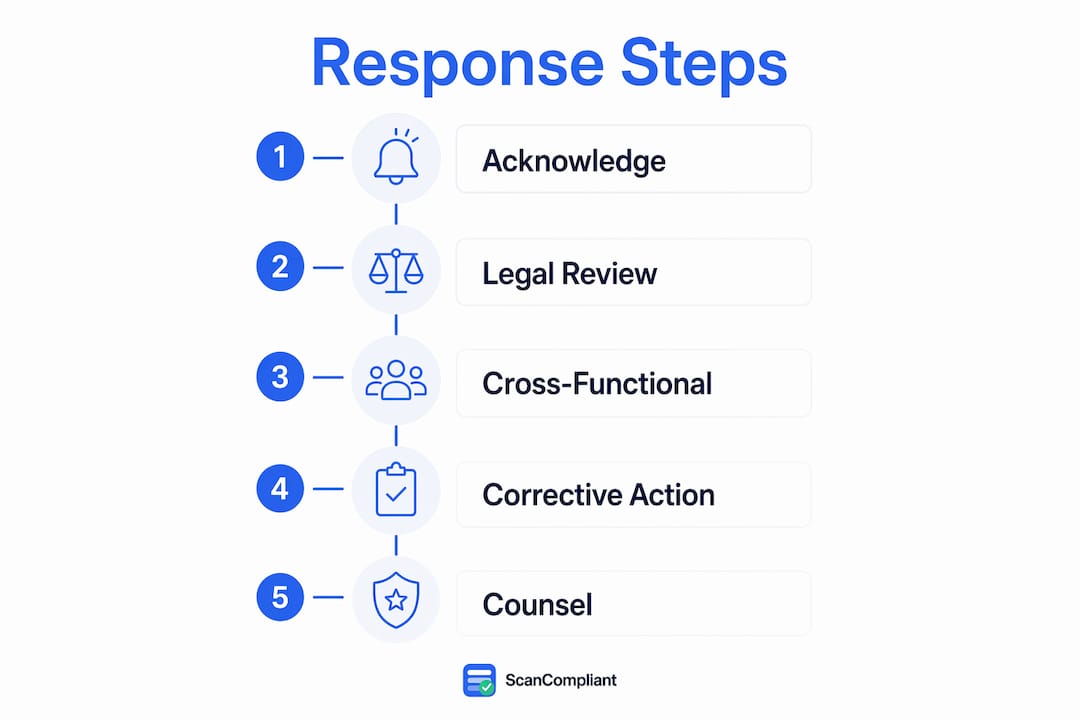
Step 1: Acknowledge receipt and conduct a careful legal review. Do not send an acknowledgment that contains substantive admissions. Your first communication should confirm receipt and indicate that a full response is forthcoming within the regulatory window.
Step 2: Map every numbered observation to a specific corrective action. FDA Warning Letters list observations by number. Your response must mirror that structure exactly, addressing each point in order. A response that reorganizes or combines observations signals that you have not fully engaged with the agency’s concerns.
Step 3: Document immediate corrective actions already taken. Regulators distinguish between actions completed before the response and actions planned for the future. Actions already taken carry more weight. These include:
- Pulling or revising the flagged marketing materials
- Updating product pages, social media posts, and retailer listings
- Notifying distribution partners of the claim corrections
- Revising internal review processes that allowed the claims to publish
Step 4: Provide planned corrective actions with specific milestones. For corrections that require more time, such as label reprints or SOP overhauls, provide a realistic timeline with named responsible parties and completion dates. Vague promises like “we will address this promptly” are the single most common reason responses fail.
Step 5: Engage experienced regulatory defense counsel throughout. Inadequate responses often worsen situations by inadvertently admitting to broader violations. Counsel reviews every sentence before submission to prevent that outcome.
Warning Letters frequently precede more serious consequences, including class action litigation and retailer delisting. Brands that engage at the Form 483 inspection stage, before a Warning Letter is issued, face significantly lower exposure. The Scancompliant blog covers the seven most common FDA Warning Letter triggers in supplement marketing, which is worth reviewing before your next content cycle.
Pro Tip: Build a response template now, before you receive a Warning Letter. A pre-built framework with placeholder sections for each observation type cuts your response preparation time significantly and reduces the risk of errors under deadline pressure.
What mistakes do health brands make when responding to scrutiny?
The most damaging errors in regulatory response are not legal missteps. They are communication failures that compound the original problem.
- Delayed response. Missing the 15-business-day FDA window, or responding late to FTC inquiries, signals indifference. Regulators interpret delay as evidence that the brand does not take compliance seriously.
- Vague, promise-only replies. Responses that contain no documentation and only commitments to “review our processes” give regulators nothing to evaluate. They typically result in follow-up requests or escalated enforcement.
- Fragmented messaging across geographies. Inconsistent regulatory messaging is read by investors as organizational fragility. A brand that tells one story to the FDA and a different story to European regulators signals that no one is in control.
- Treating the Warning Letter as a legal-only issue. Marketing teams that are kept out of the response process often continue publishing content that contradicts the corrections being made in the formal reply. That contradiction can be cited in follow-up enforcement.
- Budgeting fines as a routine cost. Treating regulatory fines as an acceptable operating expense creates a permissive culture that damages leadership credibility and brand valuation permanently. Investors and talent notice.
The pattern across all these mistakes is the same: treating a regulatory response as a contained legal transaction rather than a brand-wide operational event.
How do you protect brand value during and after regulatory scrutiny?
Brand equity does not pause while you resolve a regulatory matter. Customers, retailers, and investors are watching how you handle the situation, and their conclusions affect your valuation long after the enforcement action closes.
Clear, honest communication is the single most effective tool. Consistent, transparent messaging manages public and stakeholder perception beyond what satisfying regulators alone can achieve. Avoid corporate jargon in any public statements. Say what happened, what you are doing about it, and when it will be resolved.
Cross-functional narrative alignment is not optional. Every customer service representative, every regional sales lead, and every social media manager must work from the same approved talking points. Deviations create the fragmented narrative that investors interpret as organizational weakness. A regulatory review checklist for your marketing team helps maintain that alignment across content types and channels.
Regulatory scrutiny tests whether your compliance culture is real or performative. Brands that respond with documented evidence, unified messaging, and genuine corrective action come out with their credibility intact. Brands that respond with promises and silence do not.
Pro Tip: After your formal response is submitted, run a content audit across all active marketing channels. Flagged claims often appear in places the original review missed: email sequences, retailer product descriptions, and influencer content.
Post-response monitoring matters as much as the response itself. Embedding a corrective compliance culture, where content is reviewed before publication rather than after enforcement, is the only way to prevent the same situation from recurring. Tools that scan marketing content with AI, checking against FDA and FTC standards before anything goes live, are now standard practice for brands serious about managing regulatory risk.
Key Takeaways
Responding to regulatory scrutiny as a health brand requires documented evidence, cross-functional alignment, and a response structure that mirrors every regulatory observation with specific corrective actions and realistic timelines.
| Point | Details |
|---|---|
| Meet the 15-day window | Respond to FDA Warning Letters within 15 business days to signal organizational seriousness. |
| Document every correction | Regulators require specific milestones and evidence, not vague commitments to improve. |
| Engage counsel early | Regulatory defense counsel prevents inadvertent admissions that broaden violation scope. |
| Align all departments | Legal, PR, marketing, and compliance must work from one unified narrative. |
| Treat fines as a warning | Budgeting fines as routine costs erodes leadership credibility and depresses brand valuation. |
Why I think most health brands misread what a Warning Letter actually is
After working with regulatory and marketing teams across the health sector, the pattern I see most often is this: the legal team treats a Warning Letter as a legal problem, and the marketing team treats it as someone else’s problem. Neither instinct is correct.
A Warning Letter is a public document. The moment it is issued, it is searchable. Retailers pull it up. Investors pull it up. Journalists pull it up. The brand’s response, or its absence, becomes part of the public record too. That is not a legal dynamic. That is a brand dynamic.
The brands that handle scrutiny well share one trait: they had already built the internal infrastructure to respond. They had SOP compliance processes in place, they had cross-functional communication protocols, and they had content review systems that caught risky claims before publication. When the Warning Letter arrived, they were not starting from zero.
The brands that struggle are the ones that treated compliance as a checkbox rather than a practice. They had no documentation ready, no unified messaging, and no counsel relationship to activate. Their response took weeks to organize, and the delay itself became part of the story.
My honest recommendation: do not wait for scrutiny to build your response capacity. Build it now, when the stakes are low and the process can be tested without pressure.
— Compliant Team
Scancompliant: built for health brands under regulatory pressure
Health brand marketing teams face a specific problem: the volume of content they produce outpaces what any manual review process can reliably check. A single email sequence, a product page update, and three social posts can go live in a day. Each one carries claim risk.
Scancompliant addresses that problem directly. Its AI-powered platform scans marketing content against a database of over 1,000 risk terms, flags language that triggers FDA or FTC concern, and delivers prioritized findings in minutes. More than 200 brands have used it to catch the subtle claims that human reviewers miss. The result is a documented compliance trail that supports your regulatory response if scrutiny arrives. For marketing teams that need to move fast without creating legal exposure, Scancompliant’s platform is the practical solution. Pricing details are available at Scancompliant pricing for teams evaluating their options.
FAQ
What does regulatory scrutiny mean for a health brand?
Regulatory scrutiny means a government agency, typically the FDA or FTC, is formally reviewing your marketing claims, labeling, or advertising for compliance violations. The review can result in Warning Letters, consent orders, or financial penalties.
How long does a health brand have to respond to an FDA Warning Letter?
The FDA expects a response within 15 business days of receiving a Warning Letter. Missing this deadline signals non-compliance and can accelerate further enforcement action.
Why do regulatory fines affect brand growth beyond the fine itself?
Regulatory breaches trigger analyst revenue forecast reductions and valuation declines that persist after fines are paid. Investors interpret enforcement actions as evidence of systemic risk, which depresses growth multiples.
What is the biggest mistake brands make in regulatory responses?
The most common mistake is submitting a vague, promise-only response with no documentation. Regulators require specific corrective actions, named responsible parties, and realistic completion timelines to consider a matter resolved.
How can health brands prevent regulatory scrutiny in the first place?
Brands prevent scrutiny by reviewing all marketing content against FDA and FTC standards before publication, maintaining revised SOPs, and building a documented compliance trail. AI-powered content scanning tools catch risky claims before they reach regulators.
Recommended
- Regulatory Review Checklist for Healthcare Marketing – scancompliant.com
- Editing Health Content for Regulatory Compliance – scancompliant.com
- Compliance Review Stages: A Guide for Health and Marketing Teams – scancompliant.com
- Compliant Content Release in Healthcare Marketing: 2026 Guide – scancompliant.com