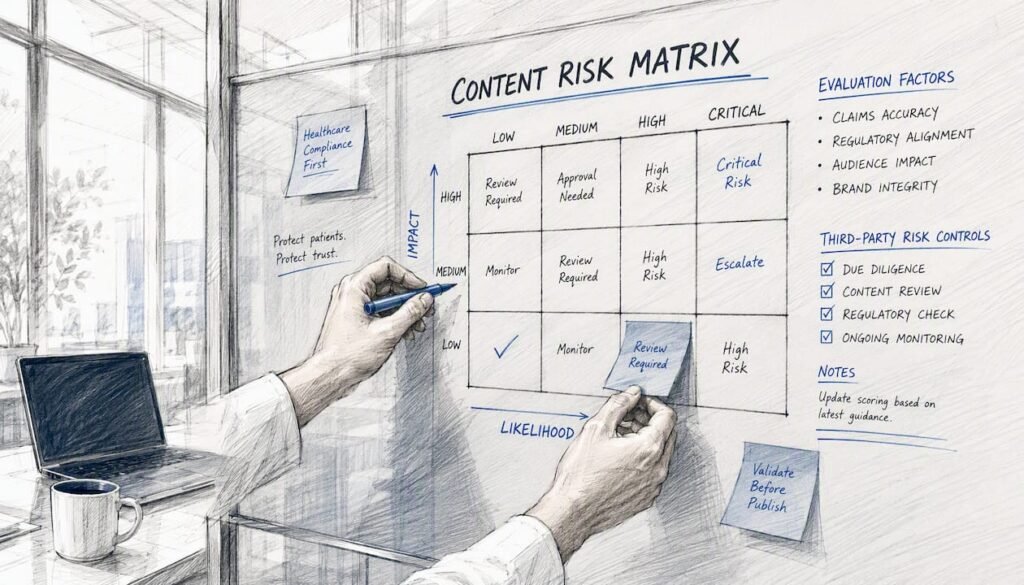
Any influencer post, affiliate review, or agency creative your brand amplifies is legally your advertising. That is the core of why third-party content creates risk: the FTC and FDA do not care who wrote the copy. If you republished it, tagged it, or paid for it, you own the liability. The FTC Health Products Compliance Guidance makes clear that advertisers must hold prior substantiation for every objective health claim a post conveys, including implied ones. The FDA’s misbranding statute, 21 U.S.C. §352, extends that exposure to compounded drugs when third-party promotion is false or misleading. For telehealth and DTC health brands, the practical risk vectors include implied objective claims in captions, visuals, or comment threads that a reasonable consumer reads as a health promise
- Missing material connection disclosures on paid, gifted, or affiliate-linked posts
- Republishing or resharing that converts independent speech into brand advertising
- Brand-adjacent phrasing (e.g., “Ozempic-like results”) that implies equivalence with FDA-approved drugs
- Before/after imagery that suggests guaranteed clinical outcomes
Key Takeaways
Third-party marketing content creates direct FTC and FDA liability for telehealth and DTC health brands the moment it is amplified, republished, or paid for, making pre-approval workflows and documented monitoring the most critical controls.
| Point | Details |
|---|---|
| Amplification equals ownership | Resharing or tagging third-party content converts it into your advertising under FTC and FDA rules. |
| Prior substantiation is required | Health claims in third-party posts must be substantiated before publication, not after a complaint. |
| GLP-1 content is highest risk | Brand-adjacent phrasing and equivalence claims for compounded products triggered 30 FDA warning letters in March 2026. |
| Contracts alone are insufficient | FTC expects active training, monitoring, and remediation programs, not just signed agreements. |
| Documentation is the defense | Claim whitelists, monitoring logs, and remediation records are what protect a brand during an inquiry. |
Table of Contents
- Why third-party content creates risk: the regulatory framework
- Where third-party content commonly goes wrong
- Red flags to catch before you amplify a post
- Practical controls your team must implement
- How to scale controls with people, process, and technology
- Contract language to insist on with every partner
- If you receive a warning letter: the first 72 hours and beyond
- The part most compliance programs get wrong
- Sources
Why third-party content creates risk: the regulatory framework
The FTC treats endorsements and third-party posts as advertising the moment a brand uses them to promote a product. Part 255 of the CFR states that advertisers are liable for misleading or unsubstantiated statements made through endorsements and recommends guidance, monitoring, and remedial action to reduce deceptive claims. Critically, liability does not require a direct contract with the creator.
The substantiation requirement is equally strict. The FTC’s advertising substantiation policy holds that advertisers must possess a reasonable basis for objective claims before dissemination. Post-claim evidence rarely substitutes. That means a creator’s testimonial about weight loss, energy, or blood sugar is your problem to substantiate before the post goes live, not after a complaint arrives.
On the FDA side, the misbranding risk is direct. Telehealth brands marketing compounded GLP-1 products faced 30 warning letters in March 2026 citing misleading promotion and brand-adjacent claims as misbranding concerns under the FD&C Act. The FDA’s DTC final rule also sets clear, conspicuous, and neutral presentation standards for risk information in broadcast and video formats, which applies when third-party video content is amplified. 21 CFR Part 202 reinforces that false or misleading prescription drug advertising can render a drug misbranded under section 502(n).
Where third-party content commonly goes wrong
Compounded GLP-1 content sits at the intersection of every high-priority row. Any post that uses phrasing like “works like Ozempic” or shows dramatic weight-loss photos without fair-balance language is FDA-sensitive under the misbranding statute and FTC-sensitive for substantiation. Learn how healthcare brands prevent enforcement actions before a warning letter forces the conversation.
Red flags to catch before you amplify a post
Compliance teams should treat these as automatic escalation triggers:
- Drug-equivalence language: “Ozempic-like,” “same as semaglutide,” “generic GLP-1,” or any phrasing that implies the compounded product is identical to an FDA-approved drug
- Outcome superlatives: “guaranteed results,” “cures,” “eliminates,” “100% effective,” or clinical outcome claims without cited studies
- Unsupported authority: “doctor recommended,” “clinically proven,” or “FDA approved” when no approval exists for the specific product
- Missing disclosures: paid posts without #ad or #sponsored; affiliate links adjacent to unlabeled testimonials; agency scripts that pre-write “personal experience” language for creators
- Before/after photos that imply a guaranteed outcome rather than an individual result
- Comparative claims that position a compounded product favorably against a named branded drug
Pro Tip: Review the comment thread, not just the caption. A creator’s benign post can become an implied objective claim when the brand’s own account replies to a comment confirming a health outcome. That reply is advertising.
Platform-specific flags: paid tagging without disclosure on Instagram and TikTok; affiliate links embedded in YouTube descriptions without clear disclosure language; reposted TikTok content with edited captions that introduce a claim the original creator never made.
Practical controls your team must implement
The FTC’s position is explicit: contracts alone are not enough. Active programs, including written guidance, training, and monitoring, are expected when health claims are involved.
| Control | What It Covers | Cadence |
|---|---|---|
| Pre-approval workflow | All paid posts reviewed before publication | Per post |
| Claim whitelist | Approved language and required disclosure copy | Updated quarterly |
| Post-publication scan | Brand tag and mention monitoring | Weekly |
| UGC amplification audit | Review before resharing any organic content | Per share |
| Remediation log | Documented takedowns, corrections, timetables | Ongoing |
| Creator training | Disclosure rules, prohibited claims, escalation path | Onboarding + annual |
Contractual protections must go beyond a standard influencer agreement. Every contract with influencers, agencies, and partner pharmacies or 503B vendors should include: pre-approval rights for all creative, audit and document production rights, a 24–72 hour takedown obligation, indemnity for regulatory issues caused by noncompliant content, and termination rights triggered by regulatory contact or warning letter. A regulatory review checklist gives your team a repeatable structure for each of these steps.
How to scale controls with people, process, and technology
Manual review breaks down fast at volume. A practical RACI for third-party content:
- Marketing owns creative briefing and creator relationships; submits content for review.
- Legal/Regulatory reviews all claims, approves or rejects language, and maintains the claim whitelist.
- Medical Affairs reviews clinical language and any content referencing drug mechanisms or outcomes.
- Operations owns monitoring cadence, takedown execution, and remediation documentation.
Technology fills the gaps between human reviews. Pre-publish API or webhook scanning flags risk terms before content reaches a live channel. Keyword and pattern detection catches implied claims that a manual reader might miss on a fast-moving feed. Automated disclosure checks confirm #ad tags are present and correctly placed. Audit trails document every approval, rejection, and remediation action.
Pro Tip: Build your claim whitelist directly into the scanning ruleset. When approved phrases are pre-cleared in the tool, reviewers spend time on genuine edge cases rather than re-approving the same safe language every week.
Timeline and cost estimates: a playbook with manual approvals takes roughly 30–60 days to stand up (low cost, high labor). Integrating automated scanning and API gating typically runs 90–120 days and moves the program from high-labor to medium-labor with better coverage. Scancompliant scans websites, social content, and documents against more than 1,000 risk terms, delivers prioritized findings in minutes, and generates a documented compliance trail. Brands handling compounded GLP-1 content should treat automated pre-publish scanning as a baseline control, not an upgrade. See how brand risk teams use AI tools to integrate scanning into existing content pipelines.
Contract language to insist on with every partner
That clause covers the three biggest failure points: pre-approval, takedown speed, and claim sourcing. Beyond it, every agreement should include:
- Disclosure and tagging requirements with specific platform language (e.g., “#ad” at the start of a caption, not buried)
- Audit rights allowing the brand to request screenshots, analytics, and launch plans on 48 hours’ notice
- Notice obligations requiring the creator or agency to notify the brand within 24 hours of any regulatory contact
- Indemnity allocating liability for claims the creator made without brand approval
- Insurance representations confirming the partner carries adequate coverage
For partner pharmacies and 503B vendors, add a clause specifically restricting them from making equivalence claims between compounded and FDA-approved products in any co-branded or co-marketed material.
If you receive a warning letter: the first 72 hours and beyond
- Hours 0–4: Assign an incident lead. Notify legal counsel and medical affairs immediately. Do not delete or modify any content until counsel advises.
- Hours 4–24: Preserve all relevant posts, metadata, analytics, and communications. Screenshot and archive with timestamps. Document chain of custody.
- Hours 24–48: Suspend amplification of the flagged content and any materially similar posts. Assess whether voluntary removal is appropriate; counsel should make that call.
- Hours 48–72: Brief executive leadership. Confirm whether the matter is material for reporting purposes.
- Days 4–30: Compile pre-approval records, claim whitelists, training logs, and monitoring reports. Run a retrospective scan for similar content across all channels. Prepare a corrective communication if counsel advises.
- Days 30–90: Implement a remediation plan, update contracts and guidance documents, and report to the board if material. Prepare for potential civil or administrative proceedings.
A content compliance audit run before a warning letter arrives is far less expensive than the retrospective version you run under regulatory scrutiny.
The part most compliance programs get wrong
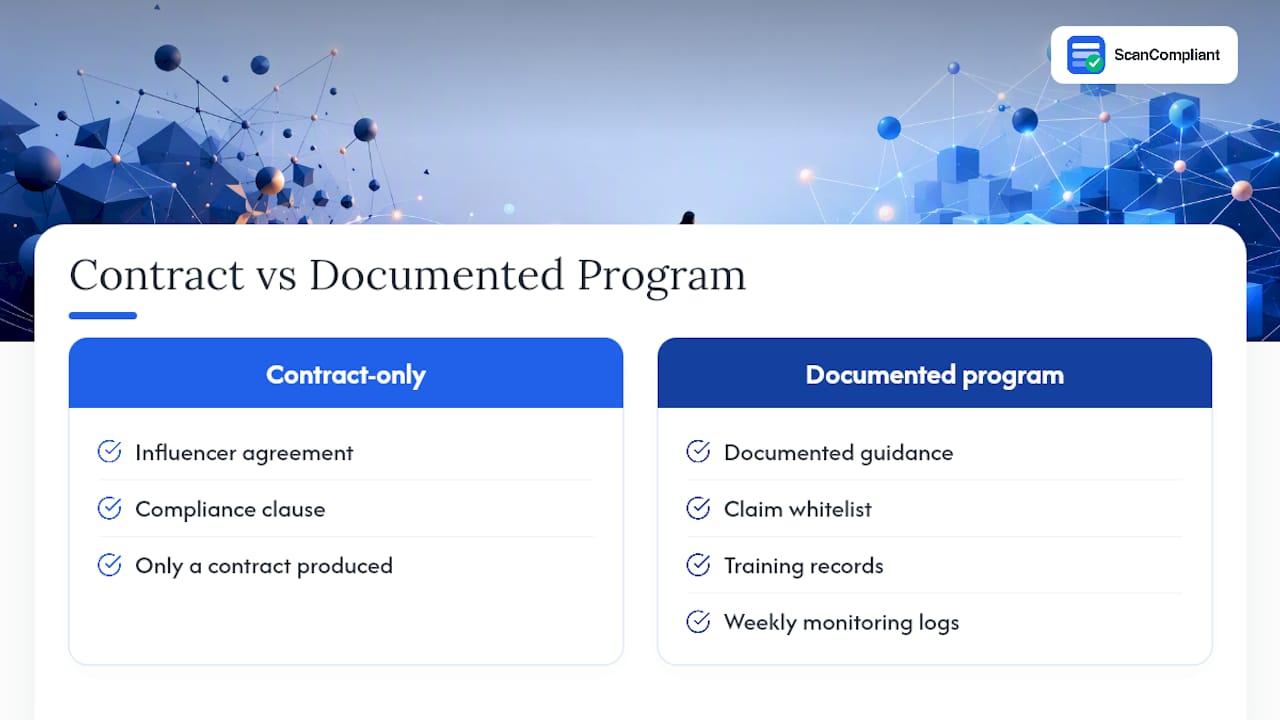
The instinct is to solve third-party content risk with a contract. Write a tight influencer agreement, add a compliance clause, and consider the problem managed. That instinct is wrong, and regulators know it.
What actually stops enforcement is the combination of documented guidance, consistent monitoring, and fast remediation. A brand that can show the FTC a claim whitelist, training records, weekly monitoring logs, and a 48-hour takedown history is in a fundamentally different position than one that can only produce a contract. The documentation is the defense.
One practical tip experienced compliance teams use: maintain an exceptions log alongside the whitelist. When a creator requests language that falls outside approved claims, document the request, the review, and the decision. That log does two things. It slows down the approval of borderline language because the requester knows it will be scrutinized. And it gives you a paper trail showing the program caught the issue before it went live.
Sources
- Health Products Compliance Guidance | Federal Trade Commission
- PART 255—GUIDES CONCERNING USE OF ENDORSEMENTS AND TESTIMONIALS IN ADVERTISING
- 21 U.S.C. § 352 (FD&C Act) (misbranding)
- GLP-1 compliance: FDA targets telehealth marketing in 30 new letters | Foley & Lardner LLP
This article is general information, not a substitute for advice from a qualified lawyer. Consult a qualified legal professional about your own circumstances before acting on anything here.
Recommended
- Benefits of Automated Compliance Screening for Telehealth – scancompliant.com
- How Healthcare Brands Prevent Enforcement Actions – scancompliant.com
- Telehealth Email Marketing Compliance Tips for 2026 – scancompliant.com
- Compliance Bottlenecks in Telehealth and DTC Health Marketing – scancompliant.com