
A compliance bottleneck is any point in a marketing review workflow where content stalls because regulatory checks cannot keep pace with production volume. For telehealth and DTC health brands, that stall is expensive: campaigns miss launch windows, FDA and FTC risk accumulates in the queue, and legal teams burn hours on rework that a better process would have caught at the draft stage. Scancompliant has already protected more than 200 brands by cutting that queue time, and turnaround-time benchmarks show the gap between high-performing and struggling teams is measurable and closable.
Key signals your team has a bottleneck:
- Campaigns routinely wait more than 48 hours for a first compliance response
- The same edits appear repeatedly across different content pieces
- Legal escalations spike whenever marketing volume increases
Table of Contents
- What causes compliance bottlenecks in regulated marketing workflows?
- How to detect and measure a compliance bottleneck
- Operational fixes that reduce queues without adding legal risk
- When automation helps and what compliance scanners actually do
- A 30/60/90-day plan to remove a compliance bottleneck
- Audit checklist: what to inspect right now
- Key Takeaways
- The trade-off most teams get wrong
- Scancompliant cuts review time without cutting corners
- Useful sources and recommended reading
What causes compliance bottlenecks in regulated marketing workflows?
The most common root cause is centralization. When all compliance knowledge resides in a small team, every piece of content must pass through the same narrow gate. One reviewer out sick, one spike in campaign volume, and the queue backs up for days.
Manual, spreadsheet-based reviews compound the problem. Spreadsheet-based risk assessments introduce human error and fail to scale, especially when platform-specific rules for paid social, organic site copy, and product listings each require separate validation passes. Rework loops follow naturally: a piece goes to legal, comes back with comments, returns to marketing, and cycles again because the original brief never specified what claims were acceptable.
Unclear ownership makes it worse. When no one knows whether marketing ops or the regulatory team owns a borderline claim, the default is escalation. Every escalation adds days.
Pro Tip: Pull your last 30 days of review requests and sort by age. The oldest items reveal your true bottleneck. Then list the top 10 repeat edits — those are your SOP gaps.
How to detect and measure a compliance bottleneck
A structured gap analysis compares what your regulatory framework requires (FDA advertising guidance, FTC endorsement rules, platform policies) against what your current controls actually produce. Run it in four steps:
- Map each regulatory requirement to a specific control or SOP step.
- Collect evidence that the control runs consistently (approval logs, version history, sign-off records).
- Score each gap by likelihood of failure multiplied by severity of consequence.
- Rank gaps and assign owners with deadlines.
Once you have the map, track these metrics to judge severity:
| Metric | What to measure | Warning threshold |
|---|---|---|
| Median review cycle time | Days from submission to approval | More than 3 business days |
| First-pass approval rate | % of pieces approved without revision | Below 70% |
| Rework rate | % of pieces returned for edits | Above 30% |
| Escalation rate | % of pieces sent to senior legal | — |
| Evidence completeness | % of approvals with a documented audit trail | Below 90% |
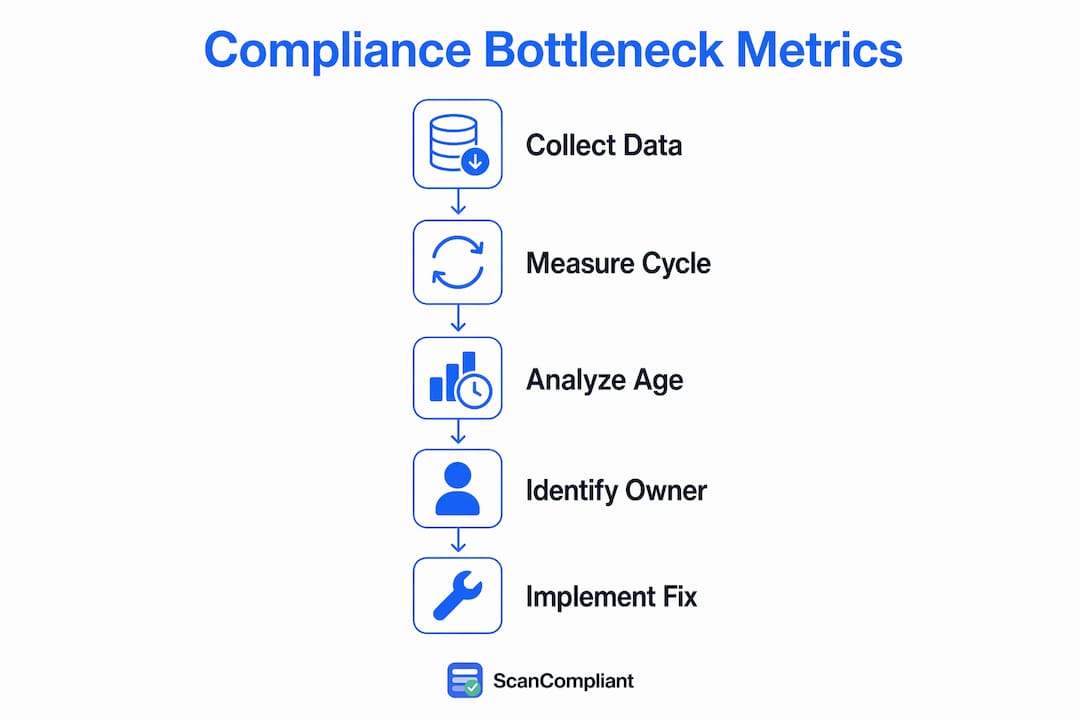
Collect data from your project management tool, email threads, or Slack channels for a 60-day window. That sample is long enough to smooth volume spikes and short enough to reflect your current process. A content compliance audit gives you a reusable template for this collection step.
Automatic evidence capture at the point of action matters here. Rebuilding audit trails after the fact is one of the most time-consuming tasks compliance teams face, and it is entirely avoidable.
Operational fixes that reduce queues without adding legal risk
Embedding compliance controls into the drafting stage rather than gatekeeping at publication is the single highest-leverage change most teams can make. Call it compliance-by-design: the brief specifies acceptable claim types, the template blocks prohibited language, and the reviewer confirms rather than discovers.
Practical changes that move the needle:
- Decentralize low-risk decisions. Give marketing writers a plain-English reference list of pre-approved claim structures. Reserve legal review for novel clinical claims and high-risk categories like GLP-1 or telehealth prescribing.
- Build a risk-scoring escalation path. Auto-approve content that matches a pre-cleared template. Queue for standard review anything that deviates slightly. Escalate to legal only when a piece makes a new efficacy claim or references a specific condition.
- Standardize phrasing. A library of approved claim templates cuts rework faster than any process change. If “supports healthy metabolism” is cleared, writers stop inventing variations that trigger another review cycle.
- Assign clear ownership per content type. Paid social goes to one owner, site copy to another, email to a third. Ambiguity is the enemy of throughput.
Cross-functional ownership models distribute accountability without distributing risk, which is the balance most teams struggle to find.
Pro Tip: Adding more reviewers almost always backfires. More reviewers increase decision latency and create compliance fatigue. Fix the process before you hire.
When automation helps and what compliance scanners actually do
Automation reliably handles the high-volume, pattern-based work: flagging explicit prohibited claims, catching restricted category language, and checking against platform advertising policies. It does not replace human judgment on novel clinical claims or context-dependent interpretations. The distinction matters because teams that automate everything end up with false confidence, and teams that automate nothing stay buried.
Scancompliant scans websites, social content, documents, and product listings against FDA and FTC risk criteria. It flags risky language by priority level, explains each finding in plain English, suggests compliant rewrites, and generates a documented approval trail. With more than 1,000 risk terms in its database, it catches the subtle implied claims that human reviewers under time pressure tend to miss. The result is faster marketing compliance review and a defensible evidence record.
API-driven compliance platforms connect directly to content management systems so checks run during drafting, not after. For telehealth teams publishing across a CMS, paid social, and email simultaneously, that integration eliminates the manual submission step that often accounts for a full day of queue time. Scancompliant’s platform supports multi-user team workspaces, which means marketing, legal, and regulatory can all see the same prioritized findings without forwarding PDFs.

Pro Tip: Start automation on your highest-volume, lowest-complexity content type first — product listing copy or email subject lines. Prove the cycle-time reduction there before expanding to landing pages and clinical claim-heavy content.
AI augmentation in regulatory affairs is maturing fast; the teams that pilot it on a scoped content type now will have a measurable advantage when volume scales.
A 30/60/90-day plan to remove a compliance bottleneck
| Phase | Weeks | Activities | Owner | Output |
|---|---|---|---|---|
| Pilot | 1–4 | Gap analysis, baseline metrics, select one high-volume content type | Compliance ops + marketing ops | Bottleneck map, baseline KPIs |
| Scale | — | Roll out SOPs, claim templates, and automation to two additional content types | Legal reviewer + marketing ops | Updated SOPs, first-pass rate improvement |
| Handover | — | Full SOP documentation, training, ongoing audit cadence | Compliance ops | Documented process, evidence trail |
Choose your pilot content type carefully. Pick something representative and high-volume — email campaigns or paid social copy — so the cycle-time improvement is visible within four weeks. Avoid starting with your most complex content (clinical landing pages) because the signal will be noisy and the wins slower.
Success metrics at each stage: median review time below 3 business days by week 4; first-pass approval rate above 70% by week 8; 100% of approvals with a documented audit trail by week 12. Integrating compliance checks into your content pipeline from the start of the pilot prevents the common mistake of bolting automation onto a broken manual process.
Audit checklist: what to inspect right now
Use this checklist in your next weekly or monthly compliance review. Tag each item High, Medium, or Low priority based on your gap analysis scores.
- SOPs documented and current? Every content type has a written review procedure updated within the last 6 months.
- Queue metrics tracked? Median cycle time and first-pass rate are pulled at least monthly.
- Evidence trails complete? Every approved piece has a timestamped approval record.
- Version control active? No content publishes from an unversioned draft.
- Approval handoffs defined? Each content type has a named owner and a named backup.
- Claim templates in use? Writers have access to a pre-approved phrasing library.
- Automation coverage mapped? You know which content types are scanned and which are not.
- Escalation path documented? Writers know exactly when to escalate and to whom.
- Platform policy updates tracked? Someone owns monitoring FDA, FTC, and ad platform policy changes.
- Audit cadence set? Full review quarterly, spot checks monthly.
Pro Tip: Run this checklist with both marketing and legal in the room. The gaps they disagree on are your highest-priority items.
A compliance database that stores approved claims, evidence records, and policy versions makes this checklist faster to complete every cycle.
Key Takeaways
Compliance bottlenecks in telehealth and DTC health marketing are operational problems with operational solutions: measure the queue, fix the process, embed the checks, and automate the pattern work.
| Point | Details |
|---|---|
| Measure before you fix | Track median review cycle time, first-pass approval rate, and rework rate for 60 days before changing anything. |
| Compliance-by-design beats gatekeeping | Embedding checks in the brief-to-publish workflow cuts rework loops faster than adding reviewers. |
| Decentralize low-risk decisions | Pre-approved claim templates and plain-English guardrails let writers self-correct without legal escalation. |
| Automate pattern-based work first | Scan high-volume, lower-complexity content types first to prove cycle-time reduction before expanding. |
| Scancompliant as your pilot tool | Scancompliant scans content against FDA and FTC criteria, prioritizes findings, and generates audit trails for more than 200 protected brands. |
The trade-off most teams get wrong
The instinct when reviews pile up is to add a reviewer. It feels like the responsible move. But adding reviewers increases decision latency and diffuses accountability. The real fix is almost always upstream: a clearer brief, a pre-approved claim library, or a scan that catches the obvious issues before a human ever sees the piece.
Compliance-by-design changed how high-performing telehealth teams operate. When checks are embedded in the drafting stage, reviewers spend their time on genuine judgment calls, not housekeeping. That shift is what actually moves first-pass approval rates. The teams that treat compliance as a system to optimize, rather than a gate to survive, are the ones publishing faster without accumulating regulatory risk.
The mistake to avoid: treating every flagged item as equally urgent. Distinguishing housekeeping issues from true compliance failures using a risk-scoring matrix (impact × likelihood) is what separates a functional compliance program from a reactive one.
Scancompliant cuts review time without cutting corners
Faster approvals without more legal exposure is the actual goal, and that is exactly what Scancompliant is built for. The platform scans your website, social content, product listings, and documents against FDA and FTC risk criteria in minutes, flags findings by priority, explains each one in plain English, and suggests compliant rewrites your writers can act on immediately.

For teams ready to pilot, scope the first 30 days to one high-volume content type. Track median review time and first-pass approval rate before and after. The evidence trail Scancompliant generates is also your audit documentation, so you are building compliance infrastructure while you reduce queue time. More than 200 brands have already used it to protect their marketing and move faster.
See how it works or review pricing and plans to scope a pilot for your team.
Useful sources and recommended reading
- FDA Advertising and Promotion Guidance — primary source for permissible claims in telehealth and DTC health marketing
- FTC Advertising Rules and Guidance — endorsement rules, substantiation requirements, and enforcement priorities
- Compliance Program Gap Analysis (Ethico) — structured methodology for identifying control weaknesses before regulators do
- Bottleneck definition and operational fixes (Investopedia) — foundational operations framing applicable to compliance workflows
- Scancompliant: compliance workflow automation for healthcare teams — concrete automation use cases and integration examples
- Content review workflow best practices for healthcare teams — approval templates and workflow design guidance
- GLP-1 marketing compliance playbook — FDA warning letter context and high-risk category guidance for GLP-1 brands
1 Comment