Undetected marketing claims cause real damage fast: consumers get hurt physically and financially, the FTC and FDA move in with enforcement, and trust erodes across the entire telehealth category, not just the brand that slipped up. The FTC’s action against NextMed and a fresh wave of FDA OPDP untitled letters shows regulators are done waiting for self-correction.
What this costs a brand, concretely:
- Consumer harm: people delay real treatment or pay fees they never agreed to.
- Regulatory exposure: consent orders, civil penalties, warning letters, injunctions.
- Category-wide trust erosion that outlasts any single settlement.
Teams that catch these claims before publication avoid six-figure settlements and keep their ad accounts, their partnerships, and their credibility intact.
Key Takeaways
Undetected marketing claims cause consumer harm first and regulatory action second, and both damage a brand’s trust long after any fine is paid.
| Point | Details |
|---|---|
| Harm comes before enforcement | Consumers face physical harm from forgone care and economic harm from hidden fees before regulators ever get involved. |
| NextMed sets the template | The FTC’s consent order covered pricing deception, fake testimonials, and review manipulation, not just efficacy claims. |
| Net impression is the real risk | FDA OPDP now scrutinizes tone, visuals, and dual-modality mismatches, not just literal wording. |
| Process gaps cause most misses | Siloed ownership and rushed timelines let subtle claims through more often than careless copywriting does. |
| ScanCompliant closes the gap | Its 1,000-plus term risk database and documented review trail have already screened content for over 200 telehealth and DTC brands. |
Table of Contents
- Why Undetected Claims Damage Brands: The Real Consequences
- How Do Subtle Claims Slip Past Review?
- Why Do Compliance Reviews Miss These Claims?
- What Should a Pre-Publish Compliance Checklist Include?
- How Automated Scanning Reduces This Risk
- What to Do If an Undetected Claim Reaches the Public
- What Metrics Signal Brand Damage From Undetected Claims
- A Practical Next Step for Teams Managing This Risk
- Frequently Asked Questions
- Sources
Why Undetected Claims Damage Brands: The Real Consequences
The damage starts with the consumer, not the compliance file. Someone who reads “clinically proven” language and skips a doctor visit, or who gets billed a recurring membership fee they never saw disclosed, has suffered a concrete harm. That’s the standard the FTC applies when it evaluates health-related advertising: physical harm from forgone care, and economic harm from deceptive pricing or unsubstantiated promises.
Once that harm surfaces, remedies escalate quickly. The FTC can issue consent orders that include monetary payments, mandatory refunds, and prohibitions on specific marketing practices going forward. The FDA works a parallel track: untitled letters, warning letters, injunctions, and in compounding cases, seizure risk. The two agencies coordinate under a liaison arrangement, so a claim that draws FTC attention for deceptive pricing can just as easily trigger an FDA look at the underlying drug claims.
The clearest recent illustration is the FTC’s case against NextMed. The complaint alleged the telehealth company advertised misleading weight-loss pricing, cited unsubstantiated “average results” figures, used fabricated testimonials, manipulated its online reviews, and failed to disclose membership terms clearly. The consent order required a monetary payment and barred the company from repeating these practices.
The FTC’s remedies weren’t limited to a fine. They included specific, ongoing prohibitions: no more unsubstantiated typical-results claims, no more review manipulation, and mandatory disclosure of true costs before consumers pay.
That combination, monetary payment plus conduct restrictions plus reputational fallout, is what “damage” actually means in this category.
How Do Subtle Claims Slip Past Review?
Most flagged content doesn’t contain an obvious lie. It contains a claim that reads fine in isolation but creates a misleading overall impression once you factor in the visuals, the tone, and the missing context. The FDA’s OPDP calls this the “net impression”, and it’s the single hardest thing for a rushed reviewer to catch.
Watch for these patterns, since they account for most enforcement triggers:
- Unsupported efficacy: a specific percentage or timeframe with no linked study behind it.
- Implied equivalence: language suggesting a compounded product works identically to an FDA-approved one.
- Disguised source: private-label vials or logos that imply the seller manufactured or compounded the drug themselves.
- Pricing omissions: a headline price that hides mandatory membership fees or recurring charges.
- Manipulated proof: testimonials or star ratings that don’t reflect typical results, or that were incentivized without disclosure.
Run this quick sequence before anything ships:
- Read the copy alone, then watch the video or scroll the ad with sound on. Do they say the same thing?
- Check every numeric claim for a linked, citable source.
- Ask whether a first-time viewer would walk away believing something the fine print doesn’t actually support.
Pro Tip: If your risk/benefit statement only appears as tiny on-screen text while the voiceover promises results, that’s a dual-modality mismatch, exactly the pattern OPDP has flagged repeatedly since late 2025.
Why Do Compliance Reviews Miss These Claims?
Undetected claims usually trace back to how the review process is built, not to any one careless writer. Growth, clinical, and legal teams often own different parts of the same asset, and nobody owns the full net impression. Creative timelines compress before a launch, and the version that goes to legal isn’t always the version that goes live.
Recurring breakdowns show up in a few predictable places:
- Reviewers evaluate text but never see the final video cut with the on-screen graphics stitched in.
- Claims get mapped to “customer feedback” instead of clinical substantiation, because nobody defined acceptable evidence tiers.
- No one tracks which ad variations passed review and which slipped through as last-minute edits.
The lifecycle gap is usually the same one: 1) the brief promises a benefit, 2) creative dramatizes it visually, 3) paid media traffics it without a final compliance pass. By the time it’s live, the compliance bottleneck that let it through is invisible until an agency notices.
What Should a Pre-Publish Compliance Checklist Include?
A workable checklist forces evidence and sign-off before anything reaches a paid channel. Build it around these controls:
- Claim-to-evidence mapping: every benefit statement or number needs a linked source, tiered by strength (product labeling, a randomized controlled trial, or documented real-world results).
- Dual-modality checks: for video or audio, confirm the spoken claim and the on-screen text say the same thing at the same time, not two versions racing past each other.
- Defined sign-off gate: name who approves what, clinical for efficacy language, legal for disclosures, compliance for risk terms, marketing for tone, and require all four before launch.
- Automated scanning: run copy against a risk-term list before a human ever opens the file, so obvious red flags get caught in minutes, not days.
- Pixel and intake audit: confirm every tracking script and third-party tag on the landing page actually matches what your privacy policy promises. This is the one teams forget most.
Pro Tip: Treat your intake forms and ad pixels as part of the claim review, not a separate IT task, mismatched data flows have triggered FTC scrutiny even when the ad copy itself was clean.
Documenting each of these steps matters as much as performing them. A misleading health claim that reaches an agency investigator looks very different when you can produce a dated evidence trail versus when you can only say you “reviewed it internally.”
How Automated Scanning Reduces This Risk
Manual review alone can’t keep pace with the volume of ads, landing pages, and email sends most DTC health brands push out weekly. Automated scanning changes the math: instead of a reviewer reading every asset cold, the system flags risky language against a known database before a human ever opens the file.
ScanCompliant runs marketing copy, product listings, and social content against a database of more than 1,000 risk terms, classifies each flagged phrase by severity, and links it to plain-English guidance on why it’s risky. That prioritization is what actually saves time: reviewers spend their attention on the handful of genuine problems instead of rereading everything from scratch.
- Faster cycles: high-risk items surface in minutes, not after a full manual pass.
- A documented trail: every scan and decision is timestamped, which matters if a regulator ever asks what your review process looked like.
- Broader coverage: the platform has already screened content for more than 200 brands, catching phrasing patterns a single in-house reviewer might not have seen before.
Hooking the scanner into your CMS and ad platform intake means nothing reaches a live URL without passing that first filter.
What to Do If an Undetected Claim Reaches the Public
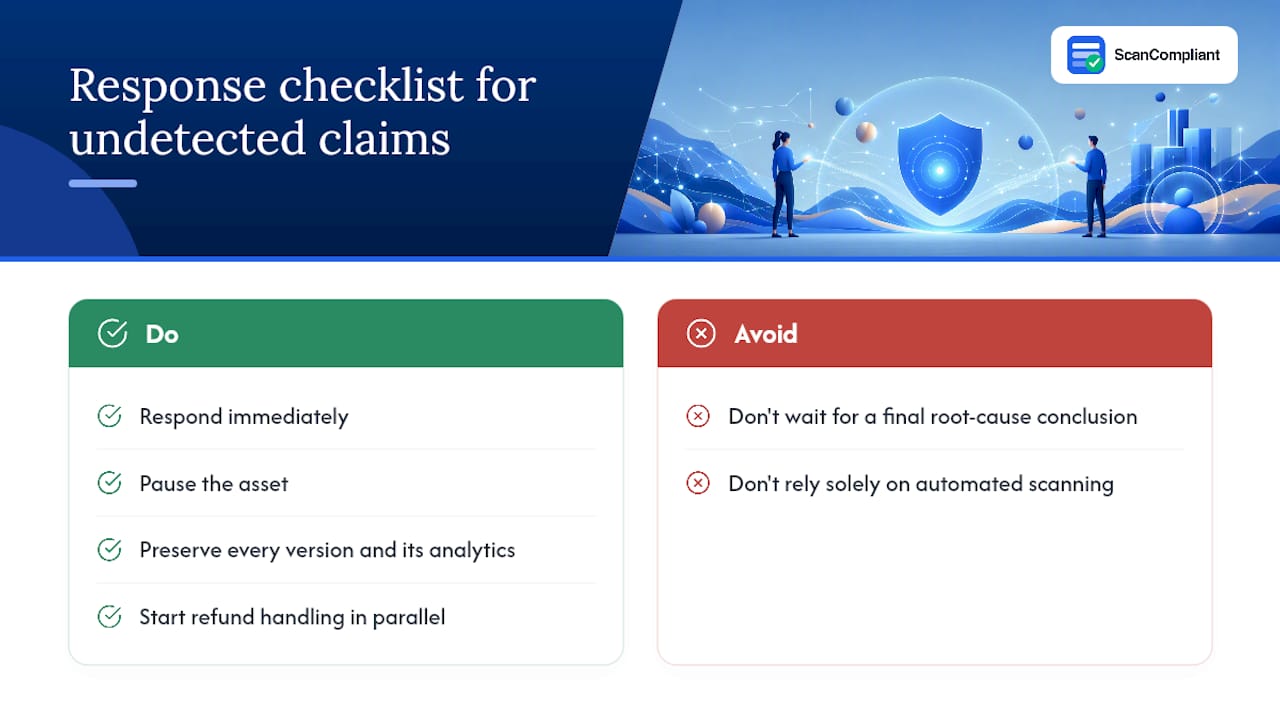
Speed matters more than perfection here. The moment you spot a problem, or receive a warning letter, move through this sequence:
- Pause the asset across every channel it’s running, paid, organic, and email.
- Preserve every version of the creative along with performance analytics, don’t let anyone quietly edit the live version first.
- Inventory pixels and third-party data flows connected to that asset in case the issue involves privacy, not just copy.
- Loop in legal and clinical teams immediately to assemble substantiation documents an agency response will require.
- Draft corrective copy, a consumer notice if refunds are owed, and a root-cause log explaining how the claim got published.
Refund handling should move in parallel with the internal review, not after it. Delayed refunds compound the original complaint into a second one about health content liability and bad faith.
What Metrics Signal Brand Damage From Undetected Claims
Watch refund request spikes, sudden jumps in escalations to legal or care teams, and a fast rise in negative reviews; these move before any regulator contacts you. A warning letter, untitled letter, or formal inquiry is a high-severity signal on its own and should trigger the remediation playbook immediately.
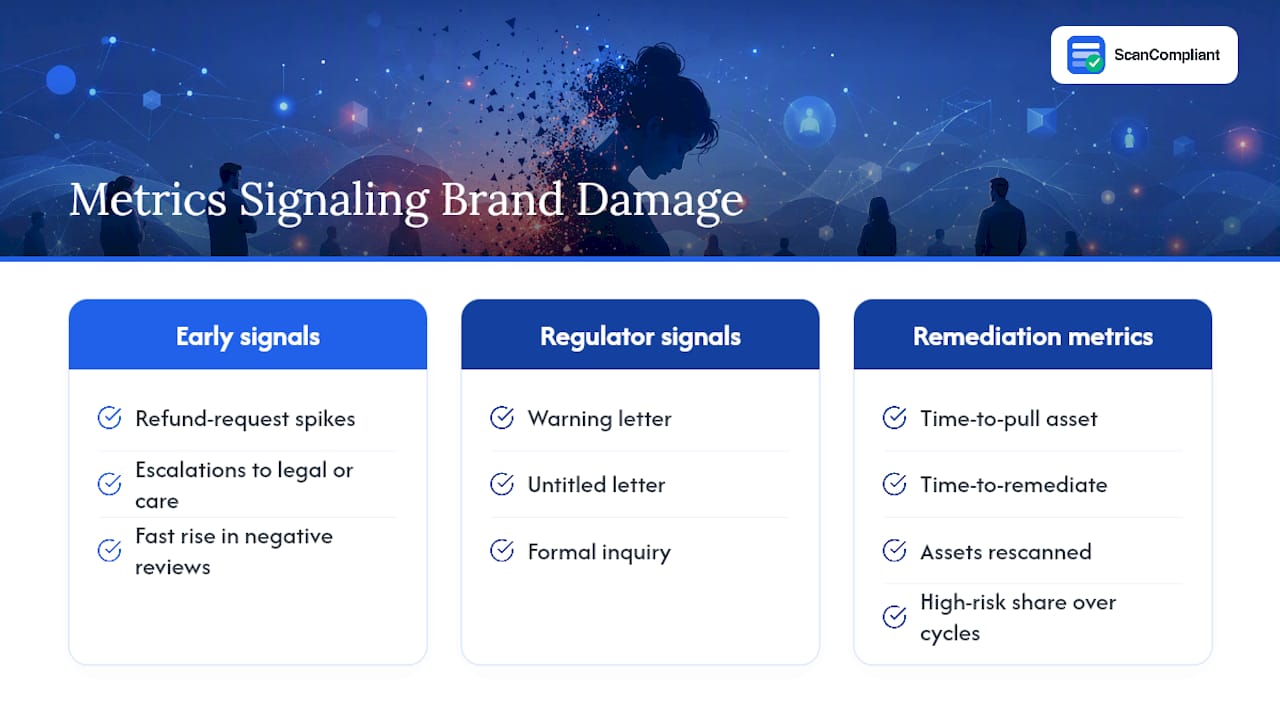
Track recovery the same way: time-to-pull an asset, time-to-remediate, how many assets get rescanned, and whether your share of high-risk flagged content actually drops over successive review cycles. If that last number isn’t shrinking, your process fix isn’t working yet.
A note on ownership
Prevention is cheaper than remediation, and it stays that way only when no single department owns compliance alone. Treating claim review as a checklist item instead of a shared responsibility is how brands end up explaining themselves to the FTC.
A Practical Next Step for Teams Managing This Risk
You don’t need a bigger legal team to catch most of what gets flagged in this article, you need the review to happen earlier, on every asset, with a paper trail attached. ScanCompliant maps directly onto the checklist above: it scans copy against a database of more than 1,000 risk terms, links flagged claims to plain-English explanations, and keeps a timestamped record of every review, the kind of documentation that matters if a regulator ever asks how a claim got approved.
The platform has already screened content for over 200 brands in telehealth and DTC health, catching the pricing omissions, implied-superiority phrasing, and testimonial issues that manual review tends to miss under deadline pressure. If your team runs GLP-1 or compounded-product marketing specifically, the GLP-1 compliance scanner checks your live site against the exact violation patterns showing up in recent FDA warning letters.
Pro Tip: Wire the scan into your pre-publish gate, not a post-launch audit, so flagged language never reaches a live URL in the first place.
Start with a free scan of your current site at ScanCompliant to see what a risk-term database catches that your last manual review didn’t.
Frequently Asked Questions
Why do undetected claims damage brands more than obvious violations?
Obvious violations get caught before launch. Undetected claims run for weeks or months, reaching more consumers and generating more of the harm, refunds, complaints, negative reviews, that regulators cite as evidence of a pattern rather than a one-time mistake.
What is the most common type of claim that escapes review?
Implied claims created by net impression, where the spoken words, on-screen text, and visuals together suggest something the label or fine print doesn’t support, are harder to catch than a flatly false statement.
Does the FTC or FDA handle telehealth marketing claims?
Both, often on the same issue. The FTC generally addresses deceptive pricing, testimonials, and general advertising claims, while the FDA addresses drug-specific efficacy and safety claims. The agencies coordinate when a case touches both areas.
How fast should a brand respond after spotting an undetected claim?
Immediately. Pause the asset, preserve every version and its analytics, and start refund handling in parallel with your internal review rather than waiting for a final root-cause conclusion.
Can automated scanning fully replace human compliance review?
No. Automated scanning against a risk-term database catches volume and obvious patterns fast, but clinical and legal judgment still decide what qualifies as adequate substantiation for a specific claim.
This article is general information, not a substitute for advice from a qualified doctor. Consult a qualified healthcare professional about your own circumstances before acting on anything here.
Sources
- FTC takes action against telemedicine firm NextMed over charges it used misleading prices, fake reviews, and unsubstantiated claims
Recommended
- Misleading Health Claims: A Compliance Guide for DTC Brands – scancompliant.com
- Health Content Liability for Telehealth and DTC Brands – scancompliant.com
- Why Third-Party Content Creates Risk for Telehealth Brands – scancompliant.com
- Wellness Blog Legal Pitfalls for DTC and Telehealth Teams – scancompliant.com