
A material connection disclosure is a plain statement telling your audience that you have a financial, personal, or business tie to a brand you’re endorsing, made whenever that tie isn’t something viewers would already assume. The controlling authority is the Federal Trade Commission (FTC), under 16 CFR § 255.5, which requires disclosure any time a connection “might materially affect the weight or credibility” people give an endorsement.
A connection counts if it isn’t reasonably expected by the audience and could change how they judge your recommendation. Payment, free products, affiliate commissions, family ties, and similar relationships all qualify.
- Required when: money, products, or perks change hands and the audience wouldn’t otherwise know
- Governed by: FTC Endorsement Guides and 16 CFR § 255.5
- Standard: disclosure must be “clear and conspicuous,” not buried or vague
Key Takeaways
A material connection disclosure is legally required under 16 CFR § 255.5 whenever an undisclosed relationship could change how a reasonable viewer weighs an endorsement.
| Point | Details |
|---|---|
| Legal test | Disclose when a connection isn’t reasonably expected and could affect audience trust in the endorsement. |
| Broad definition | Payment, free products, affiliate commissions, family ties, and equity all count as material connections. |
| Timing rule | Disclose at the moment of endorsement and repeat it throughout livestreams and long videos. |
| Placement standard | Put disclosures above the fold, in view, and paired with audio or on-screen text for video. |
| Scale with automation | Scancompliant flags missing disclosures and risky language quickly, building a documented review trail for teams managing many creators. |
Where to Read the Primary Sources
- Disclosures 101 for Social Media Influencers — the FTC’s core practical guidance
- 16 CFR § 255.5 — the binding regulatory text
- FTC’s Endorsement Guides: What people are asking — official Q&A on edge cases
- Disclosures 101 influencer guide (PDF) — platform-by-platform placement examples
This article is general information, not a substitute for advice from a qualified lawyer. Consult a qualified legal professional about your own circumstances before acting on anything here.
Table of Contents
- What Is Material Connection Disclosure Under FTC Rules?
- What Counts as a Material Connection?
- When Does a Disclosure Actually Have to Happen?
- How Do You Disclose Clearly and Conspicuously?
- Who Is Responsible for Disclosure Compliance?
- What Happens When Disclosures Go Missing?
- What Should a Disclosure Compliance Checklist Include?
- Can You Scale Disclosure Compliance Across Many Creators?
- How Automation Speeds Up Disclosure Compliance
- Sources
What Is Material Connection Disclosure Under FTC Rules?
The FTC didn’t invent this concept out of thin air. It built 16 CFR § 255.5 on a simple consumer-protection idea: people weigh a recommendation differently once they know the person making it has skin in the game. A friend’s unprompted book recommendation carries different weight than the same recommendation from someone the publisher paid $500.
The rule text is narrow but consequential: a connection must be disclosed when it’s not reasonably expected by the audience and might affect how they view the endorsement’s credibility.
The FTC’s own guidance, Disclosures 101 for Social Media Influencers, translates that legal test into working rules for creators and brands. Two elements matter most:
- Materiality — would this fact change how a reasonable viewer interprets the endorsement?
- Conspicuousness — is the disclosure placed and worded so an ordinary viewer would actually notice it?
U.S. disclosure rules apply whenever content reasonably reaches U.S. consumers, regardless of where the creator or brand is physically based. A creator posting from abroad but targeting an American audience still falls under FTC jurisdiction for that content.
What Counts as a Material Connection?
Most people picture “sponsored post” and stop there. The actual list is longer, and several categories catch marketers off guard.
- Direct payment for a post, video, or mention, in cash or in-kind
- Free or discounted products, even a single sample sent without obligation
- Affiliate commissions earned when a viewer clicks your link and buys
- Employment or family relationships, including working for the brand or being related to someone who does
- Early access to products, events, or embargoed information
- Prizes, giveaways, or contest entries tied to promoting a brand
- Equity or ownership in the company you’re featuring
The less obvious cases trip up experienced creators too. An unsolicited free product still triggers disclosure the moment you mention it publicly. Loaned products (you don’t keep them, but you used them for a review) count. So does a “maybe we’ll work together later” arrangement where a brand hints at future paid partnership in exchange for early coverage. A creator who reviews a blender she bought herself owes no disclosure. The same creator reviewing a blender the manufacturer mailed her, unprompted, owes one the second she talks about it online.
When Does a Disclosure Actually Have to Happen?
Disclosure is required whenever a material connection exists and a significant minority of your audience wouldn’t reasonably expect it. That’s the FTC’s operating threshold: not “would everyone assume this,” but “would enough people be misled without the information.”
Timing matters as much as the fact itself.
- Disclose at the time of the endorsement, not in a follow-up post or a comment reply days later
- For livestreams and long-form video, repeat the disclosure periodically, since viewers join mid-stream and won’t see an opening mention
- Update your disclosure the moment terms change, such as a free-sample arrangement converting into a paid sponsorship deal
Pro Tip: If a brand relationship evolves mid campaign, don’t wait for the next post to update your disclosure. Edit the caption or add a pinned comment immediately, because the FTC evaluates each piece of content on its own, not your account history.
How Do You Disclose Clearly and Conspicuously?
The FTC judges disclosures on placement, proximity, prominence, language, and repetition. A disclosure technically present but three scrolls below the fold, or flashed for half a second in a video, fails the test just as surely as no disclosure at all.
Platform-specific rules:
- Instagram posts — put “ad” or “sponsored” in the first two lines of the caption, above the “more” cutoff, per the FTC’s influencer guide
- Instagram/Snapchat stories — overlay text on the image itself, not just in a caption viewers can swipe past
- TikTok and YouTube videos — state the disclosure verbally and show it as on-screen text, since some viewers watch muted
- Livestreams — repeat disclosure every so often; a one-time mention at the start won’t reach viewers who join later
- X (formerly Twitter) — include “ad” or “sponsored” within the visible tweet text, not a linked thread
- Blog posts and affiliate links — disclose near the link itself, not only in a general site-wide disclosure page
Sample phrasing that clears the bar: “Ad,” "Sponsored by [Brand],” “I get paid if you buy through this link,” or “[Brand] sent me this for free.” All are short enough for constrained spaces and explicit enough that no reasonable viewer misses the point.
What fails: vague hashtags like #sp or #partner, a disclosure buried after “read more,” or text-only disclosure in an image that displays for less time than a viewer needs to read it. Platform-provided disclosure tools (Instagram’s “Paid Partnership” tag, YouTube’s paid promotion checkbox) help, but the FTC has said these tools alone may not satisfy the standard. Pair the platform tool with your own plain-language text disclosure.
Pro Tip: Never rely solely on a platform’s built-in disclosure label. Add your own written disclosure in the caption or description, since platform tags don’t always display the same way across every device or feed algorithm.
Who Is Responsible for Disclosure Compliance?
Responsibility splits between creator and brand. Influencers must actually make the disclosure. Brands carry an affirmative obligation to educate and monitor the people they work with, not just hand over product and walk away.
Practical steps for brands include:
- Requiring disclosure language in influencer contracts, with specific wording examples attached
- Reserving the right to review and approve posts before or shortly after they go live
- Escalating immediately when a disclosure is missing entirely or worded ambiguously (a lone
#adwith no other context, for instance)
Our guide to documenting compliance decisions covers how to build a paper trail that shows you took monitoring seriously if regulators ever ask.
What Happens When Disclosures Go Missing?
The FTC doesn’t only issue guidance. It sends warning letters to influencers and trade associations whose posts lack adequate disclosure, and it can pursue civil penalties, settlement agreements, and corrective advertising requirements in more serious cases.
A missing disclosure doesn’t just create a paperwork problem. It can convert an otherwise truthful, defensible claim into a deceptive advertising practice under FTC law, because the omission itself misleads consumers about the source of the recommendation.
Typical violations look mundane on their face: a beauty influencer mentioning a gifted product with no tag at all, an affiliate blogger linking a product with disclosure text only on a separate policy page. The remedies scale with severity, but even a warning letter creates reputational damage and forces retroactive content edits across an entire account. Third-party endorsement risk compounds fast once regulators start looking at a brand’s broader marketing ecosystem, something we break down further in why third-party content creates risk for telehealth and DTC brands specifically.
What Should a Disclosure Compliance Checklist Include?
Run through these steps every time a post goes out the door:
- Identify whether any material connection exists (payment, product, family, employment, equity)
- Choose disclosure wording that names the connection plainly
- Place the disclosure where the audience will actually see it before engaging further
- Repeat the disclosure for long-form or live content
- Log the disclosure decision and final content in your review system for future reference
Ready-to-use phrases for different constraints:
- “Ad”
- “Sponsored by [Brand]”
- “I get paid for links in this post”
- “[Brand] sent me this product for free”
- “Affiliate link, I earn a commission”
- “Paid partnership with [Brand]”
Brand agreements should mandate disclosure language and require creators to retain screenshots or drafts as evidence, a practice covered in more depth in our FDA compliance playbook for regulated categories.
Can You Scale Disclosure Compliance Across Many Creators?
Manual review works fine for five influencer posts a month. It breaks down at fifty. Automated scans can flag missing or ambiguous disclosures across a content queue faster than any single reviewer, building an audit trail as posts move through approval.
- Automated scans catch obvious gaps: no disclosure text, buried placement, banned vague hashtags
- Human review still handles nuance: is “collab” clear enough in this specific context, does a family relationship need naming
Automation supports legal judgment. It doesn’t replace it. Every flagged exception still needs a documented reviewer decision, which matters if the FTC ever asks how your program actually functions in practice.
Pro Tip: Combine automated pattern detection with a human legal reviewer for gray-area cases, and log every override decision. That log becomes your best evidence of a good-faith compliance program if enforcement ever comes knocking.
What compliance leads actually prioritize
Text disclosures belong above the fold, always, no exceptions for “cute” placement. Pre-approval catches problems before they’re public, which is cheaper than any after-the-fact fix. And a dated log of every disclosure decision is the single best defense if a regulator ever calls.
How Automation Speeds Up Disclosure Compliance
Reviewing every influencer post and affiliate page by hand doesn’t scale once a brand works with more than a handful of creators, and manual review is exactly where undisclosed connections slip through.
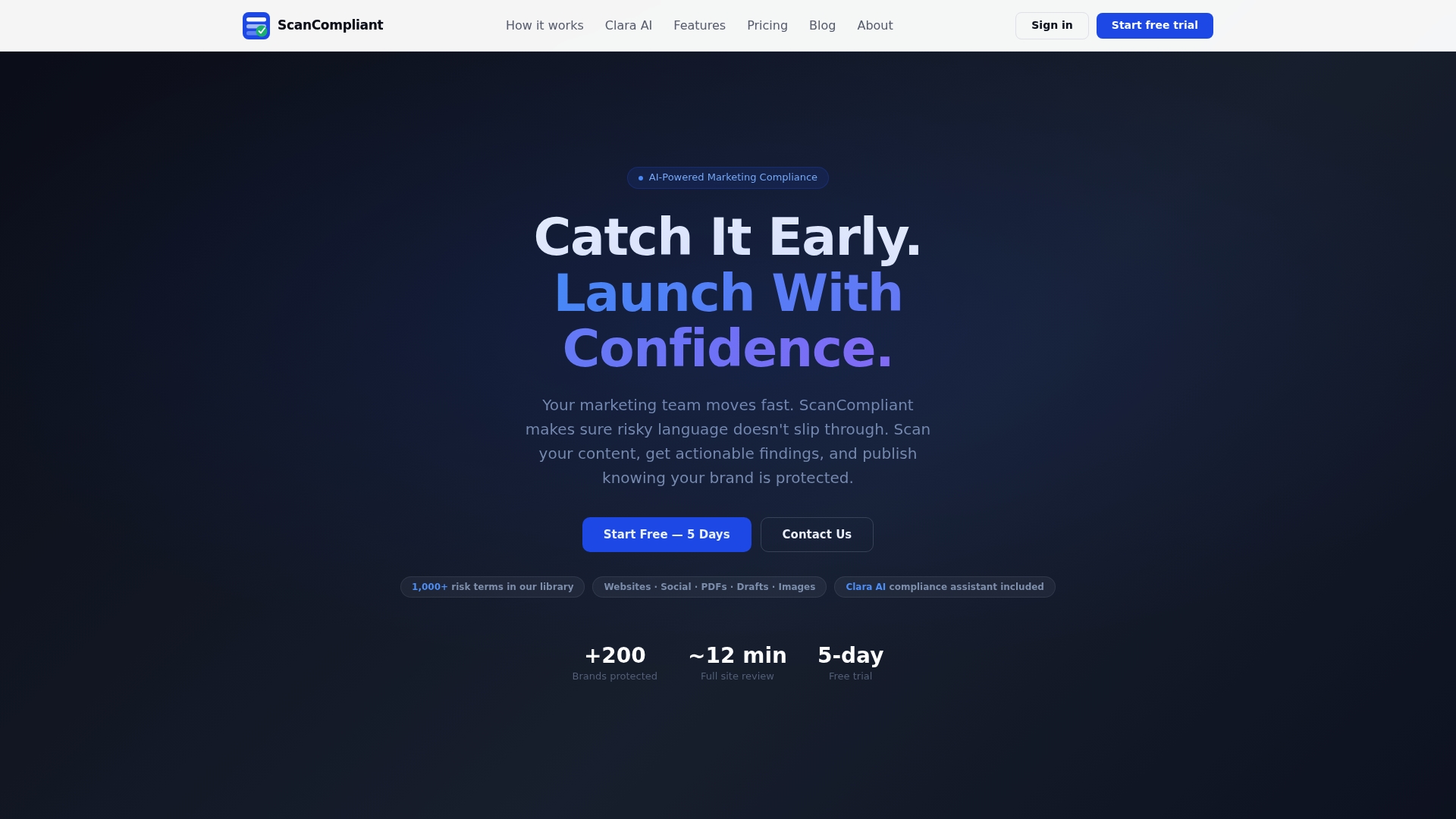
Scancompliant is built for regulatory and marketing teams who need faster answers than a manual checklist can give. The platform scans live content for missing or weak disclosures, flags risky phrasing against a database of over 1,000 known risk terms, and hands reviewers a prioritized list instead of a raw content dump. Every flagged issue and reviewer decision gets logged automatically, so you have a documented compliance trail if a regulator asks how your monitoring program actually works. That combination, faster review cycles plus a permanent audit record, is the practical difference between hoping your influencer program is compliant and knowing it. Teams in telehealth and DTC health specifically face added claim risk on top of disclosure risk, which our GLP-1 marketing compliance guide walks through in detail. Start a trial at Scancompliant to see how prioritized findings look against your own content library.
Sources
- 16 CFR § 255.5 – Disclosure of material connections.
- Disclosures 101 for Social Media Influencers | Federal Trade Commission
- FTC’s Endorsement Guides: What people are asking | Federal Trade Commission
- Disclosures 101 for Social Media Influencers (PDF) | Federal Trade Commission
Recommended
- Compliance in Investor Due Diligence: A Practical Guide – scancompliant.com
- Compliant Content Release in Healthcare Marketing: 2026 Guide – scancompliant.com
- Integrating Compliance Checks Into Your Content Pipeline – scancompliant.com
- Continuous Compliance Monitoring: Your 2026 Complete Guide – scancompliant.com