
Misleading by omission means leaving out, hiding, or burying information a reasonable person would need to make an honest decision. No false statement is required. The verdict: an omission crosses into deception when the missing fact is material and someone had a duty to share it. The rest of this piece breaks down the legal elements, shows real examples, and covers how to spot and prevent it.
Key Takeaways
Misleading by omission happens when a material fact is withheld, hidden, or presented too unclearly for a reasonable person to make an informed decision.
| Point | Details |
|---|---|
| Definition | Omission means hiding, omitting, or unclearly presenting material information likely to change a decision. |
| Lying vs. omission | Lying requires a false statement; omission requires proof of a duty to disclose plus materiality. |
| Legal triggers | Fiduciary relationships, consumer protection statutes, securities law, and contract disclosure rules can all create a duty to speak. |
| Ethical test | Ask whether the other party would still agree if they knew the omitted fact; if not, it’s material. |
| Prevention | Scancompliant scans content against numerous risk terms to flag missing disclosures and build an audit trail before publication. |
Table of Contents
- What Does Misleading by Omission Mean, Exactly?
- Lying vs. Omission: What’s the Real Difference?
- Real Examples of Misleading by Omission
- When Does Silence Become Legally Actionable?
- Why Omission Damages Trust Even When It Feels Harmless
- How to Spot Misleading Omission in Practice
- What Can You Do About It, and How Do You Prevent It?
- A Practical Workflow for Catching Omissions Before They Publish
- A Compliance Perspective on Why Disclosure Beats Cleverness
- Catching Omissions Before Regulators Do
- Frequently Asked Questions
- Sources
What Does Misleading by Omission Mean, Exactly?
Omission here means a failure to disclose, a disclosure that’s hidden, or one presented so unclearly or late that it does no good. Regulatory guidance describes it as omitting or hiding material information, or presenting it unclearly or untimely, in a way likely to change someone’s decision.
Three elements turn a plain gap into a misleading omission:
- Materiality. The information has to matter to the decision. A missing shoe size doesn’t count; a missing recurring fee does.
- Context and medium. A cramped Instagram ad has less room than a full webpage, but that only excuses so much. Regulators weigh whether the medium’s space or time limits genuinely justify the gap.
- Effect on the average consumer. Would a typical, reasonably attentive person have decided differently with the missing fact?
Intent isn’t always required for legal liability, but it shapes both the moral read and the size of the penalty. Negligent omission is still deceptive. Deliberate omission is worse.
Lying vs. Omission: What’s the Real Difference?
Lying is an affirmative false statement. Deception by omission is withholding a true, relevant fact. Both mislead, but they’re proven differently, and the law treats them differently too.
- Lying: You have to show the statement was false and that the speaker knew or should have known.
- Omission: You have to show a duty to disclose existed and that the missing fact was material.
- Example contrast: telling a buyer a car “has never been in an accident” when it has is a lie. Saying nothing about a documented accident when directly asked about vehicle history is omission.
Silence isn’t legally neutral once a duty to speak exists, which is exactly why omission claims can be just as serious as outright lies, even without a false word spoken.
Real Examples of Misleading by Omission
These show up everywhere, not just in courtrooms.
- Everyday life: A friend selling you their used laptop mentions the fast processor but not that the battery dies in 40 minutes.
- Advertising: A subscription ad screams “$9.99” but the recurring charge, cancellation window, and shipping fee sit in gray six-point text at the bottom. What counts as an “invitation to purchase” typically needs to disclose price, taxes, delivery charges, and the seller’s identity to avoid misleading consumers.
- Health marketing: A supplement page touts a clinical result but omits the sample size or that the study measured something narrower than the ad implies. Scancompliant’s breakdown of misleading health claims covers this pattern in detail.
- Securities and fiduciary settings: A financial advisor recommends a fund without mentioning they earn a commission on it. A company files an offering statement without disclosing pending litigation that could tank the stock.
- Contract law: A seller knows a house has a cracked foundation and says nothing when asked directly about structural issues. Courts have long treated this kind of omission, tied to a known defect and a direct inquiry, as legally significant, echoing older case law on failure to disclose, such as Brown v. Standard Casket Mfg. Co.
When Does Silence Become Legally Actionable?
Not every unsaid thing is a lawsuit waiting to happen. Courts and regulators look for specific triggers.
- Duty to disclose. This arises from a special relationship (doctor-patient, attorney-client), a fiduciary role, a direct question, or a statute.
- Consumer protection statutes. The Consumer Protection from Unfair Trading Regulations 2008 defines misleading omissions around “material information” the average consumer needs for an informed transactional decision. Newer UK law, the Digital Markets, Competition and Consumers Act 2024, restates the same materiality and timing tests for a digital-first market.
- Securities law. Public companies must disclose facts material to investors; omitting them can trigger enforcement even without an explicit lie.
- Contract disclosure requirements. Some contracts (real estate, insurance) carry statutory disclosure duties regardless of whether either party asks.
The materiality test asks whether a reasonable decision-maker would have acted differently with the missing fact. Context matters: a two-second TV spot gets more leeway than a static webpage with unlimited scroll space.
Remedies range from contract rescission and damages to regulatory enforcement actions, fines, or corrective advertising orders. None of these require proof of an outright lie. Proof of a hidden or buried material fact is often enough.
Why Omission Damages Trust Even When It Feels Harmless
Omission erodes trust slower than a lie does but just as thoroughly. People forgive a mistake. They rarely forgive discovering they were managed. Research on deception shows withholding information shapes how people judge and choose just as strongly as an explicit false claim, because it manipulates the inference the listener makes on their own.
There’s a real ethical line between permissible silence and exploitative omission.
- Declining to volunteer irrelevant personal details is fine.
- Staying quiet about a known defect the other party is relying on you to disclose is not.
- Selective emphasis, highlighting the good and burying the bad, sits in the gray zone but tips into exploitation once the buried fact is something a reasonable person needed.
Pro Tip: Before publishing or saying anything, ask: “If the other person knew what I’m leaving out, would they still agree?” If the honest answer is no, you have a materiality problem, not a phrasing problem.
How to Spot Misleading Omission in Practice
Run any claim, ad, or statement through this quick sequence:
- Identify the decision the reader or listener is being asked to make.
- List what they’d need to know to make that decision reasonably well.
- Check for gaps. Is any of that information missing, vague, or buried?
- Assess the medium. Does the format genuinely limit disclosure, or is the limitation just convenient?
Red flags include disclaimers in tiny fonts, an absent total price, unclear “who’s actually selling this,” and facts that seem too obviously missing to be accidental. A supplement ad claiming “clinically proven results” with no link to the study, no sample size, and no context for what was actually measured fails step three immediately.
What Can You Do About It, and How Do You Prevent It?
If you’re on the receiving end: file a complaint with the relevant regulator, request rescission if you’re still inside a contract, and document every disclosure (or lack of one) in writing before pursuing damages or legal advice.
If you’re the one publishing content:
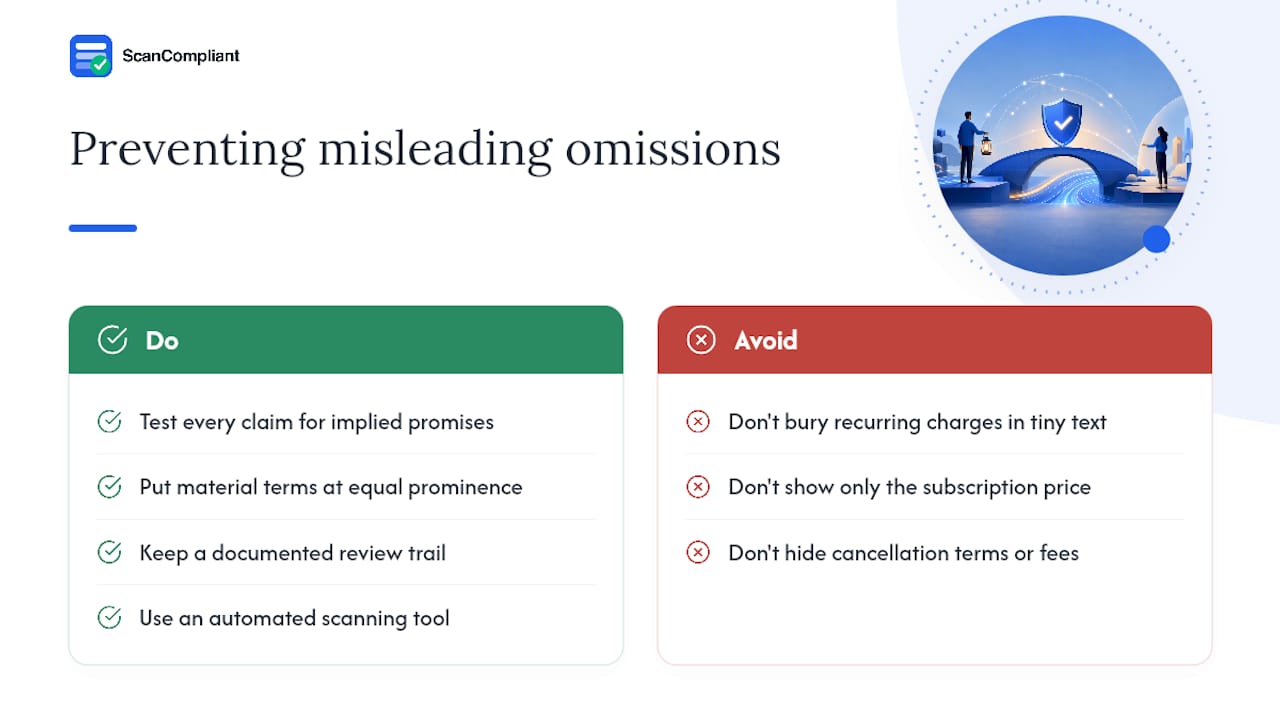
- Put material terms (price, fees, risks, who’s actually selling) in the same prominence as the headline claim, not the footnote.
- Test disclosures against the “implied claim” they support. Ads regulators specifically look at font size, placement, and prominence when judging whether something was effectively disclosed or effectively hidden.
- Keep an audit trail of what was reviewed, flagged, and changed. Scancompliant’s guide on building a compliance trail walks through what that documentation should look like.
- Train marketing teams to recognize the pattern: a generic disclaimer doesn’t cover a specific implied benefit. If the ad implies something, the disclosure burden goes up to match.
Enforcement doesn’t require intent. Regulators can and do act on unintentional omissions, which is exactly why prevention beats explanation after the fact.
A Practical Workflow for Catching Omissions Before They Publish
Compliance teams that get this right run the same basic loop: inventory every piece of live content, list the claims each one makes (including implied ones), test each claim for missing material facts, then fix or annotate before anything ships.
- Automated scanning tools shorten the “test for gaps” step dramatically, flagging risky phrasing against a database of known problem terms instead of relying on a single reviewer’s memory. Scancompliant’s risk-prioritized compliance approach is built around exactly this triage step.
- Third-party and partner content is a common blind spot. Reviewing it with the same rigor as owned content matters, as Scancompliant covers in why third-party content creates risk.
Pro Tip: Fix the highest-traffic pages first, not the newest ones. An old omission on a page nobody visits is a smaller liability than a fresh one on your top landing page.
Pro Tip: Document why a claim was approved, not just that it was. Reviewers change; the reasoning shouldn’t disappear with them.
A Compliance Perspective on Why Disclosure Beats Cleverness
Most brands treat disclosure as a legal tax on persuasive copy. That’s backward. The strongest ad copy Scancompliant’s team has seen doesn’t hide the catch. It states the catch plainly and still closes the sale, because trust converts better than cleverness does over time. Regulators aren’t hunting for lies nearly as often as they’re hunting for gaps between what an ad implies and what it actually discloses.
Catching Omissions Before Regulators Do
Scancompliant provides regulatory and marketing teams a database of numerous risk terms that flags implied claims and missing disclosures across an entire site quickly.

Instead of waiting for an FTC letter or a chargeback dispute to reveal a buried fee or an unclear claim, teams get prioritized findings with plain-English explanations and suggested rewrites before anything goes live. That documented review trail also becomes your evidence of good-faith effort if a regulator ever asks questions. If your team is publishing health or supplement marketing at any real volume, check Scancompliant’s pricing and start a trial before your next campaign goes out the door.
Frequently Asked Questions
What does misleading by omission mean in simple terms?
It means leaving out or burying a fact that a reasonable person would need to make a fair decision, even if everything actually said was technically true.
Is misleading by omission the same as lying?
No. Lying involves a false statement. Omission involves withholding a true, material fact. Both can be legally and ethically wrong, but they require different proof.
When does silence become illegal, not just rude?
When a duty to disclose exists, such as a fiduciary relationship, a direct question, or a statutory consumer protection requirement, and the missing fact was material to the decision.
What’s an example of misleading omission in advertising?
A subscription price shown prominently while the recurring charge, cancellation terms, or added fees sit in tiny, hard-to-read text elsewhere on the page.
How can a business prevent misleading omissions?
Test every claim for implied promises, put material terms at the same visual prominence as the headline, and keep a documented review trail, ideally using an automated scanning tool built for this.
This article is general information, not a substitute for advice from a qualified lawyer. Consult a qualified legal professional about your own circumstances before acting on anything here.
Sources
- Consumer Protection from Unfair Trading Regulations 2008 — regulation 6 (Misleading omissions)
- Misrepresentation — WEX, Legal Information Institute, Cornell Law School
- Gov
- Misleading by omission definition — Law Insider
- Advertising standards code: section 3 (Non-broadcast advertising) — ASA
Recommended
- Misleading Health Claims: A Compliance Guide for DTC Brands – scancompliant.com
- GLP-1 Marketing Compliance in 2026: What the FDA Warning Letter Wave Means for Your Brand — ScanCompliant
- Correcting Non-Compliant Product Descriptions for Health Brands – scancompliant.com
- The 7 Most Common FDA Warning Letter Triggers in Supplement Marketing — ScanCompliant Blog